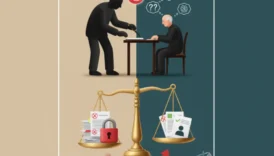
What Is Legal Rebuttal?

In court cases, each side presents evidence and arguments to support their claims. However, the process doesn’t stop there—opposing parties often get a chance to respond. This response is called a rebuttal, and it plays a critical role in clarifying disputes and challenging the credibility of arguments.
Simple Definition
A legal rebuttal is the presentation of evidence or argument intended to contradict, disprove, or weaken the claims made by the opposing party in a legal proceeding.
Real-Life Examples
- Criminal law: The prosecution presents DNA evidence; the defense rebuts by showing errors in how the evidence was collected.
- Civil law: A landlord sues a tenant for unpaid rent; the tenant rebuts by proving the property was uninhabitable.
- Personal injury cases: A plaintiff claims permanent disability, but the defense rebuts with medical records showing recovery.
- Contract disputes: One party claims breach; the other rebuts by proving the contract was already terminated legally.
Importance of the Term
- Strengthens fairness: Gives both sides a chance to respond fully.
- Clarifies disputes: Helps judges and juries see competing narratives clearly.
- Tests credibility: Exposes weaknesses or inconsistencies in the opposing party’s case.
- Shapes outcomes: Effective rebuttals can change the direction of a trial.
Rebuttal vs. Refutation
| Factor | Rebuttal | Refutation |
|---|---|---|
| Definition | Response with evidence or argument against a claim | Complete disproval of a claim |
| Strength | May weaken or challenge a claim | Seeks to fully disprove or nullify it |
| Use in court | Common in trials and hearings | Stronger but less frequent outcome |
FAQ
1) Who can present a rebuttal in court?
Both plaintiffs/prosecutors and defendants have the right to rebut opposing evidence or arguments.
2) Is a rebuttal the same as closing arguments?
No. Rebuttals address specific opposing evidence during the trial, while closing arguments summarize the case.
3) Can new evidence be introduced in rebuttal?
Yes, but only if it directly addresses points raised by the other side.
4) Are rebuttals used in both civil and criminal cases?
Yes. They are a common feature of all trial proceedings.
5) Why are rebuttals important?
Because they give parties the opportunity to challenge and correct misleading or incomplete evidence.
Closing
Legal rebuttal is a vital part of the adversarial process, ensuring that both sides have the chance to challenge one another’s evidence and arguments. By doing so, rebuttals help courts reach fairer, more accurate judgments.