Undue Influence: Definition, Meaning and Examples
What Is Undue Influence?
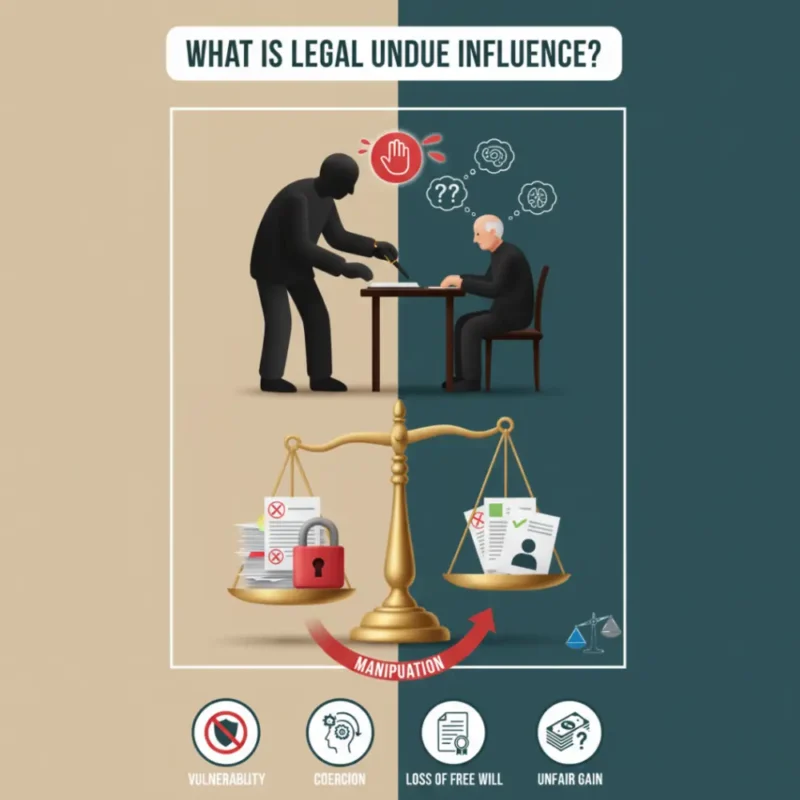
Simple definition of legal undue influence: it is a situation where one person unfairly pressures or manipulates another to make decisions, often regarding contracts, wills, or financial matters. In legal terms, undue influence occurs when free will is compromised, making the agreement or document voidable in court.
Legal Basis
Undue influence is grounded in contract and probate law. Courts view it as a form of coercion that undermines genuine consent. If proven, any contract, will, or trust influenced by such pressure can be invalidated.
Most jurisdictions require showing that a relationship of trust or authority existed, and that the stronger party used it to overpower the weaker party’s decision-making. The legal framework ensures fairness and protects vulnerable individuals.
Examples
Undue influence commonly arises in cases involving family members, caregivers, or fiduciaries. Some frequent scenarios include:
- Elderly Care Situations
- A caregiver persuades an elderly patient to change their will in favor of the caregiver.
- Courts often scrutinize such changes closely for signs of pressure.
- Financial Transactions
- A trusted advisor convinces a client to sign over assets or property under manipulative circumstances.
- If challenged, the transaction may be voided.
- Wills and Inheritance
- Family members pressuring a vulnerable relative to alter inheritance documents in their favor.
- Suspicious changes near the end of life are especially prone to legal challenge.
- Medical Decision-Making
- A person under heavy influence from a relative may agree to healthcare or financial powers of attorney they would not have otherwise signed.
- Business Relationships
- An employer or senior partner manipulates a subordinate into signing contracts that disproportionately benefit the stronger party.
Why Legal Undue Influence Matters
Undue influence matters because it protects the principle of free and informed consent in legal agreements. Without safeguards, vulnerable people—especially the elderly, sick, or financially dependent—could be coerced into unfair decisions.
By recognizing undue influence as a legal ground to challenge documents or contracts, the courts ensure fairness and prevent exploitation. This concept is vital in estate planning, family law, and contract law, preserving trust and justice in sensitive relationships.
FAQ About Undue Influence
How is undue influence different from duress?
Duress involves threats or physical force, while undue influence is more subtle and relies on manipulation or abuse of trust. Both undermine free will, but undue influence often arises in relationships of confidence, such as family or caregiving. Courts treat both as grounds for invalidating agreements.
What are common signs of undue influence?
Warning signs include sudden changes in wills, isolation of the person from family, dependency on a caregiver, or secretive financial transactions. Courts often look for suspicious timing or evidence that the person lacked independent advice. Identifying these factors can help prove undue influence.
Who has the burden of proof in undue influence cases?
Generally, the party challenging the document must prove undue influence. However, if a special relationship of trust exists—such as between caregiver and patient—courts may presume undue influence and shift the burden to the stronger party to prove fairness. This balances protection for vulnerable individuals.
Can undue influence invalidate a will?
Yes, if undue influence is proven, the will or any part of it can be declared invalid. Courts may restore a previous version of the will or distribute assets according to intestacy laws. This ensures that property distribution reflects genuine intent rather than manipulation.
Why is legal protection against undue influence important?
Because it upholds the fairness and integrity of legal agreements. Without protection, manipulative individuals could exploit vulnerable people to gain money, property, or authority. Safeguards against undue influence promote justice, protect families, and strengthen trust in legal systems.

Hamit Sahin is the founder and editor of LegalTerms.net. He researches U.S. legal terminology and publicly available legal information using statutes, court rules, judicial opinions, government publications, and established legal reference sources.
His work focuses on organizing complex legal concepts into clear, plain-English explanations for general educational purposes.
Hamit is not an attorney and LegalTerms.net does not provide legal advice.