What Is a Public Policy Defense? The Legal Doctrine Explained
What Is a Public Policy Defense?
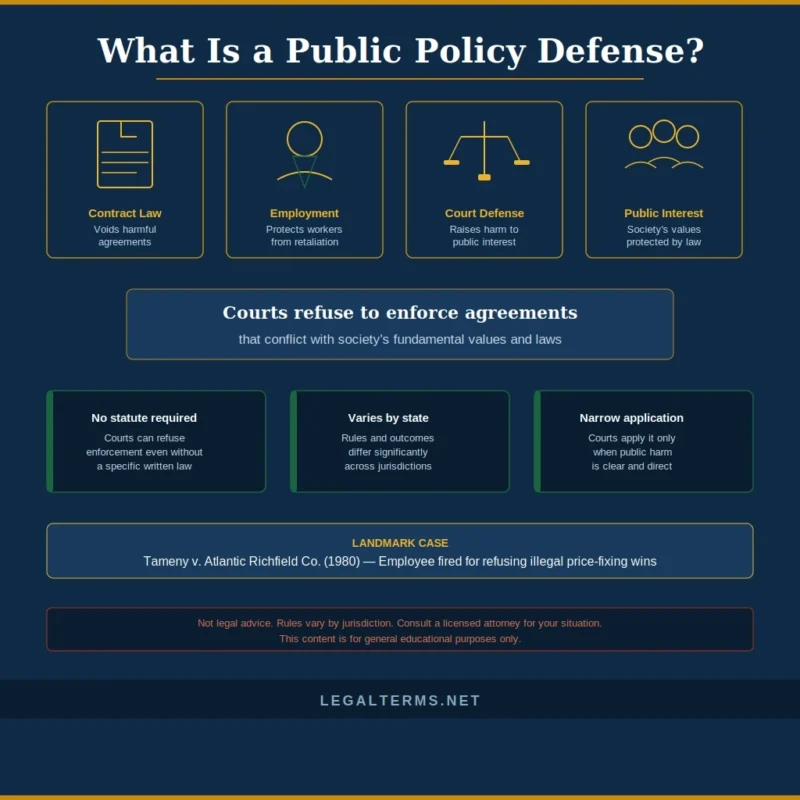
Courts sometimes refuse to enforce contracts or uphold legal actions because doing so would harm society as a whole. When that happens, the public policy defense is usually the reason why. It is one of the most important, and most misunderstood, doctrines in American law.
A public policy defense is a legal argument that a contract, agreement, or action should not be enforced by a court because it conflicts with the broader interests of society. In plain terms, it is a way of saying: “Even if this was technically agreed upon, enforcing it would be bad for the public, so the law will not back it up.”
Courts treat this as a shield. A party being sued, whether for breach of contract or wrongful termination, can raise the public policy defense to block enforcement of an agreement or to justify an action that would otherwise look like a legal violation. The defense does not require a specific statute to spell out exactly what is prohibited. Instead, courts look at the overall values and principles that laws and regulations reflect.
It is worth noting from the start that this defense is not a blanket escape from legal obligations. Courts apply it carefully and only in situations where the harm to public interests is clear. Rules vary by jurisdiction, and not every judge will weigh the same factors the same way. If you believe this defense applies to your situation, consulting an attorney is strongly recommended.
What “Public Policy” Actually Means in Plain English
The phrase “public policy” sounds vague, and that is partly intentional. It refers to the set of principles, values, and legal standards that a society has decided are fundamental to its well-being. Think of it as the law’s version of common sense: things that most reasonable people, and most lawmakers, agree should be protected even when two private parties have struck a different deal.
Public policy is not written in a single place. It emerges from constitutions, statutes, court decisions, and regulations at the federal, state, and local levels. For example, the idea that workers should not be punished for reporting illegal activity is a public policy principle. So is the idea that no one should be able to contract their way into slavery, or that a business cannot agree to commit fraud on a third party.
A helpful analogy: imagine two neighbors agree in writing that one will pay the other to dump toxic waste in a nearby river. That contract reflects a private agreement, but no court will enforce it because society has decided, through environmental laws and basic ethical norms, that poisoning public water is unacceptable. The public policy defense is what gives courts the legal authority to throw that contract out.
Where the Public Policy Defense Comes From
The doctrine has deep roots in common law, the body of judge-made law inherited from England. English courts were applying versions of this principle as far back as the 17th century, refusing to enforce agreements they deemed contrary to good morals or public welfare.
In the United States, the doctrine developed through a long line of court decisions rather than through a single piece of legislation. By the 20th century, American courts had established that public policy could serve as an independent ground for refusing to enforce contracts, independent of whether the contract technically violated a written statute. The Restatement (Second) of Contracts, a widely cited legal reference, formally recognizes this principle in Section 178, which states that a contract term is unenforceable if the harm to the public interest outweighs the interest in enforcing the agreement.
Over time, the doctrine expanded beyond contract law. Courts began applying it to employment relationships, arbitration agreements, and even certain tort claims. Today, the public policy defense shows up across multiple areas of law, though its application is most developed in contract and employment contexts.
How the Public Policy Defense Works in Contract Law
When someone sues for breach of contract, the defendant can raise the public policy defense to argue that the contract itself should never be enforced. If a court agrees, the contract is treated as void, meaning it is as if the agreement never existed. Neither party can collect damages, and neither party has any remaining legal obligation to the other.
Courts typically look at two questions. First, does the contract involve conduct that a statute or regulation prohibits? Second, even if no specific law bans it, does enforcing the contract seriously harm a recognized public interest? The first category is more straightforward. The second requires judges to weigh the benefits of enforcing private agreements against the costs to society.
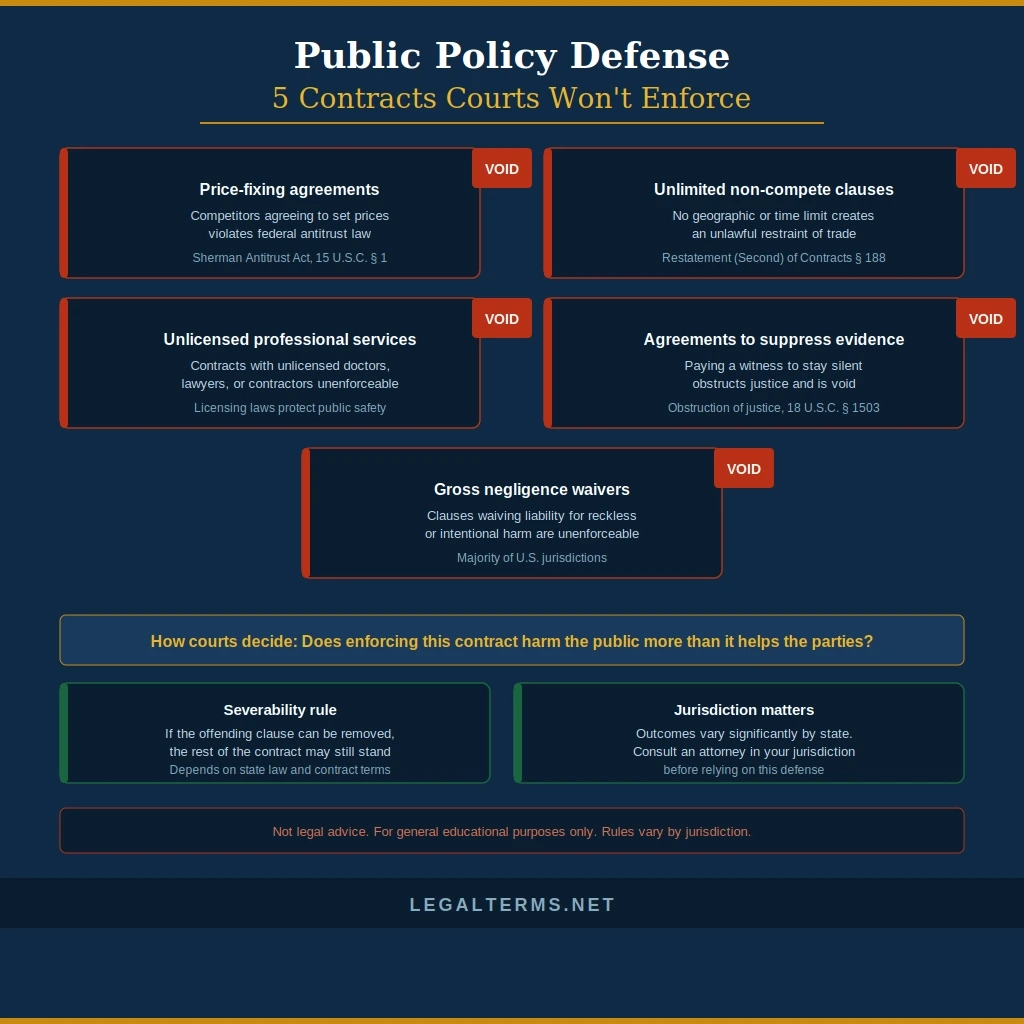
The following table shows common contract types and how courts tend to treat them under the public policy doctrine:
| Contract Type | Public Policy Issue | Likely Outcome |
|---|---|---|
| Agreement to fix prices with a competitor | Violates antitrust law | Void, unenforceable |
| Non-compete clause with no geographic or time limit | Restraint of trade | Partially or fully unenforceable |
| Contract to perform an unlicensed professional service | Licensing laws protect the public | Unenforceable in most states |
| Agreement to suppress evidence in litigation | Obstructs justice | Void |
| Exculpatory clause waiving liability for gross negligence | Harms public safety interests | Unenforceable in most jurisdictions |
One important nuance: courts do not always throw out an entire contract when one clause violates public policy. If the offending term can be removed without destroying the rest of the agreement, a court may sever that clause and enforce everything else. This is called severability, and whether it applies depends on the state and the specific facts.
How the Public Policy Defense Works in Employment Law
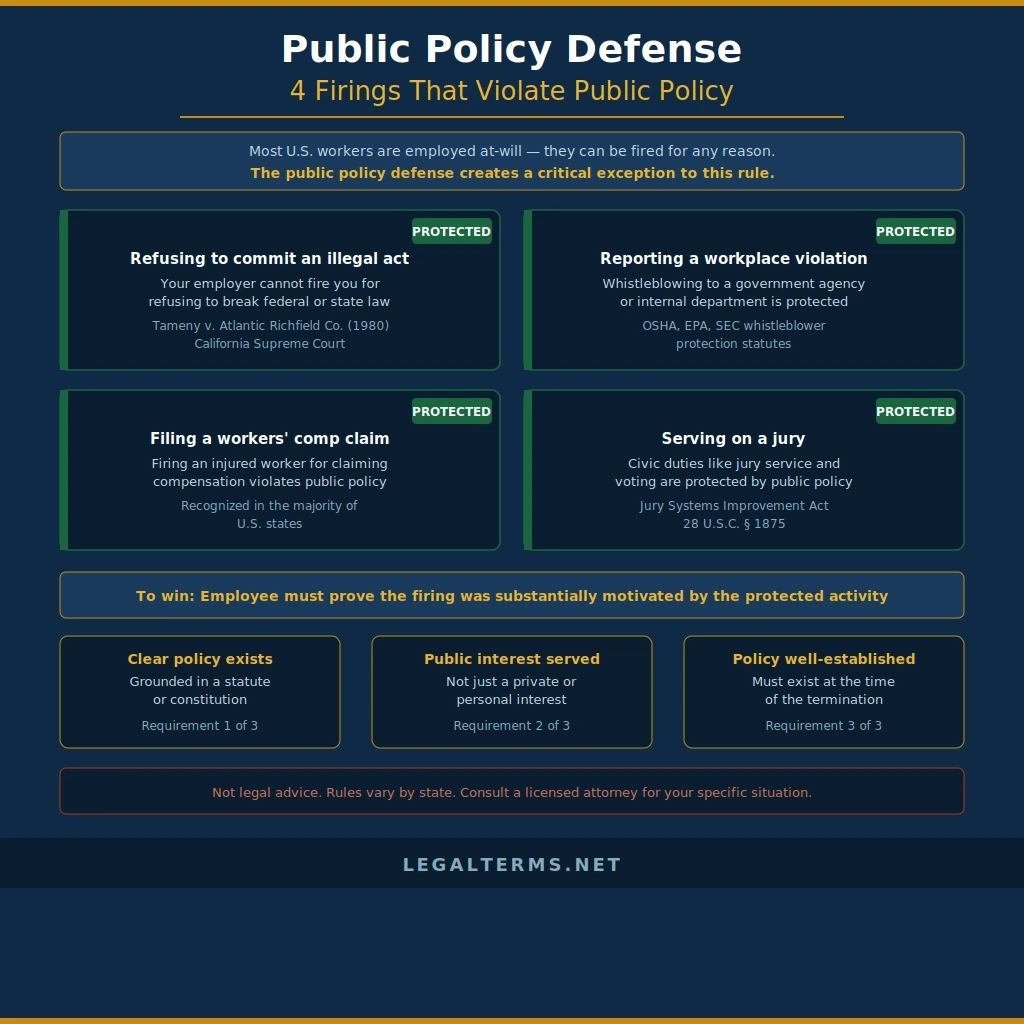
Employment law is where the public policy defense comes up most often in everyday life. Most American workers are employed at will, meaning their employer can fire them for any reason or no reason at all. The public policy defense creates a significant exception to that rule.
If an employer fires a worker for a reason that violates a clear public policy, the employee can sue for wrongful termination even without a written contract guaranteeing job security. Courts have recognized several categories where this exception applies. An employee fired for refusing to commit an illegal act, for reporting a legal violation to a government agency, for filing a workers’ compensation claim, or for serving on a jury generally has a viable wrongful termination claim grounded in public policy.
The key requirement is that the public policy in question must be clearly established, usually in a constitution, statute, or binding regulation. A general sense that something is unfair is not enough. The policy must be specific, substantial, and designed to protect public interests rather than just private ones. What counts as sufficient varies by state, so the outcome of a wrongful termination claim can differ significantly depending on where the employee works.
A Real Case: Tameny v. Atlantic Richfield Co. (1980)
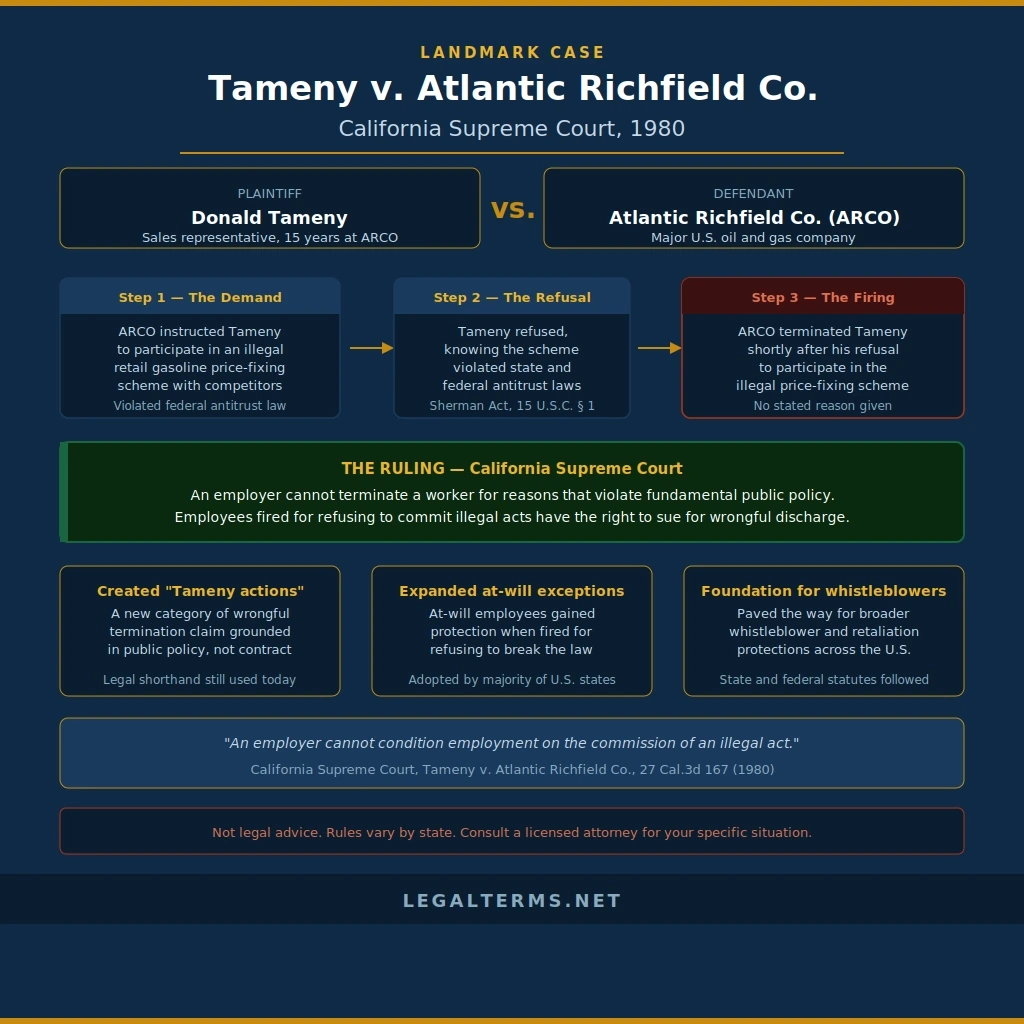
No case better illustrates the public policy defense in employment law than Tameny v. Atlantic Richfield Co., decided by the California Supreme Court in 1980.
Donald Tameny had worked for Atlantic Richfield, known as ARCO, for 15 years as a retail sales representative. His supervisors instructed him to participate in a scheme to fix gasoline prices at retail stations, conduct that violated federal antitrust laws. Tameny refused. Shortly after, ARCO fired him.
Tameny sued, arguing that his termination violated public policy because he was fired for refusing to break the law. ARCO countered that, as an at-will employee, Tameny had no legal protection. The California Supreme Court disagreed. It held that an employer cannot terminate a worker for reasons that violate fundamental public policy, and that an employee who is fired for refusing to commit an illegal act has the right to pursue a tort claim for wrongful discharge.
The ruling created what lawyers now call a “Tameny action,” a wrongful termination claim grounded in public policy rather than contract. It became the foundation for similar protections across the country. The case remains one of the most cited employment law decisions in American history, and its core principle, that no employer can use the threat of job loss to coerce illegal conduct, is now recognized in the majority of U.S. states.
Public Policy Defense vs. Illegality Defense: What’s the Difference?
These two defenses are closely related and often confused, but they are not the same thing. Understanding the distinction matters because courts treat them differently.
The illegality defense applies when a contract directly requires one or both parties to do something that a specific law prohibits. If a contract calls for the sale of an illegal substance, for example, the illegality defense voids it because the subject matter itself is criminal. The law doing the heavy lifting there is the criminal statute, not a broader principle.
The public policy defense is wider in scope. It can invalidate a contract or protect an employee even when no specific law directly bans the conduct in question. A court can refuse to enforce an agreement simply because doing so would undermine values that society has decided to protect, such as fair competition, worker safety, or the integrity of the judicial process. In practice, many cases involve both defenses at once, but the public policy defense can apply in situations where the illegality defense falls short.
Practical Takeaways: When This Defense Might Apply to You
If you are facing a breach of contract lawsuit and the contract required you to do something that harms the public, the public policy defense may be worth raising. The same applies if you were fired after refusing to break the law, reporting a workplace violation, filing a workers’ compensation claim, or fulfilling a civic duty like jury service.
A few things to keep in mind. The defense works best when the public policy you are pointing to comes from a clear statutory or constitutional source, not just a general sense of fairness. Courts are more receptive when the policy is well-established and directly connected to the reason for the termination or the disputed contract term. Timing also matters. In wrongful termination cases, statutes of limitations vary by state, and waiting too long can eliminate your right to file a claim entirely.
This defense is not a guarantee. Courts weigh competing interests, and outcomes depend heavily on the specific facts, the state where the case is heard, and how the relevant laws are written. An attorney familiar with employment or contract law in your jurisdiction can assess whether the defense is viable in your specific situation.
A Few Cautions
The public policy defense is a genuine legal doctrine, but it has real limits. Not every unfair contract and not every unjust firing qualifies. Courts apply the defense narrowly and require a clear connection between the disputed conduct and an established public interest. A vague sense that something feels wrong is not enough to prevail.
Rules vary significantly by state. Some states recognize a broad range of public policy protections for employees. Others apply the doctrine more strictly and require the policy to be grounded in a specific statute or constitutional provision. What works in California may not work in Texas or Florida. Always consult a licensed attorney in your jurisdiction before relying on this defense.
Nothing in this article constitutes legal advice. This content is provided for general educational purposes only and does not create an attorney-client relationship. If you believe the public policy defense applies to your situation, speak with a qualified attorney before taking any legal action.
Frequently Asked Questions
What is the public policy defense in simple terms?
It is a legal argument that a contract or an employment action should not be enforced because it conflicts with values and principles that society has decided to protect. Courts use it to refuse enforcement of agreements or to recognize wrongful termination claims even when no specific written law covers the exact situation.
Can the public policy defense void an entire contract?
It can, but not always. Courts sometimes void only the offending clause and enforce the rest of the agreement through a process called severability. Whether the whole contract or just a portion is thrown out depends on the state, the nature of the violation, and how central the offending term is to the overall agreement.
Does the public policy defense apply to at-will employees?
Yes. In fact, employment law is one of its most common applications. At-will employees can be fired for almost any reason, but not for a reason that violates a clear public policy. Firing someone for refusing to commit a crime, for reporting illegal conduct, or for exercising a legal right such as filing a workers’ compensation claim can all give rise to a wrongful termination claim.
What makes a public policy “clear enough” for a court to recognize?
Most courts require the policy to be grounded in a constitution, a statute, or a binding regulation. It must serve public interests rather than just private ones, and it must be well-established at the time of the disputed action. A general moral objection or an informal workplace norm is usually not sufficient.
Is the public policy defense the same in every state?
No. This is one of the most jurisdiction-dependent doctrines in American law. Some states apply it broadly. Others limit it strictly to situations where a specific statute is implicated. The available remedies, including whether punitive damages are available, also vary by state. Always verify the rules in your specific jurisdiction.
Can an employer ever win against a public policy defense?
Yes. Employers can defeat this defense by showing that the public policy the employee is citing does not meet the legal threshold, that the termination was motivated by a legitimate reason unrelated to the protected activity, or that the policy at issue serves private rather than public interests. The burden of proof generally falls on the employee in wrongful termination cases.
How is the public policy defense related to whistleblower protections?
They overlap significantly. Many whistleblower protection statutes, at both the federal and state level, codify public policy principles that courts had already recognized through the common law public policy defense. In some cases, an employee can bring both a statutory whistleblower claim and a common law public policy claim simultaneously, depending on the jurisdiction.
Does this defense apply outside of employment and contract law?
It comes up most often in those two areas, but the public policy doctrine also appears in arbitration law, family law, and international private law, particularly when courts are asked to enforce foreign judgments or arbitration awards that conflict with domestic public values. Its scope varies depending on the legal context.
References
- Cornell Law School, Legal Information Institute. “Public Policy.“
- Cornell Law School, Legal Information Institute. “Wrongful Termination in Violation of Public Policy.“
- Restatement (Second) of Contracts § 178 (American Law Institute, 1981)
- Tameny v. Atlantic Richfield Co., 27 Cal.3d 167 (Cal. Supreme Court, 1980)
- Black’s Law Dictionary (11th ed. 2019), “public policy”
- LegalTerms.net Editorial Guidelines
- LegalTerms.net Legal Sources and References

Hamit Sahin is the founder and editor of LegalTerms.net. He researches U.S. legal terminology and publicly available legal information using statutes, court rules, judicial opinions, government publications, and established legal reference sources.
His work focuses on organizing complex legal concepts into clear, plain-English explanations for general educational purposes.
Hamit is not an attorney and LegalTerms.net does not provide legal advice.