What Is a Penal Code? A Plain-English Guide to Criminal Law’s Foundation
You have probably heard the phrase “penal code” on a police procedural, in a news story about a criminal case, or in a contract’s fine print. But what does it actually mean? And why should someone who has never been charged with a crime care about it?
The answer is simple: a penal code governs what the government can and cannot do to you. It defines which actions are crimes, how serious each crime is, and what punishment a court can impose if you are convicted. It is the rulebook for the entire criminal justice system, and understanding its basic structure puts you in a far stronger position — whether you are a defendant, a victim, an employer, or simply a citizen who wants to know your rights.
This guide breaks down what a penal code is, how it works, where it comes from, and why it matters, in plain language.
What Is a Penal Code?
A penal code is a written collection of laws that defines criminal offenses and sets out the penalties for each one. Think of it as the government’s official list of prohibited conduct, complete with the consequences attached to each violation.
The word “penal” comes from the Latin poena, meaning punishment. So a penal code is, at its most basic level, a punishment code. It answers three questions for every offense it covers:
- What conduct is prohibited?
- Under what mental state does that conduct become criminal?
- What is the punishment if a court finds you guilty?
Without a penal code, none of those questions would have consistent, written answers. Courts would have to rely entirely on judicial decisions built up over centuries, which is exactly what happened under the old English common law system. The shift to written codes was a deliberate reform designed to make criminal law more transparent, more predictable, and more accessible to ordinary people.
In the United States, every state has its own penal code. California has the California Penal Code, Texas has the Texas Penal Code, New York has the New York Penal Law, and so on. The federal government has its own criminal statutes as well, codified primarily in Title 18 of the United States Code. These codes do not always agree with each other. The same conduct can be a felony in one state and a misdemeanor in another, or not a crime at all in a third.
How Penal Codes Are Organized
A well-structured penal code is divided into two main parts, and understanding this division makes the whole thing much easier to read.
The first part is called the General Part. This section contains the rules that apply to every crime across the board. It defines core concepts like criminal intent, explains what defenses are available to a defendant, and sets out the general principles a court uses to decide whether someone is criminally liable. If you want to understand what “guilty beyond a reasonable doubt” really means in practice, or what makes an act criminal in the first place, you look to the General Part.
The second part is called the Special Part. This is where the individual crimes are listed and defined, one by one. Murder, robbery, fraud, drug possession, arson — each offense has its own section that spells out exactly what conduct qualifies as that crime and what sentencing range applies.
Beyond this two-part structure, most penal codes organize offenses into broad categories based on severity. At the top are the most serious crimes, carrying the heaviest prison sentences. At the bottom are minor violations that result in nothing more than a fine. This tiered structure is not arbitrary. It reflects a core principle of criminal justice: the punishment must fit the crime.
Most penal codes also include definitions sections at the start, so that key legal terms mean the same thing throughout the entire code. This prevents ambiguity and ensures that prosecutors, defense attorneys, and judges are all working from the same dictionary.
The Model Penal Code – America’s Blueprint
If every U.S. state has its own penal code, how did American criminal law avoid becoming a completely incoherent patchwork of fifty different systems?
The answer is the Model Penal Code, commonly called the MPC.
The MPC was drafted by the American Law Institute (ALI), a prestigious organization of judges, lawyers, and legal scholars, and published in 1962. It is not itself a law. No state is required to follow it. But it is a carefully reasoned, comprehensive template that states can adopt in whole or in part when writing their own criminal statutes.
Before the MPC, American criminal law was a genuine mess. States relied on a mix of old English common law rules and locally passed statutes that often contradicted each other. Basic concepts like criminal intent had no consistent definition. Courts in different states reached opposite conclusions about the same basic factual situations.
The MPC cleaned this up by introducing a systematic approach to criminal liability. Its most influential contribution was a clear, four-level framework for criminal intent:
- Purposely — the person’s conscious goal was to cause the result
- Knowingly — the person was aware that the result was practically certain
- Recklessly — the person consciously ignored a substantial and unjustifiable risk
- Negligently — the person failed to be aware of a risk that a reasonable person would have noticed
These four mental states now appear, in one form or another, in the criminal codes of most U.S. states. Thirty-seven states have adopted at least modified or partial versions of MPC provisions. New York, New Jersey, and Oregon have adopted nearly all of them.
The MPC did not eliminate variation between states. But it gave American criminal law a common intellectual framework that it previously lacked.
Federal vs. State Penal Codes
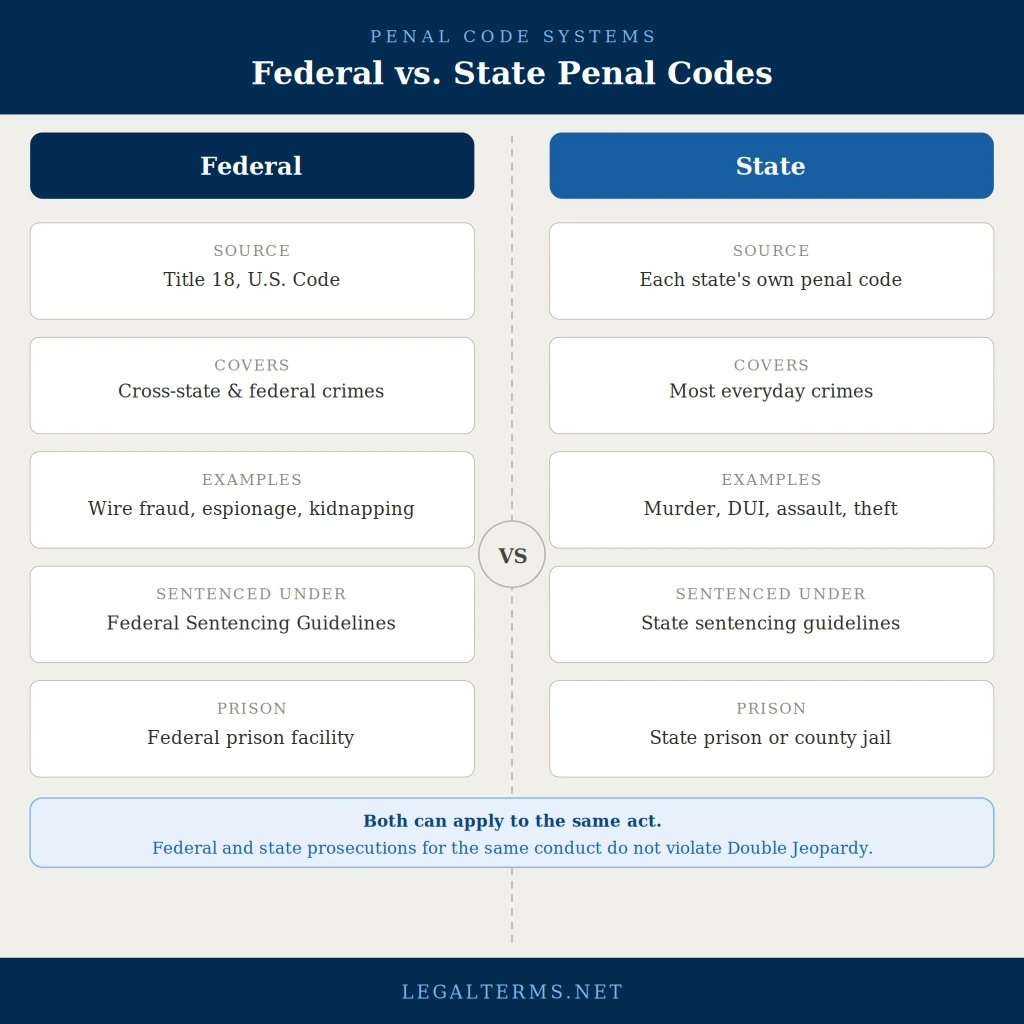
One of the most confusing things about American criminal law is that there is no single penal code that covers the entire country. There is a federal system and fifty separate state systems, and they operate side by side.
Here is how to think about the division.
Federal criminal law covers conduct that crosses state lines, involves federal property or federal officials, or falls within specific areas where Congress has the constitutional authority to legislate. Federal crimes are codified primarily in Title 18 of the United States Code. Examples include bank robbery, wire fraud, counterfeiting, kidnapping across state lines, espionage, and drug trafficking at the federal level. If you are convicted of a federal crime, you serve your sentence in a federal prison and are sentenced under the Federal Sentencing Guidelines, a detailed set of rules that judges use to calculate the appropriate punishment.
State criminal law covers the vast majority of crimes that ordinary people encounter. Murder, assault, theft, burglary, DUI, domestic violence — these are almost always prosecuted under state law in state courts. Each state’s penal code defines these offenses independently, which is why the details differ from state to state.
This creates a practical reality that surprises many people: the same act can lead to very different outcomes depending on where it occurs. Possessing a certain amount of marijuana is a felony in one state, a civil infraction in another, and entirely legal in a third. Carrying a concealed firearm without a permit is a serious felony in some states and a minor misdemeanor in others.
There is also the possibility of dual prosecution, sometimes called double jeopardy’s exception. The Double Jeopardy Clause of the Fifth Amendment prevents the federal government from trying you twice for the same offense. But it does not prevent both the federal government and a state government from prosecuting you for the same underlying conduct, because they are considered separate sovereigns with separate laws. This came up clearly in the Rodney King case, where the officers were acquitted in California state court and then prosecuted again in federal court on civil rights charges — and convicted.
If you are charged with a crime, identifying whether you are facing federal or state charges is the first and most important step, because the applicable code, the potential sentences, and the court system you will navigate are completely different.
The Three Categories of Criminal Offenses
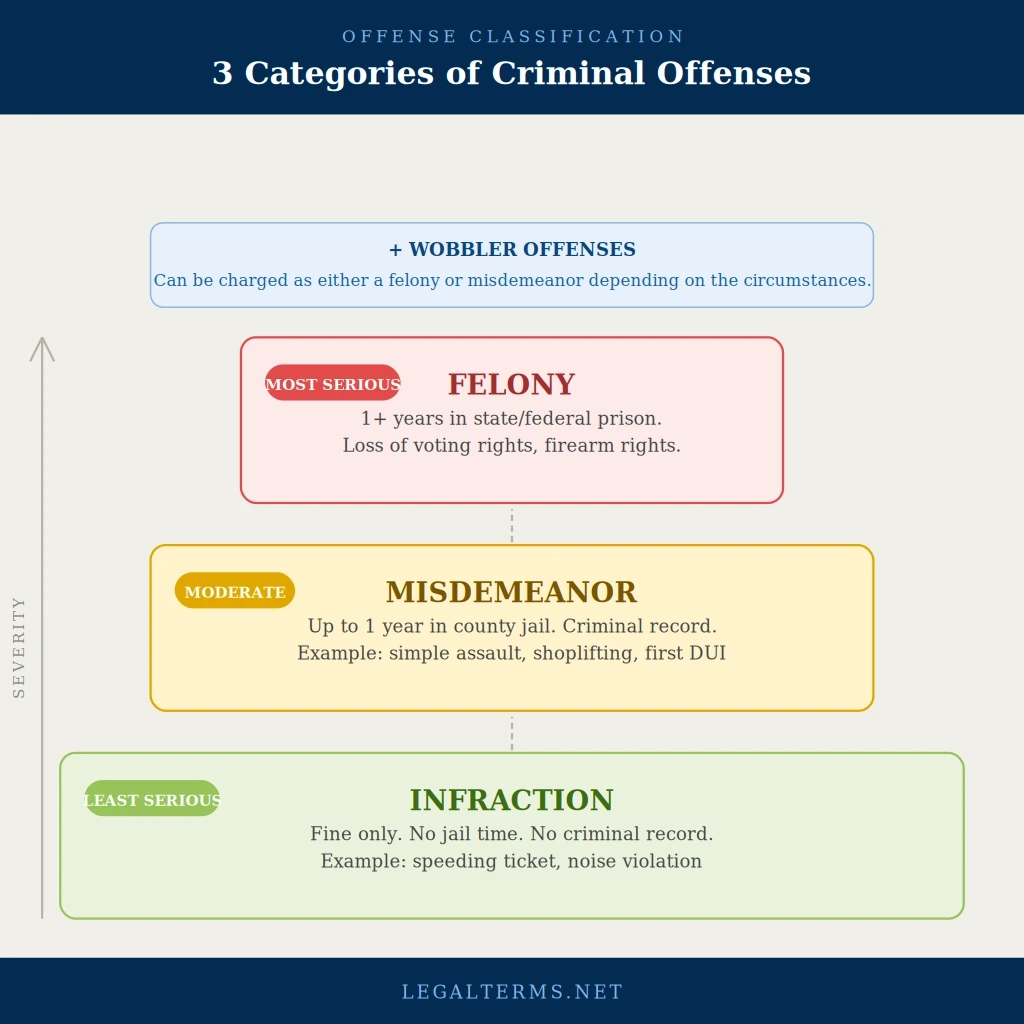
Every offense in a penal code falls into one of three categories: infraction, misdemeanor, or felony. The category determines how seriously the law treats the offense, what rights you have as a defendant, and what happens to your life if you are convicted.
Infractions
An infraction, sometimes called a violation, is the least serious category. Infractions are punishable by a fine only. There is no possibility of jail time and no criminal record attached to a conviction.
Because the stakes are low, the legal system treats infractions differently from crimes. If you are charged with an infraction, you do not have the right to a jury trial, and the government has no obligation to appoint a lawyer for you. Most infractions are resolved by paying a fine by mail.
Traffic tickets are the most common example. Speeding, running a red light, failing to signal — these are infractions in most states. Some states do not even classify them as criminal offenses at all, treating them instead as civil violations.
One important note: ignoring an infraction does not make it disappear. If you fail to pay the fine or appear in court when required, a judge can escalate the matter to a misdemeanor charge.
Misdemeanors
A misdemeanor is more serious than an infraction but less serious than a felony. Under federal law and in most states, a misdemeanor is any offense that carries a potential jail sentence of less than one year. That jail time, if imposed, is served in a local county jail, not a state or federal prison.
Because a misdemeanor can result in the loss of your freedom, the Constitution gives you more rights at this level. You have the right to a jury trial and the right to a court-appointed attorney if you cannot afford one.
States typically divide misdemeanors into classes. Under the federal sentencing guidelines, the breakdown works like this:
- Class A misdemeanor: more than six months, up to one year in jail
- Class B misdemeanor: more than thirty days, up to six months in jail
- Class C misdemeanor: more than five days, up to thirty days in jail
Common misdemeanors include simple assault, shoplifting, first-offense DUI, reckless driving, and drug possession in small amounts for personal use. A misdemeanor conviction goes on your criminal record and can affect employment, housing applications, and professional licensing, even though it is not a felony.
Felonies
A felony is the most serious category of criminal offense. Any crime that carries a potential sentence of more than one year in state or federal prison is a felony. The consequences extend far beyond the prison sentence itself.
A felony conviction results in a permanent criminal record. In most states it also means:
- Loss of the right to vote (in some states, permanently)
- Loss of the right to own or possess a firearm
- Ineligibility for many professional licenses
- Difficulty obtaining employment, housing, or student loans
- Deportation risk for non-citizens
Felonies are subdivided by class or degree. A Class A or first-degree felony — such as murder or aggravated rape — carries the heaviest penalties, including life imprisonment or, in states that retain it, the death penalty. A Class D or fourth-degree felony might carry a sentence of one to three years and result in probation rather than prison time for a first-time offender.
Wobblers
Some offenses do not fit neatly into a single category. These are called wobblers, offenses that prosecutors can charge as either a felony or a misdemeanor depending on the circumstances of the case and the defendant’s criminal history.
California’s assault with a deadly weapon statute is a classic example. The same charge can result in a sentence of up to 364 days in county jail (a misdemeanor outcome) or up to four years in state prison (a felony outcome), depending on the severity of the conduct and the judge’s decision at sentencing. If the judge imposes the county jail sentence, the conviction is treated as a misdemeanor. If the judge sends the defendant to state prison, it becomes a felony. The same underlying act, two possible outcomes.
Wobblers give prosecutors significant negotiating power in plea bargaining. A defendant facing a felony wobbler charge has a strong incentive to accept a plea deal that guarantees a misdemeanor outcome and avoids the long-term consequences of a felony record.
The Four Elements of a Crime
A penal code does not just list prohibited acts. It also defines the conditions that must be met before a court can find someone criminally liable. In most legal systems based on the common law tradition, a crime requires four elements to be proven. If even one element is missing, there is no crime.
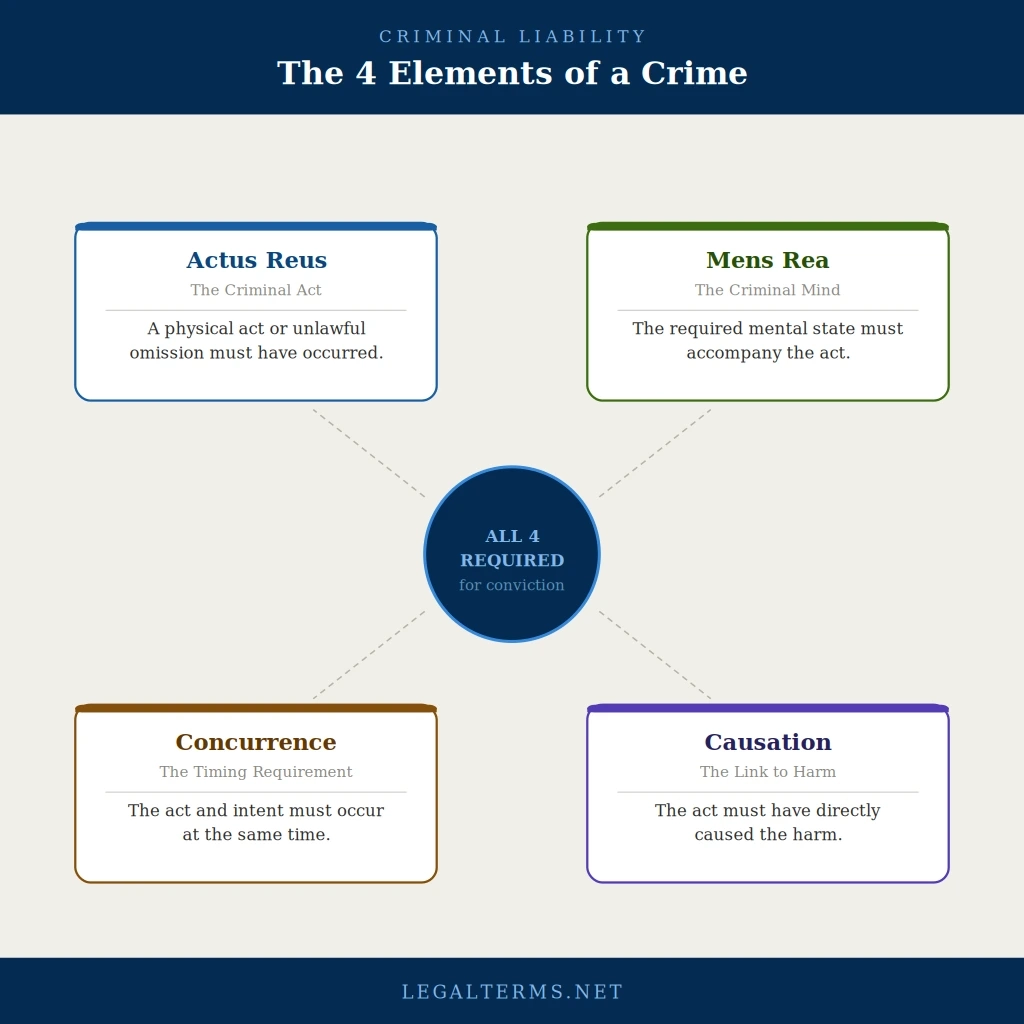
1. Actus Reus – The Criminal Act
Actus reus (pronounced AK-tus RAY-us) is Latin for “guilty act.” It refers to the physical conduct that the law prohibits. This can be an action, like striking someone or taking property that does not belong to you. It can also be a failure to act when the law requires action, such as a parent’s legal duty to provide care for a child.
The actus reus requirement protects people from being punished for thoughts alone. You cannot be convicted of theft for thinking about stealing something. You can only be convicted once you take the prohibited action.
2. Mens Rea – The Criminal Mind
Mens rea (pronounced menz RAY-ah) is Latin for “guilty mind.” It refers to the mental state a person must have had at the time of the act for the conduct to be criminal.
This is where the Model Penal Code made its most lasting contribution. Before the MPC, courts used inconsistent and often confusing language to describe criminal intent. The MPC replaced all of that with four clearly defined mental states:
- Purposely: the person’s conscious goal was to bring about the result
- Knowingly: the person was aware the result was virtually certain to follow
- Recklessly: the person consciously disregarded a substantial and unjustifiable risk
- Negligently: the person failed to recognize a risk that a reasonable person would have noticed
The required mens rea depends on the specific offense. Murder requires purposeful or knowing conduct. Criminal negligence charges require only the negligence standard. Some offenses, called strict liability crimes, require no mens rea at all. Speeding is a strict liability offense. It does not matter whether you intended to drive over the speed limit or even knew you were doing so. The act alone is enough.
3. Concurrence
Concurrence means the actus reus and the mens rea must occur at the same time. The criminal intent must accompany the criminal act. A person who accidentally takes someone else’s umbrella from a coat rack and then decides to keep it when they realize the mistake has committed the actus reus (taking the umbrella) and later formed the mens rea (deciding to keep it). Whether that sequence satisfies the concurrence requirement depends on the jurisdiction and how the theft statute is written.
4. Causation
In crimes that require a harmful result, such as homicide, the prosecution must prove that the defendant’s conduct actually caused that result. Causation has two components.
The first is actual cause, sometimes called “but-for” causation: but for the defendant’s act, would the harm have occurred? If the answer is no, the defendant is the actual cause.
The second is proximate cause: was the harm a foreseeable result of the defendant’s conduct, or did something unexpected intervene to break the chain of causation? If a defendant stabs a victim who later dies in the hospital because of a surgeon’s unrelated mistake, courts must decide whether the intervening medical error breaks the causal chain between the stabbing and the death. Different jurisdictions resolve this question differently, which is why causation disputes are some of the most contested issues in criminal trials.
Penal Codes Around the World
The United States is not the only country with a penal code, and the American approach is not the only model. Understanding the global picture helps clarify why the U.S. system is structured the way it is.
Most countries in the civil law tradition, including France, Germany, Italy, Spain, Japan, Brazil, and Mexico, have comprehensive national penal codes that cover the entire country uniformly. In these systems, the code is the primary source of criminal law. Judicial decisions play a secondary role.
Common law countries, including the United States, the United Kingdom, Canada, and Australia, historically relied more heavily on judge-made law built up through centuries of court decisions. Written codes came later and coexisted with the common law rather than replacing it entirely.
A few notable examples:
France enacted one of the earliest modern penal codes in 1791, updated significantly in 1994. The French Penal Code is organized around four categories of offenses: crimes (the most serious), délits (mid-level offenses), and contraventions (minor violations), a structure that influenced legal systems across continental Europe and Latin America.
Germany’s Strafgesetzbuch (Criminal Code), first enacted in 1871 and substantially revised after World War II, is known for its precise, systematic approach to criminal liability and its strong emphasis on proportionality in sentencing.
England and Wales stand out as a notable exception. Despite repeated attempts dating back to 1818, England never enacted a comprehensive criminal code. Criminal law there still derives from a combination of statutes and common law precedents, making it one of the few major legal systems without a unified penal code.
India operated for over a century under the Indian Penal Code of 1860, enacted during British colonial rule. In 2023, India replaced it with the Bharatiya Nyaya Sanhita, a major reform that restructured the entire criminal code and removed several colonial-era provisions.
A Real-World Example: Robinson v. California (1962)
One of the most important cases in American penal code history did not involve a violent crime, a large drug operation, or a complex fraud scheme. It involved a single man, a state law that criminalized a medical condition, and a Supreme Court ruling that permanently changed the limits of what a penal code can punish.
Lawrence Robinson was arrested in Los Angeles under a California statute that made it a criminal offense to “be addicted to the use of narcotics.” Robinson was not arrested for buying drugs, selling drugs, or possessing drugs. He was arrested simply for being an addict, a status rather than an act.
The Supreme Court struck down the California law in Robinson v. California, 370 U.S. 660 (1962). Justice Potter Stewart, writing for the majority, held that punishing a person for the status of addiction rather than for any specific conduct violated the Eighth Amendment’s prohibition on cruel and unusual punishment. A state could make it a crime to use drugs, to possess drugs, or to sell drugs. It could not make it a crime to simply be a drug addict, any more than it could make it a crime to be mentally ill or to have a disease.
The case established a foundational limit on penal codes: the actus reus requirement is not just a technical rule. It is a constitutional protection. A penal code cannot punish someone for who they are. It can only punish them for what they do.
This principle remains in force today and continues to shape how legislators draft criminal statutes. Any law that attempts to criminalize a status rather than conduct faces immediate constitutional challenge under Robinson.
Why Penal Codes Matter to Ordinary People
Most people assume the penal code only matters if they are arrested or charged with a crime. That assumption is wrong. The penal code shapes everyday life in ways that are easy to overlook until something goes wrong.
Here are the most practical reasons to understand the basics:
You interact with criminal law more often than you think. Every time you drive, sign a contract, handle money, use social media, or run a business, there are penal code provisions that apply to your conduct. Most people never cross those lines, but knowing where they are is the difference between accidental violation and informed behavior.
A conviction follows you. Even a misdemeanor conviction creates a permanent criminal record that shows up on background checks. It can disqualify you from certain jobs, professional licenses, housing applications, and government benefits. Understanding the difference between an infraction, a misdemeanor, and a felony before you decide how to respond to a charge is not optional. It is essential.
The penal code determines your rights as a defendant. Whether you have the right to a jury trial, the right to a court-appointed attorney, and the procedural protections that apply to your case all depend on how the offense you are charged with is classified under the applicable penal code. Knowing your classification tells you what the government must prove and what rights you can exercise.
Victims rely on the penal code too. If you are the victim of a crime, the penal code determines whether the conduct you experienced is actually criminal, how seriously the law treats it, and what sentences are available to a court. Understanding this helps you make informed decisions about whether and how to report what happened.
Laws vary by jurisdiction. Conduct that is legal in one state can be a felony in another. If you travel, relocate, or do business across state lines, the penal codes of multiple jurisdictions may apply to your situation simultaneously.
Cautions
Penal codes are long, technical, and frequently amended. What was true about a specific offense last year may not be true today. Never assume that general knowledge about the law is sufficient to handle a specific criminal matter.
If you are charged with a crime, retain a criminal defense attorney immediately. Do not make statements to law enforcement without legal counsel present. The right to remain silent exists precisely because anything you say can and will be used against you, regardless of whether you intended it as an admission.
If you are trying to understand whether specific conduct is criminal in your jurisdiction, consult the actual text of the applicable penal code and verify that you are reading the current version. Many states publish their penal codes online through official government websites.
If you are a business owner, employer, or professional, have legal counsel review the penal code provisions that apply to your industry. Regulatory crimes, also called strict liability offenses, do not require criminal intent. Violation of certain environmental, financial, or licensing statutes can result in criminal charges even if you had no idea you were breaking the law.
The bottom line: the penal code is not background noise. It is the legal framework that governs what the government can do to you and what you can do without consequence. Treat it accordingly.
Frequently Asked Questions
What is a penal code in simple terms?
A penal code is the government’s written rulebook for criminal law. It lists which actions are crimes, how serious each crime is, and what punishment a court can impose on someone who is convicted. Every U.S. state has its own penal code, and the federal government has its own set of criminal statutes in Title 18 of the United States Code.
What is the difference between a penal code and criminal law?
Criminal law is the broader field that includes statutes, court decisions, constitutional rules, and legal principles governing crimes and punishment. A penal code is a specific written document that codifies the criminal statutes of a particular jurisdiction. The penal code is one part of criminal law, but criminal law also includes judicial interpretations, procedural rules, and constitutional protections that are not written into the code itself.
Does every U.S. state have its own penal code?
Yes. Each state defines its own criminal offenses and penalties independently. This is why the same conduct can be treated very differently depending on where it occurs. California, Texas, New York, and Florida all have their own separate penal codes with their own definitions, classifications, and sentencing ranges.
What is the Model Penal Code and does it apply to me?
The Model Penal Code is a template drafted by the American Law Institute in 1962. It is not a law and does not apply to anyone directly. Its purpose is to give state legislatures a well-organized, consistent framework to use when writing their own criminal statutes. Thirty-seven states have adopted at least some of its provisions. When a state adopts MPC language, that language becomes part of the state’s actual penal code and does apply to people in that state.
Can the same act be both a state crime and a federal crime?
Yes. The same conduct can violate both state and federal law simultaneously, and both governments can prosecute you for it without violating the Double Jeopardy Clause. This is because the federal government and state governments are considered separate sovereigns. The Rodney King case is the most widely known example: the officers were acquitted in California state court and then prosecuted successfully in federal court on civil rights charges arising from the same incident.
What happens if I am charged under the wrong penal code?
If you are charged under a statute that does not apply to your conduct, your defense attorney can file a motion to dismiss the charges. Courts do not convict people of crimes that the applicable penal code does not cover. The principle that there is no crime without a law, known by the Latin phrase nullum crimen sine lege, is a foundational rule of every modern penal code. If the conduct you are accused of is not defined as a crime in the relevant code, you cannot be convicted of it.
References
- Cornell Law School, Legal Information Institute. “Criminal Law.”
- Cornell Law School, Legal Information Institute. “Model Penal Code.”
- Robinson v. California, 370 U.S. 660 (1962)
- Black’s Law Dictionary (11th ed.). “Penal Code”; “Mens Rea”; “Actus Reus.”
- American Law Institute. Model Penal Code (Official Draft, 1962)
- Title 18, United States Code (Federal Criminal Statutes)
- Merriam-Webster Legal Dictionary. “Penal Code.”

Hamit Sahin is the founder and editor of LegalTerms.net. He researches U.S. legal terminology and publicly available legal information using statutes, court rules, judicial opinions, government publications, and established legal reference sources.
His work focuses on organizing complex legal concepts into clear, plain-English explanations for general educational purposes.
Hamit is not an attorney and LegalTerms.net does not provide legal advice.