Is Cyberbullying a Crime Under Federal Law?
Someone sends hundreds of threatening messages to a classmate. Another person creates a fake account to humiliate a teenager. A group coordinates online attacks that drive someone to harm themselves. These situations feel like crimes. But whether they actually are crimes under federal law is a question with a more complicated answer than most people expect.
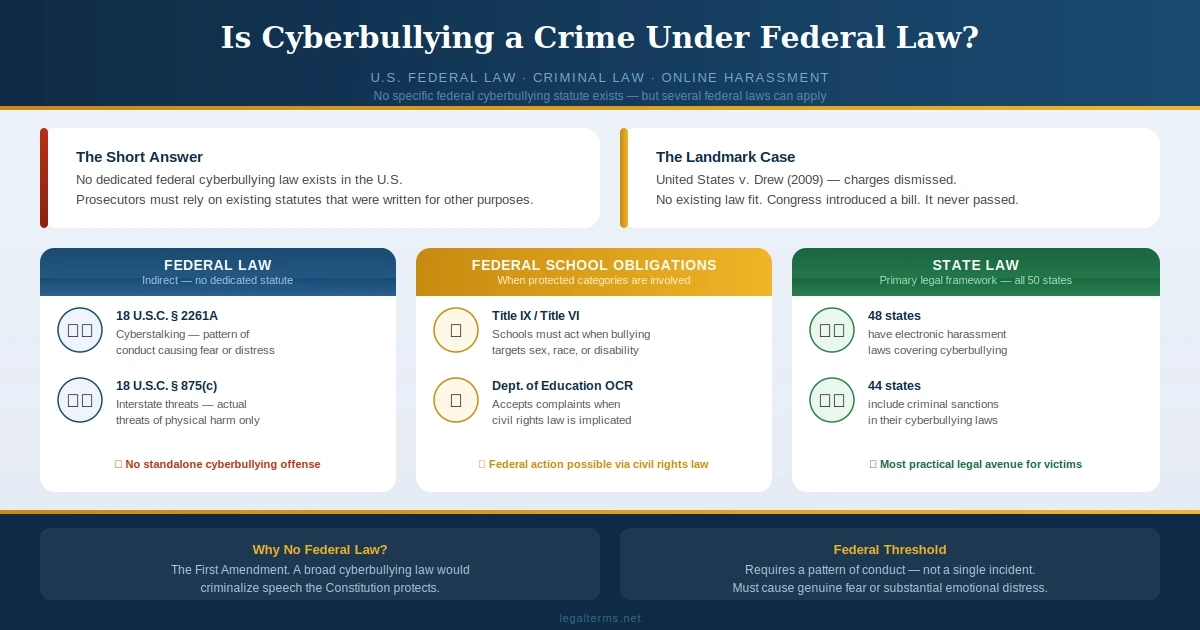
The short answer is that there is no federal law in the United States that specifically criminalizes cyberbullying as a standalone offense. Congress has never passed a statute that uses the word “cyberbullying” and defines it as a federal crime. What exists instead is a collection of older federal laws, written for other purposes, that prosecutors can sometimes use when online harassment becomes severe enough to meet their requirements. Whether any of those laws apply depends entirely on the facts of the specific situation.
What Federal Law Actually Says About Cyberbullying
Federal law does not have a dedicated cyberbullying statute. This is not an oversight that went unnoticed. Congress has debated the issue for decades. After the 2006 suicide of 13-year-old Megan Meier, who was targeted through a fake MySpace account created by a neighbor’s parent, lawmakers introduced the Megan Meier Cyberbullying Prevention Act. The bill proposed making it a federal crime to use electronic means to coerce, intimidate, harass, or cause substantial emotional distress. It never passed.
The reason it failed, and the reason no comparable bill has succeeded since, comes down to the First Amendment. Online speech, even speech that is cruel, offensive, or harmful, enjoys constitutional protection in many circumstances. A federal cyberbullying law broad enough to cover most of what people commonly call cyberbullying would likely criminalize protected speech. Courts have repeatedly struck down state cyberbullying statutes on exactly those grounds. Writing a federal law that is both effective and constitutional has proven difficult enough that Congress has not managed it.
That legal gap leaves federal prosecutors in the position of reaching for existing statutes when online harassment cases become serious enough to pursue. Whether that reach succeeds depends on whether the facts fit the elements of those laws.
The Federal Laws That Can Apply
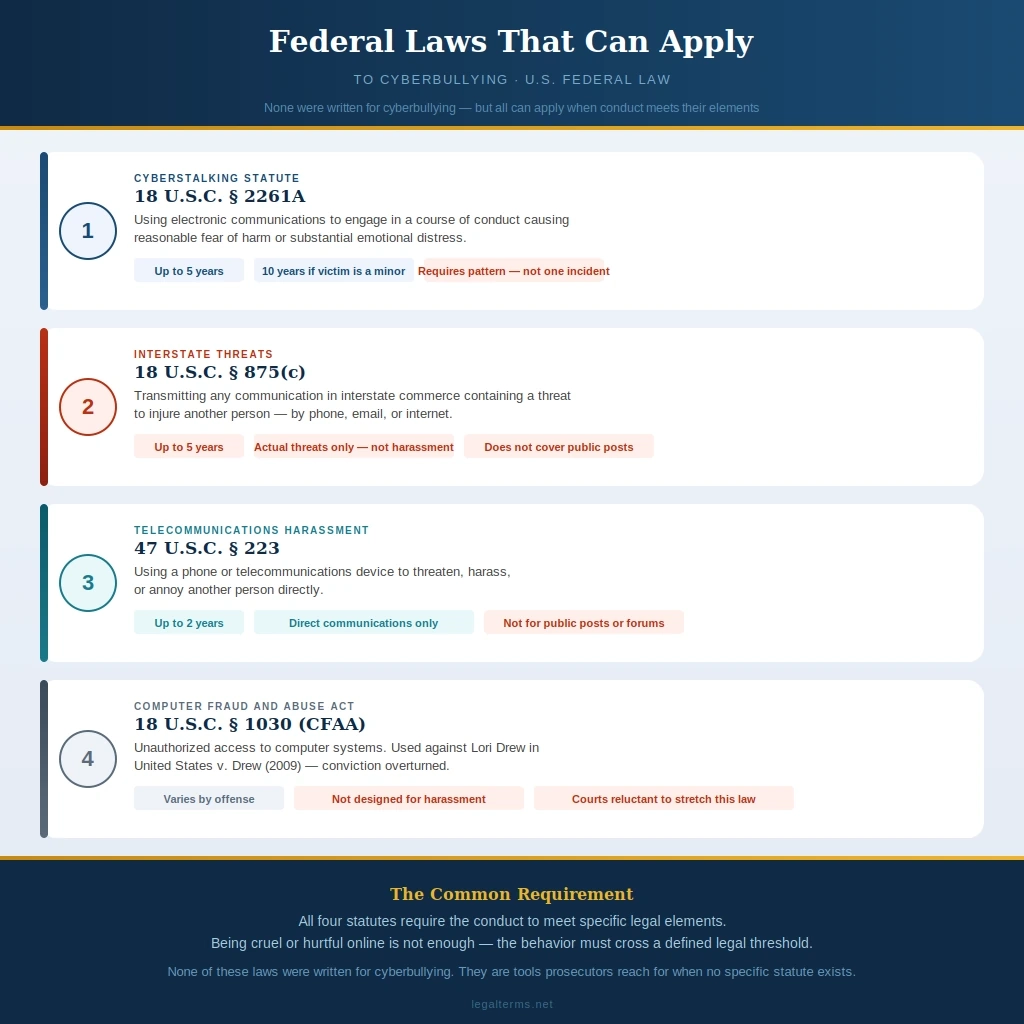
Several federal statutes can cover conduct that would commonly be called cyberbullying, though none of them were written with that conduct in mind.
| Federal Law | What It Covers | Maximum Penalty | Key Limitation |
|---|---|---|---|
| 18 U.S.C. § 2261A (Cyberstalking) | Using electronic communications to cause fear of harm or substantial emotional distress through a pattern of conduct | Up to 5 years; up to 10 years if victim is a minor | Requires a course of conduct, not a single incident |
| 18 U.S.C. § 875(c) (Interstate Threats) | Transmitting threats to injure another person across state lines | Up to 5 years | Applies only to actual threats, not harassment without a threat |
| 47 U.S.C. § 223 (Telecommunications Harassment) | Using phone or telecommunications device to harass, threaten, or annoy | Up to 2 years | Only covers direct communications to the victim, not public posts |
| 18 U.S.C. § 1030 (Computer Fraud and Abuse Act) | Unauthorized access to computer systems | Varies | Not designed for harassment; difficult to apply to social media conduct |
The cyberstalking statute at 18 U.S.C. § 2261A is the most commonly used of these. It covers anyone who uses the internet, email, or any electronic communication facility of interstate commerce to engage in a course of conduct that places someone in reasonable fear of serious harm or causes substantial emotional distress. Because almost all electronic communication travels through interstate infrastructure, the jurisdictional requirement is easy to satisfy. What is harder to satisfy is the requirement of a pattern of deliberate, fear-inducing conduct. A single hostile message, or even several, may not meet the threshold.
When the victim is under 18, the penalties under the cyberstalking statute increase. A base offense that would carry up to five years can carry up to ten years when directed at a minor, provided the offender is not also a minor and does not fall within a narrow age proximity exception..
United States v. Drew: The Case That Changed Everything
No case better illustrates the limits of federal law in cyberbullying situations than United States v. Drew, decided in 2009.
Lori Drew was a Missouri mother who, along with a teenage employee, created a fake MySpace profile posing as a 16-year-old boy to befriend 13-year-old Megan Meier. Over several weeks, Drew used the fake account to build a relationship with Megan and then turn on her, sending humiliating messages and ultimately telling her the world would be better off without her. Megan died by suicide on October 17, 2006.
Because Missouri prosecutors declined to file charges, stating there was insufficient evidence under existing state law, federal prosecutors pursued the case in Los Angeles, where MySpace was headquartered. Unable to use a cyberbullying statute that did not exist, they charged Drew under the Computer Fraud and Abuse Act, arguing that creating a fake account violated MySpace’s terms of service and therefore constituted unauthorized computer access.
A jury initially convicted Drew on three misdemeanor counts. Federal Judge George Wu then overturned those convictions, ruling that criminalizing a violation of a website’s terms of service would make an ordinary federal crime out of conduct that millions of internet users engage in every day, such as providing a false birthdate or using a pseudonym. The case was dismissed.
The Drew case exposed the central problem that has followed every attempt to prosecute cyberbullying under federal law: when no specific statute exists, prosecutors are forced to fit the facts into laws written for different purposes, and courts are often unwilling to stretch those laws far enough to cover the conduct in question. The Megan Meier Cyberbullying Prevention Act was introduced directly in response to this outcome, but it stalled in committee and was never enacted.
When Federal Charges Can Apply to Cyberbullying
Federal prosecution of cyberbullying is possible but requires the conduct to meet the specific elements of an applicable statute. In practice, federal involvement typically occurs when several factors are present.
The conduct crosses state lines, which is easy to establish given that most internet communications are routed through interstate infrastructure, but still functions as a formal jurisdictional requirement.
The behavior involves a genuine course of conduct rather than isolated incidents. A single threatening message is unlikely to meet the threshold for a federal cyberstalking charge. Repeated, sustained harassment that creates documented fear or emotional distress is more likely to qualify.
The harassment involves actual threats of physical harm, which triggers the interstate threats statute and potentially carries more serious consequences than harassment without a threat component.
The target is a minor, which can elevate penalties under the cyberstalking statute and may draw federal attention in cases where state or local law enforcement has not acted.
A protective order is already in place and is being violated. Violating a protective order while engaging in cyberstalking carries a mandatory minimum sentence of one year in federal prison, which significantly changes the calculus of prosecution.
Even where all of these factors are present, federal prosecution of cyberbullying cases remains uncommon. Federal resources are limited, and many cyberbullying situations, however harmful, do not rise to the level that federal prosecutors typically pursue. State law enforcement and local prosecutors handle the vast majority of cases where legal action is taken.
What About Schools and Federal Obligations
Even without a dedicated cyberbullying statute, federal law creates real obligations for schools that receive federal funding. Those obligations do not make cyberbullying a federal crime, but they can require schools to act, and failing to act can have consequences.
Under Title IX of the Education Amendments of 1972, schools must address harassment based on sex, including online harassment that is severe, pervasive, and objectively offensive enough to interfere with a student’s access to education. Title VI of the Civil Rights Act imposes similar requirements for harassment based on race, color, or national origin. Section 504 of the Rehabilitation Act and the Americans with Disabilities Act cover harassment targeting students with disabilities.
When cyberbullying overlaps with these protected categories, for example when a student is targeted because of their gender, race, or disability, a school’s failure to respond can constitute a violation of federal civil rights law. The U.S. Department of Education’s Office for Civil Rights investigates complaints and can withdraw federal funding from schools that fail to address harassment in these categories.
What this means in practice is that federal law reaches cyberbullying indirectly through schools when the harassment targets a protected characteristic. A school cannot look away from sustained online harassment directed at a student because of their disability and claim that it is not a school matter. It is, and federal law backs that up.
For harassment that does not fall into one of these protected categories, the kind of general social cruelty that makes up most of what people call cyberbullying, schools are governed by their own policies and state law rather than federal civil rights obligations.
State Laws Fill the Gap Federal Law Leaves
Because federal law has not addressed cyberbullying directly, states have built the primary legal framework. Every state has some form of anti-bullying law, and as of the most recent counts, 48 states have electronic harassment laws that explicitly include cyberbullying. Forty-four states include criminal sanctions in their cyberbullying laws.
The specific approach varies significantly from state to state. Some states have standalone cyberbullying statutes. Others address online harassment under broader stalking or harassment laws that cover all forms of communication. The elements required to prove a violation, the penalties available, and whether the conduct must be school-related or can occur entirely off-campus all differ depending on the state.
California allows schools to suspend or expel students for cyberbullying even when the conduct occurs off campus, if it causes a substantial disruption to the school environment. New Jersey has one of the more comprehensive frameworks, with specific provisions for school investigations, reporting requirements, and criminal referrals. Texas harassment statutes include sentencing enhancements when the conduct is designed to cause the victim to commit suicide or engage in self-harm, a provision that emerged directly from high-profile cases involving teen suicides following online harassment.
For victims, state law is usually the more practical avenue. Whether a cyberbullying situation rises to criminal conduct under state law depends on the state, the specific conduct, and how severe and sustained the behavior was. The patchwork of state laws creates real inconsistency, but it also means that legal remedies exist in nearly every jurisdiction even where federal law falls short.
The First Amendment Problem
One reason Congress has not passed a federal cyberbullying law is that the most straightforward versions of such a law would likely be unconstitutional.
The First Amendment protects speech, including speech that is offensive, hurtful, or cruel. Courts have consistently held that the government cannot criminalize speech simply because it causes emotional distress. A federal law broad enough to cover most cyberbullying would capture a wide range of online expression that, however unpleasant, is constitutionally protected.
State courts have struck down cyberbullying statutes on these grounds. A law that prohibits conduct intended to intimidate or torment without requiring that the victim suffer actual injury, and without defining key terms, has been found unconstitutionally overbroad because it reaches speech the government has no right to punish. The fact that speech occurs online does not strip it of First Amendment protection.
What survives constitutional scrutiny is narrower. True threats, meaning communications that would cause a reasonable person to fear for their safety, are not protected. A sustained course of conduct designed to instill fear meets the threshold for stalking or cyberstalking prosecution. Harassment directed at someone’s race, sex, or disability in an educational setting triggers civil rights obligations. But the broad middle ground of online cruelty, including mockery, social exclusion, rumor-spreading, and coordinated humiliation, falls in an area where the law has struggled to act without running into the First Amendment.
This is not a flaw unique to American law. It reflects a genuine tension between two values: protecting people from serious online harm and preserving the space for speech that a free society requires.
What Victims Can Actually Do
Understanding the limits of federal law matters most to people who are being harmed and trying to figure out what options they have.
Documenting everything is the first practical step. Screenshots, dates, usernames, and a record of what was sent and when create the evidentiary foundation that any legal response will require. Without documentation, even the most serious harassment is difficult to pursue.
Reporting to the platform where the harassment is occurring is often the fastest immediate response. Social media companies have terms of service that prohibit harassment, and platforms can suspend or ban accounts, remove content, and in some cases cooperate with law enforcement investigations.
Contacting local law enforcement is appropriate when the harassment involves threats of physical harm, sustained targeting that causes genuine fear, or conduct that appears to violate state harassment or stalking statutes. Local prosecutors and law enforcement are far more likely to be the avenue for criminal action than federal authorities in most cyberbullying situations.
Consulting a civil attorney is worth considering in serious cases. A victim may have civil claims for intentional infliction of emotional distress or, depending on the circumstances, defamation. Civil litigation does not require the same threshold as criminal prosecution, and in some cases it has produced significant damages awards that reflect the real harm caused by sustained online harassment.
If the harassment is occurring in a school context and involves a protected characteristic under federal civil rights law, filing a complaint with the Department of Education’s Office for Civil Rights is a federal avenue that exists precisely because Congress recognized that schools have obligations even where a federal criminal statute does not.
A Few Cautions
The absence of a federal cyberbullying law does not mean that online harassment has no legal consequences. Serious and sustained conduct can and does result in federal prosecution under existing statutes, state criminal charges, school disciplinary action, and civil liability. What the absence of a specific statute does mean is that the legal outcome depends heavily on the facts, the jurisdiction, and whether the conduct meets the specific elements of the applicable law.
Anyone dealing with a cyberbullying situation, whether as a victim, a parent, or a school official, should not assume that the conduct either is or is not a crime without looking at the specific laws in the relevant state. The legal landscape varies too much for general assumptions to be reliable.
Educational resources like this one can explain the framework, but they cannot substitute for advice from someone who knows the applicable state law and the specific facts of the situation.
Download the Quick Reference Guide
Save this article as a one-page PDF for easy reference. Click Here For Download
Frequently Asked Questions
Is cyberbullying a federal crime in the United States?
There is no federal law that specifically criminalizes cyberbullying as a standalone offense. Federal prosecutors can pursue online harassment cases using existing statutes, primarily the federal cyberstalking law at 18 U.S.C. § 2261A, but only when the conduct meets the specific requirements of those laws. Most cyberbullying situations are handled under state law rather than federal law.
What federal law comes closest to covering cyberbullying?
The federal cyberstalking statute at 18 U.S.C. § 2261A is the primary tool. It covers using electronic communications to engage in a course of conduct that places someone in reasonable fear of serious harm or causes substantial emotional distress. Because most internet communication travels through interstate infrastructure, the jurisdictional requirement is typically met. The harder requirement is showing a sustained pattern of conduct rather than isolated incidents.
Why has Congress never passed a specific cyberbullying law?
The main obstacle is the First Amendment. A federal cyberbullying law broad enough to cover most of what people call cyberbullying would likely criminalize speech that the Constitution protects. Courts have struck down state cyberbullying laws on these grounds, and drafting a federal statute that is both effective and constitutional has proven difficult enough that no bill has made it through Congress.
What happened in the Megan Meier case?
Megan Meier was a 13-year-old who died by suicide in 2006 after being targeted through a fake MySpace account created by a neighbor’s parent. Federal prosecutors charged the perpetrator under the Computer Fraud and Abuse Act, the only available federal statute, arguing that creating a fake account violated MySpace’s terms of service. A jury initially convicted on misdemeanor counts, but a federal judge overturned the conviction, ruling that criminalizing terms of service violations would make ordinary internet behavior a federal crime. The case directly prompted the introduction of the Megan Meier Cyberbullying Prevention Act, which Congress did not pass.
Do schools have federal obligations related to cyberbullying?
Yes, in specific circumstances. When cyberbullying targets a student because of their sex, race, national origin, or disability, federal civil rights laws including Title IX and Title VI require schools that receive federal funding to respond. Failure to act can result in complaints to the Department of Education’s Office for Civil Rights. For general cyberbullying that does not involve a protected characteristic, schools are governed by state law and their own policies rather than federal obligations.
What should someone do if they are being cyberbullied?
Document everything, including screenshots, dates, and records of each incident. Report to the platform where the harassment is occurring. Contact local law enforcement if the conduct involves threats or sustained harassment that may violate state law. Consider consulting a civil attorney in serious cases, as civil claims may be available regardless of whether a criminal threshold is met. If the harassment is school-related and involves a protected characteristic, filing a complaint with the Department of Education’s Office for Civil Rights is a federal option.
References
- Cornell Law School – Legal Information Institute (LII): 18 U.S.C. § 2261A – Stalking and Cyberstalking
- StopBullying.gov – Laws, Policies and Regulations
- Congress.gov – H.R. 1966, Megan Meier Cyberbullying Prevention Act, 111th Congress
- Black’s Law Dictionary: Definition of Cyberstalking, Harassment, and Interstate Commerce
- LegalTerms.net Editorial Guidelines
- LegalTerms.net Legal Sources and References

Hamit Sahin is the founder and editor of LegalTerms.net. He researches U.S. legal terminology and publicly available legal information using statutes, court rules, judicial opinions, government publications, and established legal reference sources.
His work focuses on organizing complex legal concepts into clear, plain-English explanations for general educational purposes.
Hamit is not an attorney and LegalTerms.net does not provide legal advice.