Fungible Goods: Legal Definition, Examples, and Why It Matters
Not every legal term makes its way into everyday conversation. Fungible is one of the exceptions. Most people have heard it used in the context of NFTs, but the legal concept behind it goes back centuries and shows up across contract law, commercial transactions, property disputes, and even tax filings.
Understanding fungibility is simpler than it sounds. Once you know the core idea, you will recognize it in dozens of situations you already deal with.
What Fungible Goods Actually Means
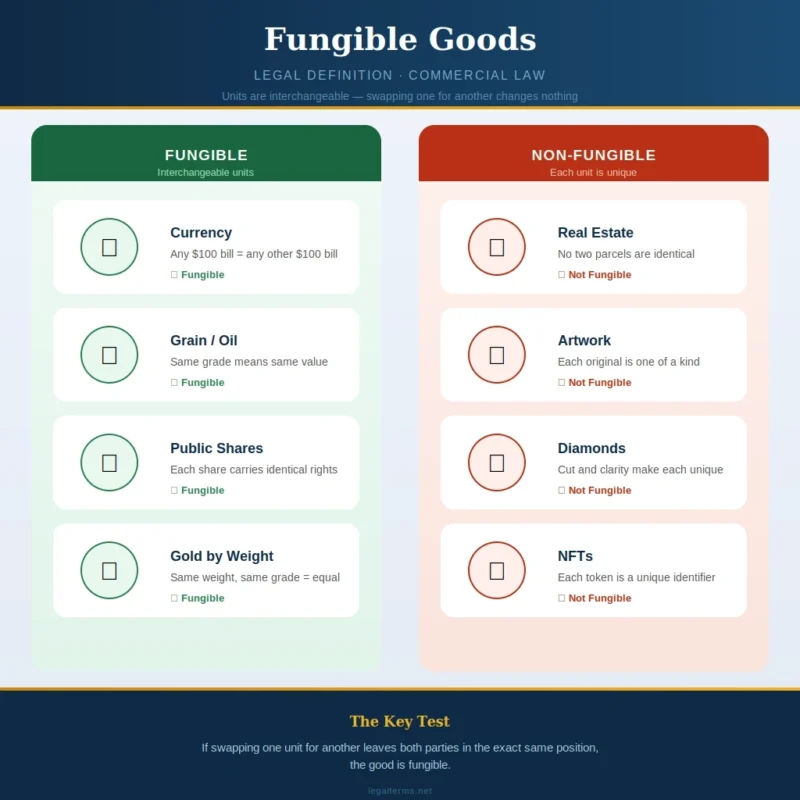
A good is fungible when one unit can be substituted for another unit of the same type without any change in value or usefulness. The specific item does not matter. Only the type, quantity, and grade matter.
A dollar bill is the clearest example. If you lend someone a twenty-dollar bill and they repay you with a different twenty-dollar bill, you have been made whole. You have no legal basis to complain that you did not get the exact same bill back. The bills are interchangeable, which makes money fungible.
The same logic applies to a barrel of crude oil, a bushel of wheat, a kilogram of gold, or a share of publicly traded stock. Fungibility refers only to the equivalence and indistinguishability of each unit of a commodity with other units of the same thing, and not to the ability to easily trade it for something else.
That last point matters. Fungibility is not the same as liquidity. A good can be fungible but hard to sell. Private company shares are a useful example. Individual shares of the same class are fungible with each other, meaning each share carries the same rights and value as any other. But those shares may be very difficult to sell because transfers are restricted. Fungible and liquid are two different qualities, even if they often appear together in practice.
The Legal Definition Under the UCC
In the United States, the formal legal definition comes from the Uniform Commercial Code. Under UCC Section 1-201(b)(18), fungible goods means goods where any unit, by nature or trade usage, is the equivalent of any other like unit, or goods that the parties have agreed to treat as equivalent.
That second part of the definition deserves attention. Fungibility can arise in two ways. The first is natural: grain, oil, and currency are fungible because that is simply what they are. The second is contractual: parties can agree to treat goods as fungible even if the units are not perfectly identical.
If your contract for 500 steel bolts treats every bolt meeting a specified tolerance as equivalent, the seller can deliver any qualifying bolts without you having the right to reject specific ones. The agreement controls, not the physical characteristics of each individual bolt.
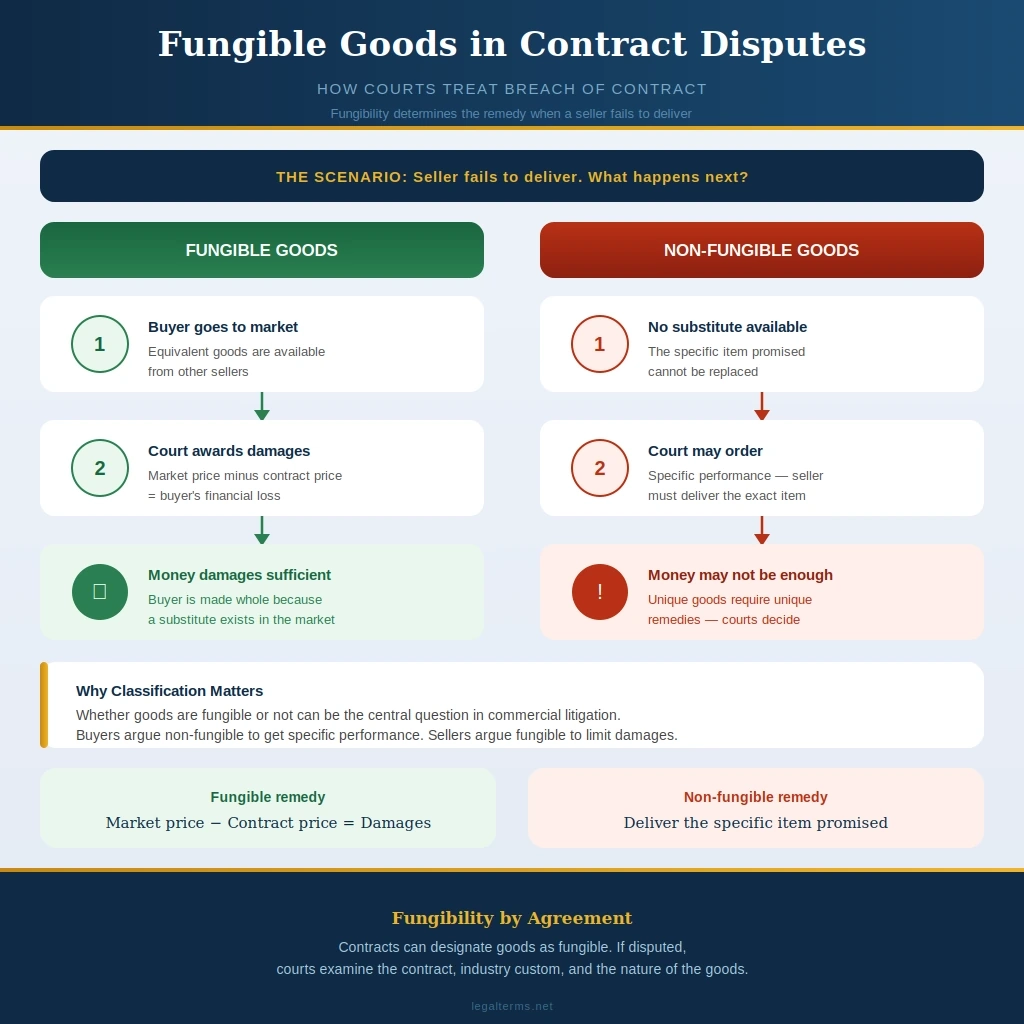
This distinction matters in contract disputes. When a seller fails to deliver, the buyer’s remedy depends partly on whether the goods were fungible. If they were, money damages are usually sufficient because the buyer can go into the market and buy equivalent goods from someone else. If the goods were unique or non-fungible, the buyer may be entitled to the specific performance of the original contract.
Fungible vs. Non-Fungible Goods
The contrast between fungible and non-fungible goods is where the concept becomes clearest.
Fungible goods
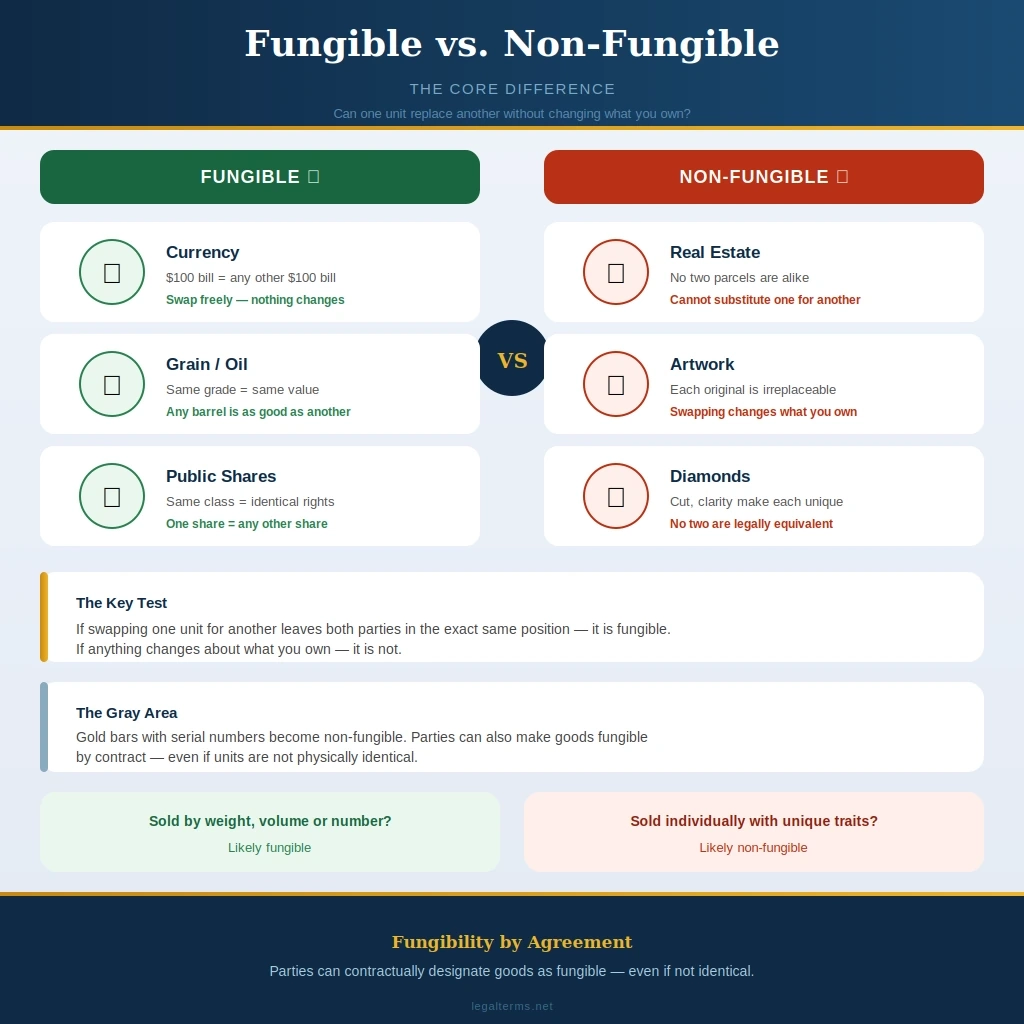
These include currency, crude oil, natural gas, grain, standard metals like gold and silver sold by weight, publicly traded shares of the same class, government bonds of the same series, and most agricultural commodities. When sold by weight, volume, or number, that is usually a reliable signal that the goods are fungible.
Non-fungible goods
These are items that cannot be substituted without changing what you actually own. Real estate is non-fungible because no two parcels of land are identical. Artwork is non-fungible because a specific painting by a specific artist is unique. Diamonds are non-fungible because differences in cut, color, clarity, and carat make each stone distinct. Even if two diamonds could be found to be almost indistinguishable or of equal value, they are not considered fungible with each other because diamonds as a class are not recognised as fungible.
Collectibles, antiques, custom-manufactured goods, and most real property fall on the non-fungible side of the line.
The gray area
Some goods sit in between, and the answer depends on context. Although gold is generally fungible, in whatever form it exists, a unique item such as a gold statuette would not be considered fungible with the same weight of gold in some other form.
Serial numbers can also shift goods from fungible to non-fungible. When gold bars are assigned unique serial numbers and allocated to specific investors held by a custodian, those bars are no longer treated as fungible. The holder owns specific bars, not just a share of a mass of gold.
What Happens When Fungible Goods Are Mixed Together
One of the most practically important legal issues with fungible goods arises when goods from different owners are combined. This is called commingling, and it happens constantly in grain elevators, oil pipelines, storage tanks, and brokerage accounts.
When fungible goods are commingled, individual ownership disappears. No one can point to specific units and say those are mine. Fungible goods so commingled are owned in common by the persons entitled thereto, and the warehouseman is severally liable to each owner for that owner’s share.
That means if a grain elevator stores wheat from ten different farmers and the total volume is destroyed in a fire, each farmer absorbs a proportional loss based on their contribution. The law does not allow any one farmer to claim they owned the specific bushels that survived.
The same principle applies to lenders who have security interests in fungible goods used as collateral. When the goods are commingled with other goods, the security interest does not disappear. It attaches to the combined mass. If multiple lenders hold security interests in the combined goods, their claims rank equally in proportion to the value each contributed.
Fungible Goods in Contract Disputes
When a contract involves fungible goods and one party breaches, courts apply a different analysis than they would for unique goods.
For fungible goods, the standard remedy for non-delivery is the difference between the contract price and the market price for equivalent goods. The buyer is not stuck without a remedy simply because the seller failed. They can go out and buy the same goods from someone else and recover the price difference.
This is why the classification of goods as fungible or non-fungible can be a central question in commercial litigation. A buyer claiming a seller failed to deliver a specific, unique item will argue the goods were non-fungible and push for specific performance or replacement value. A seller disputing that claim will argue the goods were fungible and that a market substitute was available.
Courts look at the nature of the goods, how the contract described them, industry custom, and whether the parties had designated them as interchangeable.
Fungibility and NFTs: Why the Term Went Mainstream
The term fungible reached a much wider audience because of non-fungible tokens. The name itself is a direct reference to the legal concept.
A cryptocurrency like Bitcoin is fungible. Fungible items, like a dollar bill or shares of Disney common stock, can be readily exchanged for other dollar bills or other shares of Disney common stock and you continue to own the same thing. One Bitcoin is worth exactly the same as any other Bitcoin of the same denomination.
An NFT is the opposite. Each token is uniquely identified on a blockchain and represents ownership of a specific digital asset, whether a piece of artwork, a video clip, or a collectible. Because no two NFTs are alike, they cannot be exchanged on a one-for-one basis without changing what you own.
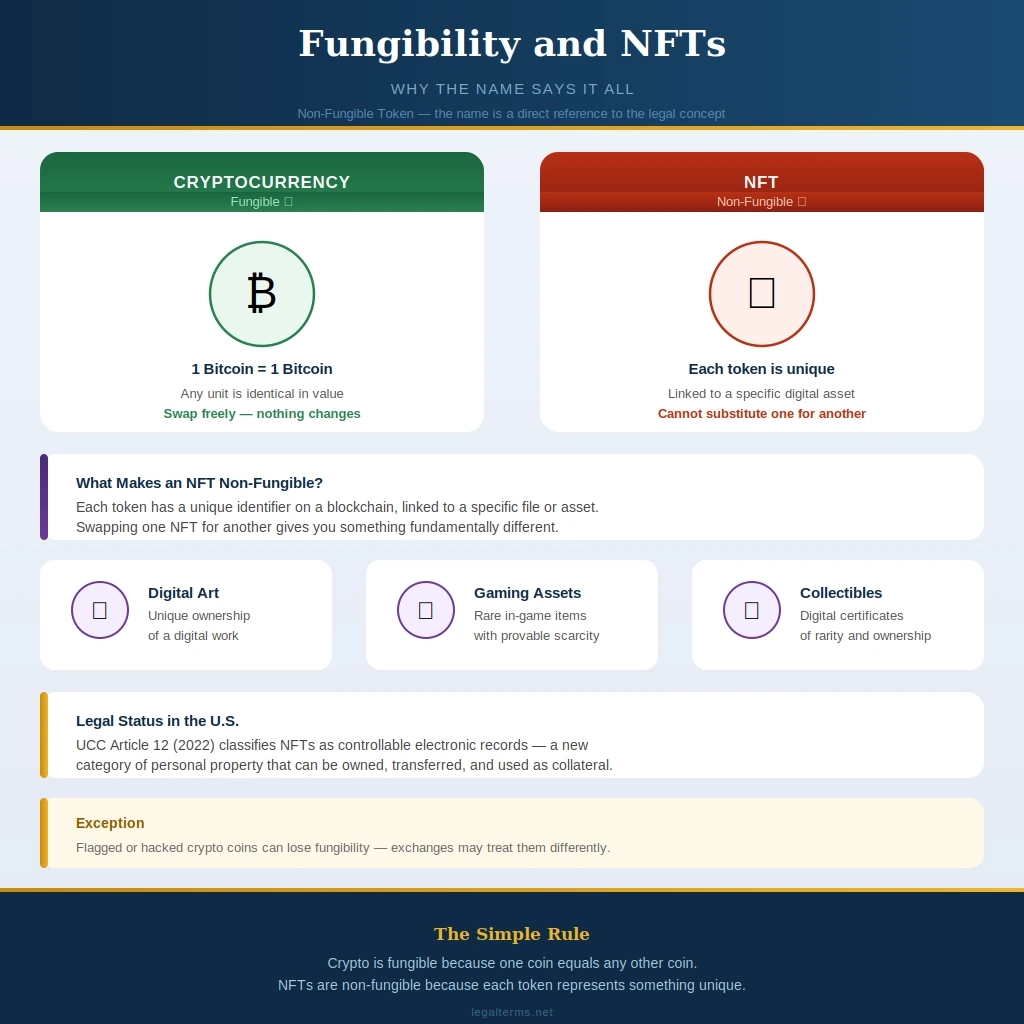
The legal treatment of NFTs is still developing. In the U.S., the UCC’s Article 12, introduced in 2022, addresses this by classifying NFTs as controllable electronic records, a new category of personal property that can be owned, transferred, and used as collateral with legal clarity.
Whether an NFT is also a security, a commodity, or something else entirely remains a live question in regulatory and litigation contexts.
Fungibility in Tax and Investment Contexts
Fungibility creates specific challenges in taxation that most investors encounter but may not connect back to the legal concept.
When you hold shares of the same stock purchased at different times and different prices, all those shares are fungible. They carry the same rights. But for tax purposes, which shares you sell matters enormously because different purchase lots have different cost bases.
Federal tax law allows investors to use several methods to identify which shares they sold: specific identification, first-in-first-out, and average cost basis are the most common. Each method produces a different taxable gain or loss. The choice of method is possible precisely because the shares are fungible, meaning there is no natural rule for which ones were sold, so the law allows the investor to designate it.
A similar issue arises with cryptocurrencies. Most major cryptocurrencies are fungible, but tax authorities require tracking of individual units by acquisition date and cost. The fungibility of the underlying asset creates the ambiguity that tax rules then have to resolve.
A Few Practical Points for Anyone Dealing with Fungible Goods
If you are involved in a transaction that involves goods sold by weight, volume, or unit count, there is a reasonable chance they are fungible. That affects your legal rights if something goes wrong.
For buyers, fungibility generally means that if a seller fails to deliver, a substitute is available in the market and your damages will be calculated based on the cost of that substitute. You are unlikely to be entitled to the specific goods the seller had.
For sellers, the same principle works in reverse. If you committed to deliver a specific quantity and grade of a fungible good and you cannot fulfill from your own inventory, you are generally expected to source an equivalent from the market rather than simply walk away.
For anyone storing fungible goods with a third party, such as a warehouse, storage facility, or financial intermediary, commingling rules mean you may not own specific units. You own a proportional interest in the pool. If the facility fails, your recovery may be less than the full value of what you deposited.
These practical points are general observations about how the law approaches fungible goods. The specific rights and remedies in any transaction depend on the governing contract, applicable state law, and the nature of the goods involved.
Frequently Asked Questions About Fungible Goods
What makes a good fungible?
A good is fungible when individual units are interchangeable without any change in value or usefulness. The defining test is simple: if swapping one unit for another of the same type leaves both parties in exactly the same position they were in before, the good is fungible. Currency, grain, standard metals, and publicly traded shares all meet this test.
Is money always fungible?
Almost always, but not without exception. A genuine hundred-dollar bill is fungible with any other genuine hundred-dollar bill. A counterfeit bill that looks identical is not fungible with a genuine one because its legal status is different. The physical appearance is not what creates fungibility. The legal equivalence is.
Can something stop being fungible?
Yes. Assigning serial numbers, unique identifiers, or specific ownership markers to goods that would otherwise be fungible can make them non-fungible in a legal context. Gold bars allocated to a specific investor and marked with unique identifiers are no longer treated as fungible with the general gold pool. Blockchain technology has introduced new ways for previously fungible assets to be made non-fungible.
What is the difference between fungible and liquid?
Fungibility means one unit can substitute for another of the same type. Liquidity means an asset can be easily converted into cash or another asset. Fungible goods are often liquid, but the two concepts are separate. Private company shares are fungible within their class but illiquid because they are difficult to sell. A rare collectible might be sold relatively quickly but is non-fungible because no two are alike.
How does fungibility affect damages in a contract dispute?
When the goods in dispute are fungible, courts typically award money damages equal to the difference between the contract price and the market price for equivalent goods. This is because a substitute is available. When the goods are non-fungible or unique, money damages may be inadequate and courts may instead order specific performance, requiring the breaching party to deliver the specific goods promised.
Why does it matter whether goods are fungible or non-fungible in storage situations?
When fungible goods from different owners are mixed together in storage, individual ownership of specific units disappears. Each owner holds a proportional interest in the combined pool. If part of the pool is lost, damaged, or subject to a legal claim, the loss is shared proportionally. Understanding this is important for anyone storing valuable goods with a third party, including investors who hold assets through a broker or custodian.

Hamit Sahin is the founder and editor of LegalTerms.net. He researches U.S. legal terminology and publicly available legal information using statutes, court rules, judicial opinions, government publications, and established legal reference sources.
His work focuses on organizing complex legal concepts into clear, plain-English explanations for general educational purposes.
Hamit is not an attorney and LegalTerms.net does not provide legal advice.