What Is Injurious Affection? Property Rights and Public Projects Explained
What Is Injurious Affection?
Losing part of your property to a government project is hard enough. But what happens when the government does not take your land at all, and a public project still damages what you have left? That situation has a name in property law, and it is called injurious affection.
Injurious affection is a legal concept that allows a property owner to seek compensation when a public authority’s project reduces the value or usefulness of their land, whether or not any of that land was actually taken. It sits at the intersection of property rights, government power, and the basic principle that people should not bear the cost of public projects alone.
The term sounds unusual at first. That is because it comes from older legal language where “injuriously” meant hurtfully or harmfully, not wrongfully. The government is not acting illegally when it builds a highway or expands a transit line. It is acting under legal authority. Injurious affection recognizes that even lawful government action can cause real financial harm to nearby property owners, and that harm may be compensable.
Injurious Affection in Plain English
Think of it this way. A government agency acquires a strip of land next to your commercial property to build a light rail line. Your land is not taken. But the construction creates months of noise and blocked access, your customers stop coming, and when the line opens, a new overpass cuts off the road frontage that gave your property its value. Your market value drops significantly.
You did not lose your land. But you lost something real. Injurious affection is the legal mechanism that may allow you to claim compensation for that loss.
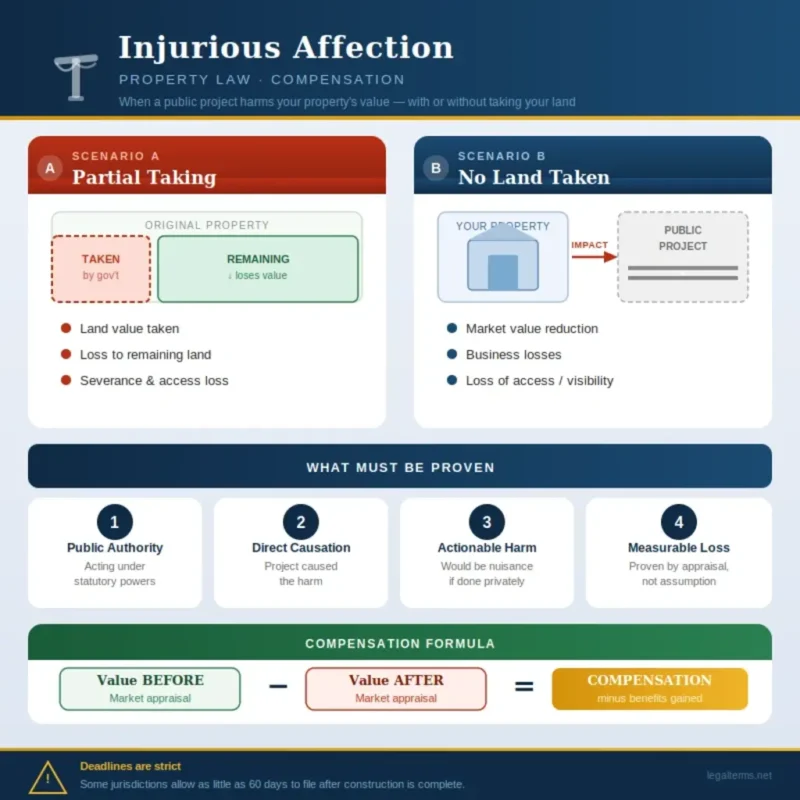
In simpler terms, injurious affection covers two main situations. The first is where part of an owner’s land is taken and the remaining land is made less valuable by what happens next. The second is where no land is taken at all, but a nearby public project still causes measurable harm to the property.
Both situations require more than just a general discomfort with what the government is building nearby. The harm has to be real, measurable, and tied to a specific public project acting under statutory authority.
Why Injurious Affection Exists
Property law generally does not compensate people for the loss they feel when a neighbor does something they dislike. That is the trade-off of living in a community. But government projects are different.
At common law, a property owner who suffered serious interference from a neighbor’s activities could sue for nuisance. However, public authorities are typically protected from nuisance claims by a defense called statutory authority. If the government has legal power to build something, the fact that it inconveniences or harms a neighbor is generally not enough to win a nuisance lawsuit.
That creates an obvious problem. Without some compensating mechanism, property owners close to public projects could suffer serious financial harm with no recourse. Injurious affection developed as the legal answer to that gap. It is a statutory remedy, meaning it comes from legislation rather than common law, that replaces the nuisance action the property owner cannot bring.
The underlying principle is one of fairness. When the public as a whole benefits from a new highway or transit system, individual property owners should not absorb the financial losses that come with it. Injurious affection is the mechanism that spreads that burden back toward the public through compensation.
The Two Types of Injurious Affection
Understanding injurious affection requires knowing that it operates in two distinct ways, and the rules are often different depending on which applies.
Where land has been partially taken
When a government authority takes part of a property, such as a strip along the front for road widening, the owner is entitled to compensation for the land taken. But the taking often affects the rest of the property too. The remaining land may be smaller, oddly shaped, harder to develop, or worth less simply because of what is being built on the part that was taken.
Compensation for that harm to the remaining land is one form of injurious affection. It is sometimes described alongside severance, which refers to the physical division of a property by an acquisition. Together, severance and injurious affection are assessed by asking how much less the remaining land is worth after the project compared to before it.
Where no land has been taken
This is the broader and often more contested category. A property owner whose land is not expropriated at all may still have a claim if a public project causes substantial interference that reduces market value.
The classic example is a business located near a major construction project. If the construction blocks access, generates significant disruption, and results in a measurable drop in property value or business revenue, the owner may have a claim even though no land changed hands. This category of injurious affection is harder to establish because the connection between the project and the harm must be clear, and the interference must meet a specific legal threshold. It is not enough to show inconvenience. The harm must be something that would have been actionable as a nuisance if a private party had caused it.
What Has to Be Proven
Injurious affection is not automatic. A property owner who wants compensation has to demonstrate several things, and courts and tribunals tend to examine claims closely.
The harm must come from a public authority acting under statutory powers. A private developer building next door does not trigger injurious affection, as that falls under other areas of property law.
The damage must be connected to the public project, not to general market conditions or unrelated causes. A drop in property values because the economy slowed down is not injurious affection.
The interference must be the kind that would have been an actionable nuisance if it had been caused by a private party rather than a public authority. This is a key legal test in many jurisdictions. Noise, vibration, loss of access, and loss of visibility have all been recognized in different cases. General inconvenience or a dislike of what is being built nearby usually is not enough.
The harm must also be real and measurable. Speculation about what might happen to property values is not sufficient. Claimants typically need evidence such as appraisals, before-and-after valuations, and business records that show an actual reduction in market value or documented financial loss.
Courts have also made clear that injurious affection is not a guaranteed outcome of any taking. Just because part of a property was acquired does not mean the remaining land was automatically harmed. The claimant has to show the harm, not simply assume it.
Common Examples of Injurious Affection
Several types of harm show up regularly in injurious affection cases.
Loss of access is one of the most common. If a public project changes road configurations and makes it significantly harder for customers or clients to reach a property, that can support a claim. Access does not need to be eliminated entirely. A meaningful reduction in the practicality or convenience of access can be enough in some circumstances.
Loss of visibility or frontage also appears frequently. A commercial property that previously had exposure to a major road may lose that exposure when an overpass or barrier is built. That loss of visibility can translate directly into reduced market value.
Noise, vibration, dust, and fumes from ongoing public works have been recognized in various cases, though these claims tend to be more difficult to sustain unless the interference is serious and prolonged rather than a temporary construction nuisance.
Landlocking, where a partial taking cuts off access to the remaining land entirely, is among the more severe forms. Loss of parking, changes to drainage, and proximity to infrastructure like power lines or transmission towers have also featured in decided cases.
How Compensation Is Calculated
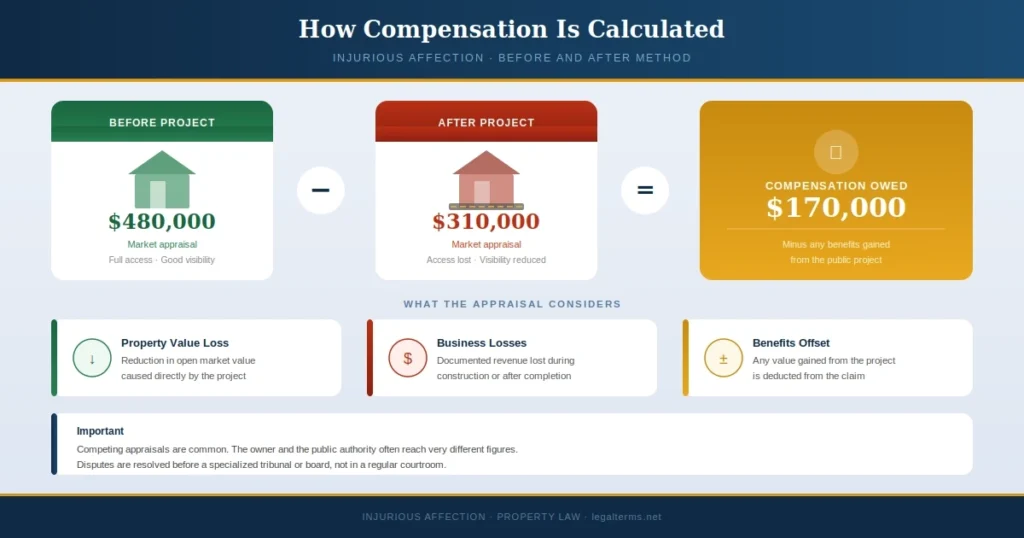
The standard approach is to compare the value of the property before and after the public project. The difference between the before value and the after value, where that difference is caused by the project, is the measure of the loss.
This before-and-after method sounds straightforward, but in practice it involves competing appraisals, disputed assumptions, and arguments about causation. The owner and the public authority often arrive at very different numbers, and the resolution typically happens before a specialized tribunal or board.
In cases where land has been taken, the injurious affection claim is assessed alongside the compensation for the land itself. The goal is to make the owner whole, meaning to restore them in financial terms to the position they would have been in without the project. At the same time, if the project also increases the value of the remaining land in some way, that benefit may be set off against the claim.
In cases where no land was taken, the analysis focuses on market value reduction and, in some jurisdictions, documented business losses.
Injurious Affection Without a Taking: A Harder Claim
When no land has been expropriated, the bar for a successful injurious affection claim is higher. Most jurisdictions impose additional requirements, and the statutory language tends to be more restrictive.
In some places, the claim is limited to properties that directly abut the public work. Owners further away may have no recourse even if they can show harm. Strict time limits often apply as well. Missing the deadline to file a claim, which in some jurisdictions can be as short as 60 days after construction is complete, can bar the claim entirely regardless of how strong it might otherwise be.
The connection to what would have been actionable nuisance also becomes more important in the no-taking context. Courts and tribunals are generally careful not to allow injurious affection to become a general compensation scheme for anyone who dislikes a public project. The harm has to be of the kind that the law recognizes, tied to a specific project, and proven on the evidence.
Real-World Example
A truck stop operates on a highway near a mid-sized city. The provincial government builds a new parallel highway nearby, redirecting traffic away from the old route. The truck stop’s access becomes difficult, its customer base disappears, and its market value drops dramatically. No land was taken from the truck stop owner.
The owner brings a claim for injurious affection. The case eventually reaches the Supreme Court of Canada, which rules that the public benefit of building a safer highway does not automatically protect the government from liability. The severity of the interference with the owner’s property rights is a separate and serious consideration. The owner is found to be entitled to compensation.
That outcome reflects the core principle: a public authority acting lawfully can still cause compensable harm, and the fact that the project serves the public good is not, by itself, a complete answer to a property owner’s loss.
Now change the facts slightly. Suppose the same owner had other road access that remained fully functional. Suppose the decline in business was gradual and partly explained by a broader economic slowdown. Suppose the owner waited years before filing a claim and missed the statutory deadline. Each of those changes weakens or eliminates the claim. Injurious affection depends on the specific facts, the applicable statute, and the evidence the owner can bring.
Injurious Affection vs. Expropriation
These two concepts are related but not the same, and mixing them up leads to confusion.
Expropriation is the taking of land. The government acquires ownership or a right over the property, and compensation is owed for what was taken. Injurious affection is the harm caused to land that remains, or to land that was never taken at all.
In a partial taking, both apply. The owner is compensated for the value of the land that was expropriated, and separately for the injurious affection to the land that was not. In a no-taking situation, expropriation is not involved at all, and only injurious affection is in play.
The practical significance of that distinction is that the rules, deadlines, and procedures can be different. A claim that is treated as an expropriation matter may have different time limits and different rights to recover legal costs than a standalone injurious affection claim under municipal legislation.
A Few Cautions for Anyone Facing This Situation
Injurious affection claims are technical, fact-dependent, and governed by legislation that varies significantly between jurisdictions. The rules in one province, state, or country may differ substantially from the rules in another. Time limits are particularly unforgiving. Some jurisdictions give property owners as little as 60 days to file a claim after construction is complete, and missing that window can end the matter regardless of merit.
Property owners who believe they may have a claim should treat deadlines as real and immediate. The value of a potential claim, and whether it is worth pursuing, depends on the applicable statute, the evidence available, and the costs of the process. Educational resources like this one can explain the concept, but they cannot substitute for a review of the governing law and a qualified assessment of the specific facts.
Injurious affection exists because the law recognizes that government projects, however necessary, should not leave individual property owners to absorb losses that belong to the public. Whether a particular situation qualifies is always a question that turns on the details.
Frequently Asked Questions About Injurious Affection
What is the difference between injurious affection and expropriation? Expropriation is the actual taking of land by a government authority. Injurious affection is the harm caused to property that was not taken, either the land remaining after a partial taking, or property that was never acquired at all. Both can occur in the same project, but they are assessed separately and follow different rules.
Do I have to lose part of my land to make a claim for injurious affection? Not necessarily. In many jurisdictions, a property owner whose land was not expropriated at all can still bring a claim if a public project caused substantial harm that reduced market value. However, the requirements for these no-taking claims are generally stricter, and some jurisdictions limit them to properties that directly border the public work.
What kinds of harm can be compensated? Loss of market value is the primary measure. Courts and tribunals have recognized loss of access, loss of visibility, noise and vibration damage, landlocking, and loss of parking as examples of harm that can support a claim. General inconvenience or a preference for things to have stayed the same is not enough.
How is the compensation amount determined? The standard method compares the value of the property before and after the project and calculates the difference caused by the public work. This typically requires professional appraisals. If the project also increased the value of the remaining land in some way, that benefit may be deducted from the compensation owed.
Are there time limits for making a claim? Yes, and they are strictly enforced. Deadlines vary significantly by jurisdiction and by whether land was taken. Some no-taking claims must be filed within as little as 60 days of receiving notice that construction is complete. Missing a deadline can bar a valid claim entirely. If a public project nearby may have affected your property, treat the deadline question as urgent.
Does injurious affection only apply to large commercial properties? No. Residential properties can also be affected, though the types of harm and the amounts in dispute tend to differ. Any property owner whose land is diminished in value by a nearby public project, whether a business, a farm, or a home, may have grounds to explore a claim under the applicable legislation.
Is injurious affection recognized in the United States? The concept exists in U.S. law but is not typically called injurious affection. American property law addresses similar situations under the headings of severance damages and consequential damages in eminent domain proceedings. The underlying principle, that a partial taking or a nearby public project can harm remaining property and give rise to compensation, is recognized, but the terminology and specific rules differ from Canadian, British, and Australian frameworks where the term injurious affection is used more directly.

Hamit Sahin is the founder and editor of LegalTerms.net. He researches U.S. legal terminology and publicly available legal information using statutes, court rules, judicial opinions, government publications, and established legal reference sources.
His work focuses on organizing complex legal concepts into clear, plain-English explanations for general educational purposes.
Hamit is not an attorney and LegalTerms.net does not provide legal advice.