What Is Lex Mercatoria? Meaning, Pronunciation, and Plain-English Guide
International business deals happen across borders every day. Two companies from different countries sign a contract, ship goods, and exchange payment, often without agreeing on which country’s law governs the deal. When a dispute arises, what rules apply?
In many cases, the answer is lex mercatoria. It is one of the oldest concepts in international commercial law, and it is still very much alive in arbitration rooms and cross-border contracts today.
What Does Lex Mercatoria Mean?
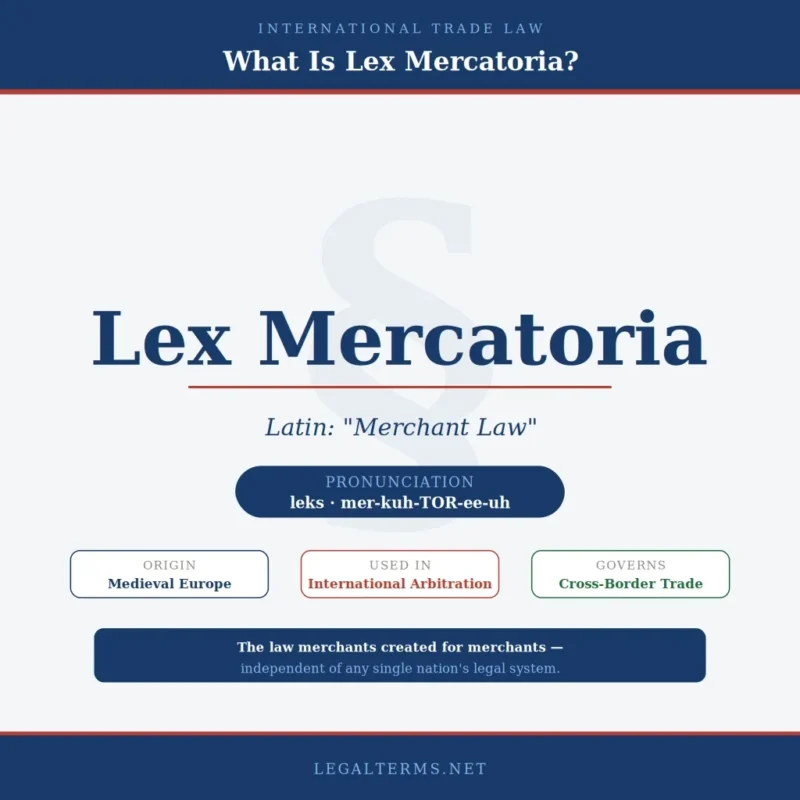
Lex mercatoria is Latin for “merchant law” or “mercantile law.” The word lex means “law,” and mercatoria derives from mercator, meaning “merchant” or “trader.”
Pronunciation: leks mer-kuh-TOR-ee-uh
It refers to a body of rules, customs, and principles that govern international commercial transactions, not created by any single government or parliament, but developed organically by the international business community itself over centuries.
The concept dates back to medieval Europe, where merchants trading across borders needed a common set of rules that worked regardless of which kingdom or city-state they were operating in. No national law could serve that purpose. So merchants created their own. These rules were enforced at trade fairs and merchant courts along the main trade routes of Europe, from the Champagne fairs of France to the ports of Venice and Hamburg.
Today, lex mercatoria is no longer an informal merchant custom. It has evolved into a recognized body of international commercial law that arbitrators and courts apply when parties to a cross-border contract have not specified which national law governs their agreement, or when no single national law provides a satisfactory answer.
What It Covers
Lex mercatoria is not a single written code. It draws from multiple sources, all of which reflect established international commercial practice:
- Trade customs and usages: standard practices that the international business community has consistently followed over time, such as how payment terms, delivery obligations, and risk transfer work in cross-border sales
- International conventions: treaties like the United Nations Convention on Contracts for the International Sale of Goods (CISG), which provides uniform rules for international sales contracts and has been adopted by over 90 countries
- Model laws and principles: instruments like the UNIDROIT Principles of International Commercial Contracts, which codify general principles of contract law accepted across legal systems
- Standard trade terms: INCOTERMS, published by the International Chamber of Commerce, define the responsibilities of buyers and sellers in international shipments and are used in contracts worldwide
- Arbitral awards: decisions by international arbitration panels that interpret and apply commercial principles consistently across cases
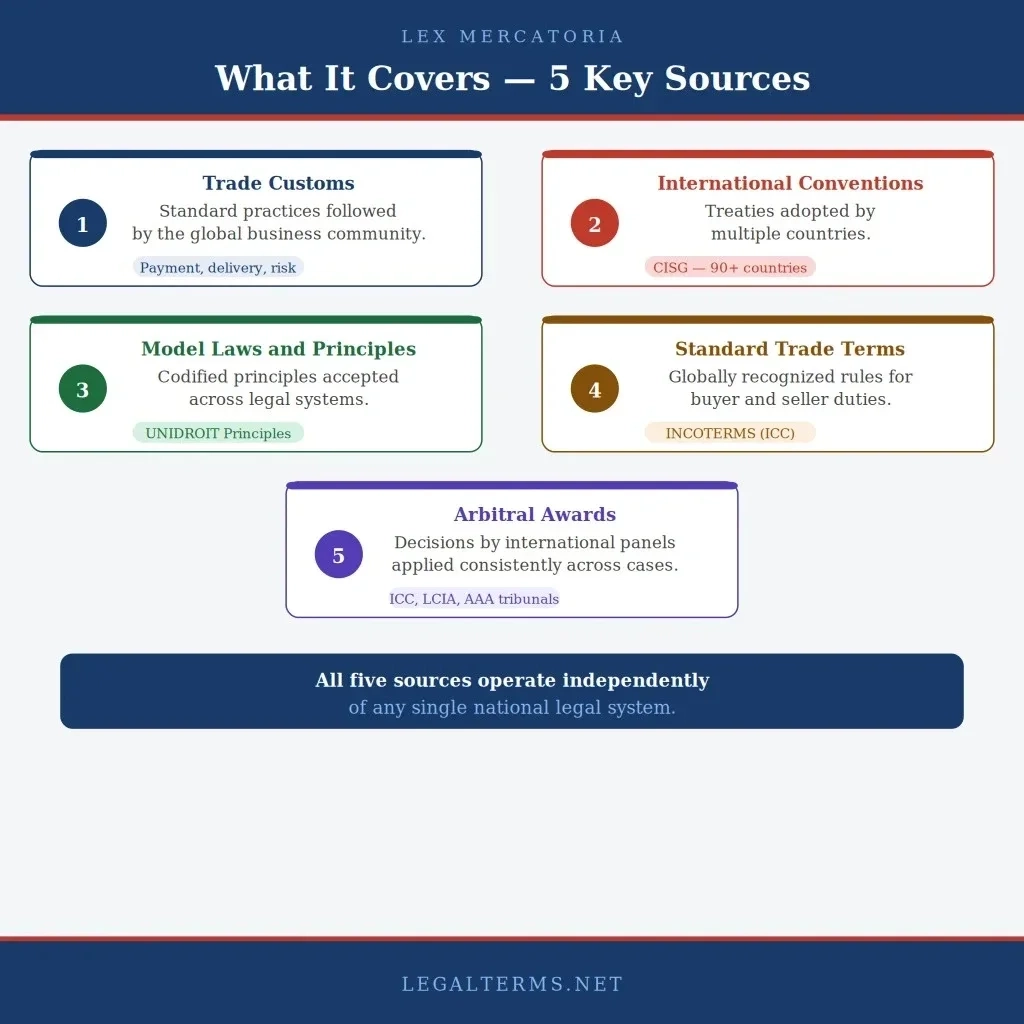
Together, these sources form a body of law that operates independently of any single national legal system. A contract between a Brazilian exporter and a German importer, governed by lex mercatoria, is not subject to Brazilian law or German law. It is subject to internationally recognized commercial principles that both parties can rely on regardless of where they are based.
Who Uses It and Where
Lex mercatoria is used primarily in international commercial arbitration, the process by which businesses resolve cross-border disputes outside of national courts.
When two companies from different countries agree to arbitrate their disputes, they often designate a set of rules to govern the arbitration. If they do not choose a specific national law, or if they explicitly choose “general principles of international trade law,” arbitrators apply lex mercatoria to fill the gaps and resolve the dispute.
Major international arbitration institutions, including the International Chamber of Commerce (ICC), the London Court of International Arbitration (LCIA), and the American Arbitration Association (AAA), all recognize lex mercatoria as a valid body of law for this purpose.
It also appears in contracts directly. Parties sometimes include a clause stating that their agreement is governed by “the general principles of international trade law” or “lex mercatoria.” This gives them a neutral, nationally unbiased framework, particularly useful when neither party wants to submit to the other’s home country’s legal system.
Why It Still Matters Today
Global commerce has grown far more complex than medieval trade fairs. Supply chains span dozens of countries. Digital transactions cross borders in seconds. No single national legal system can adequately govern all of this.
Lex mercatoria fills that gap. It provides a flexible, internationally recognized framework that adapts to the practical needs of modern commerce without requiring parties to navigate the legal system of a foreign country. For businesses operating internationally, understanding that this body of law exists, and that arbitrators can apply it, is essential knowledge when drafting contracts, negotiating dispute resolution clauses, and managing cross-border risk.
Cautions
Lex mercatoria is not universally accepted as a complete legal system. Some national courts do not recognize it as a standalone source of law and require parties to designate a specific national law to govern their contracts. If your contract involves parties or courts in jurisdictions that take this position, relying solely on lex mercatoria creates legal uncertainty.
Always have international contracts reviewed by legal counsel with expertise in international commercial law before signing. The governing law clause in any cross-border agreement is one of the most consequential provisions in the entire contract.
Frequently Asked Questions About Lex Mercatoria
Is lex mercatoria a real law?
Lex mercatoria is a recognized body of international commercial law, but it is not a statute or code enacted by any government. It consists of customs, principles, conventions, and arbitral decisions that the international business community has developed and accepted over time. International arbitration institutions treat it as a valid source of law. Some national courts do not.
How is lex mercatoria different from national contract law?
National contract law is created and enforced by a specific country’s government. Lex mercatoria is created by international commercial practice and applies across borders without reference to any single country’s legal system. It exists precisely to serve situations where no single national law is adequate or acceptable to both parties.
Where does CISG fit into lex mercatoria?
The CISG is one of the most important sources of modern lex mercatoria. It is an international treaty that provides uniform rules for contracts for the international sale of goods. When parties to a cross-border sales contract have not excluded it, the CISG applies automatically in countries that have ratified it. It is widely considered a codification of the most widely accepted principles of international commercial contract law.
References
- Cornell Law School, Legal Information Institute. “Lex Mercatoria.“
- UNIDROIT Principles of International Commercial Contracts (2016)
- United Nations Convention on Contracts for the International Sale of Goods (CISG), 1980
- Black’s Law Dictionary (11th ed.). “Lex Mercatoria.”
- International Chamber of Commerce. INCOTERMS 2020.

Hamit Sahin is the founder and editor of LegalTerms.net. He researches U.S. legal terminology and publicly available legal information using statutes, court rules, judicial opinions, government publications, and established legal reference sources.
His work focuses on organizing complex legal concepts into clear, plain-English explanations for general educational purposes.
Hamit is not an attorney and LegalTerms.net does not provide legal advice.