What Does Due Process Mean in the Constitution?
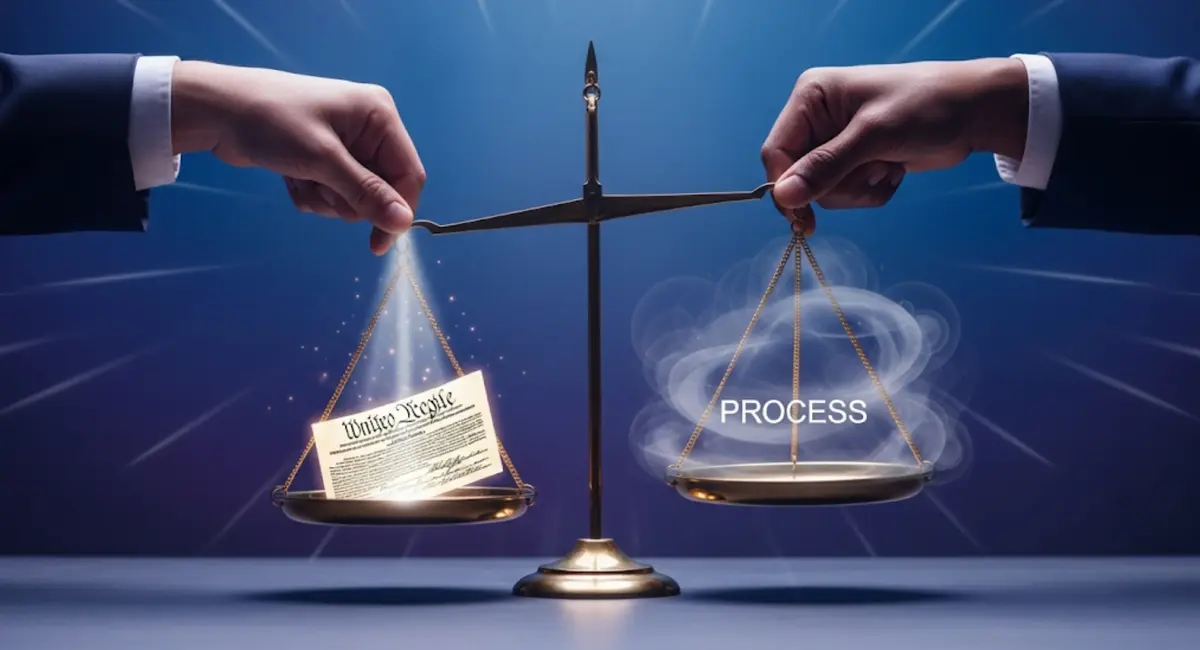
Due process is a cornerstone of American constitutional law that ensures fairness when the government interacts with individuals. Rather than allowing arbitrary actions, it requires proper notice, an opportunity to be heard, and impartial procedures before life, liberty, or property can be taken away.
Plain Definition
Due process means the government must follow fair legal procedures before depriving someone of fundamental rights. In plain English: the state cannot punish, imprison, or take your property without giving you a fair chance to defend yourself.
Real-Life Examples
- Criminal trials: A person accused of a crime must have a lawyer, a jury, and the chance to present evidence.
- Property disputes: Government agencies must hold hearings before seizing land for public projects.
- School discipline: Public schools must give students a chance to explain before suspension.
- Immigration cases: Individuals facing deportation must receive notice and a fair hearing.
Importance of the Term
- Protects rights: Ensures individuals are not deprived of freedom or property unfairly.
- Checks government power: Prevents abuse and arbitrary decisions.
- Guarantees fairness: Creates a balanced system where both sides are heard.
- Applies broadly: Covers both procedural rights (trials, hearings) and substantive rights (privacy, equality).
Comparison (Due Process vs. Equal Protection)
| Factor | Due Process | Equal Protection |
|---|---|---|
| Purpose | Ensures fair procedures and safeguards | Ensures no unfair discrimination |
| Focus | How laws are applied to individuals | How laws treat different groups of people |
| Constitutional Base | Fifth & Fourteenth Amendments | Fourteenth Amendment |
| Key Question | Was the process fair? | Was everyone treated equally? |
What Does Due Process Mean in the Constitution? – FAQ
- Where is due process mentioned?
In the Fifth Amendment (federal level) and the Fourteenth Amendment (state level). - Is due process only about criminal cases?
No. It applies in civil, property, education, and administrative cases too. - What is the difference between procedural and substantive due process?
Procedural ensures fair steps (hearings, trials), while substantive protects core rights (like privacy). - Can due process rights be waived?
Yes, but only knowingly and voluntarily, such as accepting a plea bargain. - Why is due process important today?
It prevents unfair treatment and protects individual freedom in a wide range of legal issues.
Closing
Due process is one of the most fundamental guarantees in the U.S. Constitution. By demanding fairness, transparency, and balance, it acts as the ultimate safeguard against government overreach and ensures that justice applies equally to everyone.

Hamit Sahin is the founder and editor of LegalTerms.net. He researches U.S. legal terminology and publicly available legal information using statutes, court rules, judicial opinions, government publications, and established legal reference sources.
His work focuses on organizing complex legal concepts into clear, plain-English explanations for general educational purposes.
Hamit is not an attorney and LegalTerms.net does not provide legal advice.