What Is the Clean Hands Doctrine? A Plain-English Guide
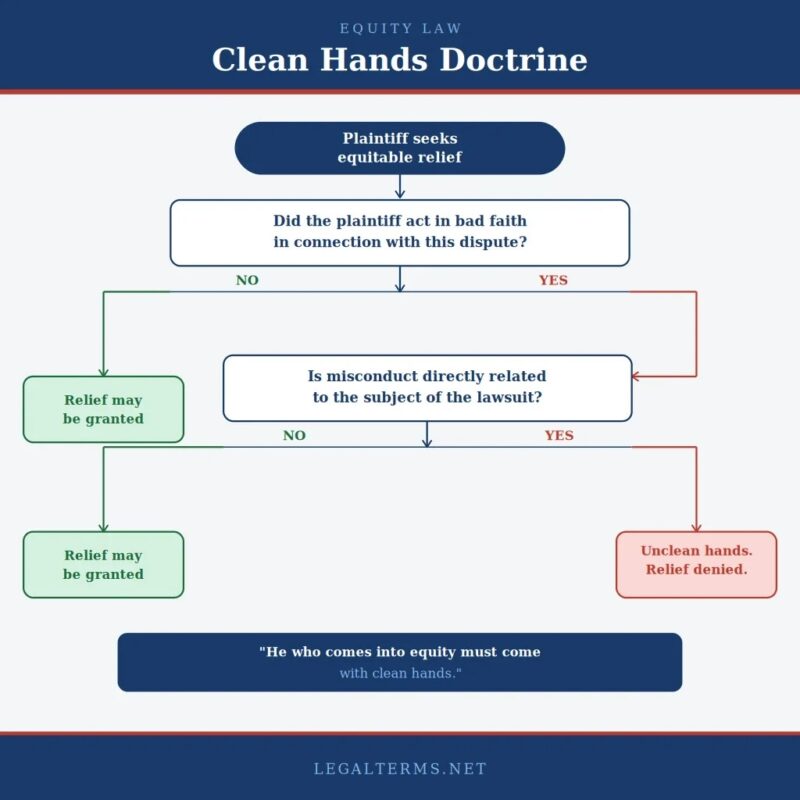
Picture this: a landlord rents out an apartment that violates local housing codes. When the tenant stops paying rent, the landlord sues to recover the unpaid amount. The tenant’s lawyer raises a simple argument: you cannot come to court asking for fairness when your own conduct in this very dispute has been anything but fair.
That argument has a name. It is called the clean hands doctrine, and it is one of the most practical and intuitive principles in all of American law. You do not have to be a lawyer to understand it. If you want a court to help you, you need to have acted decently in the matter you are asking about. If you have not, the court can turn you away entirely.
This guide explains what the clean hands doctrine is, where it comes from, how courts apply it, and what it means if you are ever on either side of a lawsuit that involves it.
What Is the Clean Hands Doctrine?
The clean hands doctrine is a legal principle that prevents a party from obtaining relief from a court if that party has acted unfairly, in bad faith, or dishonestly in connection with the very dispute before the court.
It is most commonly expressed through two Latin-rooted maxims that courts have repeated for centuries:
- “He who comes into equity must come with clean hands.”
- “Those seeking equity must do equity.”
In plain terms: if you want a judge to step in and give you something, you must be able to show that your own conduct in this matter has been honest and fair. If you have acted badly in connection with the same dispute, the court has the power to refuse to help you, regardless of whether the other side has also done something wrong.
The doctrine applies specifically in cases where a party is seeking what lawyers call an equitable remedy. An equitable remedy is any court-ordered relief other than a simple money payment. Common examples include:
- An injunction (a court order telling someone to stop doing something)
- Specific performance (a court order requiring someone to fulfill a contract)
- A constructive trust (a court-imposed arrangement that prevents unjust enrichment)
If you are only asking for money damages, the clean hands doctrine does not apply in most jurisdictions. It is a tool of equity, not of ordinary legal claims.
The party accused of having unclean hands is not automatically disqualified. The judge has discretion. If the misconduct is minor, if the public interest would be harmed by denying relief, or if applying the doctrine would produce a result more unjust than the original wrong, the court can choose not to invoke it.
Where Does the Doctrine Come From?
To understand the clean hands doctrine, you need a brief detour into legal history, because this principle did not come from a statute or a constitution. It grew out of a completely separate court system that no longer exists in its original form.
Centuries ago, English law was administered by two entirely different systems operating side by side. The common law courts handled most disputes and awarded money damages, but they were rigid. If your case did not fit neatly into a pre-established category of legal claim, you had no remedy, no matter how unfair the situation was.
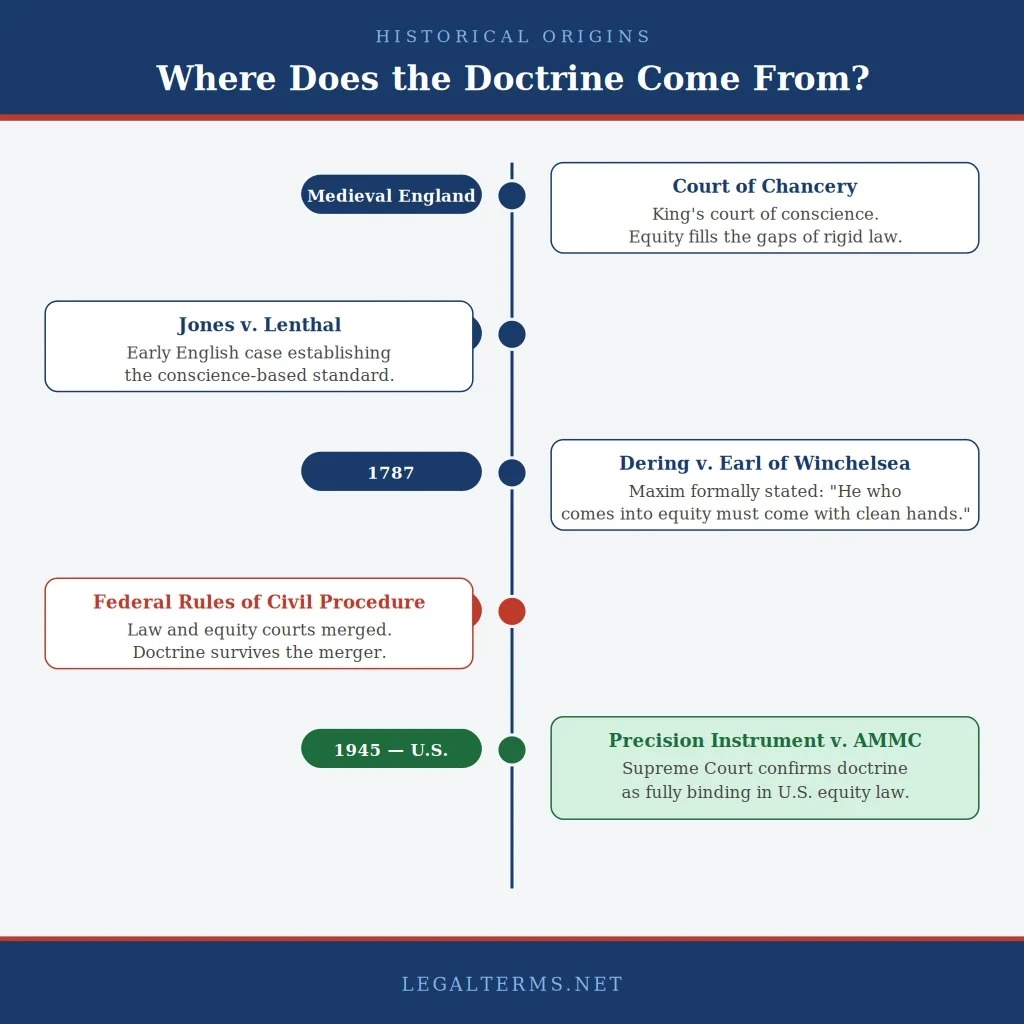
To address this problem, the King of England created a separate court called the Court of Chancery, presided over by an official known as the Lord Chancellor. Unlike the common law courts, the Court of Chancery was not bound by fixed rules. It operated on principles of conscience, fairness, and good faith. The body of law it developed became known as equity.
The clean hands doctrine emerged directly from this tradition. The earliest recorded formulations appear in English cases from the late 1600s and 1700s, including Jones v. Lenthal (1669) and Dering v. Earl of Winchelsea (1787). The core idea was simple: a court of conscience would not lend its authority to someone who had themselves acted unconscionably in the same matter.
England and the United States eventually merged their courts of law and equity into a single system. In the U.S., this merger happened at the federal level with the adoption of the Federal Rules of Civil Procedure in 1938. But the principles of equity, including the clean hands doctrine, survived the merger and remain fully applicable in American courts today.
The U.S. Supreme Court confirmed the doctrine’s continued vitality in Precision Instrument Mfg. Co. v. Automotive Maintenance Machinery Co., 324 U.S. 806 (1945), describing it as far more than a platitude and as a self-imposed rule that closes the doors of equity to anyone tainted with bad faith in the matter at issue.
The Three Elements Courts Look For
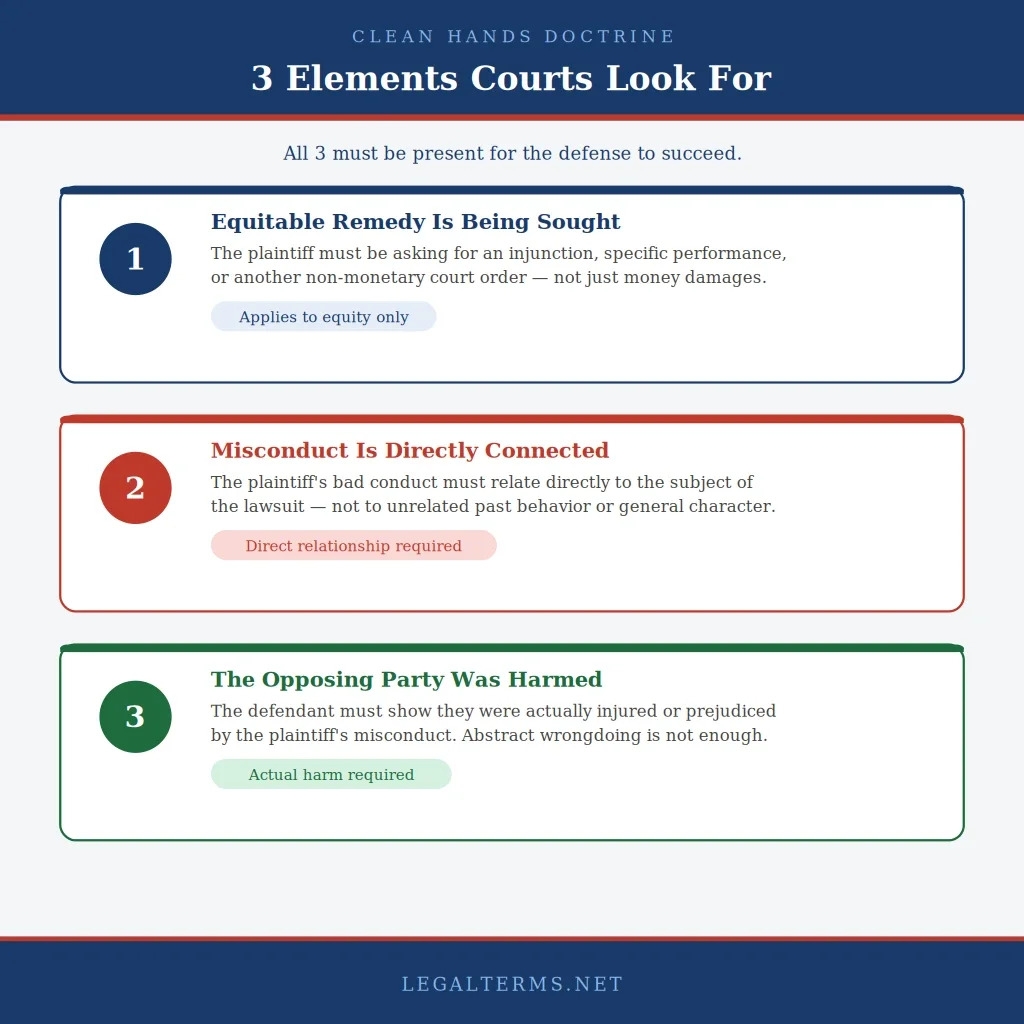
For a court to apply the clean hands doctrine and deny relief to a plaintiff, the party raising the defense typically needs to establish three things. If any one of the three is missing, the doctrine does not apply.
1. The plaintiff is seeking an equitable remedy.
The clean hands doctrine is a tool of equity. It applies when the plaintiff wants an injunction, specific performance, a constructive trust, or some other non-monetary court order. In most jurisdictions, the doctrine does not bar a claim for money damages alone. This distinction matters in practice. A party denied equitable relief because of unclean hands may still be able to pursue a damages claim in the same courthouse.
2. The plaintiff’s misconduct is directly connected to the dispute.
This is the most important limitation on the doctrine. The plaintiff’s bad conduct must relate directly to the subject matter of the lawsuit. General dishonesty, past misconduct in unrelated matters, or a bad reputation in business does not qualify. As courts have put it: if someone is a liar or a bad actor in general but not in this particular transaction, equity is still available to that person.
The misconduct does not have to be illegal. Dishonest, unethical, or bad-faith conduct that falls short of breaking the law is enough, as long as it directly connects to the dispute at hand.
3. The opposing party suffered harm from that misconduct.
The clean hands doctrine is not designed to punish plaintiffs in the abstract. It protects defendants and preserves the integrity of the court. For that reason, most jurisdictions require that the defendant raising the defense show they were actually harmed or prejudiced by the plaintiff’s conduct. If the plaintiff behaved badly but the defendant suffered no injury from it, many courts will decline to apply the doctrine.
How It Works as a Defense
In practice, the clean hands doctrine is almost always raised by the defendant as an affirmative defense. An affirmative defense (a defense where the defendant admits the basic facts of the claim but argues there is a legal reason the plaintiff should not win) is exactly what this is. The defendant is not saying the plaintiff’s story is false. The defendant is saying: even if everything the plaintiff says is true, the plaintiff’s own conduct disqualifies them from receiving the court’s help.
The burden of proof rests entirely on the defendant. To successfully invoke the doctrine, the defendant must show:
- The plaintiff engaged in misconduct or bad faith
- That misconduct is directly related to the subject matter of the lawsuit
- The defendant was harmed by that misconduct
Because the burden sits with the defendant, simply alleging that the plaintiff “acted badly” is not enough. The defendant must produce actual evidence. This typically happens through discovery, where the defendant requests documents, emails, contracts, and testimony that reveal the plaintiff’s conduct in connection with the disputed transaction.
The defense is decided by the judge, not the jury. Because unclean hands is an equitable defense, it falls squarely within the judge’s authority. Even if a jury is hearing the underlying damages claims, the judge rules separately on equitable defenses like this one.
A plaintiff can also use the doctrine offensively, though this is less common. If the defendant is trying to raise an equitable defense of their own, the plaintiff can argue that the defendant has unclean hands and is therefore barred from asserting that defense. This offensive use is a shield against a shield.
One important rule: a defendant who raises the unclean hands defense cannot themselves have clean hands. A court will not allow a party that instigated or participated in the misconduct to then turn around and use that same misconduct to deny the other party relief. Both parties having unclean hands creates a situation where neither party may get what they want, a result courts sometimes describe using the Latin phrase in pari delicto, meaning “in equal fault.”
Where the Doctrine Applies
The clean hands doctrine shows up across a wide range of civil disputes. These are the areas where it appears most frequently.
Contract disputes. When one party seeks specific performance of a contract, meaning they want a court to force the other side to perform their obligations rather than just pay damages, the other side can raise unclean hands if the plaintiff misrepresented facts during negotiations, concealed material information, or otherwise acted in bad faith in connection with the contract itself.
Intellectual property and trade secrets. If a company sues a former employee to obtain an injunction preventing use of confidential information, the employee can argue unclean hands if the company itself violated the employment agreement, withheld compensation, or engaged in its own improper conduct related to the information at issue.
Real estate. A buyer seeking specific performance to force the sale of a property can be denied relief if they misrepresented their financing, concealed material facts about their ability to close, or engaged in fraudulent conduct during the transaction.
Employment and non-compete agreements. An employer trying to enforce a non-compete clause through an injunction faces an unclean hands defense if the employer itself breached the employment contract, failed to pay agreed compensation, or violated the terms under which the non-compete was created.
Family law. In divorce proceedings and custody disputes, courts regularly encounter unclean hands arguments when one party seeks equitable relief related to property division, spousal support, or parenting arrangements, and the other party can show that the requesting party acted deceptively or in bad faith in connection with the same matters.
Unjust enrichment claims. Unjust enrichment is itself an equitable concept, meaning a court can deny recovery to a party who claims they were unfairly deprived of a benefit if that party’s own conduct in the transaction was improper.
Where the Doctrine Does NOT Apply
Understanding where the clean hands doctrine does not apply is just as important as knowing where it does.
Purely legal claims for money damages. In the vast majority of U.S. jurisdictions, unclean hands is an equitable defense that applies only against equitable claims. If the plaintiff is simply suing for money, the doctrine does not bar the claim. The plaintiff’s misconduct may be relevant to other defenses, but the clean hands doctrine itself is not available.
Conduct unrelated to the dispute. A defendant cannot invoke unclean hands by pointing to the plaintiff’s dishonesty in some other transaction, their general bad character, or past conduct with third parties. The misconduct must connect directly to the subject matter of the lawsuit. Courts are consistent on this point: general immorality or a history of bad behavior in other contexts is not enough.
Minor or technical misconduct. Not every imperfection in a plaintiff’s conduct triggers the doctrine. Courts apply it when the misconduct is substantial, unconscionable, or directly prejudicial to the defendant. A minor procedural error, a trivial inconsistency, or a technical breach of a side obligation typically does not rise to the level of unclean hands.
When public interest overrides it. Courts retain discretion to refuse application of the doctrine when doing so would harm the public interest. If denying relief to the plaintiff would allow a more serious injustice to stand, or if the case involves enforcement of laws designed to protect the public, courts can and do set the doctrine aside. The U.S. Court of Appeals for the Seventh Circuit, for example, declined to apply unclean hands in an antitrust case on the grounds that doing so would undermine the purpose of competition law.
A Real-World Example: Precision Instrument Mfg. Co. v. Automotive Maintenance Machinery Co. (1945)
The most important U.S. Supreme Court statement on the clean hands doctrine came in a patent case that most people have never heard of, but that every lawyer studying equity learns.
Precision Instrument Mfg. Co. v. Automotive Maintenance Machinery Co., 324 U.S. 806 (1945), involved a dispute over patent rights. The plaintiff sought to enforce a patent and a related agreement. The defendant raised unclean hands, arguing that the plaintiff had knowingly participated in conduct that involved perjury during the patent application process, specifically allowing false statements to be submitted to the patent office without correction.
The Supreme Court agreed with the defendant. Justice Murphy, writing for the Court, held that a party who has participated in any way in conduct involving perjury or fraud in connection with a patent cannot come to a court of equity to enforce rights derived from that patent. The plaintiff’s misconduct was directly connected to the very patent it was trying to enforce. The clean hands doctrine barred relief entirely.
The Court’s reasoning went beyond the specific facts of the case. It articulated a broader principle: courts of equity exist to dispense justice, not to serve as instruments for parties who have themselves acted unjustly in the matter before the court. This language has been quoted in American courts ever since.
The case also illustrates a key practical point. The plaintiff’s misconduct did not have to be a separate, independent wrong that harmed a third party. It was enough that the plaintiff had acted in bad faith in connection with the very rights it was trying to enforce. The direct connection between the misconduct and the claim is what triggered the doctrine.
Why It Matters to Ordinary People
The clean hands doctrine is not just an abstract principle that lawyers argue about in commercial litigation. It has direct, practical implications for anyone involved in a civil dispute.
If you are a plaintiff seeking equitable relief, your own conduct is on trial too. The moment you ask a court for an injunction, specific performance, or any other equitable remedy, you open the door to scrutiny of your own behavior in connection with the dispute. How you negotiated the contract, what you disclosed to the other party, whether you acted in good faith throughout the transaction — all of this becomes relevant. A plaintiff who assumes the court will only look at what the defendant did wrong is making a serious mistake.
If you are a defendant, the doctrine can be a powerful tool. If the plaintiff seeking an injunction against you acted dishonestly or in bad faith in connection with the very claim they are bringing, you have a viable defense. This is true even if the plaintiff is otherwise legally in the right. A court of equity is a court of conscience, and it will not enforce the rights of a party who has forfeited its moral standing in the dispute.
It creates a strong incentive for honest dealing. The clean hands doctrine is not just a litigation tool. It shapes behavior before any lawsuit is filed. Parties who know that their own misconduct can bar their access to equitable relief have a concrete reason to act in good faith throughout a transaction. In that sense, the doctrine does exactly what it was designed to do: it encourages the kind of honest dealing that makes courts of equity worth having.
It applies in disputes that affect everyday life. Landlord-tenant disputes, business partnerships, non-compete agreements, real estate transactions, divorce proceedings — these are not abstract commercial matters. They are the kinds of disputes ordinary people find themselves in. In all of these contexts, how you conduct yourself in connection with the dispute directly affects what remedies are available to you.
Cautions
The clean hands doctrine is a powerful defense, but it comes with real limits that both plaintiffs and defendants need to understand before relying on it.
The doctrine does not excuse the defendant’s own wrongdoing. Raising unclean hands does not mean the defendant walks away without consequences. It means the plaintiff loses access to equitable relief. The defendant may still face separate liability for their own conduct, and the plaintiff may still recover money damages through a legal claim.
The misconduct must be connected to the specific dispute. Defendants who try to use unclean hands as a general attack on the plaintiff’s character or business practices will not succeed. Courts require a direct relationship between the plaintiff’s misconduct and the subject matter of the lawsuit. If the connection is not clear, the defense fails.
The doctrine is entirely discretionary. Judges are not required to apply it even when unclean hands are clearly established. If invoking the doctrine would produce an outcome more unjust than the plaintiff’s original misconduct, the court can decline to use it. This means the outcome of an unclean hands defense can be difficult to predict, and relying on it as your primary strategy in litigation is risky without strong supporting evidence.
Jurisdiction matters. How courts apply the clean hands doctrine varies significantly from state to state. Some states apply it broadly, including in certain legal claims for damages. Others restrict it strictly to equitable claims. If your dispute involves parties or conduct in multiple states, the applicable law can affect whether the defense is even available.
Consult a lawyer before raising or responding to an unclean hands defense. The evidentiary requirements, procedural timing, and jurisdictional rules that govern this doctrine are technical enough that navigating them without legal counsel creates real risk of losing a defense that could otherwise have been decisive.
Frequently Asked Questions
What does “clean hands” mean in law?
In law, having clean hands means that a party seeking relief from a court has acted honestly, in good faith, and without misconduct in connection with the dispute they are bringing. A party with “unclean hands” has engaged in dishonest, unfair, or bad-faith conduct directly related to the same matter. Courts of equity require clean hands as a condition of receiving equitable relief.
What is the difference between clean hands and unclean hands?
Clean hands and unclean hands are two sides of the same doctrine. “Clean hands” describes the standard a party must meet to receive equitable relief: honest, fair conduct in connection with the dispute. “Unclean hands” is the defense raised when a party fails that standard. A defendant raises unclean hands to argue that the plaintiff’s own misconduct disqualifies them from receiving the court’s help.
Does the clean hands doctrine apply to money damages?
In most U.S. jurisdictions, no. The clean hands doctrine applies primarily to equitable claims, where the plaintiff is seeking a court order such as an injunction or specific performance rather than a money payment. If a plaintiff is only asking for damages, the doctrine typically does not bar the claim. An important exception exists in patent litigation, where federal statute makes unenforceability, including unclean hands, a defense even in damages actions.
Can a defendant with unclean hands still raise the defense?
Courts approach this carefully. A defendant who participated in or instigated the plaintiff’s misconduct cannot use that same misconduct to invoke the clean hands doctrine. However, a defendant whose own conduct is unrelated to the plaintiff’s misconduct can still raise the defense. When both parties have acted badly in connection with the same dispute, courts may deny relief to both, a situation governed by the related doctrine of in pari delicto.
How is the clean hands doctrine different from the estoppel doctrine?
Both doctrines are rooted in equity and both can bar a party from asserting certain rights. The key difference is focus. Estoppel prevents a party from taking a position that contradicts a previous representation or conduct that another party relied on to their detriment. The clean hands doctrine is broader and more general: it bars a party from receiving any equitable relief if their own conduct in the dispute has been dishonest or unfair, regardless of whether the other party relied on that conduct. Estoppel is about consistency. Clean hands is about moral standing before the court.
Does the clean hands doctrine apply outside the United States?
Yes, with variations. The doctrine is well established across common law jurisdictions including England, Canada, and Australia, all of which inherited it from the English Court of Chancery. Civil law systems in continental Europe have a related concept called abuse of rights, which prevents parties from exercising legal rights in bad faith. International law has been more reluctant to adopt the doctrine in full, though it has not rejected it outright either.
References
- Cornell Law School, Legal Information Institute. “Clean-Hands Doctrine.”
- Precision Instrument Mfg. Co. v. Automotive Maintenance Machinery Co., 324 U.S. 806 (1945)
- Keystone Driller Co. v. General Excavator Co., 290 U.S. 240 (1933)
- Black’s Law Dictionary (11th ed.). “Clean Hands Doctrine”; “Unclean Hands”; “Equity.”
- American Law Institute. Restatement (Third) of Restitution and Unjust Enrichment (2011)
- Merriam-Webster Legal Dictionary. “Unclean Hands.”

Hamit Sahin is the founder and editor of LegalTerms.net. He researches U.S. legal terminology and publicly available legal information using statutes, court rules, judicial opinions, government publications, and established legal reference sources.
His work focuses on organizing complex legal concepts into clear, plain-English explanations for general educational purposes.
Hamit is not an attorney and LegalTerms.net does not provide legal advice.