Can You Sue a Doctor for Misdiagnosis? The Legal Standard Explained
Can You Sue a Doctor for Misdiagnosis?
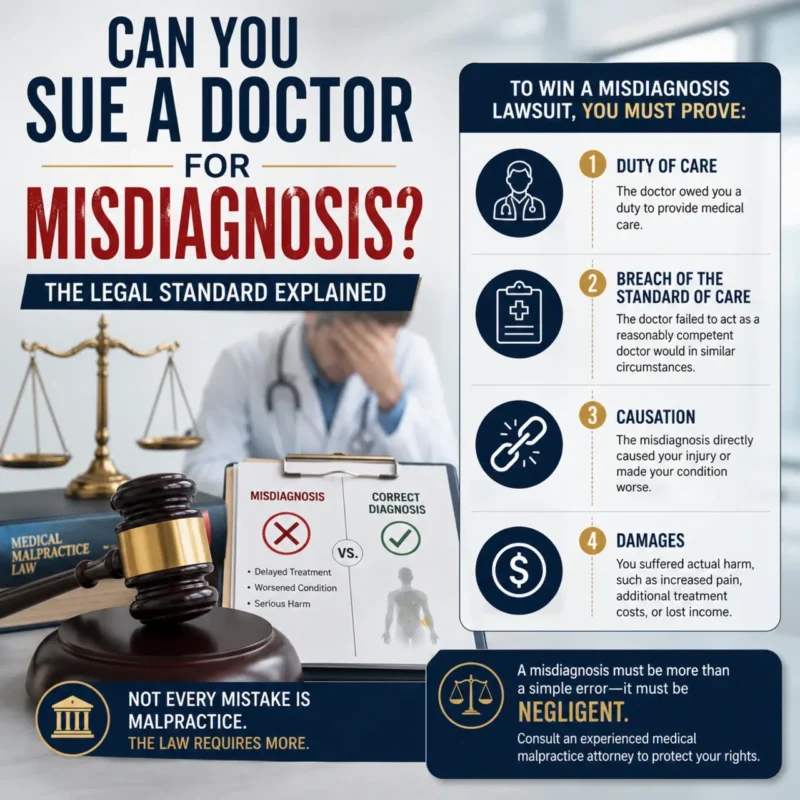
Getting the wrong diagnosis can change your life. A condition that should have been caught early gets worse, treatment gets delayed, and sometimes the damage becomes permanent. The natural next question is whether the law gives you a way to hold the doctor accountable. The short answer is yes, you can sue a doctor for misdiagnosis, but only if your situation meets four specific legal requirements that courts apply across the United States.
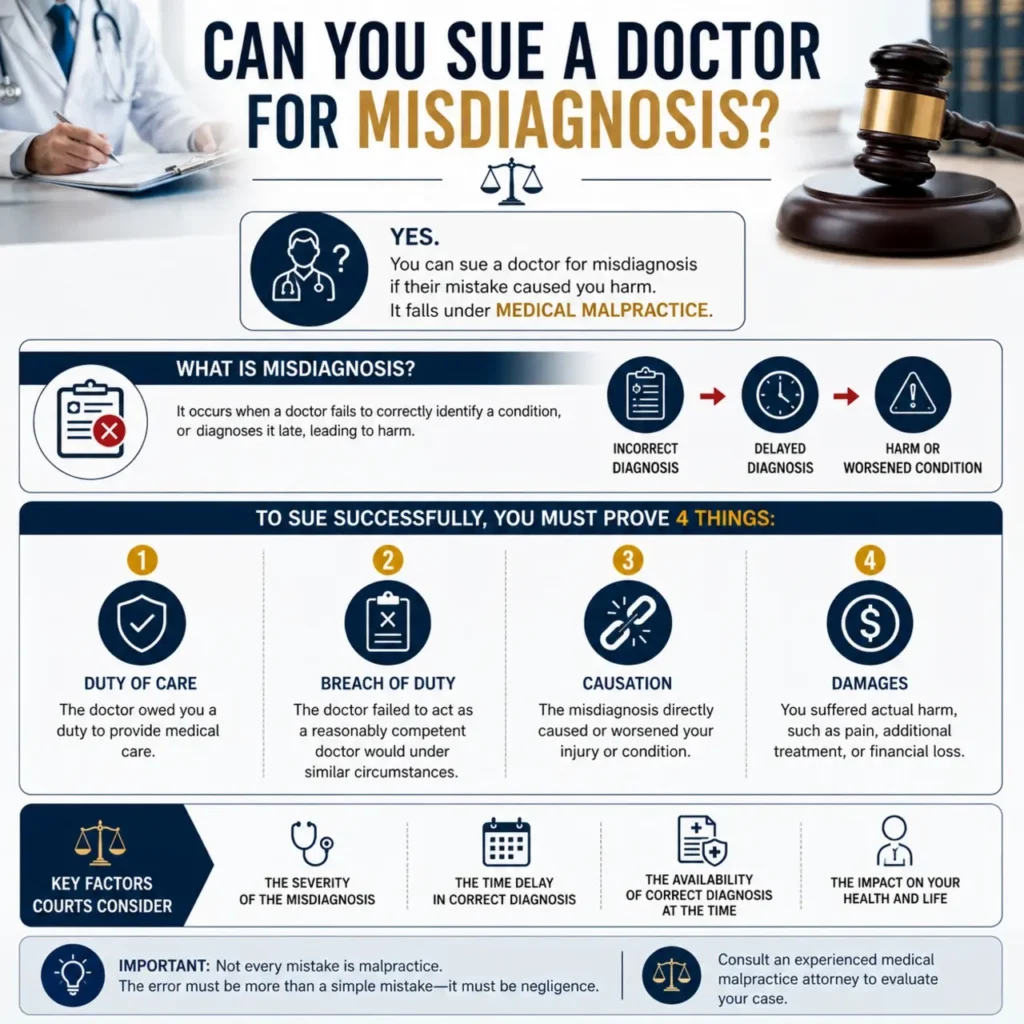
A misdiagnosis on its own is not a lawsuit. Medicine involves uncertainty, and the law has never expected doctors to be right every time. What the law expects is that a doctor will act the way a reasonably careful doctor in the same field would have acted under the same circumstances. When a misdiagnosis happens because the doctor skipped steps, ignored warning signs, or failed to order tests that any competent doctor would have ordered, that is when a lawsuit becomes possible.
The legal name for this kind of case is a medical malpractice claim. Misdiagnosis is one of the most common reasons these lawsuits get filed. Cancer, heart attacks, and strokes are the conditions most often missed, and the consequences of missing them are often severe. But filing a claim and winning one are not the same thing, and the rest of this article walks you through what the law actually requires.
What Counts as Misdiagnosis in the Eyes of the Law
Not every diagnostic error counts as misdiagnosis in the legal sense. The law breaks diagnostic errors into three categories, and the differences matter when you are deciding whether you have a case.
The first category is wrong diagnosis. This is when a doctor tells you that you have one condition when you actually have another. A patient told they have acid reflux when they are actually having a heart attack is the classic example. The second category is missed diagnosis. This happens when a doctor sees you, reviews your symptoms, and sends you home without identifying any condition at all, even though a real condition was present. The third category is delayed diagnosis. The doctor eventually gets it right, but only after a delay that allowed your condition to progress to a worse stage. Delayed cancer diagnoses are among the most common examples in this category.
A bad outcome alone is like a coin flip landing the wrong way. The law does not punish doctors for outcomes, it punishes them for skipping the steps a careful doctor would have taken. A patient can have a terrible result without the doctor having done anything legally wrong, and a doctor can be legally wrong even when the patient eventually recovers. The legal question is always about the doctor’s conduct, not the patient’s luck.
What this means: if you think you were misdiagnosed, the first step is figuring out which of these three categories your situation falls into. That detail shapes everything that follows, including what evidence will matter and how the timeline of harm gets measured. A licensed attorney who handles medical malpractice cases can tell you which category fits your facts and whether the harm you suffered is the kind courts recognize.
The Four Legal Elements You Have to Prove
A misdiagnosis lawsuit succeeds only when four legal elements are proven together. Courts across the United States apply this same four-part test, and the law was summarized in this form by the National Center for Biotechnology Information in its overview of medical malpractice in the United States. If even one element is missing, the case does not move forward.
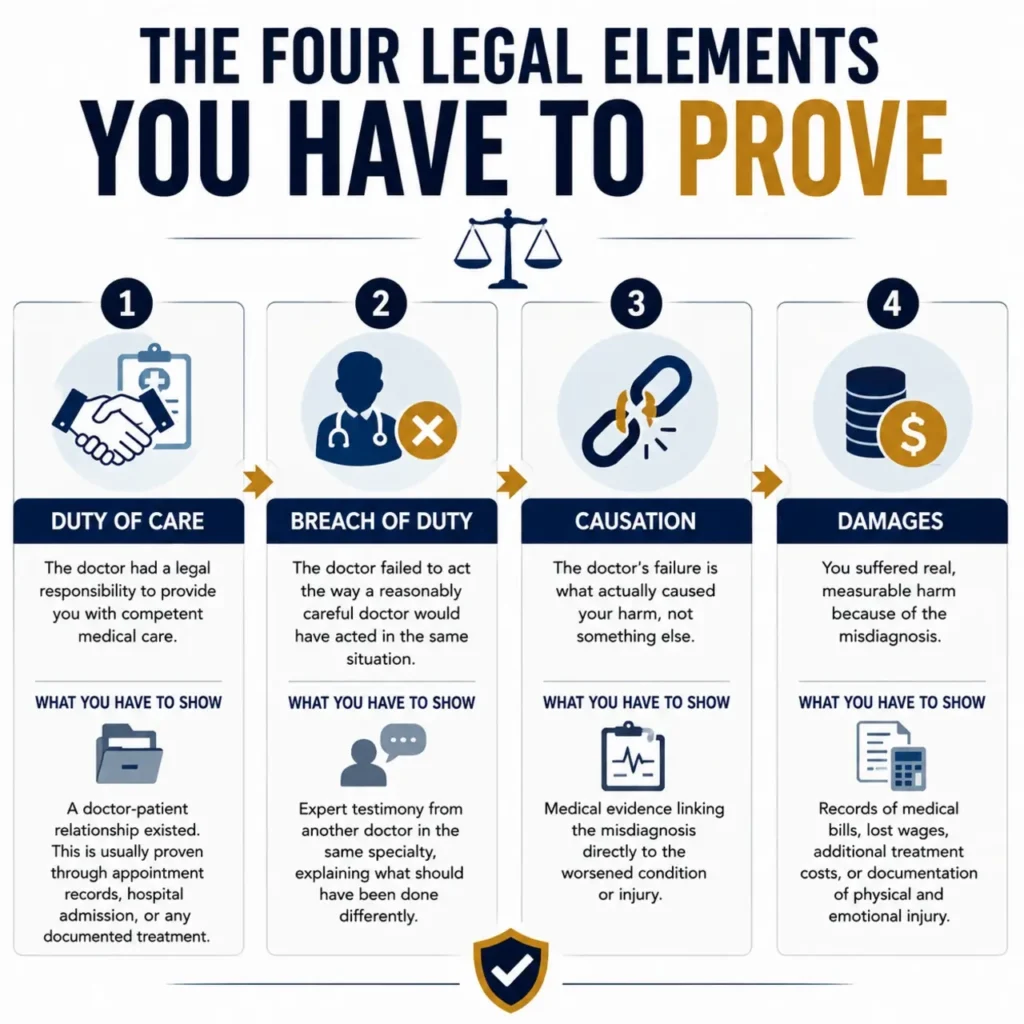
Think of the four elements as four legs of a table. Knock any one out, and the whole case falls over. The four elements are duty of care, breach of duty, causation, and damages. Each one has a specific legal meaning, and each one has to be supported with real evidence, not just personal belief that something went wrong.
| Element | What It Means | What You Have to Show |
|---|---|---|
| Duty of Care | The doctor had a legal responsibility to provide you with competent medical care. | A doctor-patient relationship existed. This is usually proven through appointment records, hospital admission, or any documented treatment. |
| Breach of Duty | The doctor failed to act the way a reasonably careful doctor would have acted in the same situation. | Expert testimony from another doctor in the same specialty, explaining what should have been done differently. |
| Causation | The doctor’s failure is what actually caused your harm, not something else. | Medical evidence linking the misdiagnosis directly to the worsened condition or injury. |
| Damages | You suffered real, measurable harm because of the misdiagnosis. | Records of medical bills, lost wages, additional treatment costs, or documentation of physical and emotional injury. |
The hardest element to prove is usually causation. A patient may have had a serious underlying illness, and the doctor’s defense team will often argue that the harm would have happened anyway, even with a correct diagnosis. Beating that argument requires medical experts who can explain, in clear terms, how the outcome would have been different if the diagnosis had been made on time.
What this means for you: if you are gathering information about a possible case, focus on documents that can support each of these four elements. Appointment records, test results, second-opinion reports, and bills are the starting point. A licensed medical malpractice attorney can review what you have and tell you whether the four elements are realistically provable in your situation.
The Standard of Care: How Courts Decide What a “Reasonable Doctor” Would Do
The second element, breach of duty, depends on a concept called the standard of care. This is the benchmark courts use to decide whether a doctor’s conduct was acceptable or not. The standard of care is not what a perfect doctor would have done, and it is not what the very best specialist in the country would have done. It is what a reasonably competent doctor in the same field, facing the same circumstances, would have done.
Standard of care is like the recipe most chefs would follow. If a chef skips a step that every other chef in town includes, and someone gets sick, that is not just bad cooking, that is a breach of standard practice. In medicine, those steps include ordering certain tests, asking certain questions, considering certain conditions, and referring patients to specialists when warning signs appear.
Proving what the standard of care actually was in your situation almost always requires an expert witness. This is another doctor, usually in the same specialty as the one being sued, who testifies about what should have happened. Courts rely heavily on this testimony because judges and juries are not doctors and cannot decide on their own what a competent physician would have done. Most states require this expert testimony before a malpractice case can even reach trial.
One important nuance is that “what doctors usually do” is not always the same as “what the law requires.” Courts sometimes find a doctor negligent even when the doctor followed the customary practice in their field. This happens when the customary practice itself is found to be unreasonable, and the next section walks through the landmark case that established this principle.
A Real Case: Helling v. Carey (1974)
One of the most influential misdiagnosis cases in American legal history is Helling v. Carey, decided by the Washington Supreme Court in 1974. The facts are straightforward, and the ruling changed how courts think about the standard of care.
Barbara Helling was a 32-year-old woman who had been seeing her ophthalmologists, Dr. Carey and Dr. Laughlin, for years. She visited them with complaints about her vision, and they treated her for various eye conditions over time. What they did not do was perform a simple test for glaucoma, called a tonometry test. At the time, the customary practice in ophthalmology was to skip this test for patients under 40, because glaucoma was considered rare in younger adults. By the time Helling was finally diagnosed, the damage to her vision was permanent.
Helling sued. The doctors defended themselves by pointing out that they had followed the standard practice in their profession. Skipping the glaucoma test for a patient her age was what every other ophthalmologist would have done. Under traditional legal reasoning, this should have ended the case in their favor, because following customary practice usually protects doctors from liability.
The Washington Supreme Court ruled in Helling’s favor anyway. The court held that even though the doctors had followed the customary practice, the practice itself was unreasonable. The glaucoma test was simple, inexpensive, and quick. The harm from missing the diagnosis was severe and permanent. When a test is cheap and the stakes are high, the court said, doctors are required to perform it even if their peers usually do not.
The court basically told doctors that following the crowd is not always a defense. If a simple, cheap test could prevent serious harm, skipping it because everyone else does is not good enough. The ruling has been cited in misdiagnosis cases for decades and remains one of the strongest statements that “what doctors usually do” is not always the same as “what the law requires.”
What this means: even when a doctor argues that they followed standard practice, that argument is not bulletproof. If a reasonable, low-cost test could have caught your condition and prevented serious harm, the Helling principle may give your case room to move forward. Whether your specific facts fit this framework is something a licensed medical malpractice attorney would need to evaluate.
Conditions Most Often Missed: Where Misdiagnosis Lawsuits Come From

Some medical conditions get misdiagnosed far more often than others. Research from Johns Hopkins Medicine has estimated that between 40,000 and 80,000 patients in the United States die each year from misdiagnosed conditions, and another 80,000 to 160,000 suffer non-fatal harm. The study found that a small group of conditions accounts for most of these errors.
The three categories that produce the most misdiagnosis lawsuits are:
- Vascular events, including heart attacks, strokes, and pulmonary embolisms. These conditions can present with symptoms that look like indigestion, anxiety, or minor pain, and missing them often leads to severe harm within hours.
- Cancers, especially breast, lung, colon, and skin cancers. Delayed cancer diagnoses are particularly damaging because cancer outcomes depend so heavily on the stage at which treatment begins.
- Infections, including sepsis, meningitis, and severe respiratory infections. These can escalate quickly, and a delay of even a day can mean the difference between recovery and permanent injury.
These three groups are sometimes called the “big three” in medical diagnostic error research. The reason they show up so often in lawsuits is that the symptoms are common, the conditions are serious, and the cost of being wrong is high. A patient sent home from an emergency room with what looked like a panic attack but was actually a heart attack is a textbook example.
The legal significance is that when one of these conditions gets missed, courts are often willing to take a close look at whether the doctor followed the standard of care. The harm is severe, the diagnostic pathways are well known, and expert witnesses can usually point to specific steps that should have been taken. This does not guarantee a successful lawsuit, but it does mean these cases tend to be taken seriously when the four legal elements are present.
The Statute of Limitations: How Long You Have to File
Every state has a deadline for filing a medical malpractice lawsuit. This deadline is called the statute of limitations, and once it passes, the case is generally dead no matter how strong the evidence is. The exact length varies, but in most states the window is between one and three years from the date of the injury or the date the harm was discovered.
A statute of limitations is like the expiration date on a legal claim. Once it passes, the case has spoiled, even if everything you said was true. The reason these deadlines exist is that courts want disputes to be resolved while evidence is still fresh, while witnesses still remember what happened, and while medical records are still complete.
Misdiagnosis cases often involve a special rule called the discovery rule. The harm from a misdiagnosis is not always obvious right away. A cancer that was missed in 2022 might not show its consequences until 2024. Under the discovery rule, the clock often does not start running until the patient knew, or reasonably should have known, that they were harmed by a misdiagnosis. The exact way this rule is applied varies a great deal from state to state, and some states have an outer limit, called a statute of repose, that caps the total time regardless of when the harm was discovered.
There are also special rules for minors. In many states, if the patient was a child at the time of the misdiagnosis, the clock does not start until the child reaches the age of majority, which is usually 18.
What this means for you: deadlines are unforgiving in this area of law. If you suspect you were harmed by a misdiagnosis, the worst thing you can do is wait to see if you feel better about it. Speaking with a licensed medical malpractice attorney early is important, even if you are not sure you want to file a lawsuit. The attorney can tell you exactly how much time you have under your state’s rules and whether the discovery rule applies to your facts.
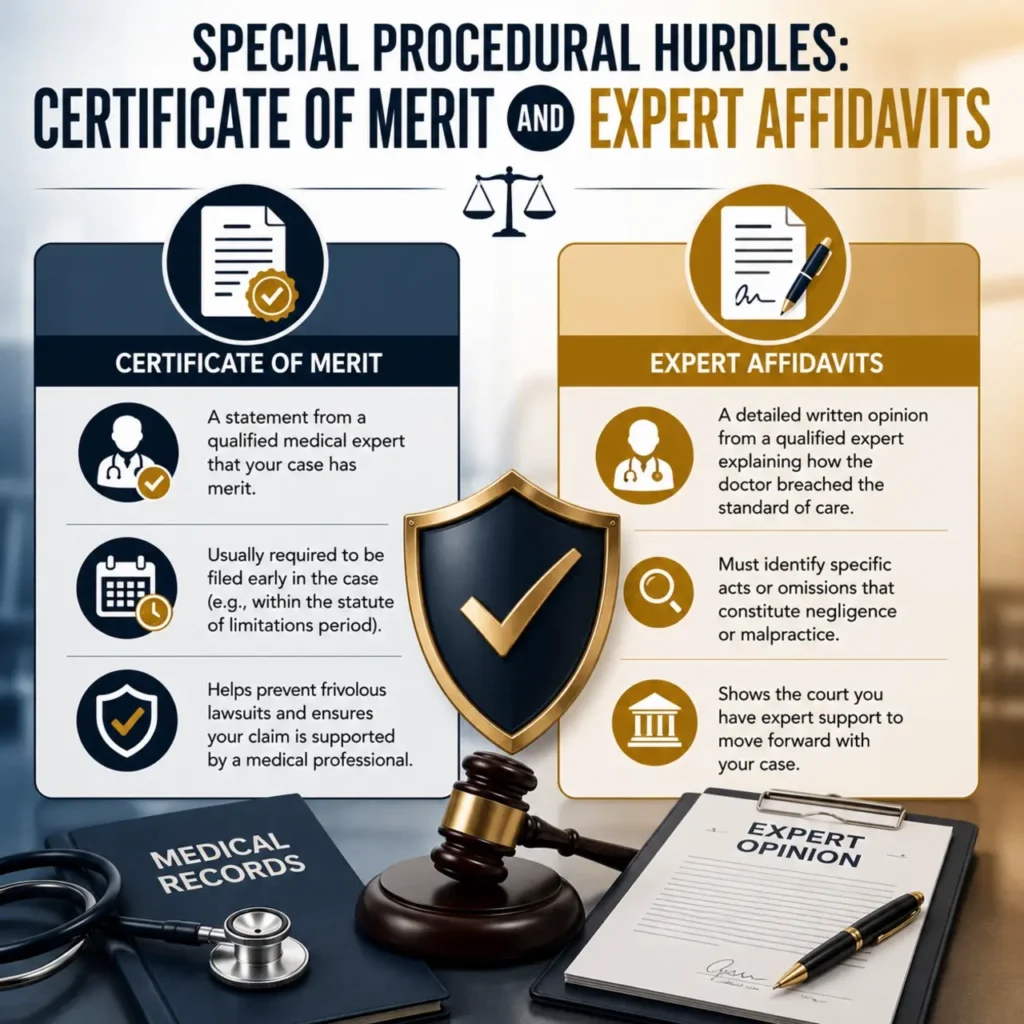
Special Procedural Hurdles: Certificate of Merit and Expert Affidavits
Medical malpractice cases come with extra procedural requirements that ordinary lawsuits do not have. The most common of these is a certificate of merit, sometimes called an affidavit of merit. Most states now require this document, and missing it can get a case dismissed before it has a chance to be heard.
A certificate of merit is a sworn statement, signed by a qualified medical expert, confirming that the case has a reasonable basis. The expert reviews the medical records, evaluates the doctor’s conduct, and certifies in writing that there is a legitimate question about whether the standard of care was breached. Some states require this document to be filed with the original complaint, while others give the patient a short window after filing.
The purpose of this requirement is to filter out lawsuits that have no real medical foundation. Before this rule existed, doctors were sometimes sued by patients who had no expert support for their claims. The certificate of merit forces a patient to find a qualified expert before the lawsuit can move forward, which raises the cost and effort of filing but also weeds out cases that would have failed anyway.
Beyond the certificate of merit, many states require that any expert witness testifying about the standard of care must practice in the same specialty as the doctor being sued. Some states also have caps on damages, particularly for non-economic damages like pain and suffering, and the amount of these caps varies widely. These procedural rules vary so much from state to state that two patients with nearly identical facts can have very different paths to court depending on where they live.
What This Means in Practice
A misdiagnosis case is not something to navigate alone. The four legal elements have to be proven with real evidence, the standard of care has to be established with expert testimony, the deadlines are strict, and the procedural rules vary by state. Even patients with strong cases sometimes lose because of a missed deadline or a procedural error.
If you believe you were harmed by a misdiagnosis, there are practical steps you can take while you decide whether to pursue legal action. Start by requesting a complete copy of your medical records from every provider involved. Write down a detailed timeline of your symptoms, appointments, tests, and the treatment you received, while the details are still fresh. Keep copies of all bills, test results, and any communication with your doctors. None of this requires a decision about whether to sue, but having the documentation ready makes any future conversation with a lawyer far more productive.
The next step is consultation with a licensed medical malpractice attorney in your state. Most attorneys in this field offer free initial consultations and work on a contingency fee basis, which means they only get paid if you recover compensation. The attorney can review your records, identify which of the four legal elements are strong or weak in your situation, and tell you whether your state’s procedural rules give you a realistic path forward.
A Few Cautions
The information in this article is general legal information, not legal advice. Medical malpractice law varies significantly from state to state, and the same facts can produce very different legal outcomes depending on where the misdiagnosis happened. Statutes of limitations, certificate of merit rules, damage caps, and expert witness requirements all differ. Nothing in this article should be used as a substitute for advice from a licensed attorney who knows the law in your jurisdiction and has reviewed the facts of your specific situation.
It is also worth being honest about something many patients struggle with. A bad outcome is painful, and the emotional weight of feeling failed by a doctor is real. But the law does not award compensation for disappointment or for outcomes that were tragic but not preventable. A licensed attorney will tell you, in plain terms, whether your situation meets the legal standard, and that honest assessment is one of the most valuable things they can offer.
Frequently Asked Questions
Is every wrong diagnosis considered medical malpractice?
No. A wrong diagnosis only becomes malpractice when it results from a doctor failing to meet the standard of care that a reasonably competent doctor in the same field would have met. Medicine involves uncertainty, and some diagnostic errors happen even when doctors do everything right. The law focuses on whether the doctor’s conduct was unreasonable, not just whether the diagnosis turned out to be wrong.
How long do I have to file a misdiagnosis lawsuit?
Most states give patients between one and three years from the date of the injury or the date the harm was discovered. The exact deadline depends on your state’s statute of limitations and whether the discovery rule applies. Some states also have an outer cap called a statute of repose. Because these deadlines are unforgiving and vary so much, speaking with a licensed attorney early is important.
What kind of evidence is needed in a misdiagnosis case?
The core evidence is your medical records, expert testimony from a doctor in the same specialty, and documentation of the harm you suffered. Records of bills, lost wages, additional treatment, and any second-opinion reports also matter. Expert testimony is usually required to establish both the standard of care and how the doctor’s conduct fell below it.
Can I sue if a doctor delayed my diagnosis but eventually got it right?
Possibly. Delayed diagnosis is one of the three legal categories of misdiagnosis. The key question is whether the delay caused you measurable harm, such as a condition advancing to a worse stage that required more aggressive treatment. If the delay made no medical difference, a lawsuit is unlikely to succeed.
What if the misdiagnosis happened in an emergency room?
Emergency rooms are not exempt from medical malpractice law. A doctor-patient relationship is created the moment an emergency physician begins treating you, and the same four legal elements apply. However, emergency medicine is one of the highest-risk specialties for malpractice claims, partly because emergency doctors have less information and less time than other physicians, which courts sometimes take into account when evaluating the standard of care.
How much does a misdiagnosis lawsuit typically cost to file?
Most medical malpractice attorneys work on a contingency fee basis, which means you do not pay legal fees upfront. The attorney is paid a percentage of any compensation recovered, usually between 30 and 40 percent. You may still be responsible for case expenses, such as expert witness fees, deposition costs, and filing fees, but these are often advanced by the attorney and recovered from the eventual settlement or verdict.
References
- Cornell Legal Information Institute on Medical Malpractice
- An Introduction to Medical Malpractice in the United States, National Center for Biotechnology Information
- Helling v. Carey, 83 Wn.2d 514 (1974), Washington Supreme Court
- Johns Hopkins Medicine on Diagnostic Errors
- our editorial policy
- research sources we rely on
- LegalTerms.net Copyright Notice

Hamit Sahin is the founder and editor of LegalTerms.net. He researches U.S. legal terminology and publicly available legal information using statutes, court rules, judicial opinions, government publications, and established legal reference sources.
His work focuses on organizing complex legal concepts into clear, plain-English explanations for general educational purposes.
Hamit is not an attorney and LegalTerms.net does not provide legal advice.