Arbitration vs Mediation: Key Differences and When to Use Each
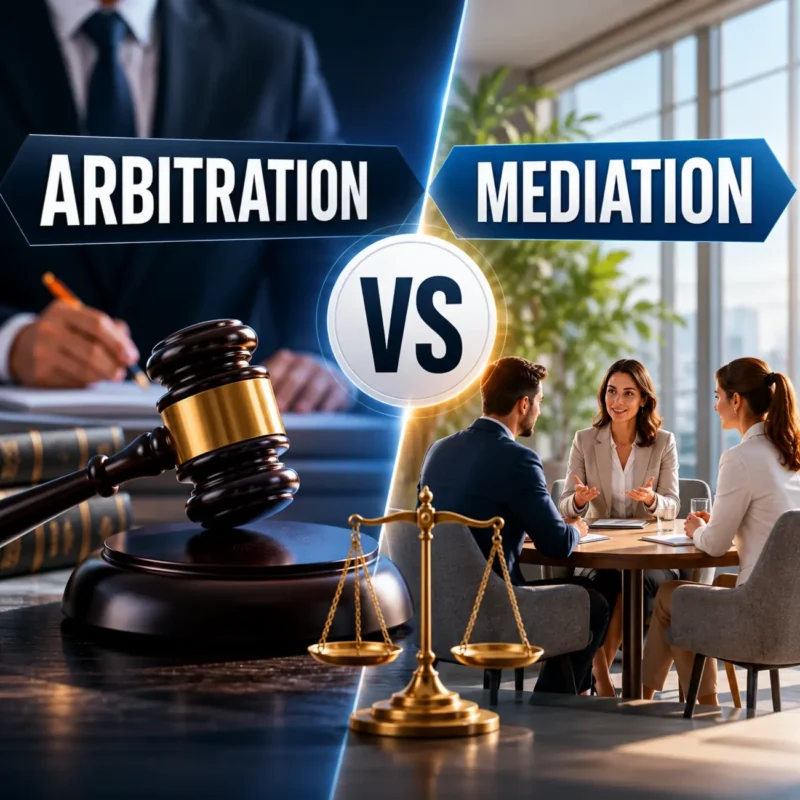
What Is the Difference Between Arbitration vs Mediation?
If you are facing a legal dispute, someone may suggest arbitration or mediation instead of going to court. People often lump the two together as alternatives to a trial, but they are not the same. The real difference comes down to who has the power to make the final decision.
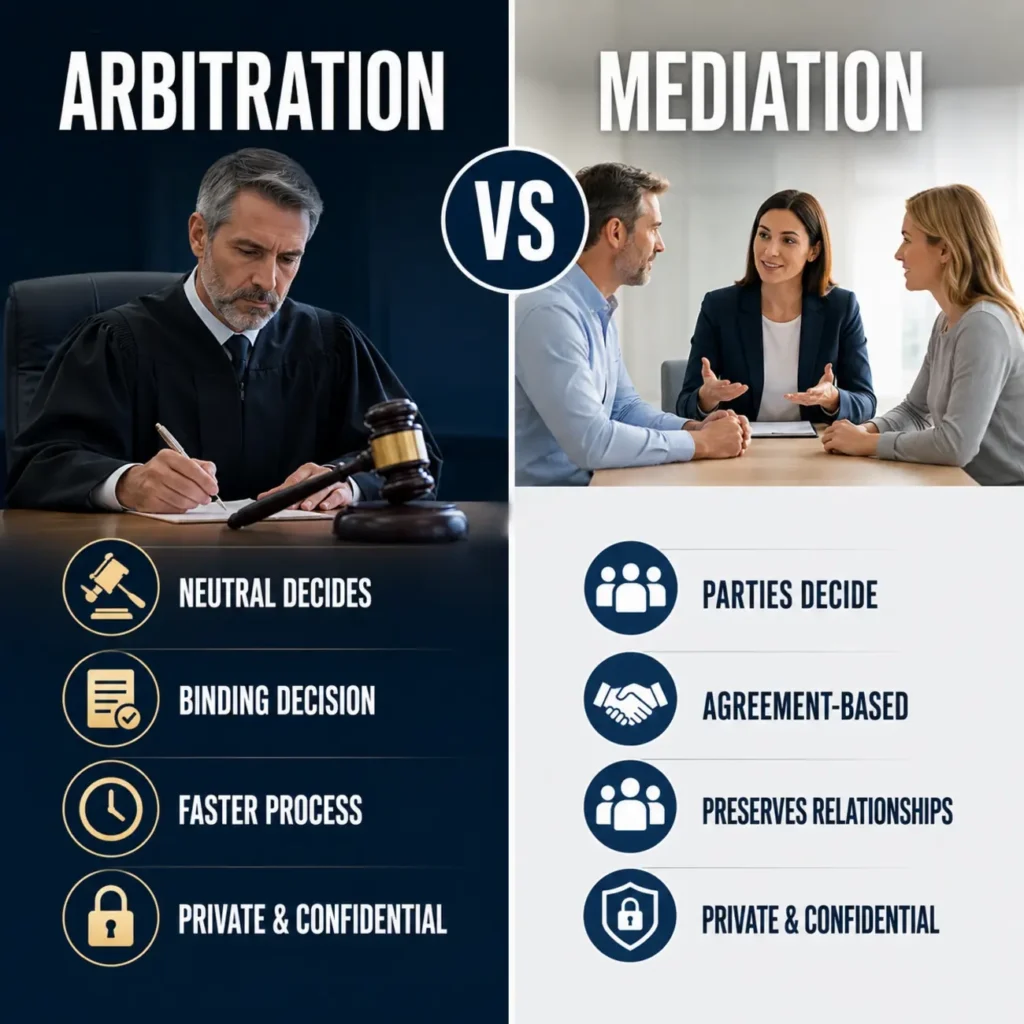
In arbitration, a neutral third party listens to both sides and decides the outcome, much like a private judge. In mediation, a neutral third party helps the two sides reach their own agreement and has no power to impose a result.
Quick Comparison:
- Arbitration: A private decision-maker (the arbitrator) hears both sides and issues a ruling
- Mediation: A neutral facilitator (the mediator) helps the parties negotiate their own agreement
- Who decides: The arbitrator decides the outcome; in mediation, the parties decide for themselves
- Binding effect: Arbitration is usually binding and enforceable like a court judgment; mediation is non-binding unless the parties sign a settlement
- Appeal: Arbitration awards are very hard to overturn; mediation has no decision to appeal
- Cost and speed: Both are usually faster and cheaper than a trial, with mediation typically the least expensive
- Privacy: Both keep the dispute out of the public court record
- Key difference: Arbitration replaces a trial with a private verdict; mediation replaces a fight with a guided negotiation
Both arbitration and mediation are forms of what lawyers call alternative dispute resolution, or ADR, meaning ways to settle a disagreement without a full courtroom trial. They are tools for resolving civil disputes, such as disagreements over contracts, money, property, or business deals, rather than criminal charges brought by the government.
The dividing line is control. In arbitration, you hand the decision to someone else and agree to live with the result. In mediation, you keep control the whole way through, and nothing is decided unless you say yes. If it helps, picture an arbitrator as a referee who watches the play and makes the final call, while a mediator is more like a bridge-builder who helps two people who are stuck reach their own handshake.
That one difference, who controls the outcome, shapes almost everything else: how binding the result is, whether you can appeal, how long it takes, and how much it costs.
How Does Arbitration Work?
Arbitration works like a streamlined, private version of a trial. Both sides present their evidence and arguments to a neutral arbitrator, who then issues a decision called an award that is usually binding.
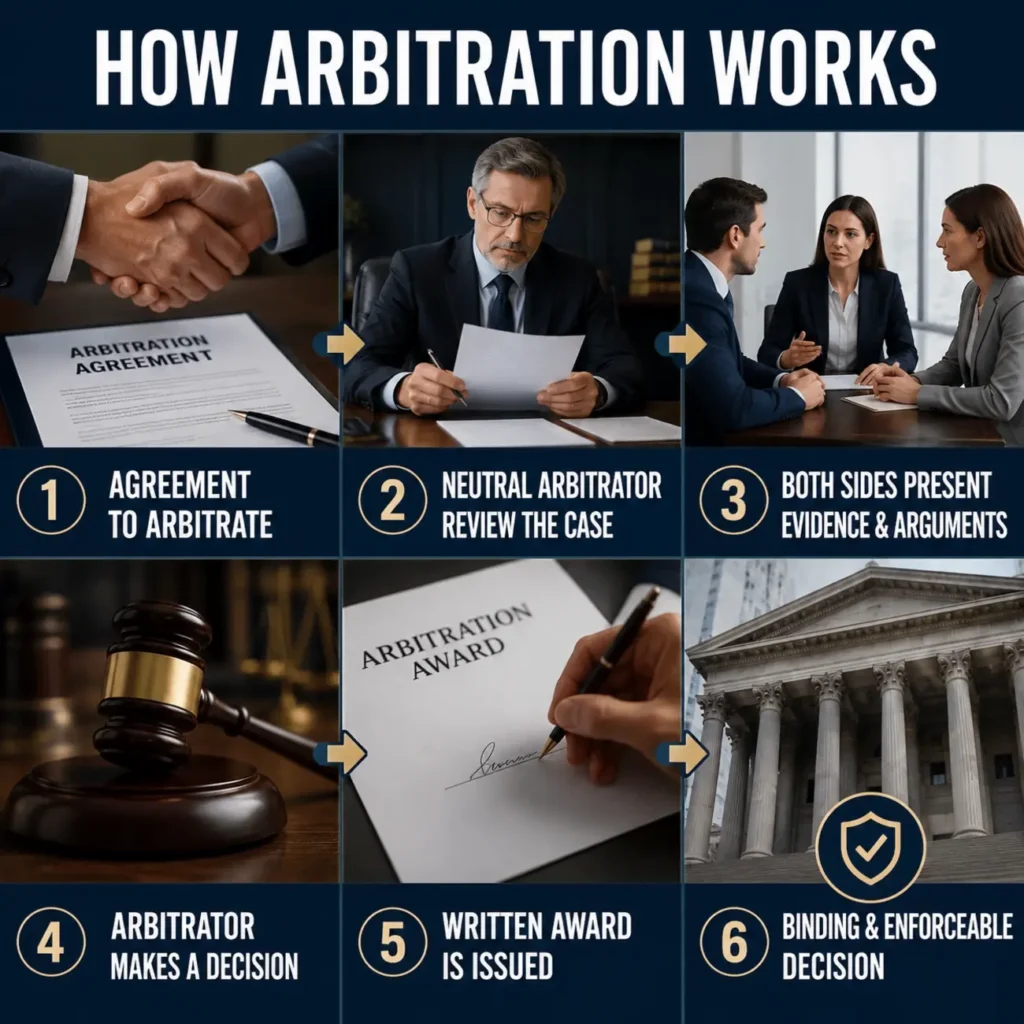
Most arbitration starts long before any dispute exists. It often begins with a clause tucked into a contract you already signed, an employment agreement, a credit card or cell phone contract, or a deal between two businesses. By signing, you agreed that if a problem came up later, it would go to arbitration instead of court.
The arbitrator sits at the center of the process. This is often a retired judge or an experienced lawyer who knows the subject area well. A single arbitrator handles many cases, while large commercial disputes sometimes use a panel of three. Whatever the setup, the arbitrator plays the role a judge would play at trial, weighing the evidence and deciding who wins.
Here is how a typical arbitration unfolds:
- Each side presents documents, witnesses, and arguments, though the rules are more relaxed than in a courtroom
- The pretrial exchange of information, known as discovery, is often limited, which helps keep things faster and cheaper
- The hearing takes place in private, so the details never enter the public court record
- The arbitrator issues a written award, and the winning party can ask a court to confirm and enforce it
Once that award is issued, your options to challenge it are narrow. An arbitration award is binding in most cases, meaning a court will enforce it even if you think the arbitrator got it wrong. We will look at why that finality matters so much further below.
How Does Mediation Work?
Mediation is a guided negotiation. A neutral mediator helps both sides talk through the dispute and look for common ground, but the mediator has no authority to force a decision on anyone.
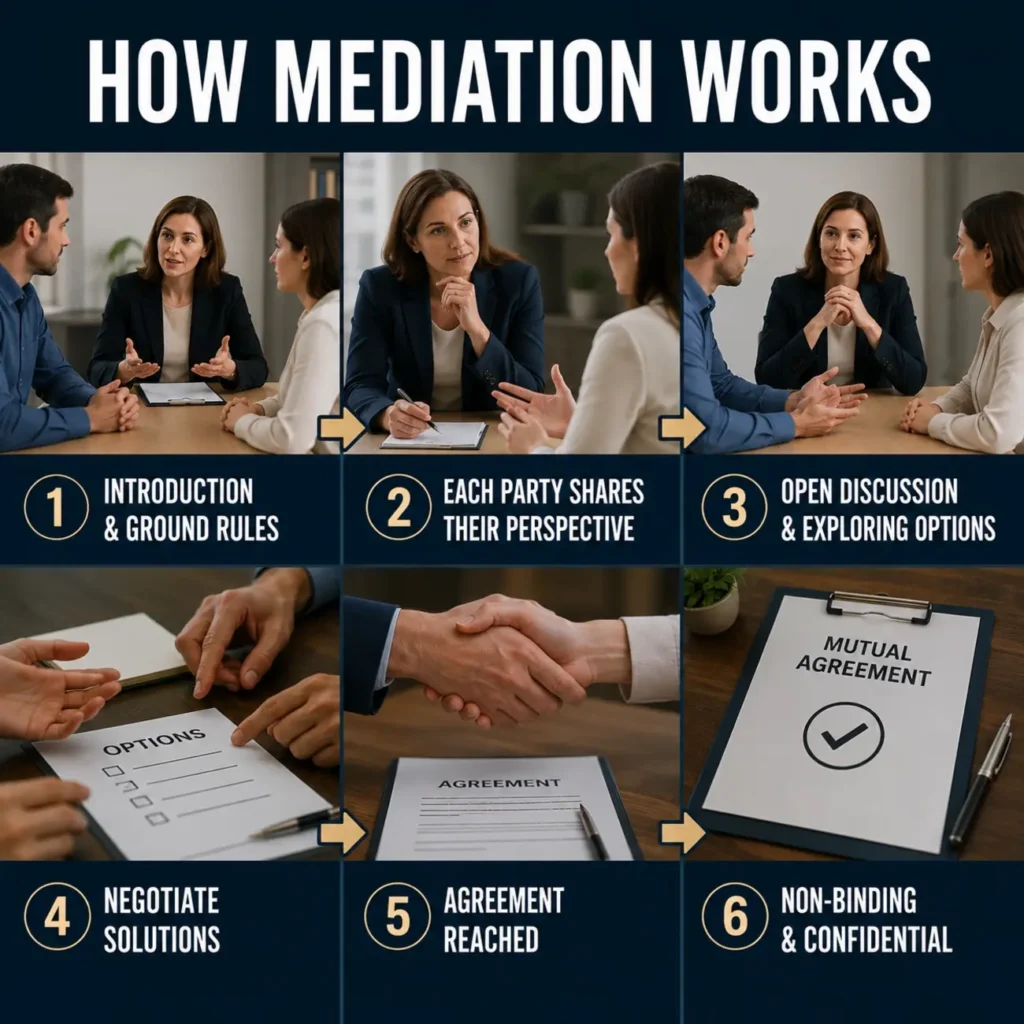
Mediation can begin in several ways. Sometimes the parties choose it voluntarily because they want to settle without a fight. Other times a judge orders it before a case goes to trial, or a contract requires it as a first step before arbitration or a lawsuit. However it starts, the goal stays the same: to reach an agreement both sides can accept.
The mediator’s job is to facilitate, not to judge. A good mediator usually does the following:
- Listens to both sides and helps each one understand the other’s position
- Meets with each side privately, in what is called a caucus, to explore options
- Suggests possible compromises but never imposes them
- Has no power to rule, award damages, or declare a winner
Unlike a courtroom, where a plaintiff and defendant face off and a judge or jury picks a winner, mediation treats both sides as partners in solving a shared problem. Because a mediator cannot impose a decision, mediation only resolves a dispute when both sides voluntarily agree to the terms. If they cannot agree, the mediation simply ends, and they remain free to take the matter to court or arbitration.
One feature makes mediation especially appealing. What is said during mediation is generally confidential, which lets both sides speak openly without fearing their words will be used against them later. That privacy is a big reason mediation can succeed where stiff, on-the-record negotiations fail.
Which Process Is Binding, and Which One Isn’t?
Whether the outcome binds you is the sharpest practical difference between the two. An arbitration award is binding and enforceable in court, while a mediation ends with nothing binding unless both sides sign a settlement agreement.
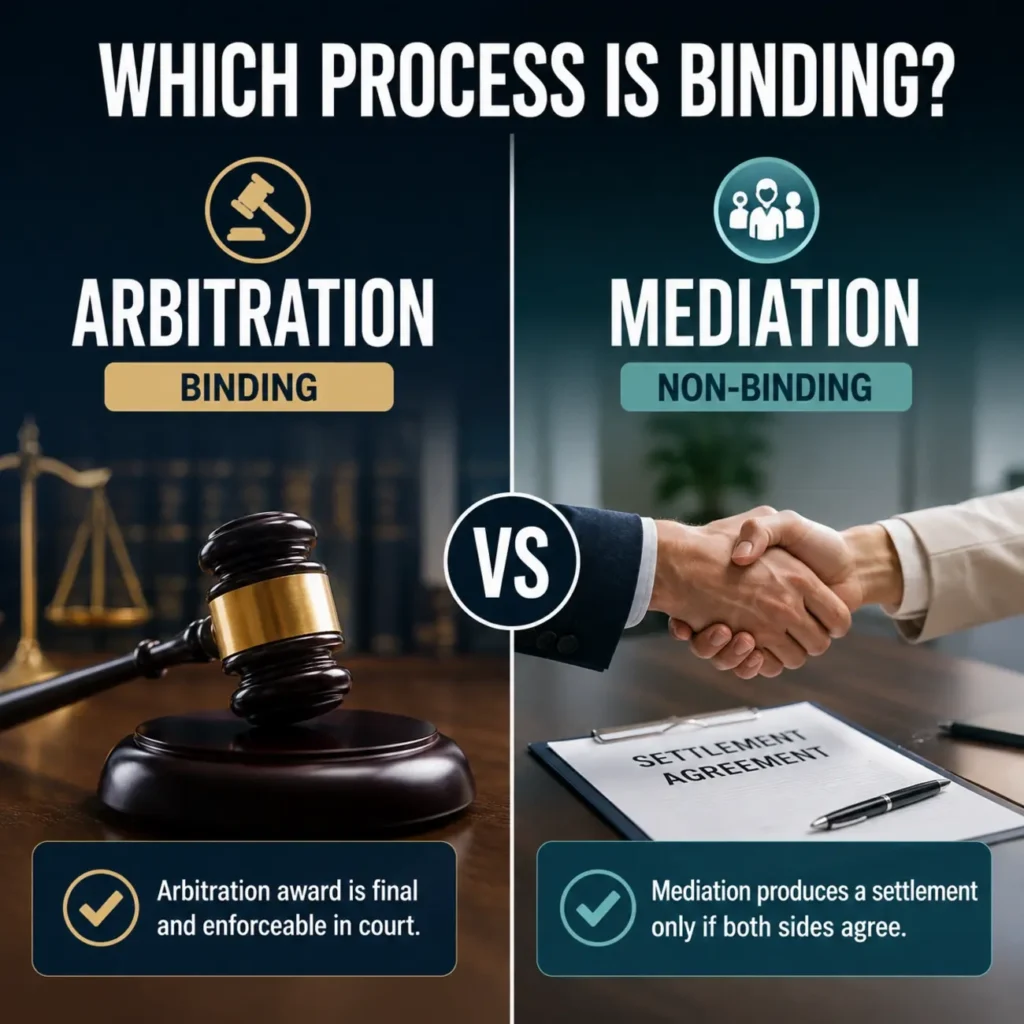
There is an important wrinkle here that many people miss. The question that matters first is not whether the result is binding, but whether you are bound to use the process at all. It helps to think about “binding” in two separate senses:
- Being bound to the process: A valid arbitration clause can force you into arbitration and keep you out of court whether you like it or not. An agreement to mediate does not force any result; you can sit down, talk, and still walk away.
- Being bound to the result: An arbitration award is final and enforceable like a judgment. A mediation produces a binding result only if you sign a settlement at the end.
This gap is why arbitration clauses carry so much weight. A valid arbitration clause is hard to escape, because the Federal Arbitration Act requires courts to enforce agreements to arbitrate in most situations. If you signed a contract with an arbitration clause, a court will usually send you to arbitration even if you would rather have your day in front of a jury.
Mediation sits at the opposite end. Nothing is forced on you. If the talks produce a deal, both sides sign it, and that settlement becomes a binding contract a court can enforce if someone later backs out. A mediated settlement becomes binding the moment both sides sign it, turning a friendly understanding into an enforceable promise. Until that signature, you owe nothing and concede nothing.
How Do Arbitration and Mediation Compare on Cost, Time, and Privacy?
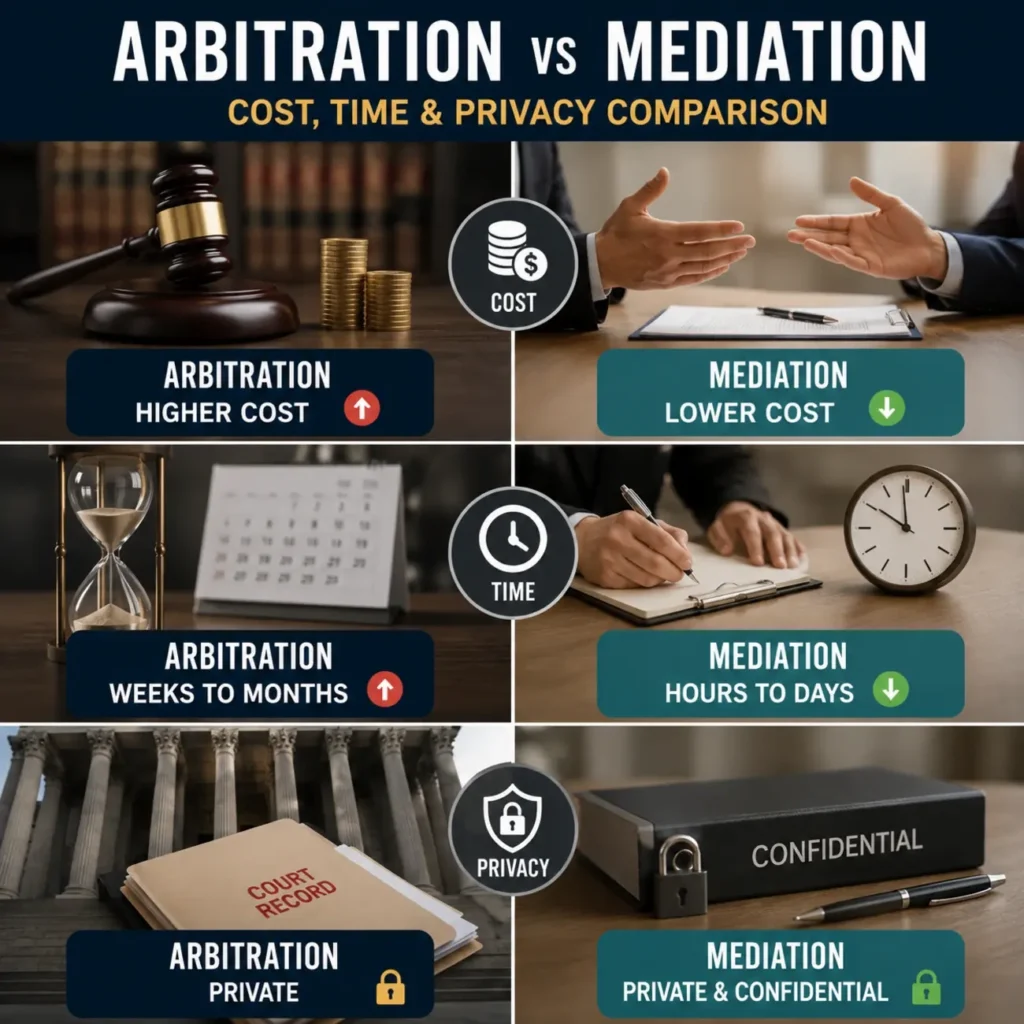
Both processes tend to be cheaper and faster than a full courtroom trial, and both keep your dispute out of public view. Of the two, mediation is usually the quicker and less expensive option, while arbitration costs more because it works so much like a trial.
The table below puts the two side by side:
| Factor | Arbitration | Mediation |
|---|---|---|
| Who decides the outcome | The arbitrator | The parties themselves |
| Binding result | Usually binding and final | Only if a settlement is signed |
| Typical cost | Moderate to high, plus arbitrator and filing fees | Lowest, with a shared mediator fee |
| Typical speed | Faster than trial, slower than mediation | Often the fastest, sometimes one session |
| Privacy | Private, kept off the public record | Private and confidential |
| Right to appeal | Very limited | Nothing to appeal |
| Formality | Structured, trial-like | Informal and flexible |
| Control over the result | You give it up | You keep it |
On cost, the gap is real. In mediation, the two sides usually split the fee of a single mediator and can often wrap up in a day, which keeps the bill low. Arbitration is heavier: you pay the arbitrator, who may charge by the hour, along with filing and administrative fees, and a complex commercial arbitration can end up rivaling the cost of a lawsuit.
Time follows a similar pattern. A mediation may take a single afternoon, while an arbitration can run for weeks or months. Even so, arbitration is generally faster than litigation, which can drag on for years.
Privacy is where both shine compared to court. When you sue in public court, the filings and the trial become part of the public record. Arbitration and mediation both stay private, which is one reason companies, employers, and families often prefer them when they want to keep a dispute out of the headlines.
When Should You Choose Mediation Over Arbitration?
Choose mediation when preserving the relationship matters and you want to stay in control of the result. Arbitration makes more sense when the two sides cannot reach a deal on their own and you need a final decision someone will enforce.
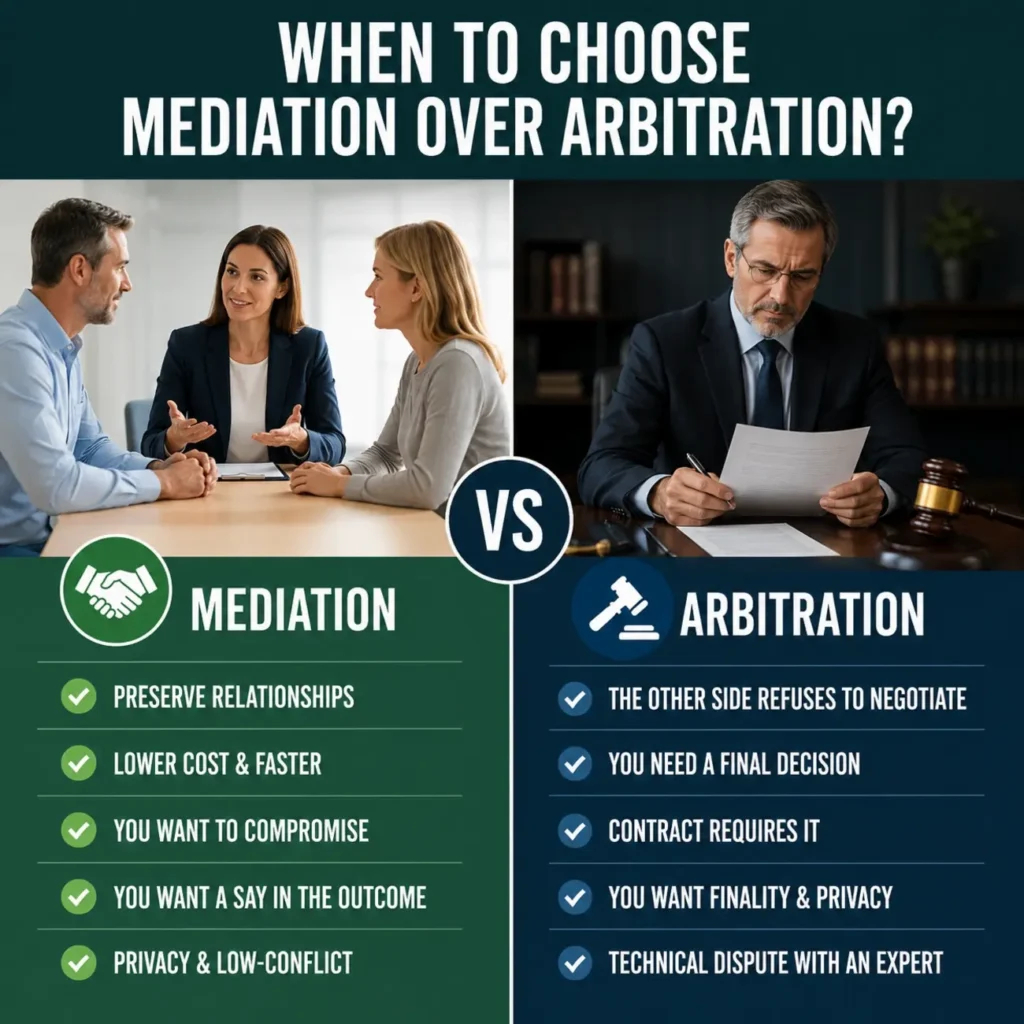
Mediation tends to be the better fit when:
- You and the other side still have a relationship worth protecting, such as business partners, family members, or an employer and employee
- You want the lowest cost and the fastest resolution
- You are open to compromise and want a say in the final terms
- Privacy and a low-conflict tone matter to you
Arbitration tends to be the better fit when:
- The other side refuses to negotiate, and you need a decision that actually settles the matter
- A contract you signed already requires it
- You want finality and privacy but still need a neutral expert to rule
- The dispute is technical and benefits from an arbitrator who knows the field
Here is something worth knowing: you do not always have to pick just one. Many contracts use a stepped, or tiered, dispute resolution clause that requires the parties to try mediation first and move to arbitration only if mediation fails. Some use a hybrid known as med-arb, where a neutral starts as a mediator and switches to an arbitrator if no agreement is reached. If you ever read a contract and see mediation and arbitration mentioned together, that is usually a tiered clause at work, not a contradiction.
Because these choices shape your rights in ways that are hard to undo, read any contract for a dispute resolution clause before a problem arises, and consult a licensed attorney about how that clause affects you. Once you are locked into arbitration, getting back out is difficult.
What Courts Have Said
Two cases show why the differences between arbitration and mediation are more than theory. One reveals how final an arbitration award really is, and the other shows how strong mediation confidentiality can be.
In Hall Street Associates, L.L.C. v. Mattel, Inc., 552 U.S. 576 (2008), the U.S. Supreme Court faced a dispute over a leased property and who should pay for environmental cleanup. The two sides had agreed to arbitrate, and their agreement even said a court could review the arbitrator’s decision for legal errors. When the losing side tried to use that review, the Supreme Court refused. It held that the Federal Arbitration Act sets the only grounds on which a court may overturn an award, and that parties cannot expand those grounds by agreement, no matter what their contract says. The practical lesson is striking. Arbitration is so final that you cannot even contract for a judge to double-check the arbitrator’s legal reasoning. If an arbitrator misreads the law, you are usually stuck with the result.
Cassel v. Superior Court, 51 Cal. 4th 113 (2011), shows the other side of the coin. After settling a business dispute in mediation, a client sued his own attorneys, claiming they had pressured him into a bad deal during the session. To prove it, he needed to reveal what was said in the mediation. The California Supreme Court would not allow it, ruling that the state’s mediation confidentiality law was so broad that even a client could not use those private communications against his own lawyers. The takeaway cuts both ways. The same confidentiality that lets people speak freely in mediation can later seal off evidence you might wish you could use.
Is Arbitration the Same as a Lawsuit?
No, arbitration is not a lawsuit, even though it can feel like one. A lawsuit plays out in a public court before a government judge or a jury, while arbitration happens privately before a neutral the parties selected.
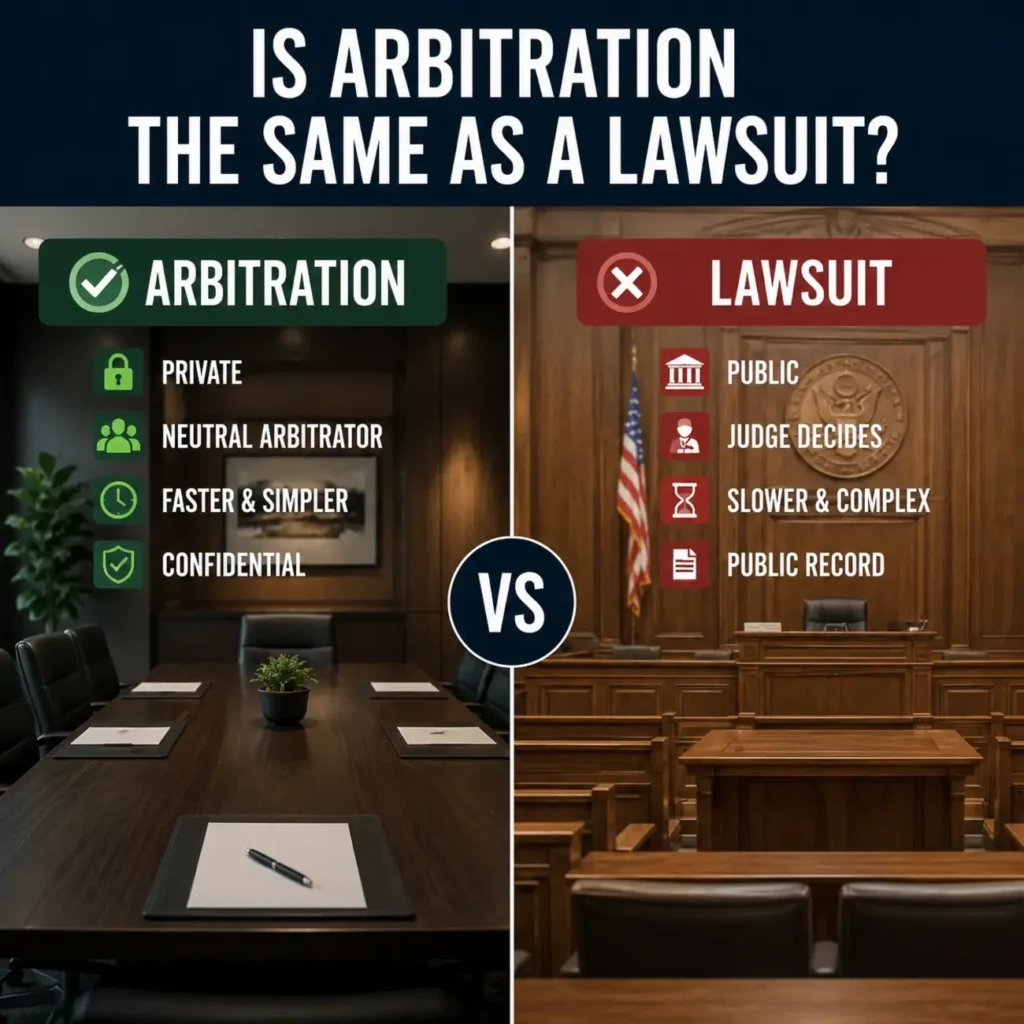
The confusion is understandable, because arbitration borrows the look of a trial. There is a hearing, each side presents evidence, and someone issues a ruling at the end. But the differences run deep. A court case is open to the public and follows strict rules of evidence and procedure, and the loser keeps a real right to appeal. Arbitration is private, uses looser rules, limits the pretrial gathering of evidence, and offers almost no way to challenge the result.
That trade-off is the heart of it. Arbitration is private and final, while a lawsuit is public and can be appealed, which is the core difference between the two. When you agree to arbitrate, you give up the open courtroom and the safety net of appeal in exchange for speed, privacy, and a decision-maker you helped pick.
A Few Cautions
A few practical warnings are worth keeping in mind before you rely on either process.
Arbitration clauses are easy to overlook. They often sit in the fine print of contracts most people sign without reading, from job offers to phone plans. Once you have agreed to one, a court will usually hold you to it, and you give up both your day in open court and most of your right to appeal. Look for these clauses before you sign, not after a dispute begins.
A mediated settlement deserves the same care. The moment you sign it, it becomes a binding agreement, so never sign one you do not fully understand or feel pressured to accept in the room. Confidentiality can also work against you later, as the Cassel case showed, since the private things said during a session may be off-limits as evidence down the road.
Finally, outcomes depend heavily on the specific facts, the wording of your contract, and the rules of your state, which can differ from federal rules. This article explains how arbitration and mediation generally work, but it is not legal advice. For guidance on your own situation, consult a licensed attorney.
Frequently Asked Questions
Is arbitration or mediation cheaper?
Mediation is usually the cheaper of the two. The parties typically split the cost of one mediator and often finish in a single session, which keeps fees low. Arbitration costs more because you pay the arbitrator, sometimes by the hour, plus filing and administrative fees, and a complex case can approach the cost of a lawsuit.
Is mediation legally binding?
Not on its own. A mediator cannot impose anything, so the process itself binds no one. It becomes binding only when the parties reach a deal and sign a written settlement, which then works like any other enforceable contract.
Can you refuse arbitration if it is written into a contract?
Usually not. If you signed a contract with a valid arbitration clause, courts will generally enforce it under the Federal Arbitration Act and send your dispute to arbitration. There are narrow exceptions, such as a clause that is fraudulent or wildly one-sided, but they are hard to win, so it is worth reviewing any clause with an attorney.
What happens if mediation does not lead to a settlement?
If mediation does not produce an agreement, nothing is decided and no one is bound. You walk away as you came in and remain free to take the dispute to court or, if your contract requires it, to arbitration. Anything you said during the session generally stays confidential.
Can a single dispute use both mediation and arbitration?
Yes, and many do. Contracts often include a tiered clause that requires mediation first and arbitration only if mediation fails. A related hybrid, med-arb, has a neutral begin as a mediator and switch to an arbitrator if the parties cannot agree. Seeing both terms in one contract usually points to this kind of step-by-step process.
Do you need a lawyer for arbitration or mediation?
It depends on the stakes. You are allowed to handle either one without a lawyer, and many small mediations work fine that way. But because arbitration awards are nearly impossible to appeal and signed settlements are binding, the higher the stakes, the more it makes sense to have a licensed attorney advise you before and during the process.
References
- Federal Arbitration Act, Title 9 of the U.S. Code (Cornell Law School Legal Information Institute)
- Arbitration: Wex Legal Definition (Cornell Law School Legal Information Institute)
- Mediation: Wex Legal Definition (Cornell Law School Legal Information Institute)
- Hall Street Associates, L.L.C. v. Mattel, Inc., 552 U.S. 576 (2008) (Justia)
- LegalTerms.net Editorial Guidelines
- LegalTerms.net Sources and References
About This Article
- Author: Hamit Sahin, Legal Researcher & Editor
- Published: June 2026
- Last Updated: June 2026
- Article Type: Comparative legal analysis
- Research Sources: Cornell Law School Legal Information Institute (Federal Arbitration Act, plus Wex entries on arbitration and mediation), Justia (Hall Street Associates, L.L.C. v. Mattel, Inc., 552 U.S. 576 (2008)), and Cassel v. Superior Court, 51 Cal. 4th 113 (2011)
- Scope: This article compares arbitration and mediation as methods of resolving civil disputes in the United States, covering how each works, which is binding, how they differ on cost, time, and privacy, and when each tends to fit. It does not cover international or cross-border arbitration, how to draft a dispute resolution clause, jurisdiction-by-jurisdiction procedural rules, or other forms of ADR such as conciliation or neutral evaluation.
- Editorial Standards: This article was researched using primary legal sources and reviewed for accuracy before publication. Case citations were verified against published court records.
- Disclaimer: This article is for general informational purposes only and does not constitute legal advice. For advice specific to your situation, consult a licensed attorney.
- Disclosure: LegalTerms.net is an independent editorial resource. This article was not sponsored or influenced by any law firm, legal service provider, or other commercial entity.

Hamit Sahin is the founder and editor of LegalTerms.net. He researches U.S. legal terminology and publicly available legal information using statutes, court rules, judicial opinions, government publications, and established legal reference sources.
His work focuses on organizing complex legal concepts into clear, plain-English explanations for general educational purposes.
Hamit is not an attorney and LegalTerms.net does not provide legal advice.