What Is Lex Talionis? Meaning, History, and Real Examples
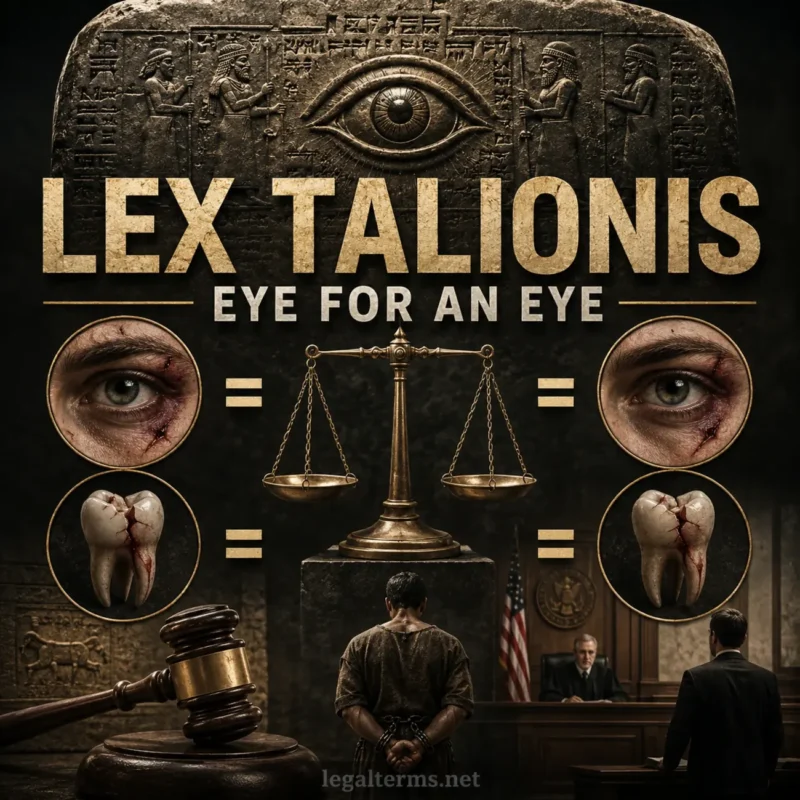
Lex talionis is one of the oldest ideas in legal history. Most people know it as “an eye for an eye.” The phrase sounds brutal, but its real purpose was to control revenge, not to encourage it. This guide explains what lex talionis means, where it came from, and why it still shapes the way courts think about punishment.
Quick answer: Lex talionis is Latin for “the law of retaliation.” It holds that a punishment should match the harm caused by the offense. The idea appears in the Code of Hammurabi, the Hebrew Bible, Roman law, and Islamic law. No modern Western court applies it literally, yet its core logic, that punishment should fit the crime, still runs through sentencing today.
What Lex Talionis Actually Means?
Lex talionis translates from Latin as “law of retaliation.” The word “talio” refers to a penalty identical in kind to the offense. In its simplest form, the rule says that whatever harm you cause, you should suffer the same harm in return.
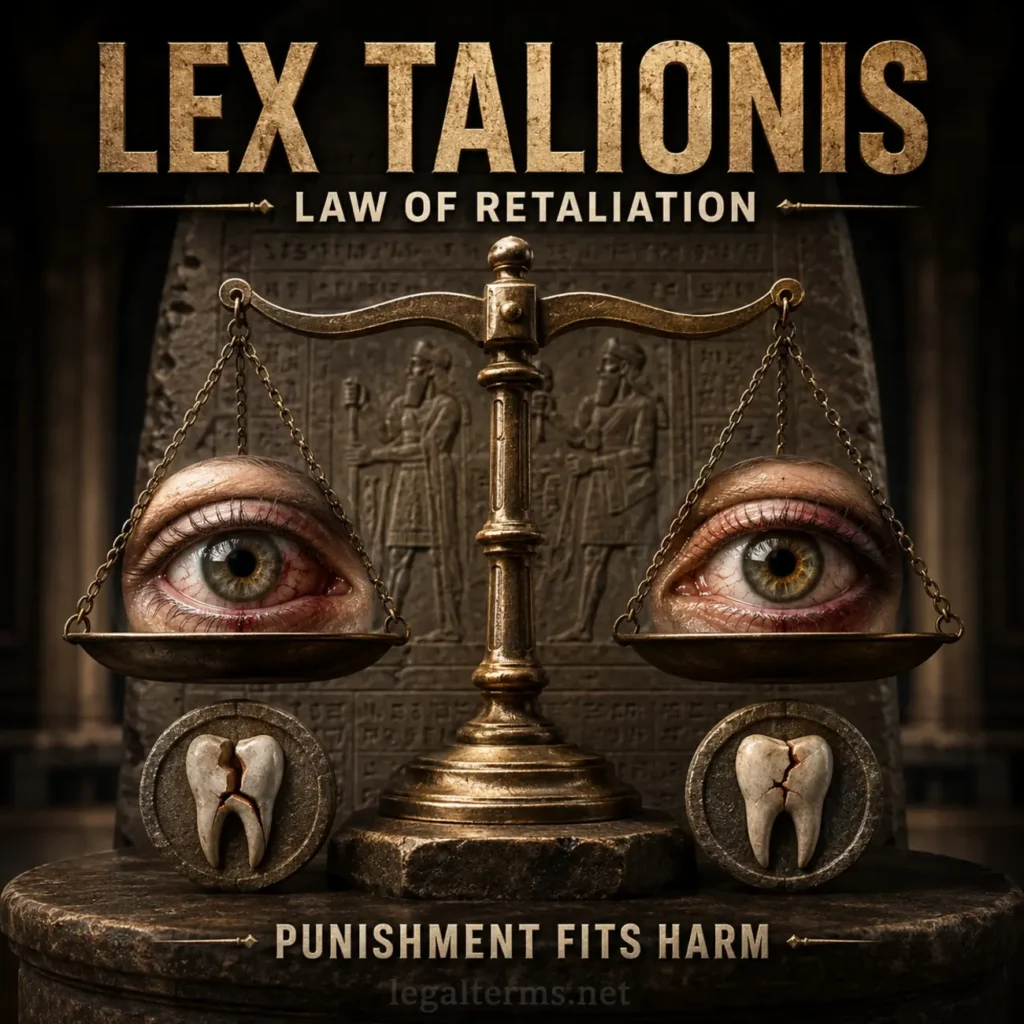
That is the literal reading. The broader meaning is more useful. Lex talionis describes any legal system that sets a fixed, fitting penalty for a specific wrong. The punishment does not always mirror the crime exactly. It only needs to be proportionate to it.
This distinction matters. People often picture lex talionis as a system of mutilation. In practice, most cultures that adopted it allowed payment instead of physical harm. The “eye for an eye” formula set the value of an injury. The actual penalty was usually money, not matching pain.
So the principle works on two levels. At face value, it demands equal injury. Underneath, it expresses a deeper rule about balance and limits. That second meaning is the one that survived.
Where Lex Talionis Came From?
The principle predates written law in the way we understand it. Before formal courts existed, communities handled wrongs through private revenge. If someone harmed your family, your family struck back. The trouble was that revenge rarely stayed equal.
A single insult could escalate into a blood feud. One death led to two, then to a wider clan war. These cycles destroyed early societies from the inside. Something was needed to cap the violence.
Lex talionis was that cap. By declaring that a penalty could not exceed the original wrong, early lawmakers gave communities a stopping point. The injured party got a fixed measure of justice and nothing more. The cycle of escalating vengeance had a ceiling.
This origin explains the principle’s strange double nature. It looks like a license for revenge. It was designed as a brake on it. The same words that authorized retaliation also limited how far it could go.
Lex Talionis in the Code of Hammurabi
The earliest complete legal code we have comes from Babylon. King Hammurabi issued it around 1754 BCE. The laws were carved onto a tall stone stele and displayed in public for everyone to see. The code contains roughly 282 case laws covering trade, family, property, and personal injury.

Several of these laws state the talion principle directly. Law 196 declares that if a man destroys the eye of another man, his own eye shall be destroyed. Law 197 applies the same rule to a broken bone. Break for break, the penalty mirrors the harm.
But the code did not treat everyone equally. Punishment depended on the social rank of the victim. Physical retaliation applied mainly when the injured person belonged to the upper class. When the victim ranked lower, the offender usually paid a fine instead.
| Victim’s social class | Typical penalty for the same injury |
|---|---|
| Upper class (awilum) | Equal physical retaliation, such as eye for eye |
| Commoner or lower class | A fixed monetary fine |
| Enslaved person | Compensation paid to the owner |
This detail reveals something important about lex talionis from its earliest days. “Equal” retaliation was often equal only among social equals. Societies shaped the principle to fit their existing power structures. The rule about proportional harm coexisted with deep inequality.
The Principle in the Hebrew Bible
The phrase “an eye for an eye” appears three times in the Hebrew Bible. It shows up in Exodus, Leviticus, and Deuteronomy. The Leviticus version is the most direct, listing fracture for fracture, eye for eye, and tooth for tooth.
Read literally, these passages sound like a demand for matching injury. Jewish legal tradition, however, did not read them that way for long. Rabbinic interpreters argued that the verses called for monetary compensation, not physical retaliation.
Their reasoning was practical. A literal rule could not apply fairly to everyone. How would you take “an eye for an eye” from an offender who was already blind? Because the law had to work for all people, the physical reading made no sense. Payment did.
The Talmud built this into a detailed system. It set out five categories of compensation for a personal injury. These covered damages, pain, medical costs, lost income, and mental anguish. This five-part framework reads like an early version of modern personal injury damages.
So within the same tradition that recorded “eye for eye,” the dominant practice became financial. The phrase set the seriousness of the wrong. The payout came in silver.
How Roman Law Treated the Idea?
Roman law inherited the talion concept and reshaped it. The early Twelve Tables, written around 450 BCE, kept a form of retaliation on the books for serious injuries. A victim could demand equal harm in certain cases.
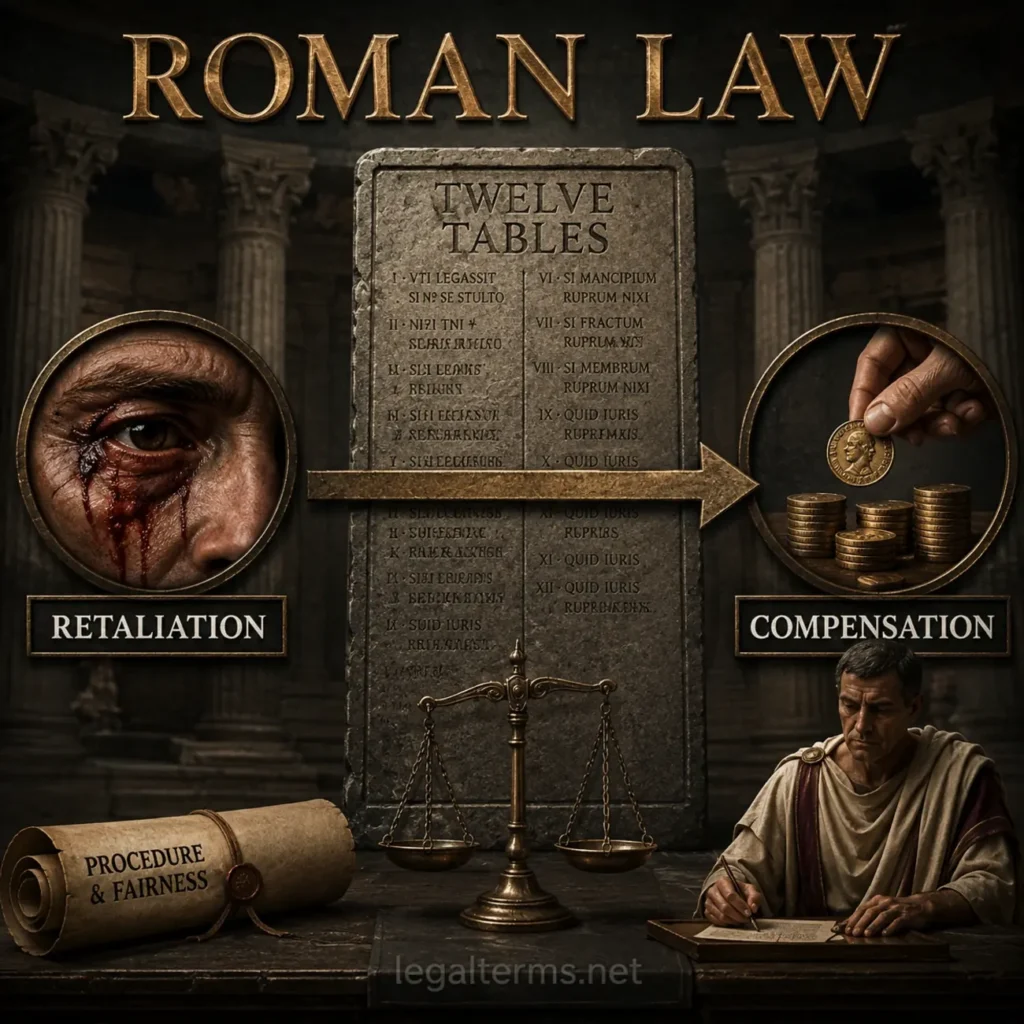
Yet Roman practice moved quickly toward compensation. The Twelve Tables also allowed the parties to agree on a cash settlement instead. If both sides accepted a payment, physical retaliation was avoided. Over time, the monetary option became the norm.
This pattern repeats across cultures. The literal penalty stayed in the text. The everyday outcome was a negotiated payment. Roman law helped pass this model into the European legal tradition that followed.
The Romans added something else of lasting value. They developed early ideas about legal procedure, representation, and fairness. These concepts softened the raw talion rule and folded it into a more structured system of justice.
Lex Talionis in Islamic Law
Islamic law contains its own version of the principle, known as qisas. The term means retaliation in kind. It applies to murder and to the intentional infliction of bodily harm. The relevant verses appear in the Quran, including chapter 2, verse 178, and chapter 5, verse 45.
The wording closely echoes the older Near Eastern formula. Life for life, eye for eye, tooth for tooth. On its face, this is a classic statement of lex talionis. The context, however, points toward restraint.
Each passage is followed by a call for mercy. The Quran encourages the injured party, or the victim’s family in a murder case, to accept compensation instead of demanding retaliation. This payment is called diya, often translated as blood money. Forgiveness is presented as a virtue and an act of atonement.
In a murder case, the victim’s family typically holds three options. They may seek qisas, accept diya, or grant a pardon. Classical Islamic jurisprudence treated such cases more like a private dispute between families than a public crime managed by the state.
A few countries still incorporate qisas into their criminal codes today. Iran is the most prominent example, where families of murder victims can decide between execution and compensation. Saudi Arabia and Pakistan retain qisas provisions as well, though application varies. International human rights organizations have sharply criticized these systems, especially in cases involving juveniles or defendants with mental illness.
Why an Eye for an Eye Was a Limit, Not a License
This is the point most people miss. Lex talionis was a ceiling on punishment, not a floor. It told communities how much retaliation was allowed at most. It did not demand that they take it.
Picture the alternative. Before such rules, a wronged family might respond to one killing with several. Vengeance had no fixed measure, so it grew. The talion principle stopped that growth by tying the penalty to the original harm.
A wronged person could take no more than an eye for an eye. They could not take a life for a tooth. The injury could not lead to a death. The rule protected the offender from excessive revenge as much as it served the victim.
Seen this way, lex talionis was an early human rights idea wrapped in harsh language. Its goal was to prevent punishment from becoming worse than the crime. That goal, keeping penalties proportionate, never went out of date.
The Christian Challenge to Lex Talionis
The most famous critique of the principle comes from the Sermon on the Mount. In the Gospel of Matthew, Jesus quotes the old rule directly. He repeats “eye for eye, and tooth for tooth,” then sets it aside.
In its place he urges a different response. Do not resist an evil person. Turn the other cheek. This teaching moved away from retaliation entirely and toward forgiveness and restraint.
Historians read this passage in context. By that time, the talion rule was being misused to settle private grudges rather than to limit violence. The teaching pushed back against that abuse. It reframed justice around mercy instead of matching harm.
Over the following centuries, Christian legal thinking gave talion sentencing a smaller role than it held in other traditions. Mutilating punishments faded. The idea of proportionate justice survived, but the literal eye for an eye did not carry the same weight.
Lex Talionis and Modern Retributive Justice
The modern descendant of lex talionis is retributive justice. This is the theory that offenders deserve punishment in proportion to their wrongdoing. The focus sits on what the offender did, not on future benefits like deterrence.
The philosopher Immanuel Kant gave this view its strongest defense. He argued that a criminal earns punishment by the act itself. For Kant, failing to punish a serious wrong was an injustice on its own, regardless of any practical outcome.
This is where lex talionis still lives in legal philosophy. The principle supplies a rough rule for proportionality. The punishment should reflect the gravity of the offense. A minor theft should not draw the same sentence as a violent assault.
Critics point out that the rule is hard to apply precisely. How do you measure the “equal” punishment for fraud, or for tax evasion? There is no literal mirror penalty. The deeper debate about how to scale punishment to crime belongs in a dedicated discussion, and the comparison between strict retaliation and graded proportionality is covered in lex talionis vs proportionality. For this article, the key point stands. Retributive justice keeps the talion instinct alive in a more flexible form.
Where the Principle Survives in Today’s Law?
No Western court today gouges out eyes or breaks bones as a sentence. The literal form of lex talionis is gone. The underlying logic, though, is woven through modern law in several places.
The clearest example sits in the United States Constitution. The Eighth Amendment bans cruel and unusual punishment. This is a proportionality rule. A penalty that is wildly out of line with the offense can be struck down. That is the talion ceiling restated in constitutional terms.
The same idea appears in everyday sentencing. Judges and guidelines aim to match the severity of the punishment to the seriousness of the crime. Sentencing structures try to make penalties predictable and proportional, which is the goal Hammurabi’s code pursued thousands of years ago.
Civil law carries the principle too. Punitive damages punish especially egregious conduct rather than simply repaying a loss. Courts limit these awards using proportionality, generally requiring a reasonable link between the punitive amount and the actual harm. Victim compensation also traces back to the ancient practice of paying for an injury, a theme explored further in restitution in law.
One tension stands out. Mandatory minimum sentences fix a floor below which a judge cannot go. Lex talionis was meant to set a ceiling on punishment. By locking in a minimum instead, mandatory minimums can push a sentence past what proportionality would justify. The ancient principle and the modern policy point in opposite directions.
Common Misconceptions About Lex Talionis
Several myths surround the principle. Clearing them up sharpens the picture.
The first myth is that lex talionis was pure revenge. As we have seen, it was built to limit revenge. The rule capped retaliation rather than unleashing it.
The second myth is that ancient societies routinely mutilated offenders. In practice, most disputes ended in payment. The physical penalty was the benchmark, not the usual result.
The third myth is that the rule treated everyone the same. Hammurabi’s code shows it did not. Penalties shifted with the social rank of victim and offender.
The fourth myth is that modern law has discarded the idea completely. It has discarded the literal form. The proportionality principle at its heart remains a foundation of criminal and civil law.
Lex Talionis vs Restorative Justice
Lex talionis sits at one end of a spectrum of justice models. At the other end sits a more recent approach that focuses on repair rather than retaliation. Comparing the two shows how legal thinking has shifted.
Retributive systems ask what the offender deserves. Repair-focused systems ask how the harm can be healed. The contrast is sharp, and it shapes how communities respond to crime today. The repair-focused model is described in detail under restorative justice.
| Feature | Lex talionis | Restorative justice |
|---|---|---|
| Main goal | Match the punishment to the crime | Repair the harm to victim and community |
| Central focus | The offense and the penalty | The relationships affected |
| Who is centered | The wrongdoer and the wrong | The victim and the community |
| Typical outcome | Proportional punishment | Dialogue, amends, and reintegration |
| View of justice | Balance restored through penalty | Balance restored through healing |
Neither model has fully replaced the other. Modern systems blend them. A court may punish proportionally while also ordering restitution or community service. The ancient instinct for balance survives, but it now shares space with the goal of repair.
Why Lex Talionis Still Matters
The principle endures because the problem it solved never disappeared. Every legal system must answer one question. How much punishment does a given wrong deserve?
Lex talionis offered the first clear answer. The penalty should fit the harm, and it should not exceed it. That answer was crude, but it introduced order where private vengeance once ruled.
Today the answer looks different in detail. We use prison terms, fines, probation, and damages rather than matching injuries. The calibration behind every one of those decisions still echoes the talion rule. Each sentence weighs the crime against the penalty and tries to keep them in balance.
That is the quiet legacy of “an eye for an eye.” Not the literal injury, but the demand that justice stay proportional. It is one of the oldest ideas in law, and it is still doing its work.
Questions and Answers
What does lex talionis mean in simple terms?
It means “the law of retaliation” in Latin. The idea is that a punishment should match the harm someone caused. Most people know it through the phrase “an eye for an eye.”
Where did the idea of an eye for an eye come from?
The earliest written version appears in the Code of Hammurabi, a Babylonian legal code from around 1754 BCE. The principle also shows up in the Hebrew Bible, Roman law, and Islamic law. It developed as a way to limit endless cycles of revenge.
Was lex talionis really about revenge?
Not in the way people assume. It set a maximum limit on punishment, not a minimum. By tying the penalty to the original harm, it stopped retaliation from escalating into feuds.
Did ancient societies actually take an eye for an eye?
Rarely in practice. Most cultures allowed payment instead of physical harm. The injury set the value of the wrong, and the offender usually paid compensation.
Is lex talionis still used today?
Not in its literal form in Western law. A few countries retain qisas, an Islamic version, mainly for murder and serious injury. The core idea of proportional punishment still guides modern sentencing everywhere.
How is lex talionis different from restorative justice?
Lex talionis focuses on matching punishment to the crime. Restorative justice focuses on repairing the harm and restoring relationships. One centers the penalty, the other centers healing.
Why do courts care about proportionality?
Proportionality keeps punishment fair and prevents excessive penalties. In the United States, the Eighth Amendment bans cruel and unusual punishment for this reason. The principle traces directly back to the talion idea of fitting the penalty to the crime.
References and Legal Sources
- The Avalon Project, Yale Law School. Code of Hammurabi.
- New World Encyclopedia. Lex talionis.
- Stanford Encyclopedia of Philosophy. Retributive Justice.
- Oxford Journal of Legal Analysis. Unlocking lex talionis.
- EBSCO Research Starters. Eye-for-an-Eye (Talion).
- Abdorrahman Boroumand Center. Lex Talionis: An Ancient Principle Limiting Capital Punishment in Abrahamic Faiths.

Hamit Sahin is the founder and editor of LegalTerms.net. He researches U.S. legal terminology and publicly available legal information using statutes, court rules, judicial opinions, government publications, and established legal reference sources.
His work focuses on organizing complex legal concepts into clear, plain-English explanations for general educational purposes.
Hamit is not an attorney and LegalTerms.net does not provide legal advice.