Acknowledgment of Paternity: Meaning, How It Works, and State Rules
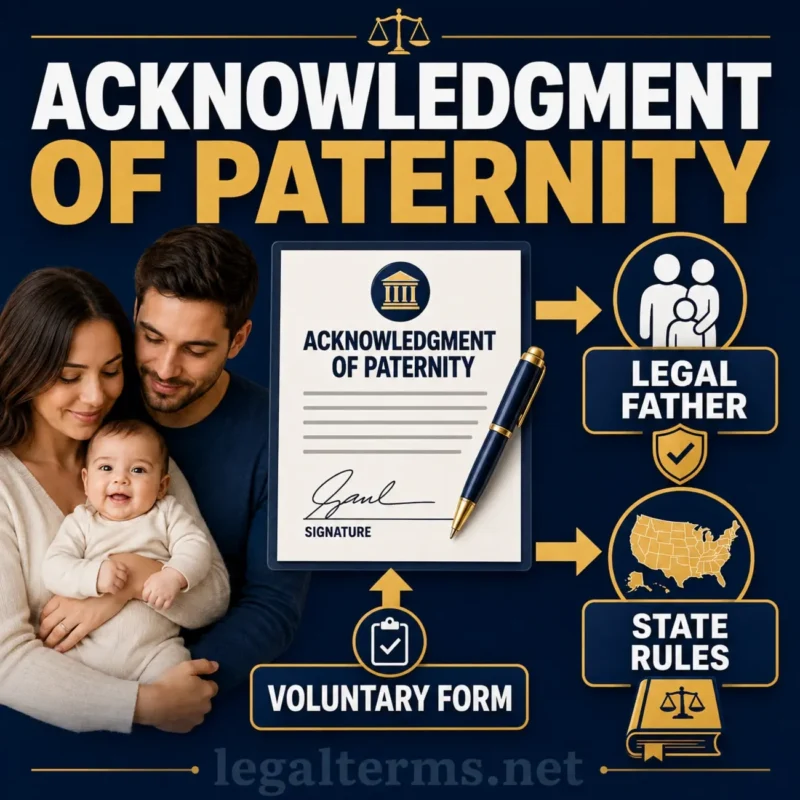
An acknowledgment of paternity is a legal form that names a child’s father without a court hearing. Unmarried parents sign it under penalty of perjury. Once filed, it carries the same weight as a judge’s order. This guide explains what it does, why it matters, and how the rules differ by state.
What Is an Acknowledgment of Paternity?
An acknowledgment of paternity is a sworn document. A man and a child’s mother both sign it. By signing, they confirm that the man is the child’s father. The statement is made under penalty of perjury.
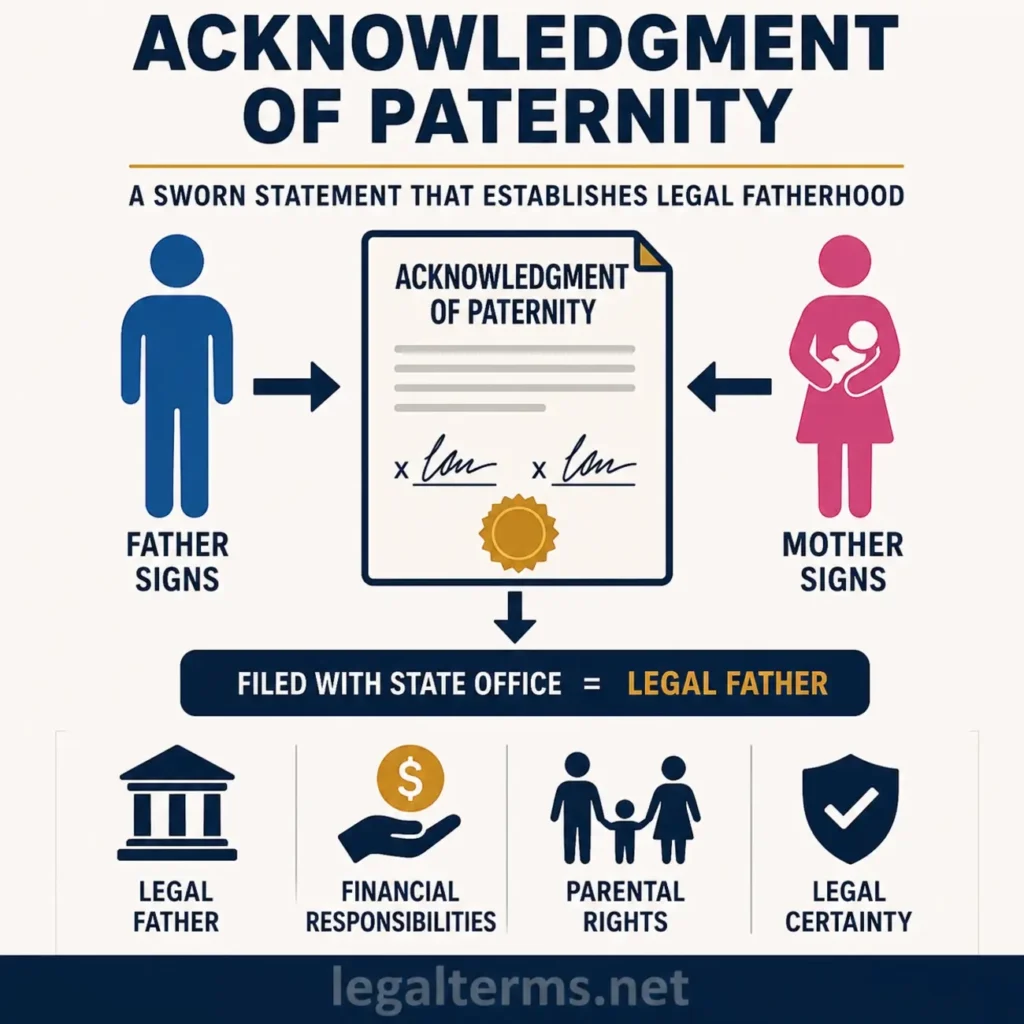
The form is mainly used by unmarried parents who agree on the father’s identity. When parents are married, the law usually presumes the husband is the father. Unmarried fathers have no automatic legal tie to a child. The acknowledgment creates that tie.
In its core function, the document works like a sworn legal affidavit. Both parents declare facts they swear are true. Filing it with the right state office turns those statements into a legal finding.
Once the completed form reaches the state birth records or vital statistics office, the man becomes the legal father. He gains all the rights and duties of a parent. No separate court order is needed. The acknowledgment itself is the legal finding of paternity.
States use slightly different names for the same document. You may see Voluntary Acknowledgment of Paternity (VAP), Affidavit of Parentage, Voluntary Declaration of Parentage, or Acknowledgment of Parentage. The label changes, but the legal effect is broadly the same across the country.
Why an Acknowledgment of Paternity Matters?
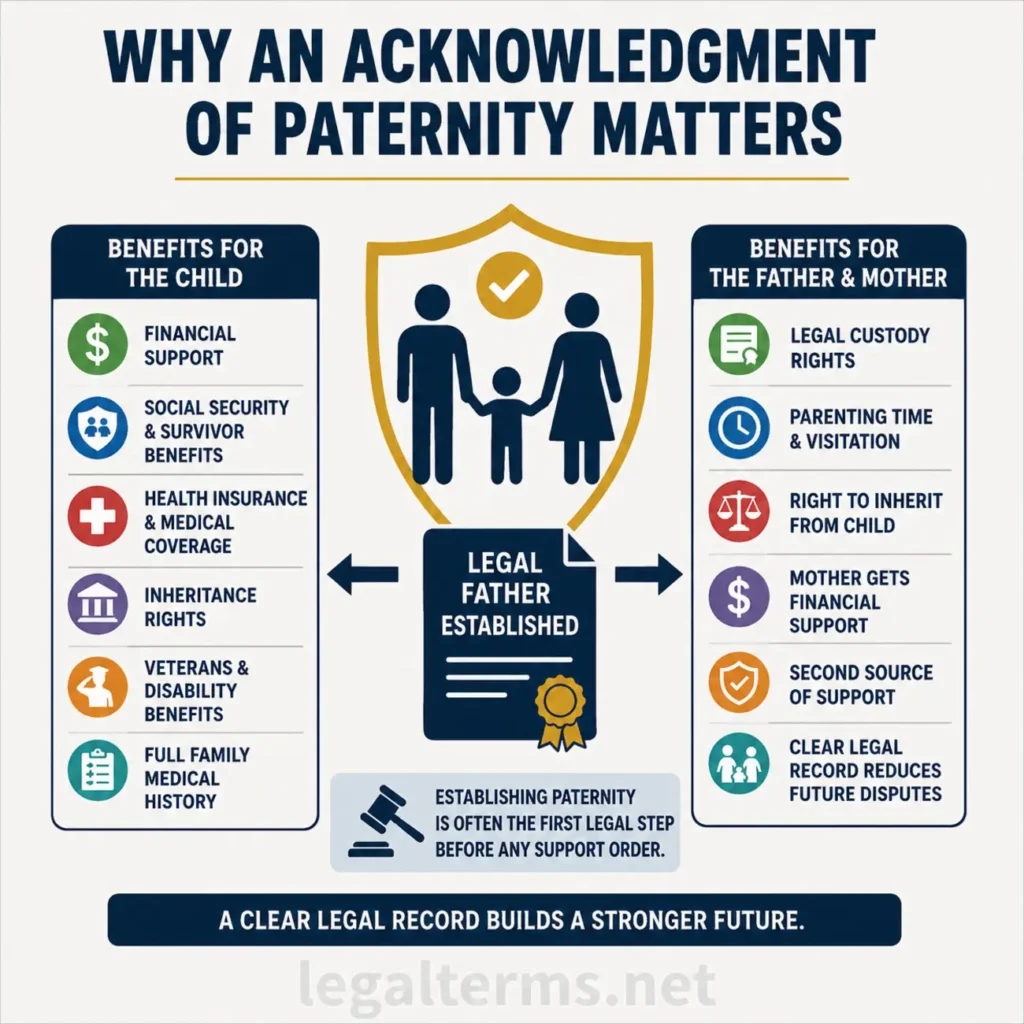
Establishing paternity protects the child first. A child with a legal father gains access to support and benefits that depend on a parent-child link.
These benefits often include the following:
- Financial child support from the father
- Social Security and survivor benefits
- Health insurance and medical coverage
- Inheritance rights from the father
- Veterans and disability benefits when available
- A full family medical history
Medical history alone can be vital. Children have a right to know about inheritable health conditions. Without a legal father on record, that information can be lost.
A court cannot order a father to pay support until paternity is established. So the acknowledgment is often the first legal step before any support order. It removes the need for a separate paternity lawsuit.
The father gains protected interests as well. His name can go on the birth certificate. He gains standing to seek legal custody, parenting time, or visitation. He can also inherit from the child in many states.
The mother benefits too. She secures a second source of financial support. She also shares the duty to provide medical coverage. For the whole family, a clear legal record reduces future disputes.
Biological, Legal, and Presumed Fathers Are Not the Same
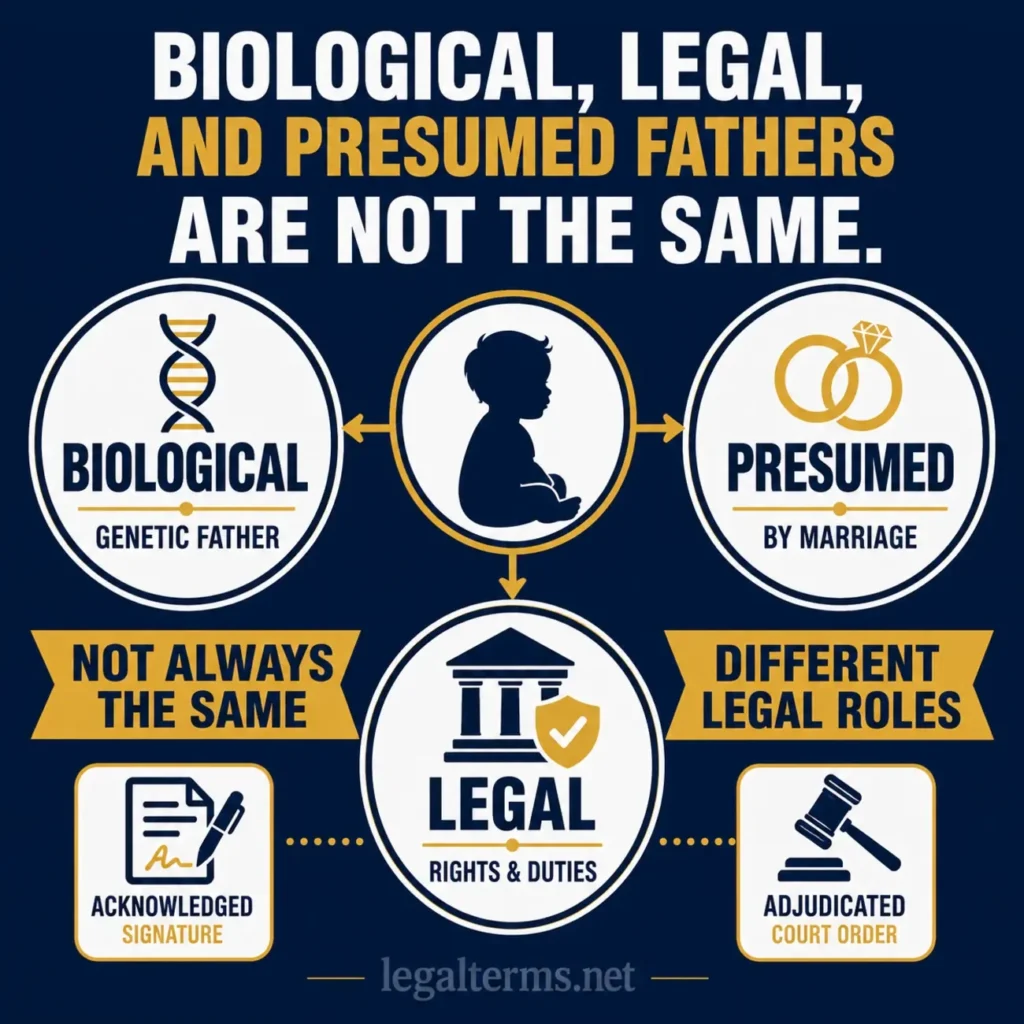
People often treat “father” as one idea. In law, the word splits into several roles. The acknowledgment of paternity sits at the center of these distinctions.
A biological father is the genetic parent. A legal father is the man the law recognizes, with rights and duties. The two are usually the same person, but not always.
A presumed father is recognized by law because of certain facts. The most common trigger is marriage. If a mother is married when the child is born, her husband is the presumed father. The presumption often extends to a child born within 300 days after a divorce.
An acknowledged father is a man who signs a valid acknowledgment of paternity. An adjudicated father is a man named by a court order after a contested case. Each path leads to the same legal status, but through a different process.
These roles matter because they can conflict. A biological father may want rights while a presumed father already holds them. When roles overlap, extra steps are needed before an acknowledgment can take effect.
The Federal Framework Behind Every State’s Form
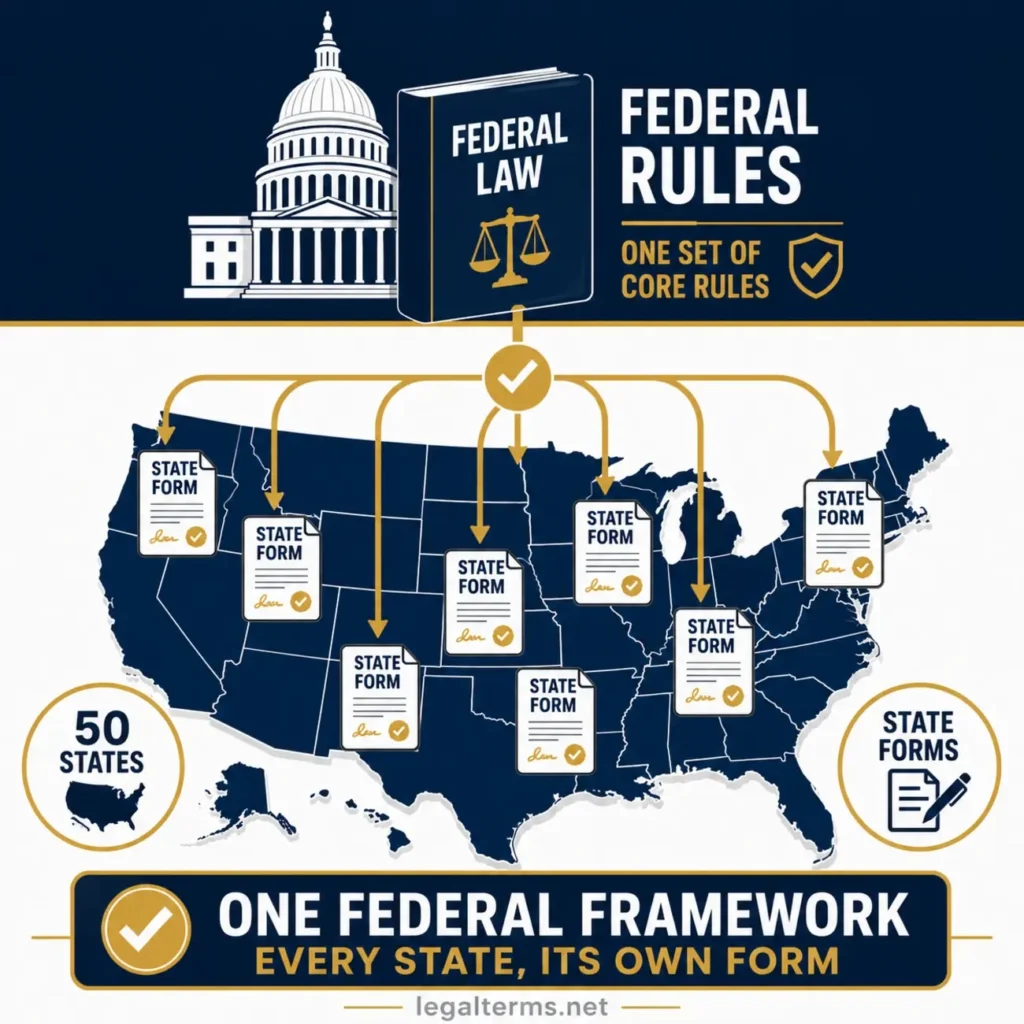
Acknowledgment of paternity is not purely a state invention. A federal law sets the floor for all 50 states. This is why the core rules look so similar from coast to coast.
The Personal Responsibility and Work Opportunity Reconciliation Act of 1996 created the modern system. People often call it welfare reform. It built a voluntary path to establish paternity for children born to unmarried parents.
The rules appear in Title 42 of the U.S. Code, Section 666. States must follow them to keep federal child support funding under Title IV-D. No state wants to lose that money, so compliance is near universal.
The federal statute requires several specific features. Each state must offer a simple civil process to acknowledge paternity. Each must run a hospital-based program around the time of birth.
Before signing, parents must receive notice of their rights and duties. That notice must come in writing and orally. It must explain the alternatives and the legal consequences of signing.
The form must collect each parent’s Social Security number. A signed acknowledgment counts as a legal finding of paternity. States must give full faith and credit to a valid acknowledgment signed in another state.
Federal law also bars ratification proceedings. Courts cannot be required or even permitted to confirm an unchallenged acknowledgment. The document stands on its own once the rescission window closes.
Because these rules flow from one federal source, paternity establishment is fairly uniform nationwide. The real differences appear in form names, filing offices, and the fine print around challenges.
How to Sign an Acknowledgment of Paternity?
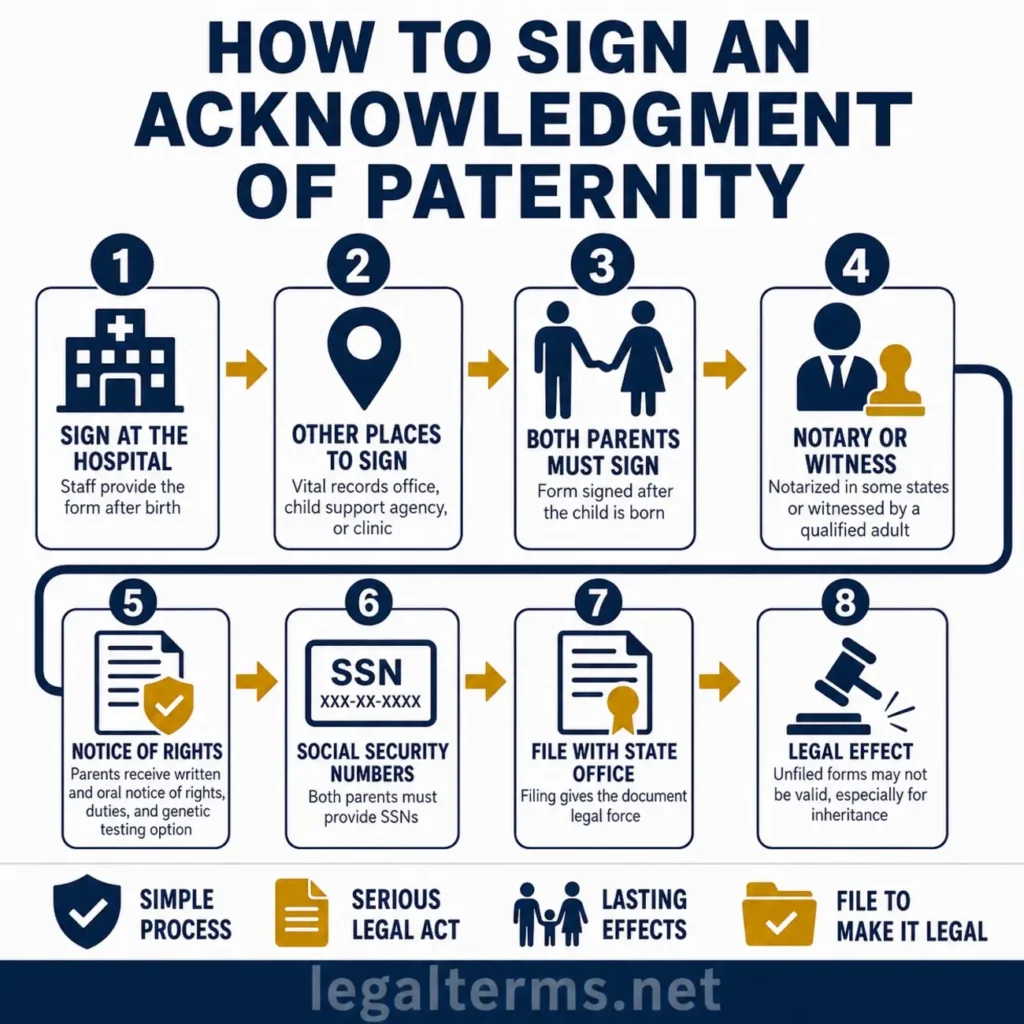
The signing process is designed to be simple. Most parents complete it without a lawyer. Still, it is a serious legal act with lasting effects.
The most common place to sign is the hospital. Staff offer the form soon after the birth. They help the parents complete and file it correctly.
Parents who miss the hospital window have other options. They can sign at a vital records office. Many sign through a state child support agency. Some clinics also offer the form before birth in certain states.
Both parents must sign for the acknowledgment to be valid. The form is signed after the child is born. There is usually no fee for filing it.
Federal rules require a notary or a witness at signing. Some states require the document to be notarized, which links the process to a notary public. Other states accept a qualified adult witness instead.
Parents must receive the required notice before they sign. That notice explains rights, duties, and the chance to request genetic testing. In several states, signing the form waives the right to a genetic test.
Minors can usually sign without a parent or guardian’s permission. The law treats the young parent as competent for this specific act. This rule appears in states such as Texas and Illinois.
After signing, the form is filed with the proper state office. Filing is the step that gives the document legal force. An unfiled acknowledgment may not carry full effect, especially for inheritance.
What Information the Form Requires?
The acknowledgment is short, but every field matters. Errors can cause the state to reject it. A rejected form means paternity is not established.
The document asks for basic identity details about the child. This includes the child’s full name and date of birth. It also records the place of birth.
The form collects details about both parents. Each parent gives a full legal name and date of birth. Federal law requires each parent’s Social Security number on the form.
A section covers the marital status of the mother. She must state whether she was married, or recently divorced, around the time of birth. This answer decides whether a denial of paternity is needed.
The signature block is the heart of the document. Both parents sign under penalty of perjury. A notary or qualified witness signs as well, depending on the state.
The form also confirms that parents received notice. By signing, they certify they understood their rights and duties. They confirm they knew about the option of genetic testing.
Accuracy protects everyone. A clean form moves smoothly through the state office. A form with errors can be rejected, leaving the child without a legal father.
When a Presumed Father Complicates the Process?
A simple acknowledgment assumes there is no competing legal father. That assumption breaks when the mother is married to someone else. Then an extra form is usually required.
Suppose the mother is married, or was recently divorced, when the child is born. Her husband or ex-husband is the presumed father. The biological father cannot simply sign an acknowledgment and take that role.
To fix this, the presumed father must sign a Denial of Paternity. This form states, under penalty of perjury, that he is not the genetic father. It clears the path for the true father’s acknowledgment.
Both forms then work together. The mother and biological father sign the acknowledgment. The mother and presumed father sign the denial. All forms are filed with the state office at the same time.
If the presumed father refuses to sign the denial, the shortcut closes. He remains the legal father by default. The parties may then need a court to sort out paternity.
The 60-Day Rescission Window
Signing an acknowledgment is not always final on day one. Federal law gives both parents a short window to change their minds. This is the rescission period.
Either signatory may rescind the acknowledgment. The right belongs to the mother and to the man who signed. No reason is required during this window.
The window runs for the earlier of two events. The first is 60 days from the signing date. The second is the date of any court or agency proceeding about the child where the signer is a party. Whichever comes first ends the window.
A child support hearing can therefore cut the window short. If a support case starts before day 60, the chance to rescind freely may end early. Parents should act quickly if they have doubts.
To rescind, a parent files the right paperwork. Some states use a simple administrative rescission form. Others require a petition filed in court. Notice to the other parent is generally required.
If the rescission succeeds, the legal record changes. When the father’s name already appears on the birth certificate, a court order can direct its removal. The vital statistics agency then amends the record.
The 60-day rule is a feature, not a flaw. It gives parents a fair chance to reconsider a major decision. After it closes, the law treats the acknowledgment as settled.
Challenging an Acknowledgment After 60 Days
Once the rescission window closes, the acknowledgment hardens. Federal law limits how anyone can attack it. The easy exit is gone.
After 60 days, a signer can challenge the acknowledgment only in court. There are only three accepted grounds. They are fraud, duress, and material mistake of fact.
Fraud means the signer was intentionally deceived. For example, a mother who knew the man was not the father but told him he was, leading him to sign. The deception must be deliberate.
Duress means the signer was threatened or coerced. The signature was not truly voluntary. Pressure must rise above ordinary stress or persuasion.
Material mistake of fact means both parties genuinely believed the man was the father. They signed in good faith. They later discovered, often through DNA, that the belief was wrong.
The burden of proof sits on the person challenging the form. That party must prove the ground by the standard the state sets. Many courts demand clear and convincing evidence.
Federal law adds a hard rule about money. Child support duties continue during the challenge. A court can suspend them only for good cause shown. So a man cannot stop paying just by filing a petition.
State law sets the deadline for these challenges, which works like a statute of limitations. The window after the 60-day period varies. Some states allow two years. Others extend the time, and a few allow challenges at any time.
Genetic testing is often available during a challenge, but it is not a magic key. Courts in many states will order a test once the challenger raises a valid claim. Even so, a DNA exclusion alone may not undo the acknowledgment.
Two doctrines can block a man who is not the biological father. Paternity by estoppel keeps a man bound if he held the child out as his own for years. Res judicata treats the acknowledgment as a final judgment that cannot be relitigated.
Acknowledgment of Paternity by State
The federal floor makes the basic rules consistent. The 60-day window, the fraud, duress, and mistake standard, and the full faith and credit rule apply everywhere. These do not change from state to state.
The differences sit in the details. States vary in the form name, the filing office, the rescission method, and the deadline to challenge after 60 days. A few states also let signers challenge at any time.
The table below summarizes common variations. Always confirm the current rule with the relevant state agency, since procedures are updated over time.
| State | Form name | Where it is filed | Challenge window after 60 days |
|---|---|---|---|
| Texas | Acknowledgment of Paternity (AOP) | Vital Statistics Unit | Court challenge for fraud, duress, mistake |
| California | Voluntary Declaration of Parentage | Dept. of Child Support Services | Generally up to two years |
| New York | Acknowledgment of Parentage | Birth registrar | Petition to vacate for fraud, duress, mistake |
| Illinois | Voluntary Acknowledgment of Paternity (VAP) | Healthcare and Family Services | Generally barred after two years |
| Maryland | Affidavit of Parentage | State health office | Challenge allowed at any time |
| Washington | Acknowledgment of Parentage | State vital records | Up to four years after the effective date |
The following sections add detail for several states with distinctive rules.
Texas
Texas uses the Acknowledgment of Paternity, known as the AOP. Parents complete it with an AOP-certified entity trained by the Attorney General. The completed form is filed with the Texas Vital Statistics Unit.
Once filed, the genetic father becomes the legal father. He takes on all parental rights and duties. The state also runs an AOP hotline to answer questions.
A married mother triggers the denial rule. If she has a husband or recent ex-husband, that man is the presumed father. He must sign a Denial of Paternity before the AOP can establish the genetic father.
To rescind in Texas, a signer files a Rescission of Acknowledgment of Paternity form. This must happen before the 60th day, and before a court case about the child begins. After that, only a court challenge remains.
California
California renamed its document to the Voluntary Declaration of Parentage. The change reflects gender-neutral language under the modern parentage act. The state child support agency oversees the program.
Parents can sign at the hospital, a child support office, or some prenatal clinics. A copy goes to each parent. Out-of-state signing requires notarization.
California keeps the 60-day rescission window. After that, it sets a two-year outer limit to challenge based on fraud, duress, or mistake. The policy assumes that two years of acting as a parent should settle the question.
California does not offer a separate denial-of-parentage procedure in the same way some states do. The state has adopted the 2017 parentage model, which broadens who can sign.
New York
New York now uses the Acknowledgment of Parentage. Older forms were titled Acknowledgment of Paternity. The document carries the same force as a court order of filiation.
To rescind, a signer files a petition to vacate with the family court. The deadline is the earlier of 60 days or a related child proceeding. After that, only fraud, duress, or material mistake of fact will work.
New York courts apply equitable estoppel firmly. A man who acted as the father for a long time may be stopped from denying paternity. This holds even when DNA shows no biological link.
The state also files copies with the birth registrar and a putative father registry. Inheritance rights depend on proper filing with the registrar.
Illinois
Illinois uses the Voluntary Acknowledgment of Paternity, or VAP. The form is filed with the state Healthcare and Family Services agency. Each parent signs before a witness who is 18 or older.
The witness cannot be a parent or child named on the form. Signing the VAP also waives the right to a genetic test. Minors may sign and have the form witnessed without a guardian’s permission.
A married mother, or one in a civil union, triggers the denial rule. The presumed parent must sign a Denial of Parentage. Without it, the presumed parent stays the legal parent.
Either parent can rescind by filing a Rescission of VAP within 60 days or before a related proceeding. After that, a challenge is generally not allowed after two years.
Maryland
Maryland uses the Affidavit of Parentage. Notarization is required when the form is not completed in the hospital at birth. The state recognizes the standard 60-day rescission window.
Maryland is notable for its open challenge window. Courts can revisit paternity at any time under the right conditions. This sets it apart from states with strict deadlines.
State courts allow genetic testing for a material mistake claim after 60 days. Yet a test result alone does not undo the affidavit. The challenger must still prove fraud, duress, or material mistake of fact.
Maryland case law also created an exception. A man who signed while knowing he was not the father may lose the usual right to testing. The court will not reward a knowing misstatement.
Washington
Washington uses the Acknowledgment of Parentage under the 2017 model act. A notarial officer or a third-party witness must be present at signing. The form takes effect at the child’s birth or when filed.
Washington extends the challenge window beyond the federal floor. After the rescission period, a signer has up to four years to challenge the document. The grounds remain fraud, duress, or material mistake of fact.
The state protects the child during contested testing. A guardian ad litem must represent the child in any motion for genetic testing. This safeguard keeps the child’s interests in view.
States That Allow Challenges at Any Time
Most states impose a firm deadline to challenge an acknowledgment. A small group does not. These states allow a paternity challenge at any time under their statutes.
This group includes Colorado, Louisiana, Maryland, Michigan, and Virginia. In these states, the door to a court challenge stays open longer. The challenger still carries the burden of proof.
An open window does not guarantee success. Doctrines like estoppel and the child’s best interests still apply. Courts weigh stability for the child against the truth of biology.
Acknowledgment of Parentage and Same-Sex Couples
The original system was written for one man and one woman. Modern family law has moved past that frame. The acknowledgment process now reaches more families.
The 2017 revision of the model parentage act rewrote the rules in gender-neutral terms. It renamed the document the acknowledgment of parentage. The change lets same-sex couples use the same simple process.
The revised act expanded who can sign. It now includes an alleged genetic parent, an intended parent, and a presumed parent. Some states also recognize a de facto parent who has acted as a parent.
Adoption of the new rules is uneven. Only a handful of states had enacted the 2017 version in recent years. Others still use older models or their own statutes.
Several states expanded access through their own laws. They include California, Washington, Maryland, New York, Nevada, Colorado, Michigan, Hawaii, Oregon, Illinois, and the New England states. Rules differ slightly in each one.
In states that have not updated their laws, gaps remain. A non-biological parent in a same-sex couple may still need a second-parent adoption. A court order can also secure parental rights where the form does not reach.
Key Court Decisions That Shaped Paternity Law
Statutes set the rules, but courts give them meaning. A few decisions explain how presumptions and acknowledgments hold up. They show why these documents are hard to undo.
In Michael H. v. Gerald D. (1989), the U.S. Supreme Court reviewed a strong marital presumption. California treated a child of a married, cohabiting couple as the husband’s child. A biological father challenged that rule on due process grounds.
The Court upheld the presumption. It found that the biological father had no protected right to override the marital family. The case shows how powerful a legal presumption can be, even against genetic truth.
In Stanley v. Illinois (1972), the Court explained why presumptions exist. Justice White noted that it is often more convenient to presume than to prove. Presumptions add efficiency and certainty to family law.
Maryland’s Faison v. Montgomery County Office of Child Support Enforcement (2017) addressed challenges to an affidavit of parentage. The court allowed genetic testing for a material mistake claim. Yet it warned that a test result is not enough by itself, and it carved out an exception for a man who signed knowing he was not the father.
The earlier Langston v. Riffe (2000) decision in Maryland also shaped testing rights. It helped define when a man can seek genetic testing to revisit paternity. These cases built Maryland’s open-challenge approach.
Vermont’s Godin v. Godin (1998) protected long-settled relationships. A presumed father sought DNA testing 15 years after the birth. The court refused it absent a clear showing that testing served the child’s best interests.
Together, these cases reveal a pattern. Courts favor stability and the child’s welfare. The longer a man acts as a father, the harder it becomes to walk away.
Common Mistakes to Avoid With an Acknowledgment
The form looks simple, which is part of the risk. People sign quickly and regret it later. A few mistakes appear again and again.
The biggest mistake is signing without certainty. A man who has any doubt should request a genetic test first. Signing the form often waives that right.
Signing under hospital pressure is another trap. The moment is emotional and busy. Parents should still read the notice and understand the consequences before they sign.
Missing the 60-day window causes hardship. After it closes, the easy exit disappears. The only path left is a hard court challenge with a heavy burden.
Many people assume DNA alone reverses everything. It does not. A man must still prove fraud, duress, or material mistake of fact, and estoppel may block him.
Failing to file the form is a quiet error. An unsigned or unfiled document may not carry full legal effect. Inheritance rights in particular can depend on proper filing.
Finally, people forget that the form is permanent like a judgment. It is not a casual paper. It creates lasting duties, including child support that continues during any challenge.
Acknowledgment of Paternity vs Court-Ordered Paternity
There are two main ways to establish legal fatherhood. One is the voluntary acknowledgment. The other is a court adjudication. They reach the same status by different routes.
The acknowledgment suits parents who agree. It is fast, low cost, and avoids court. The court route fits parents who dispute paternity or refuse to cooperate.
The table below compares the two paths.
| Feature | Acknowledgment of Paternity | Court-Ordered Paternity |
|---|---|---|
| Agreement needed | Both parents must agree | No agreement required |
| Process | Administrative form | Civil court case |
| Genetic testing | Often optional or waived | Often ordered if contested |
| Cost and speed | Usually free and fast | Slower, with court costs |
| Final result | Legal finding of paternity | Judgment of paternity |
Both outcomes carry full legal weight. Both can support child support, custody, and inheritance claims. The right path depends on whether the parents agree.
What an Acknowledgment of Paternity Does Not Do
People often expect the form to settle everything. It does not. Understanding its limits prevents costly surprises later.
The acknowledgment does not set a custody arrangement. It gives the father standing to ask for custody. The actual schedule still needs a separate court order.
The form does not create a visitation plan. Parenting time is decided through agreement or by a judge. The acknowledgment is only the gateway to those rights.
It does not fix a child support amount. It makes support possible by naming a legal father. A support order must still calculate the dollar figure.
The document does not replace adoption. Adoption transfers full parental rights, often to a non-biological parent. The acknowledgment simply records an existing parent-child link.
It also does not erase a presumed father on its own. When a husband is involved, a denial of paternity is needed. Without that, the presumed father stays in place.
Finally, it does not pause once signed. The duties begin right away. They continue even while a later challenge moves through the courts.
Question and Answers
Is an acknowledgment of paternity the same as a court order?
In legal effect, yes. Once signed and filed, it counts as a legal finding of paternity. You do not need a separate court order to confirm it.
Can a man undo an acknowledgment if DNA proves he is not the father?
Not automatically. After 60 days, he must prove fraud, duress, or material mistake of fact in court. A DNA exclusion helps but may not be enough on its own.
Does signing the form give the father custody rights?
It gives him legal standing to seek custody or visitation. It does not grant custody by itself. A separate court order sets the actual parenting arrangement.
What happens if the mother is married to someone else?
Her husband is usually the presumed father. He must sign a denial of paternity before the biological father’s acknowledgment can take effect.
Can a minor sign an acknowledgment of paternity?
Yes, in most states. A young parent can sign without a parent or guardian’s permission. The form still carries full legal weight.
How long do I have to cancel an acknowledgment?
You have 60 days, or until a related court case about the child begins, whichever comes first. After that, you can only challenge it in court on limited grounds.
Does the form work the same in every state?
The core rules are uniform because of federal law. The form name, filing office, and challenge deadlines can differ by state.
Legal References and Sources
- Office of the Law Revision Counsel, 42 U.S.C. Section 666, Requirement of Statutorily Prescribed Procedures
- Legal Information Institute, Cornell Law School, 42 U.S.C. Section 666
- U.S. Department of Health and Human Services, Office of Child Support, Essentials for Attorneys in Child Support Enforcement
- Uniform Law Commission, Uniform Parentage Act (2017)
- Texas Office of the Attorney General, Acknowledgment of Paternity (AOP)
- TexasLawHelp.org, Acknowledgment of Paternity and Denial of Paternity
- New York State Office of Temporary and Disability Assistance, Acknowledgment of Parentage (LDSS-5171)
- Illinois Department of Healthcare and Family Services, Voluntary Acknowledgment of Paternity
- Maryland People’s Law Library, Disestablishing Paternity
- Washington Courts, Parentage and the Uniform Parentage Act
- GLAD Law, Voluntary Acknowledgment of Parentage FAQ
- Michael H. v. Gerald D., 491 U.S. 110 (1989)
- Faison v. Montgomery County Office of Child Support Enforcement, 235 Md. App. 76 (2017)
- Godin v. Godin, 725 A.2d 904 (Vt. 1998)

Hamit Sahin is the founder and editor of LegalTerms.net. He researches U.S. legal terminology and publicly available legal information using statutes, court rules, judicial opinions, government publications, and established legal reference sources.
His work focuses on organizing complex legal concepts into clear, plain-English explanations for general educational purposes.
Hamit is not an attorney and LegalTerms.net does not provide legal advice.