What Is a Summary Proceeding and How Does It Work?
A summary proceeding is a fast, narrow court process used to settle one specific legal question without a full trial. It is common in evictions, small claims, and minor offenses. This guide explains what it is, the main types, and how it differs from ordinary litigation in 2026.
Quick Answer: Key Points at a Glance
- A summary proceeding is an expedited court case that decides a single, defined issue.
- It skips most of the steps of a regular lawsuit, such as broad discovery and long pleadings.
- The most common example is a landlord-tenant eviction, often called summary process.
- “Summary” means streamlined, not “without a hearing.” You still get your day in court.
- The losing side can often still raise other claims later in a separate, ordinary lawsuit.
What Is a Summary Proceeding?
A summary proceeding is a court action designed to resolve a narrow dispute quickly, using a simplified procedure set by statute. The goal is speed and finality on one issue, not a complete examination of every grievance between the parties.
Courts created summary proceedings because some disputes cannot wait. A landlord who is not being paid, a city enforcing a small fine, or a creditor seeking quick relief all need an answer in days or weeks, not years. To deliver that speed, the law trims away most of the machinery of a normal case.
In practice, a summary proceeding usually has a few defining features. The pleadings are short, sometimes just a fill-in form. Discovery is limited or nonexistent. There is often no jury, so a judge decides. The court focuses on one question, such as who is entitled to possession of a property, and sets aside everything else.
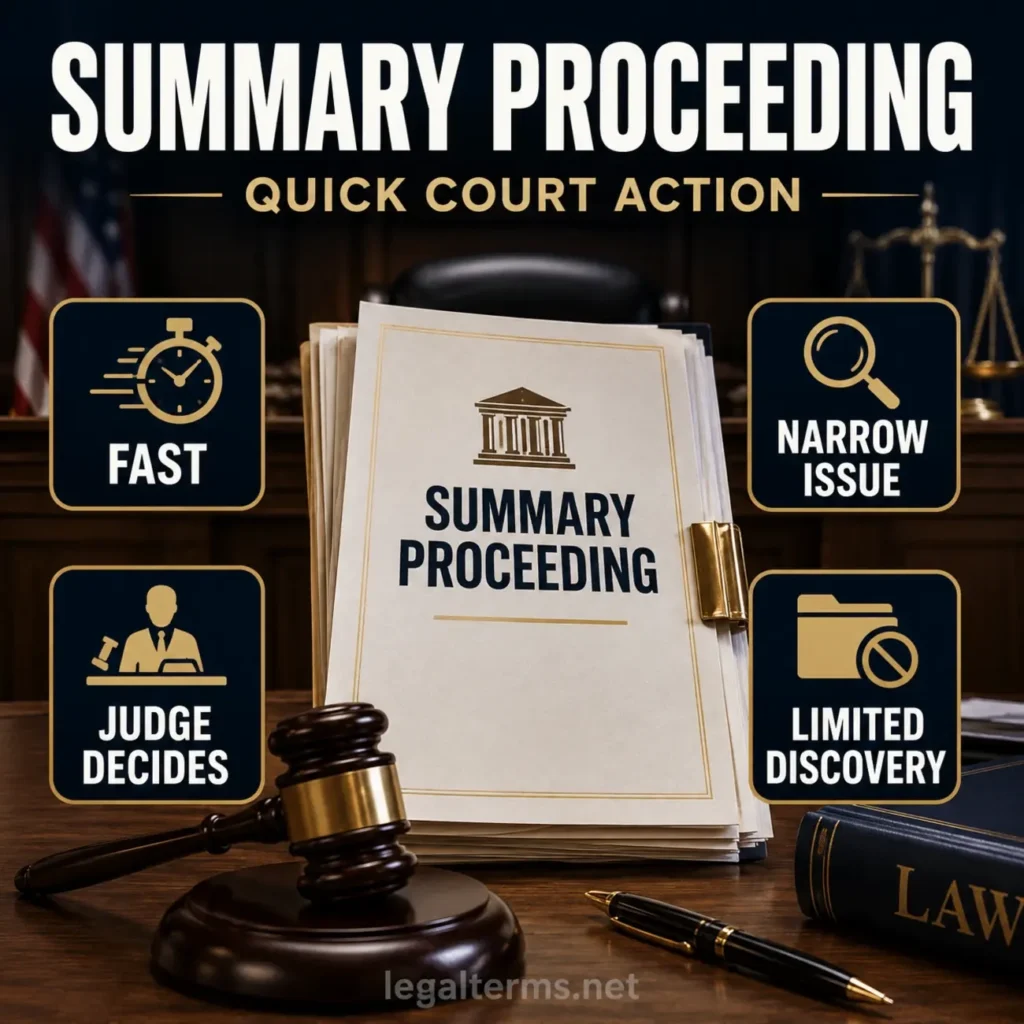
This focus is the heart of the concept. A summary proceeding does not try to do justice on all fronts at once. It answers the urgent question, then sends the parties on their way. Anyone who wants to litigate broader claims usually has to file a separate, ordinary case to do it.
The word “summary” here describes the procedure, not the outcome. It does not mean the decision is automatic or that the defendant is silenced. The defendant still receives notice and a chance to be heard. What changes is the pace and the scope, not the basic right to a hearing.
How a Summary Proceeding Differs From a Full Trial
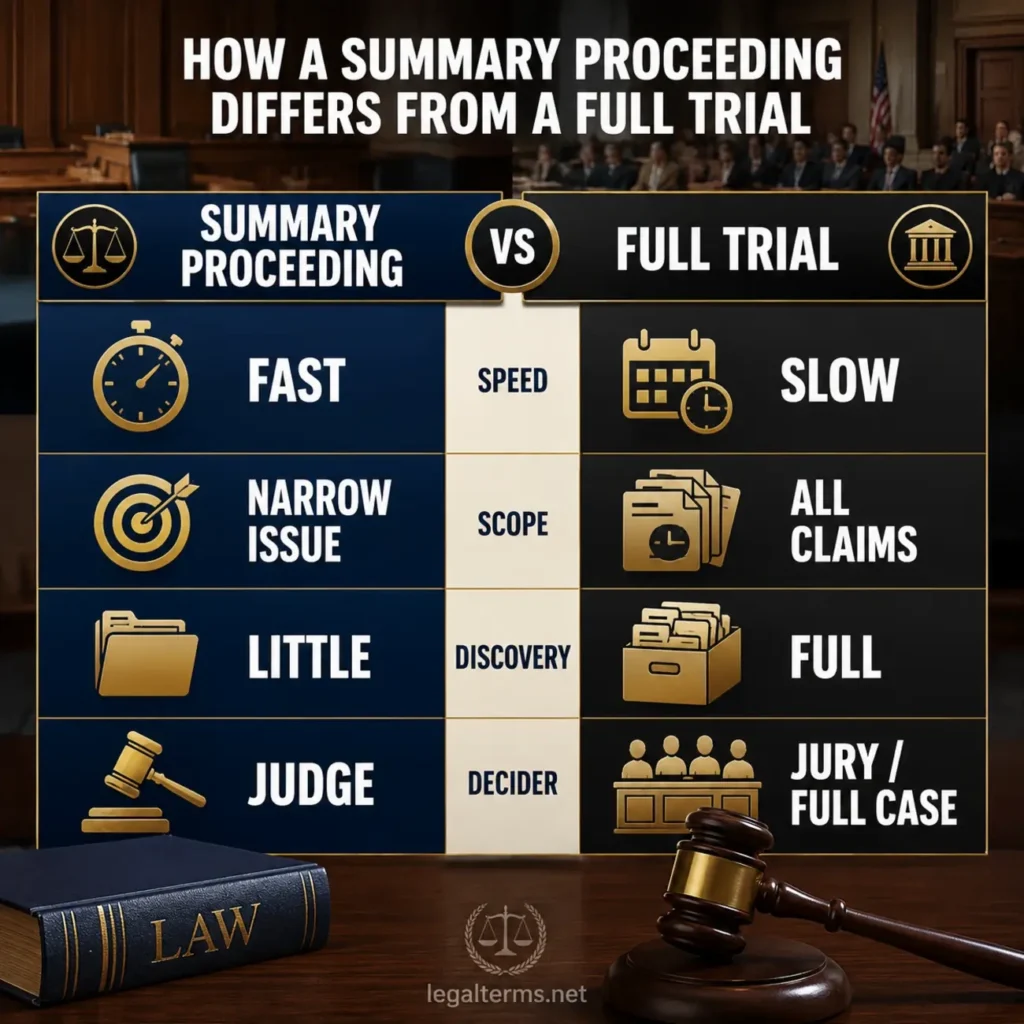
The clearest way to understand a summary proceeding is to compare it to a normal lawsuit. In ordinary civil litigation, the process is thorough and slow because the court tries to resolve every claim with full procedural protections.
A summary proceeding strips that down to the essentials. The table below shows the core contrasts.
| Feature | Summary proceeding | Full trial |
|---|---|---|
| Speed | Days to a few weeks | Many months to years |
| Pleadings | Minimal, often a single form | Detailed complaint and answer |
| Discovery | Little or none | Full discovery and depositions |
| Issues decided | One narrow question | All claims and counterclaims |
| Jury | Usually none, a judge decides | Available for many claims |
| Evidence | Brief, often documentary | Full witnesses and exhibits |
| Appeal | Allowed, sometimes a new trial | Allowed, usually on the record |
The biggest practical difference is scope. A full case lets each side raise every related claim and counterclaim. A summary proceeding refuses to hear most of them. That refusal is what makes the process fast, and it is also its main limitation.
This is why a tenant cannot usually turn an eviction hearing into a wide dispute about repairs, harassment, or damages. Those issues may be real and important. They simply belong in a regular civil lawsuit, not in the summary case about possession.
Speed comes at a cost. Short deadlines and limited discovery can pressure an unprepared party, especially someone without a lawyer. The trade-off is deliberate. The law accepts a narrower process in exchange for a quick, peaceful resolution of an urgent dispute.
Summary Proceeding vs Summary Judgment
People often confuse a summary proceeding with summary judgment. They share a word, but they are very different things, and mixing them up causes real mistakes.
A summary proceeding is a type of case. It is an entire action built to move quickly from start to finish on one issue. It is its own track through the court system.
Summary judgment is a motion inside a normal case. A party files a motion for summary judgment to ask the judge to decide the case, or part of it, without a trial because the key facts are not genuinely disputed. The lawsuit itself is still an ordinary one, with full pleadings and discovery behind it.
Think of it this way. A summary proceeding is a fast lane you enter from the beginning. Summary judgment is an exit ramp you can take partway through a regular trip. One defines the whole journey. The other ends a journey that started on the standard road.
There is a third source of confusion worth naming. In criminal law, a “summary offense” and “summary contempt” both use the same word again. None of these three ideas are interchangeable, and treating them as the same concept is the single most common error people make with this term.
Common Types of Summary Proceedings
Summary proceedings appear across many areas of law. The label fits any case where a statute provides a faster, narrower path than ordinary litigation. The most frequent examples are below.
Landlord-Tenant Eviction (Summary Process)
This is by far the most common summary proceeding the average person will ever see. It goes by several names, including summary process, unlawful detainer, and forcible entry and detainer. Whatever it is called, its purpose is the same, which is to decide quickly who has the legal right to possess a property.
Small Claims Court
Small claims courts run a simplified, summary-style process for low-value disputes. Filing is easy, lawyers are often discouraged or barred, and a judge hears the case in a short session. The streamlined design mirrors the same goal of fast, affordable resolution.
Summary Criminal Offenses
Minor offenses, sometimes called petty offenses, can be tried without a jury in a quick hearing before a judge. Many traffic violations and low-level misdemeanors move through this kind of summary process, where the penalties are limited and the procedure is compressed.
Summary Contempt
When someone disrupts a courtroom in the judge’s presence, the judge can impose punishment immediately, without a separate trial. This is summary contempt. It is a narrow power, reserved for conduct the judge personally witnesses, and serious contempt still requires fuller procedures.
Special Statutory Proceedings
Many statutes create their own summary tracks. Examples include actions to confirm or vacate an arbitration award, mechanic’s lien enforcement, certain probate matters, and some debt-collection steps. Each is built to settle a defined question without a full trial.
How a Summary Eviction Proceeding Works
Because eviction is the summary proceeding most people encounter, it helps to walk through the typical steps. The exact rules vary by state and even by county, but the structure is broadly similar across the United States in 2026.
First comes notice. Before filing, the landlord usually must give the tenant a written notice, such as a notice to pay rent or quit, or a notice to vacate. The notice period is set by state law and can range from a few days to a month or more.
Second comes the filing. If the tenant does not pay or leave, the landlord files a short complaint with the court and the tenant is formally served. The complaint is narrow. It states the property, the basis for possession, and the relief sought.
Third comes a fast hearing. Courts schedule eviction hearings far sooner than ordinary trials, often within one to a few weeks. At the hearing, the judge focuses almost entirely on possession, meaning who is legally entitled to be there.
Fourth comes the judgment. If the tenant does not appear, the landlord can usually win a default judgment without a contest. If the tenant appears and raises a valid defense, the judge weighs it, but only the defenses the statute allows.
Fifth comes enforcement. A judgment for possession does not let the landlord remove the tenant personally. Instead, a court officer, such as a sheriff or marshal, carries out the removal under a writ. Self-help eviction, like changing the locks, is illegal in most states.
Throughout, the tenant keeps an important right. Claims that fall outside the possession question, such as a demand for damages over poor conditions, are not erased. They can be pursued in a separate civil case, even after the eviction is decided.
Summary Proceedings in Criminal Court
On the criminal side, a summary proceeding means a quick prosecution of a minor offense without a jury. The judge hears the evidence and decides guilt and punishment in a single, compressed process.
This is allowed only for offenses the law treats as minor. The line is drawn by the possible punishment. When the potential jail time is low, the Constitution does not require a jury, so the case can proceed summarily.
When the stakes rise, the protections expand. An offense that can lead to more than six months in jail is treated as serious. At that point the accused is entitled to a jury trial, and a summary, no-jury process is no longer permitted.
Summary contempt sits in its own corner of criminal procedure. A judge can punish disruptive conduct that happens in open court on the spot, because the judge witnessed it and the court must keep order. This power is intentionally narrow, and harsher contempt sanctions trigger fuller procedural rights.
These criminal summary processes show the same pattern as the civil ones. Speed is allowed when the stakes are low. As the potential punishment grows, the law restores the slower, more protective procedures of a full trial.
What Courts Have Said
The Supreme Court has directly addressed whether fast, narrow proceedings are constitutional, and the answer is a qualified yes. States may expedite these cases, but they cannot use speed to strip away basic fairness.
The leading case on civil summary proceedings is Lindsey v. Normet, decided in 1972. Tenants challenged Oregon’s eviction statute, arguing that its quick trial timeline and its refusal to hear certain defenses violated their constitutional rights.
The Court upheld the core of the fast process. It ruled that a state may insist on a speedy hearing limited to the possession question, and that excluding unrelated defenses from that narrow case does not by itself violate due process. The reasoning was that the tenant could still litigate other claims in a separate action.
The Court did draw a line, however. It struck down a requirement that a tenant post a bond in double the rent simply to appeal, finding that this unfairly singled out eviction defendants. The lesson is that speed is permitted, but arbitrary barriers to a fair appeal are not.
On the criminal side, Baldwin v. New York from 1970 set the boundary for summary, no-jury trials. The Court held that any offense carrying more than six months of possible imprisonment is serious enough to require a jury. Below that threshold, a summary bench process is constitutional.
Together these cases frame the rule. Summary proceedings are a legitimate tool for handling urgent or minor matters efficiently. They remain valid only when they preserve notice, a real chance to be heard, and a fair route to challenge the result.
Due Process Limits on Summary Proceedings
Even the fastest proceeding must satisfy due process. This constitutional floor cannot be traded away for the sake of efficiency, no matter how minor the dispute appears.
The guarantee of due process requires two basic things in any proceeding that can take your property or liberty. The first is notice, meaning you must be told that a case is being brought and what it concerns. The second is an opportunity to be heard before a neutral decision-maker.
A summary proceeding can compress these protections, but it cannot eliminate them. The notice period may be short, yet it must exist. The hearing may be brief, yet it must be real. A judge who decided possession with no notice to the tenant would cross the constitutional line.
What due process does not guarantee is unlimited scope. It does not entitle a party to raise every conceivable claim in the summary case. The narrow focus is lawful, as long as the excluded claims can be pursued somewhere else.
This balance explains why summary proceedings survive constitutional challenge. They limit what a court will hear in one sitting, but they keep the essentials of notice and a hearing intact. Procedure is shortened, fairness is not abandoned.
Advantages and Disadvantages
A summary proceeding is a deliberate trade-off. It buys speed and low cost by giving up breadth and some procedural protection. Whether that trade is good depends entirely on which side you are on and what you need.
| Strengths | Limits |
|---|---|
| Resolves urgent disputes in days or weeks | Decides only one narrow question |
| Costs far less than full litigation | Little or no discovery to build a case |
| Eases court backlogs and delays | Short deadlines pressure unrepresented parties |
| Follows clear, statute-driven steps | Most counterclaims must be raised separately |
For a plaintiff with a strong, simple claim, the speed is a major advantage. A landlord owed rent or a creditor with clear documents can get an answer fast and at low cost.
For a defendant with a complicated story, the same speed can feel harsh. A tenant who wants to argue about repairs, retaliation, and damages may find the court unwilling to hear most of it in the summary case. Those arguments are not lost, but they have to move to a slower forum.
What to Do If You Are Facing a Summary Proceeding
If you are served with a summary proceeding, the worst response is to ignore it. The short timeline is unforgiving, and missing the hearing usually means an automatic loss against you.
Read the papers immediately and note every deadline. Summary cases move in days, not months. The date on the notice is not a suggestion, and a late response can forfeit defenses you would otherwise be allowed to raise.
Identify the one issue the court will decide. In an eviction, that issue is possession. Focus your preparation on the defenses the statute actually permits for that issue, rather than on grievances the court will not hear in this case.
Gather your documents. Summary proceedings lean heavily on paper, such as the lease, the notice, payment records, and any written communications. Clear documents often matter more here than lengthy testimony.
Show up, on time, every time. If you cannot attend, ask the court about a continuance before the date, not after. If you lose, ask promptly about your right to appeal the ruling, because appeal deadlines in summary cases are also very short.
Finally, get advice tailored to your situation. Rules differ sharply by state and by court, and the stakes, such as losing your home, can be serious. A licensed attorney in your area can tell you which defenses apply and how the local process works. This article is general information, not legal advice.
A Few Cautions
Treat any general description of summary proceedings as a starting point, not a final answer for your state. The names, deadlines, and allowed defenses vary widely, and a rule that holds in one place may not hold in another.
Do not assume “summary” means you have no rights. It does not. You are entitled to notice and a genuine hearing, and a process that denies those basics may be challenged. Knowing this can change how you respond.
Also be careful not to confuse the three uses of the word. A summary proceeding, a summary judgment motion, and a summary criminal offense are distinct. Acting on the wrong one can cost you a defense or a deadline.
Finally, this content does not constitute legal advice and does not create an attorney-client relationship. If you are facing a real summary proceeding, consult a licensed attorney in your jurisdiction who can apply the current law to your specific facts.
Frequently Asked Questions
Question: What is a summary proceeding in simple terms? Short answer: It is a fast court case that decides one specific issue without a full trial. Pleadings are short, discovery is limited, and a judge usually decides. Evictions and minor offenses are the most common examples.
Question: Is a summary proceeding the same as summary judgment? Short answer: No. A summary proceeding is an entire fast-track case. Summary judgment is a motion filed inside a normal lawsuit to end it early without a trial. They share a word but work very differently.
Question: Do you still get a hearing in a summary proceeding? Short answer: Yes. “Summary” describes the speed and narrow scope, not the absence of a hearing. You are entitled to notice and a real chance to be heard. What is limited is the range of issues the court will consider.
Question: Can you have a jury in a summary proceeding? Short answer: Usually not. A judge typically decides. In criminal matters, a no-jury summary process is allowed only for minor offenses, generally those carrying six months or less of possible jail time.
Question: What happens if I miss a summary proceeding hearing? Short answer: The other side can often win a default judgment against you without a contest. Because the timeline is short, missing the date can be very costly. Contact the court immediately if you cannot attend.
Question: Can I raise other claims later if I lose a summary proceeding? Short answer: Often yes. Claims outside the narrow issue, such as a demand for damages, are usually not erased by the summary case. You can typically pursue them in a separate, ordinary lawsuit.
References and Sources
- Lindsey v. Normet, 405 U.S. 56 (1972), United States Supreme Court.
- Baldwin v. New York, 399 U.S. 66 (1970), United States Supreme Court.
- Legal Information Institute, Cornell Law School, entries on forcible entry and detainer, unlawful detainer, and summary process.
- U.S. Courts, civil and criminal procedure overviews.
About This Article
This article was written and edited by Hamit Sahin, Legal Researcher and Editor at LegalTerms.net. It was last reviewed and updated in 2026 to reflect current procedure and case law.
Disclosure: LegalTerms.net is an independent educational resource. It does not provide legal services and has no commercial relationship with any party named in the cases discussed.
Disclaimer: This article is general legal information, not legal advice, and does not create an attorney-client relationship. Laws and court rules vary by jurisdiction and change over time. For guidance on your specific situation, consult a licensed attorney in your state.

Hamit Sahin is the founder and editor of LegalTerms.net. He researches U.S. legal terminology and publicly available legal information using statutes, court rules, judicial opinions, government publications, and established legal reference sources.
His work focuses on organizing complex legal concepts into clear, plain-English explanations for general educational purposes.
Hamit is not an attorney and LegalTerms.net does not provide legal advice.