What Is Severability? A Plain-English Guide to Severability Clauses
Imagine you sign a one-year lease for an apartment. Buried in the fine print is a clause saying the landlord can enter your unit without any notice, at any time. A court later rules that clause is illegal under your state’s tenant protection laws. Does that mean your entire lease falls apart? Do you suddenly have no place to live?
In most cases, no. The rest of your lease survives. That is severability at work.
Severability is the legal concept that keeps a contract or a law standing even when one part of it is struck down. It is one of the most quietly important ideas in contract drafting, and it shows up in everything from apartment leases to Supreme Court decisions. This guide walks you through what it means, how it works, and why it matters, in plain language without the legal jargon.
What Does Severability Mean?
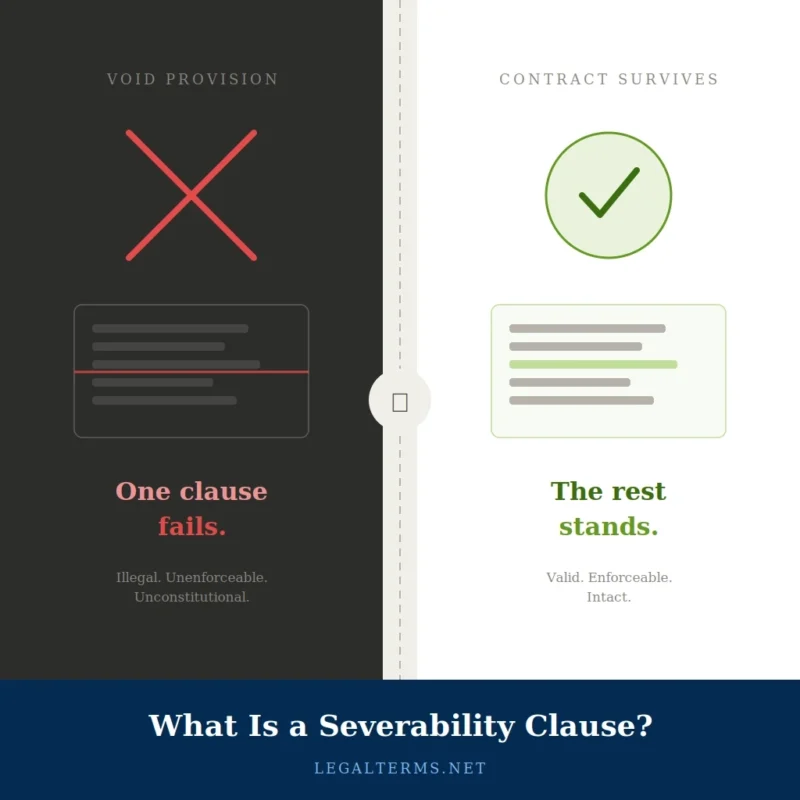
At its core, severability means that the parts of a legal agreement are treated as separate from each other. If one part fails, the others do not automatically fail with it.
Think of it like a string of Christmas lights. On older strings, when one bulb burns out, the whole string goes dark. On modern strings, one dead bulb does not affect the rest. A severability clause turns your contract into the modern kind of string.
The word itself comes from the Latin salvatorius, meaning “saving.” That Latin root captures the idea well: severability saves what can be saved.
In legal terms, a contract without a severability clause can be entirely voided by a court if even one provision is found to be illegal or unenforceable. With a severability clause in place, the court removes the bad provision and enforces the rest. The deal lives on, just without the offending part.
There is one important limit to this. If the part that gets struck down was so central to the whole agreement that removing it fundamentally changes what the parties agreed to, a court will typically void the entire contract rather than try to save a shell of the original deal. Severability is a safety net, not a blank check for sloppy drafting.
How a Severability Clause Works
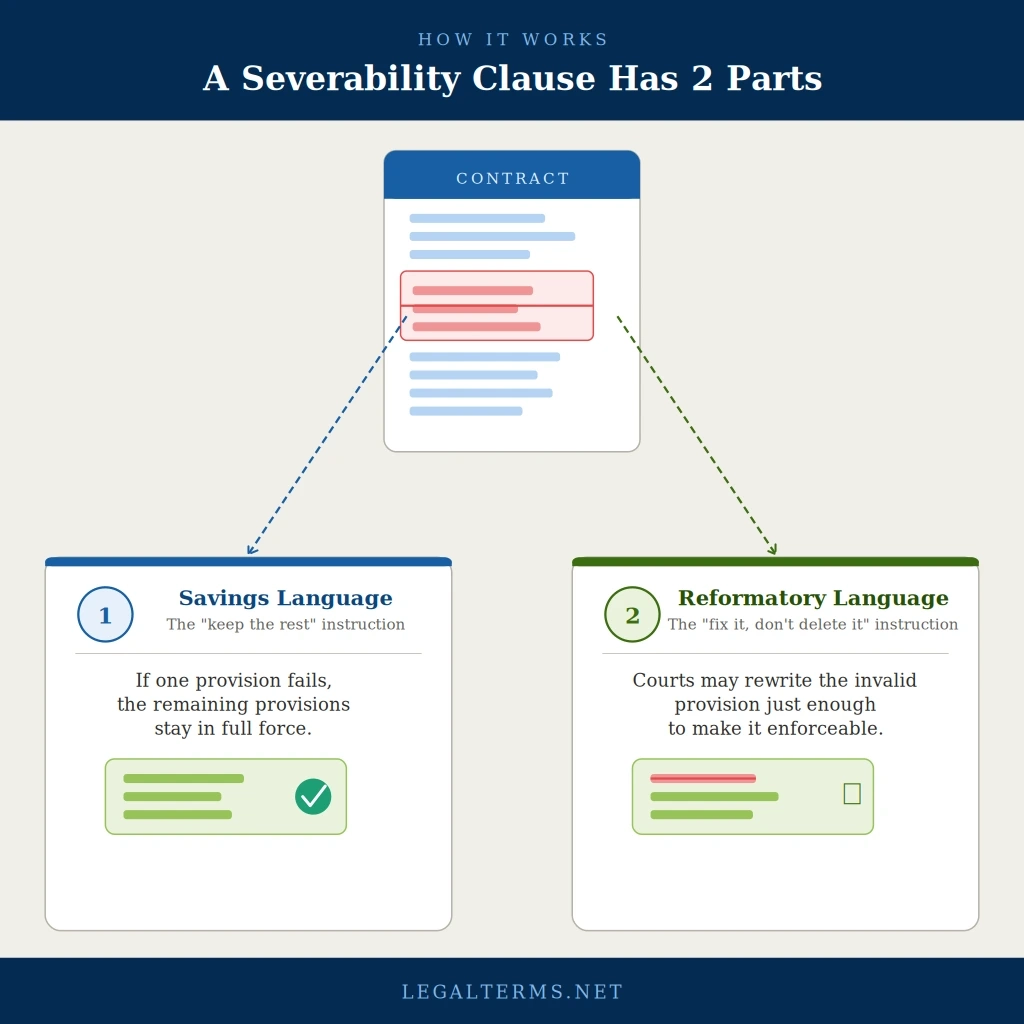
A standard severability clause does two things, and understanding both helps you know what you are actually agreeing to when you sign a contract that contains one.
The first part is called savings language. This is the portion that says: if a court finds any provision of this agreement invalid or unenforceable, the rest of the agreement stays in force. It is the “save what you can” instruction to the court.
The second part is called reformatory language. This goes a step further. Instead of just deleting the bad provision, it gives the court permission to modify it, to rewrite it just enough to make it legal, while keeping the original intent of the parties as intact as possible.
A typical severability clause combining both parts looks something like this:
“If any provision of this Agreement is held to be invalid or unenforceable, such provision shall be modified to the minimum extent necessary to make it enforceable, and the remaining provisions shall continue in full force and effect.”
In practice, courts use reformatory language to do what lawyers call “blue-penciling.” Blue-penciling simply means a judge crosses out or rewrites the parts of a clause that go too far, rather than throwing the whole clause away.
A common real-life example of blue-penciling involves non-compete agreements. Say you sign an employment contract with a non-compete clause that says you cannot work in the same industry anywhere in the United States for five years after leaving the company. A court might find that restriction unreasonably broad. Rather than voiding your entire employment contract, the judge can blue-pencil the non-compete down to something reasonable, say a 50-mile radius for one year, and let the rest of your contract stand.
Whether a court will step in and sever or rewrite a provision depends on three main factors:
- The law of the state or jurisdiction where the dispute is heard
- Whether the contract includes an explicit severability clause
- How essential the invalid provision was to the overall purpose of the agreement
If any of those factors cuts against severability, the court may decide the entire contract has to go. That is why the clause matters, but also why it is not a substitute for careful drafting in the first place.
Severability in Contract Law
Severability clauses appear in almost every type of commercial contract. Employment agreements, software licenses, real estate purchase contracts, insurance policies, loan agreements, non-disclosure agreements — if you have ever signed anything longer than a page, there is a good chance a severability clause was somewhere near the bottom, tucked in among the other boilerplate provisions.
“Boilerplate” is a term lawyers use for standard clauses that get copied from contract to contract without much thought. Severability is one of the most common boilerplate provisions, and that routine treatment can actually be a problem. Because attorneys often paste it in automatically, the language sometimes does not fit the specific agreement it ends up in.
Here is why that matters. Not all severability clauses are the same. Some are narrow and only protect against provisions that turn out to be outright illegal. Others are broader, covering any provision that becomes unenforceable for any reason, including ambiguity, changed circumstances, or conflict with public policy. The scope of the language you agree to can make a significant difference if a dispute ever reaches a court.
Severability in non-disclosure agreements is a good example of where this plays out. An NDA might include a confidentiality period that a court later finds unreasonably long under local law. A well-drafted severability clause allows the court to shorten the period rather than throw out the NDA entirely, which would leave the parties with no confidentiality protection at all.
Severability in insurance contracts works similarly but with its own wrinkles. An insurer might argue that a coverage exclusion is severable from the rest of the policy, meaning that striking the exclusion should not affect the policyholder’s other obligations. The policyholder, on the other hand, might argue that removing the exclusion changes the fundamental nature of the contract and should void it entirely. Courts in different states resolve this tension differently, which is one reason why the governing law clause in your contract, the provision that says which state’s law applies, matters so much when severability comes into play.
It is also worth understanding a related but distinct concept: the severable contract. A severable contract, sometimes called a divisible contract, is a contract made up of multiple independent obligations, where a breach of one part does not automatically constitute a breach of the whole. For example, imagine a supply agreement that covers five separate product lines. If a dispute arises over deliveries of one product, the obligations for the other four products may remain intact and enforceable. This is different from a severability clause, which deals with invalid or unenforceable provisions. A severable contract deals with breaches and performance.
If you are signing a contract that involves significant money, a long-term commitment, or obligations across multiple states or countries, it is worth asking a lawyer to review the severability language specifically, not just assume it is standard boilerplate that does not need attention.
Severability in Constitutional and Statutory Law
Severability is not only a contract law concept. It plays an equally important role in constitutional law, where courts regularly have to decide what happens when part of a statute, a law passed by a legislature, turns out to be unconstitutional.
When lawmakers draft legislation, they often include a severability clause in the statute itself. The language typically says something like: if any section of this law is found unconstitutional, the remaining sections continue in full force and effect. The reasoning behind this is practical. Legislators want to preserve as much of their work as possible. A single unconstitutional provision should not necessarily bring down an entire regulatory framework that took years to build.
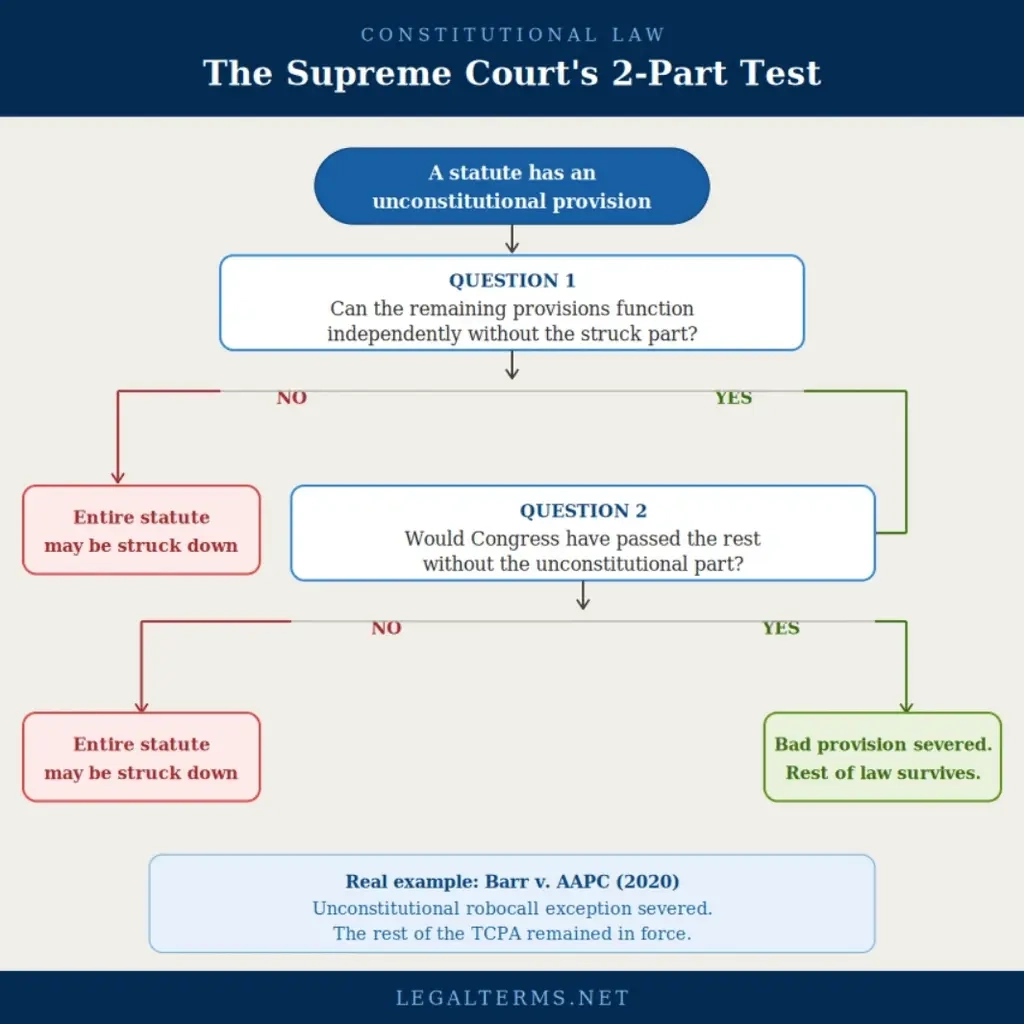
When a statute does not include an explicit severability clause, courts have to figure out on their own whether the unconstitutional part can be separated from the rest. The U.S. Supreme Court applies a two-part test in these situations:
- Would the remaining provisions of the law still function independently, without the part being struck down?
- Would Congress have passed those remaining provisions on their own, even without the unconstitutional section?
If both answers are yes, the Court severs the bad section and upholds the rest of the statute. If either answer is no, the entire law may fall.
This is not a mechanical exercise. It requires judges to look at the structure of the legislation, its legislative history, and what Congress was actually trying to accomplish. Two justices looking at the same statute can reach different conclusions about whether severance is appropriate, which is why severability disputes in constitutional cases can be genuinely contested even among experienced lawyers and judges.
State legislatures follow similar approaches, though the specific standards vary from state to state. Some states presume that any statute is severable unless the text clearly indicates otherwise. Others require an explicit clause before courts will sever anything. If you are dealing with a question about a specific state law, the rules of that particular state govern, not any general federal standard.
A Real-World Example: Barr v. American Association of Political Consultants (2020)
Few cases illustrate how severability actually operates at the highest level better than Barr v. American Association of Political Consultants, decided by the U.S. Supreme Court in 2020.
Here is the background in plain terms. A federal law called the Telephone Consumer Protection Act, passed in 1991 and commonly known as the TCPA, restricts robocalls to cell phones. Most people are familiar with its effects even if they do not know the law by name: it is a big part of why telemarketers are not supposed to bombard your mobile phone with automated calls.
In 2015, Congress added an exception to the TCPA. The exception allowed robocalls to cell phones specifically for the purpose of collecting debts owed to or guaranteed by the federal government. In other words, if you owed money on a student loan or a government-backed mortgage, automated calls to your cell phone to collect that debt were suddenly permitted, even though political organizations, charities, and businesses calling about other matters were still restricted.
The American Association of Political Consultants challenged this exception. Their argument was straightforward: the law now favored one type of speech, debt-collection calls, over others, like political calls. That kind of content-based distinction, they argued, violated the First Amendment’s guarantee of free speech.
A plurality of the Supreme Court agreed that the government-debt exception was unconstitutional. It singled out one type of call for favorable treatment based on its content, which is the kind of discrimination the First Amendment generally does not allow.
But here is where severability came in. The Court did not strike down the entire TCPA. Instead, it asked the two-part question: could the TCPA function without the 2015 exception? And would Congress have preferred a TCPA without the exception over no TCPA at all? The answer to both questions was yes. The TCPA had existed and functioned for over two decades before the exception was added. Removing the exception simply restored the law to its prior state.
The result: the unconstitutional government-debt exception was severed and struck down. The rest of the TCPA, including all the protections against unwanted robocalls, remained fully in force.
For anyone trying to understand severability in practice, this case is a clean example. The Court did not rewrite the law or invent a new rule. It removed the offending piece and left the structure standing, exactly what a well-functioning severability analysis is supposed to do.
Why Severability Clauses Matter
For most people, severability feels like fine print that does not deserve much attention. It is easy to skip past it when signing a contract, especially when the clause is written in dense legal language buried on the last page. But understanding what it does, and what it does not do, can make a real difference if something goes wrong later.
Here is the practical case for paying attention to severability clauses:
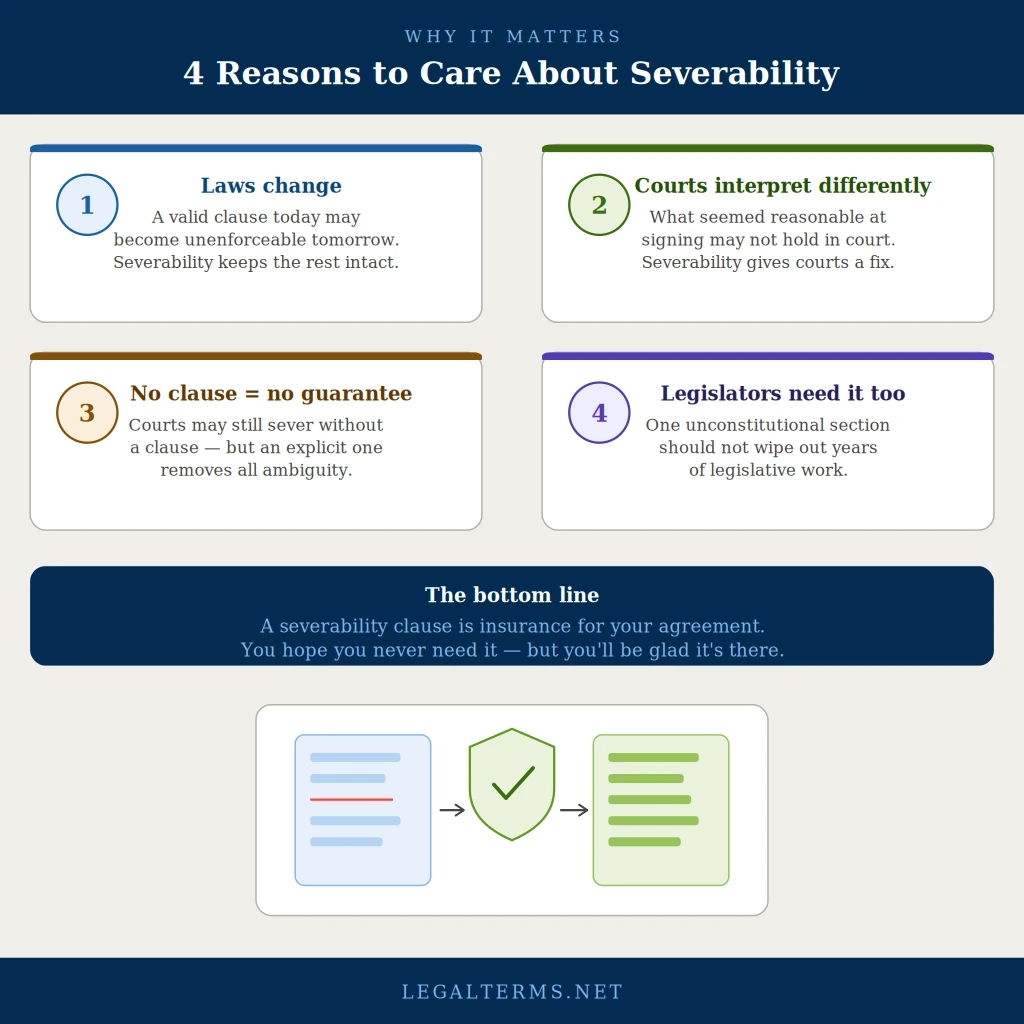
- Laws change. A provision that is perfectly legal when you sign a contract may become unenforceable years later because of new legislation or a court ruling. A severability clause means the rest of your agreement does not collapse along with the outdated provision.
- Courts interpret things differently than the parties expected. What seemed like a reasonable restriction at signing can look very different to a judge applying the law of a specific jurisdiction. Severability gives the court a tool to fix the problem without destroying the whole deal.
- The absence of a severability clause is not automatically fatal. Many courts will conduct their own severability analysis even when a contract is silent on the issue. But an explicit clause removes ambiguity and gives the court clear direction, which generally works in favor of the party who drafted the contract.
- For legislators, the stakes are even higher. A severability clause in a statute signals to courts that the legislature preferred partial enforcement over none. Without it, a single constitutional defect can potentially wipe out years of legislative work.
The bottom line is this: a severability clause is a form of insurance for your agreement. Like most insurance, you hope you never need it. But when a court finds a problem with one part of your contract, you will be glad it is there.
Cautions
Severability clauses offer real protection, but they are not unlimited. There are a few important things to keep in mind before assuming yours will save the day.
A severed provision cannot be essential to the deal. If the provision that gets struck down was the core of what the parties agreed to, most courts will void the entire contract rather than enforce a hollowed-out version of it. For example, if the payment terms in a service contract are found unenforceable, no severability clause is going to save the rest of that agreement. The payment terms are fundamental. Removing them does not leave you with a modified contract; it leaves you with no real contract at all.
Jurisdiction matters significantly. Severability rules vary by state and by country. A court in California may approach a severability question very differently from a court in Texas or New York. If your contract covers obligations in multiple states or involves parties from different countries, the governing law clause, the provision that specifies which jurisdiction’s law applies, will determine whose rules govern the severability analysis. This is worth confirming with a lawyer before you sign anything significant.
Vague reformatory language can backfire. If the severability clause gives a court broad discretion to rewrite invalid provisions, you may end up with a modified agreement that looks quite different from what you originally negotiated. Precise language that limits how far a court can go in rewriting terms protects both parties from surprises.
A severability clause is not a substitute for good drafting. The best protection against a severability problem is a well-written contract in the first place. A severability clause is a backstop, not a reason to be careless about the provisions it protects. Always have significant contracts reviewed by qualified legal counsel before signing, particularly if long-term obligations, large sums of money, or cross-jurisdictional issues are involved.
Frequently Asked Questions
What is the purpose of a severability clause?
A severability clause protects an agreement from complete invalidation when one provision is found to be unenforceable or illegal. It tells the court to remove the problematic part and enforce the rest of the contract as written, preserving as much of the parties’ original deal as possible. Without one, a single bad provision can potentially bring down the entire agreement, depending on the jurisdiction and the nature of the problem.
Does a contract need a severability clause to be severable?
Not necessarily. Many courts will conduct a severability analysis even when a contract says nothing about it. However, including an explicit clause removes uncertainty and gives the court clear instruction on what the parties intended. In close cases, that clarity can be the difference between an agreement that survives a legal challenge and one that does not.
What does “blue-penciling” mean in plain English?
Blue-penciling is when a court takes a provision that goes too far and rewrites it down to something reasonable and enforceable, rather than striking it out entirely. The term comes from the old editorial practice of marking corrections with a blue pencil. In contract law, it most often comes up with non-compete clauses and other restrictive covenants that courts find overly broad. The court does not throw the whole clause away; it narrows it to what the law will allow.
Can a court rewrite a contract under a severability clause?
Yes, but only within limits. Reformatory language in a severability clause gives courts permission to modify an invalid provision to the minimum extent necessary to make it legal. Courts will not, however, rewrite a contract so extensively that it becomes a fundamentally different deal from the one the parties originally made. The goal is to honor the parties’ intent as closely as possible within the boundaries of the law.
Is severability the same in all U.S. states?
No. Severability doctrine varies meaningfully by state. Some states presume that any contract or statute is severable unless the text clearly says otherwise. Others require an explicit clause before courts will separate out an invalid provision. The governing law clause in your contract determines which state’s rules apply, which is one reason that clause deserves more attention than it usually gets.
How is severability different from rescission?
Rescission is the legal undoing of an entire contract, as if it never existed. Severability is the opposite: it is a tool for keeping a contract alive despite a problem with one of its parts. When a court applies severability, the contract continues with the bad provision removed or rewritten. When a court grants rescission, the whole agreement is cancelled and the parties are, in theory, returned to where they started.
References
- Cornell Law School, Legal Information Institute. “Severability Clause.“
- Barr v. American Association of Political Consultants, 591 U.S. 9 (2020)
- Merriam-Webster Legal Dictionary. “Severability Clause.”
- Black’s Law Dictionary (11th ed.). “Severability”; “Blue Pencil Doctrine.”
- Telephone Consumer Protection Act, 47 U.S.C. § 227
- U.S. Constitution, First Amendment

LegalTerms.net Editorial Staff produces plain-English explanations of legal terminology for general educational purposes. Content is developed through a structured research process using publicly available legal resources, including statutory frameworks, case law databases, and authoritative legal publications.
All articles are reviewed for clarity, factual consistency, and alignment with widely accepted legal standards before publication. Content does not constitute legal advice.
Learn how our content is created: Content Methodology · Editorial Guidelines · Legal Sources