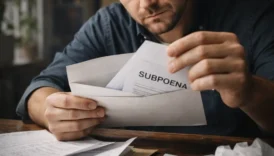
Can You Ignore a Subpoena? What Happens Next

A subpoena cannot be ignored. If you fail to respond, the court may impose penalties such as fines, contempt charges, or even arrest in serious cases.
What Does It Actually Mean to Ignore a Subpoena?
Ignoring a subpoena doesn’t just mean “not going.” It means failing to comply with a legal order issued by a court or attorney. In the United States, a subpoena is not optional—it is a binding legal document that requires action within a specific timeframe.
Many people misunderstand this. They assume that if they didn’t sign anything, or if the document was delivered informally, they can simply ignore it. That assumption is often wrong and can lead to serious consequences.
A subpoena typically requires one of the following:
- Appearing in court on a specific date
- Providing documents or evidence
- Giving testimony (either in court or during a deposition)
If you do nothing—no response, no objection, no compliance—you are considered to be in violation of a court order.
Common situations where people ignore subpoenas:
- Thinking it’s not important
- Believing it doesn’t apply to them
- Assuming it’s a scam
- Being afraid of legal involvement
- Not understanding what to do
In reality, none of these are valid legal excuses.
What Happens Immediately After You Ignore a Subpoena?
The consequences don’t always happen instantly, but they do follow a predictable legal process. Courts usually give you a chance to comply—but if you continue to ignore the subpoena, the situation escalates quickly.
Step-by-step timeline:
1. No response from you
You fail to appear or provide the requested information.
2. The issuing party notices your absence
The attorney or court records that you did not comply.
3. A motion to compel may be filed
This is a formal request asking the court to force you to comply.
4. Court order is issued
The judge may order you to comply within a new deadline.
5. Continued non-compliance triggers penalties
At this stage, the court may take stronger action.
Legal Consequences of Ignoring a Subpoena

This is where things get serious. Ignoring a subpoena is not treated as a minor mistake—it can be seen as disrespecting the authority of the court.
Possible consequences include:
- Contempt of court
This is the most common result. You are officially in violation of a court order. - Fines
Courts may impose daily or fixed penalties until you comply. - Bench warrant
In more serious cases, a judge may issue a warrant for your arrest. - Forced compliance
You may be legally compelled to testify or provide documents. - Additional legal trouble
Ignoring a subpoena can negatively affect your position in related legal matters.
Real Example: What Happens in Practice
Let’s make this very clear with a real-world style example:
John receives a subpoena asking him to testify in a civil case. He believes it’s not important and ignores it.
- He does not appear in court
- The attorney files a motion
- The judge issues a court order
- John still ignores it
At this point:
The court finds John in contempt
A fine is issued
Eventually, a bench warrant is requested
What started as a simple request becomes a serious legal problem.
Can You Legally Refuse a Subpoena?
This is where many people get confused.
You can challenge a subpoena
But you cannot ignore it
If you believe the subpoena is invalid, unreasonable, or violates your rights, you must take legal action—not silent inaction.
Valid ways to respond instead of ignoring:
- Filing a motion to quash (cancel the subpoena)
- Filing a motion to modify (change scope or deadline)
- Raising legal objections
- Consulting an attorney
Ignoring the subpoena removes your chance to defend yourself properly.
Is Ignoring a Subpoena Worse in Criminal or Civil Cases?
Not all subpoenas carry the same level of risk. The consequences of ignoring one can vary depending on whether it is tied to a civil case or a criminal investigation.
In civil cases:
Ignoring a subpoena is still serious, but the consequences are usually financial or procedural.
- Courts may issue fines
- You can be held in contempt
- A judge may force compliance through additional orders
- Your position in the case may be weakened
While this may not immediately lead to arrest, continued non-compliance can escalate the situation.
In criminal cases:
The risks are significantly higher.
- Ignoring a subpoena may lead directly to a bench warrant
- Law enforcement may become involved
- You may be required to appear under custody
- The court treats non-compliance as a direct challenge to legal authority
In short, ignoring a subpoena in a criminal matter can move from a procedural issue to a serious legal offense much faster.
Do You Need a Lawyer to Handle a Subpoena?
Technically, you are not required to hire a lawyer in every situation. However, in many cases, getting legal advice is the safest move.
You should strongly consider a lawyer if:
- The subpoena requests sensitive documents
- You are asked to testify in a complex case
- You believe the request is unfair or too broad
- The case involves criminal law
- You are unsure how to respond properly
A lawyer can help you:
- understand your obligations
- file objections if necessary
- protect your rights
- avoid accidental legal mistakes
Handling a subpoena incorrectly can create bigger problems than the original request.
What Should You Do Instead of Ignoring a Subpoena?

The most important takeaway is this:
Ignoring a subpoena is never the correct response. Taking action—even a simple one—is always better than doing nothing.
Recommended steps:
1. Read the document carefully
Identify what is being requested: appearance, documents, or testimony.
2. Check the deadline
Subpoenas always include a specific response time.
3. Verify validity
Make sure the subpoena is legitimate and properly served.
4. Decide how to respond
You may comply, object, or request modification.
5. Seek legal advice if needed
Even a short consultation can prevent serious issues.
Can a Subpoena Be Invalid or Challenged?
Yes, not every subpoena is automatically valid.
There are situations where a subpoena may be challenged legally.
Common grounds for challenge:
- It is overly broad or unreasonable
- It requests irrelevant information
- It violates privacy rights
- It was not properly served
- It creates an undue burden
In these cases, you can file a motion to quash or request changes through the court.
However, this must be done formally. Ignoring the subpoena removes your ability to challenge it effectively.
Final Answer: Can You Ignore a Subpoena?
No. Ignoring a subpoena is not a safe or legal option.
Even if the situation seems minor, the legal system treats subpoenas as enforceable orders. Failing to respond can lead to escalating consequences, including fines, court orders, and in some cases, arrest.
The correct approach is always to respond—either by complying or by challenging the request through proper legal channels.
Frequently Asked Questions
Can you refuse to comply with a subpoena?
You cannot simply refuse a subpoena. However, you can legally challenge it by filing a motion to quash or objecting through the court. Ignoring it without taking action can lead to penalties.
What happens if you don’t show up for a subpoena?
If you fail to appear, the court may issue a motion to compel, impose fines, or hold you in contempt. In some cases, a judge may issue a bench warrant.
Is ignoring a subpoena a crime?
Ignoring a subpoena is not always a criminal offense by itself, but it can result in contempt of court, which may carry legal penalties including fines or jail time.
Can a subpoena be canceled?
Yes, a subpoena can be canceled or modified if it is unreasonable, invalid, or improperly served. This requires a formal legal request to the court.
Do subpoenas always require court appearance?
No. Some subpoenas only require you to provide documents or records. Others may require testimony in court or during a deposition.

LegalTerms.net Editorial Staff produces plain-English explanations of legal terminology for general educational purposes. Content is developed through a structured research process using publicly available legal resources, including statutory frameworks, case law databases, and authoritative legal publications.
All articles are reviewed for clarity, factual consistency, and alignment with widely accepted legal standards before publication. Content does not constitute legal advice.
Learn how our content is created: Content Methodology · Editorial Guidelines · Legal Sources