How Long Does a Lawsuit Take to Resolve?

How Long Does the Average Lawsuit Take to Resolve?
If you have just filed a lawsuit, or expect to be served with one, the first question on your mind is usually a practical one: when will this actually be over? The honest answer is that timelines swing from a few months to several years, and the single biggest factor is something most people never think about.
Most lawsuits resolve within one to three years, but the realistic timeline depends far more on when the parties settle than on when a court is finally ready to act.
Key Points at a Glance:
- Typical Range: A few months to several years, with most cases landing somewhere between one and three years
- Median Federal Civil Case: About 13.7 months from filing to disposition
- Early Settlement, No Court Action: Median around 8.3 months
- Contested Case With Court Action: Median around 16 months, and longer once pretrial motions are involved
- Cases That Reach Trial: Median roughly 27 months from the filing date, sometimes several years
- Add for an Appeal: Another 10 to 12 months on average
- Biggest Variable: Whether and when the two sides settle, not how busy the court is

Those medians hide something important. The federal figure of roughly 13.7 months is pulled down by the large share of cases that settle or get dismissed early, sometimes within a couple of months of filing. A genuinely contested case, where both sides dig in through discovery and motions, lives in a different world. Push it all the way to a verdict and you are usually looking at well over two years.
Here is the part that catches people off guard. Only about three to five percent of civil cases ever reach a trial. The rest end through settlement, dismissal, or a ruling on a motion. So when you ask how long a lawsuit takes, you are usually really asking how long it takes to settle, and that clock is set by the parties, not the courthouse.
What Are the Stages of a Lawsuit?
A lawsuit moves through a predictable sequence of stages, and each one adds its own block of time to the total.
Think of it less like a single event and more like a long road trip with several mandatory checkpoints. You cannot skip ahead, and a holdup at any one stop pushes back everything that follows. The stages below show where the months tend to go.
| Stage | What Happens | Typical Time |
|---|---|---|
| Pre-filing | Investigation, demand letters, confirming the filing deadline | Weeks to over a year |
| Pleadings | Complaint filed, defendant served, answer or motion to dismiss | 1 to 3 months |
| Discovery | Both sides exchange evidence, documents, and sworn testimony | 3 months to over a year |
| Pretrial motions | Requests asking the court to narrow or end the case | Several months |
| Trial | A judge or jury hears the case and reaches a verdict | A few days, but scheduling adds months |
| Post-trial and appeal | Verdict, then a possible challenge in a higher court | 10 to 24 months or more if appealed |
A surprising amount of the timeline is set before a complaint is ever filed. Your lawyer first has to investigate the facts, often send a demand letter to try to resolve things without suing, and confirm you are still within the statute of limitations, the legal deadline for bringing your claim. Miss that window and the case ends before it begins. Once the complaint is filed, the defendant typically has 20 to 30 days to respond, though that deadline does not start running until they are properly served.
Why Does Discovery Take the Longest?
Discovery is usually the longest phase of a lawsuit, because it is the stage where both sides gather and exchange every relevant piece of evidence, and that process can run from a few months to well over a year.
During discovery, each party can send written questions, demand documents, and take depositions, which are sessions where witnesses answer questions under oath. The more documents, witnesses, and technical issues a case involves, the longer this takes. A straightforward dispute might wrap up discovery in three to six months. A complex commercial or legal discovery heavy case can stay in this phase for a year or more.
Two things quietly stretch discovery out. The first is expert witnesses, who need time to review records, write reports, and sit for their own depositions. The second is disagreement over what must be turned over. When one side refuses to produce something, the other files a motion to compel, the court has to rule, and weeks slip away. Discovery disputes are one of the most common reasons a case that looked simple drags on far longer than expected.
What Makes One Lawsuit Take Longer Than Another?
The length of a lawsuit comes down to a handful of variables, and the most powerful one is whether the parties are willing to settle.
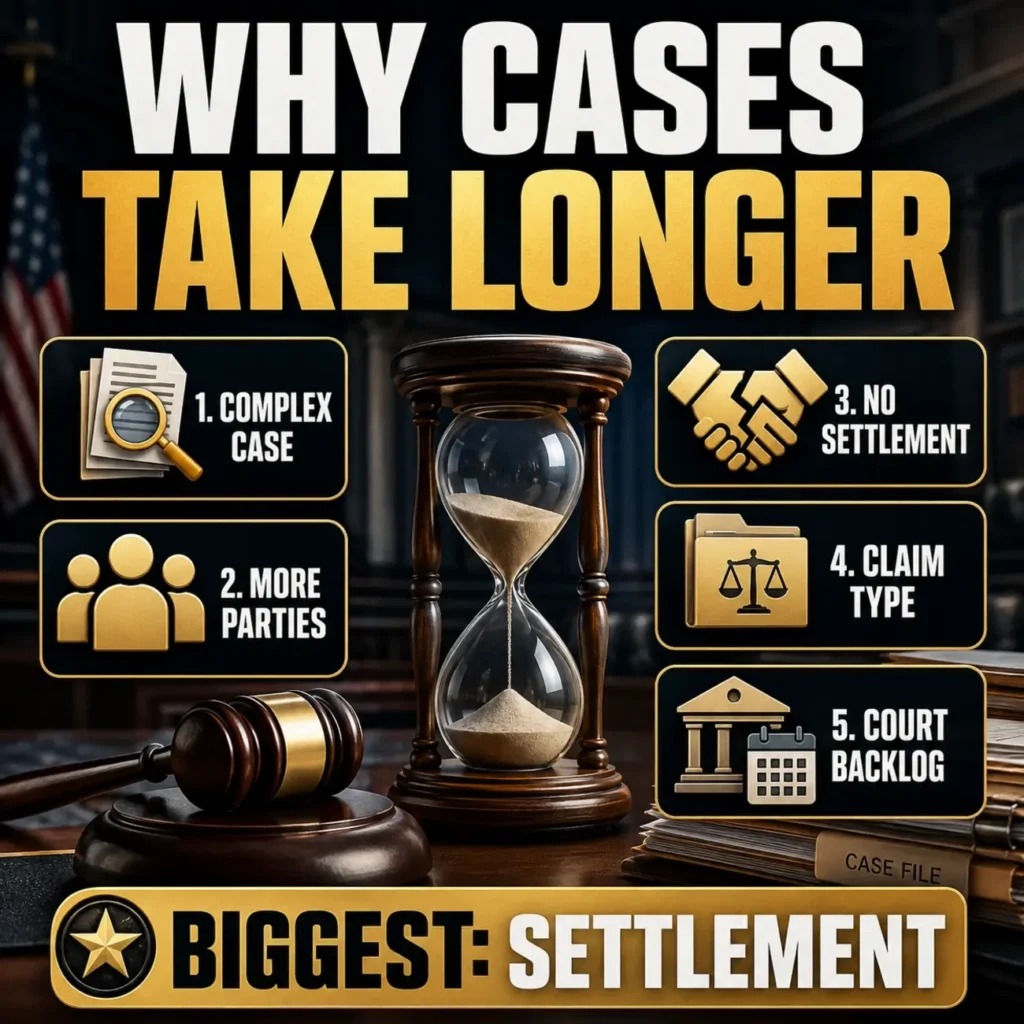
The factors that move the needle most often are these:
- Complexity of the case, including the number of legal issues and the volume of evidence
- Number of parties, since every additional plaintiff or defendant adds schedules, lawyers, and disputes
- Willingness to settle, which can end a case in months or, when absent, extend it for years
- Type of claim, because some categories simply take longer to work through
- Court backlog in the jurisdiction where the case is filed
Case type matters more than people expect. Auto accident cases often resolve relatively quickly because fault is usually clear, while product liability and medical malpractice cases sit among the slowest, frequently averaging close to three years to reach a verdict. Court congestion adds another layer. Filing in a busy urban court can feel like waiting for a table at a packed restaurant: your case is in line behind hundreds of others, and the wait has little to do with the merits of your claim.
Does Going to Trial Make a Lawsuit Take Longer?
Yes. Taking a case all the way to trial almost always adds significant time, often pushing the total past two years, while cases that settle tend to resolve much sooner.
Most cases never get there. Many end well before trial when a court grants a motion for summary judgment, a ruling that decides the case without a trial because the key facts are not genuinely in dispute. Others settle once both sides see the evidence discovery has produced and can finally weigh their odds. A trial itself may last only a few days, but getting onto the court’s calendar is the slow part. Trial dates are routinely postponed because of crowded dockets or last minute settlement talks, and each postponement can cost weeks or months.
So the choice to litigate to the end, rather than negotiate, is often the difference between a case that closes in a year and one that runs for three. That decision belongs to the parties and their lawyers, which is why timelines vary so widely even among similar claims.
How Much Time Does an Appeal Add?
An appeal usually adds about 10 to 12 months to the overall timeline, and in some courts considerably more.
An appeal does not reopen the whole case. Instead, a higher court reviews the trial court’s decision for legal errors, working mostly from written briefs and, sometimes, a short oral argument. The losing party generally has 30 days to file a notice of appeal, or 60 days when the government is a party. After that, briefing and scheduling take over, and how long it all lasts depends heavily on the court. Some appellate courts move through cases in well under a year, while the busiest run closer to a year and a half. If the appeal succeeds, the case can even be sent back for a new trial, which starts another stretch of the clock all over again.
Can a Lawsuit Be Dismissed for Taking Too Long?
Yes. If a case sits dormant for too long without the plaintiff moving it forward, a court can dismiss it for failure to prosecute, sometimes ending the lawsuit for good.
This catches many people by surprise, because they assume delay only costs time, not the case itself. It does not work that way. Under the rules that govern civil cases, and under a court’s own inherent authority, a judge can throw out a case that has stalled because the party who filed it failed to keep it moving. The court can even do this on its own initiative, without the other side asking. In serious situations the dismissal can be with prejudice, meaning the claim cannot be filed again. The lesson is simple: once you sue, the responsibility to push the case along sits with you and your lawyer, and sitting on it carries real risk.
What Courts Have Said
The clearest statement of this principle came from the U.S. Supreme Court in Link v. Wabash Railroad Co. (1962). William Link had filed a personal injury claim in 1954 after a collision between his car and one of the railroad’s trains. More than six years later, with two scheduled trial dates already postponed, his lawyer failed to show up for a pretrial conference. The trial court, acting on its own, dismissed the case for failure to prosecute.
The Supreme Court upheld that dismissal. It ruled that federal courts have a long recognized power to clear their dockets of cases that have gone dormant through a party’s inaction, and that exercising that power here was not an abuse of discretion. The Court also made a point that still stings: a client is bound by the choices of the lawyer they hired, so the attorney’s failure to appear was treated as the plaintiff’s own.
The practical takeaway reaches well beyond this one case. Courts are not obligated to wait forever, and a case that drags without effort can be ended on timing alone, regardless of how strong it might have been on the merits. Speed is not just a convenience in litigation. Letting a case stall can quietly destroy it.
Questions to Ask Your Attorney About Timing
No article can predict how long your specific case will take, but you can get a far more realistic picture by asking the right questions early.
Start by figuring out which path your case is likely to follow. A claim where the other side accepts fault and wants to settle behaves very differently from one headed for a contested trial. Once you know roughly where you stand, these are useful questions to put to your lawyer:
- What is a realistic timeline range for a case like mine in this court?
- Which stage is likely to take the longest, and why?
- How backed up is the court where we are filing?
- What would make this resolve faster, and what could drag it out?
- Is early settlement realistic, and how would that change the timeline?
The goal here is to set your own expectations, not to manage the litigation yourself. Timing in a lawsuit depends on facts, local court conditions, and judgment calls that only a professional can weigh for your situation. For anything specific to your case, consult a licensed attorney.
A Few Cautions
The figures in this article are general benchmarks drawn from national data, not predictions for any individual case. Real timelines vary widely by state, by court, by case type, and by the conduct of the parties. A median tells you where the middle of the pack lands, not where your case will. Two lawsuits that look almost identical on paper can finish years apart depending on settlement decisions and court backlog. Use these ranges to orient yourself, then rely on a qualified attorney for an estimate grounded in your actual facts.
Frequently Asked Questions
How long does the average lawsuit take?
Most civil lawsuits resolve within one to three years. The median federal civil case runs about 13.7 months from filing to disposition, but that number is weighed down by cases that settle or get dismissed quickly. Contested cases that go the distance routinely take longer.
Why do lawsuits take so long?
A few reasons stack up. Discovery, where both sides exchange evidence, eats months on its own. Court calendars are crowded, motions take time to brief and decide, and any disagreement between the parties slows things further. Add a trial and an appeal, and a case can stretch across several years.
What is the longest stage of a lawsuit?
Discovery, in most cases. Gathering documents, taking depositions, and working with expert witnesses can take anywhere from a few months to over a year, and disputes over what must be shared push it longer still.
Can a lawsuit be resolved without going to court?
Yes, and most are. Only about three to five percent of civil cases reach a trial. The rest end through settlement, dismissal, or a ruling on a motion, which is why the realistic timeline usually depends on when the parties agree to settle.
How long does a defendant have to respond to a lawsuit?
Generally 20 to 30 days after being properly served, though the exact deadline varies by court. That clock does not start until service is complete, so delays in locating or serving a defendant can push the early timeline back.
How long do appeals usually take?
It depends on the court, but the median federal appeal takes roughly 10 to 12 months from the notice of appeal to a decision. Busier appellate courts run longer, and a successful appeal that sends the case back for a new trial restarts much of the clock.
Can a case be thrown out for taking too long?
It can. If a plaintiff lets a case sit without moving it forward, a court can dismiss it for failure to prosecute, sometimes permanently. Courts have a recognized power to clear cases that have gone dormant, so delay is never risk free.
References Links
- Cornell Law School Legal Information Institute, Federal Rules of Civil Procedure, Rule 41 (Dismissal of Actions)
- Justia, Link v. Wabash Railroad Co., 370 U.S. 626 (1962)
- United States Courts, Caseload Statistics Data Tables
- LegalTerms.net Editorial Guidelines
- LegalTerms.net Sources and References
About This Article
- Author: Hamit Sahin, Legal Researcher & Editor
- Published: June 2026
- Last Updated: June 2026
- Article Type: Legal process explainer (civil litigation timeline)
- Research Sources: Administrative Office of the U.S. Courts caseload statistics, U.S. Bureau of Justice Statistics trial data, Cornell Law School LII (Federal Rules of Civil Procedure), and the U.S. Supreme Court decision in Link v. Wabash Railroad Co. (1962)
- Scope: This article explains general timelines and stages for civil lawsuits in the United States. It does not cover criminal case timelines, state-by-state procedural variations in detail, or specific statute-of-limitations deadlines for individual claim types.
- Editorial Standards: Content is reviewed against primary sources, including federal court statistics and published case law, and updated as those sources change.
- Disclaimer: This article is for general informational purposes only and does not constitute legal advice. Timelines vary significantly based on jurisdiction, case type, and individual facts. For advice specific to your situation, consult a licensed attorney.
- Disclosure: LegalTerms.net is an independent editorial resource. This article was not sponsored or influenced by any law firm, legal service provider, or other commercial entity.

Hamit Sahin is the founder and editor of LegalTerms.net. He researches U.S. legal terminology and publicly available legal information using statutes, court rules, judicial opinions, government publications, and established legal reference sources.
His work focuses on organizing complex legal concepts into clear, plain-English explanations for general educational purposes.
Hamit is not an attorney and LegalTerms.net does not provide legal advice.