Are Lie Detector Tests Admissible in Court? What U.S. Law Says.
Are Lie Detector Tests Admissible in Court?
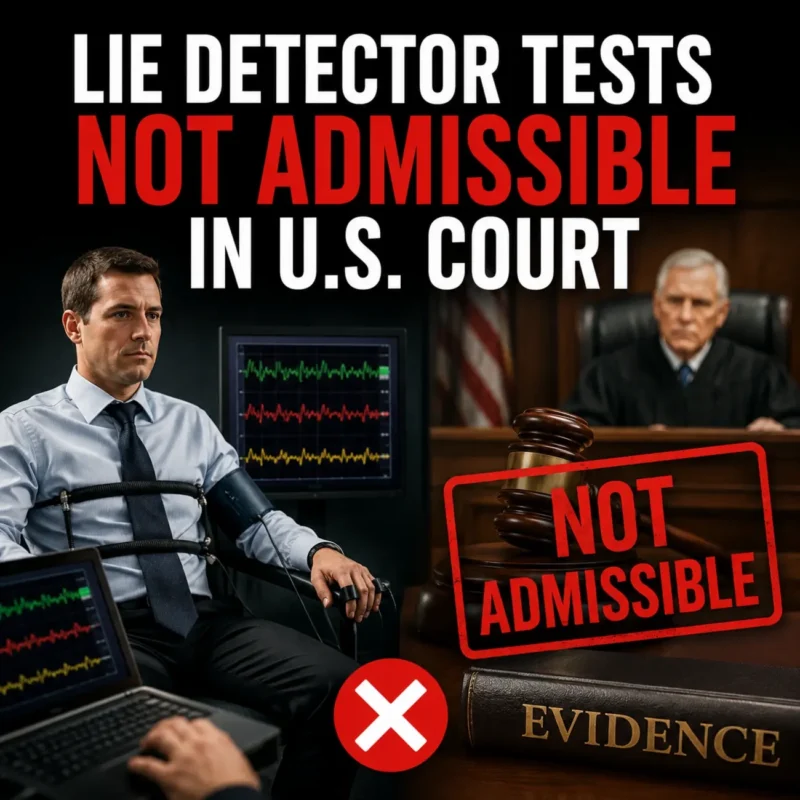
In most U.S. courtrooms, the short answer is no. Lie detector results, usually produced by a polygraph machine, are generally kept out of evidence because courts do not trust them enough to let a jury rely on them. There are a few narrow exceptions, and the rules shift depending on which state you are in, so the full picture is more useful than a flat yes or no.
What a Polygraph Test Actually Measures?
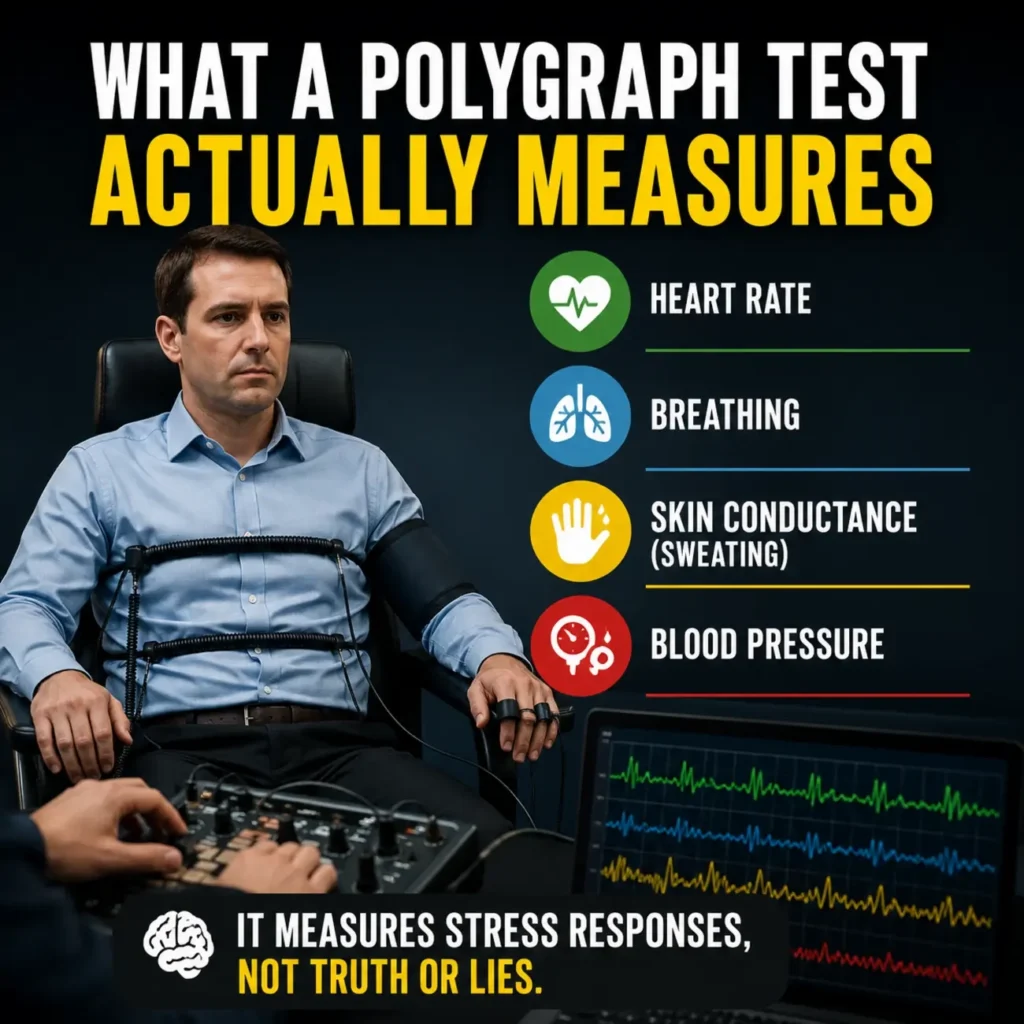
A polygraph does not actually detect lies. It measures physical reactions in your body while you answer questions: heart rate, blood pressure, breathing, and how much your skin sweats. An examiner then reads the pattern in those signals and gives an opinion on whether you were being truthful or deceptive.
That gap between what the machine records and what it claims to prove sits at the center of the legal problem. A polygraph can show that your heart rate jumped when a certain question was asked. It cannot tell anyone why it jumped. Fear, anger, confusion, or simply the stress of being wired to a machine during an investigation can spike the same signals as a lie.
Think of a polygraph like a smoke detector that goes off just as loudly for burnt toast as it does for a real fire. The alarm is genuine, but it does not tell you what set it off. A nervous but honest person can fail, and a calm, practiced liar can pass.
The General Rule: Why Most Courts Refuse Polygraph Evidence?
Across the United States, the default rule is that polygraph results stay out of the courtroom. Judges treat them as too unreliable to hand to a jury, and the worry is not only about raw accuracy. Courts also fear that jurors will give a “scientific” test far more weight than it deserves, treating a printout as if it had settled the question of guilt.
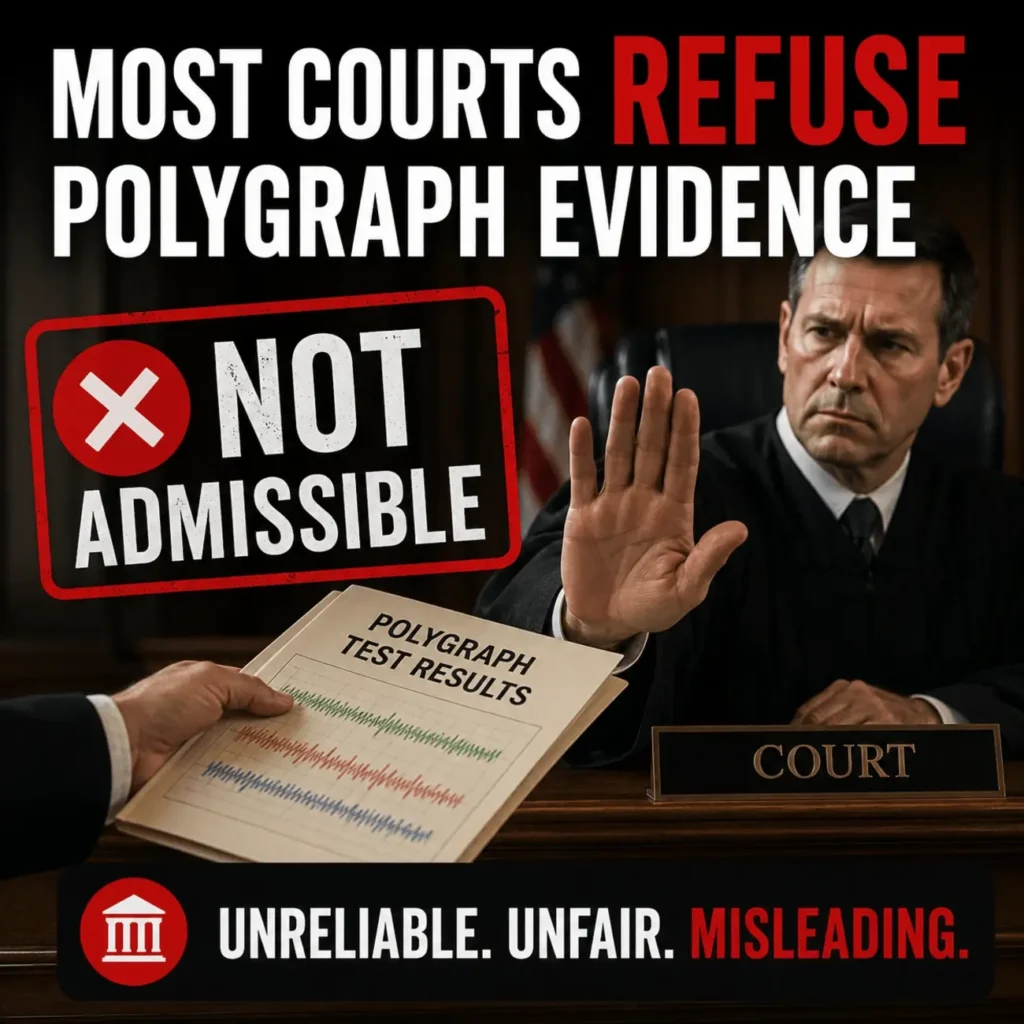
Evidence law puts judges in a gatekeeping role. Before a jury hears scientific or expert evidence, the judge decides whether the method behind it is reliable enough to be trusted. Polygraph testing has spent roughly a century failing that screening in most courts, because the scientific community has never agreed that it works consistently. When experts cannot agree that a technique is dependable, judges tend to keep its results away from the people deciding the case.
There is also a practical fear about the jury’s job. Deciding who is telling the truth is supposed to be the jury’s central task, not a machine’s. A polygraph result risks shortcutting that work, letting a printout stand in for the careful weighing of testimony a trial is built around. Courts already exclude other categories of doubtful proof for similar reasons, such as much of what falls under the rules on hearsay evidence, and they apply the same caution to lie detector results.
A Real Case: Frye v. United States (1923)
The reason courts are so cautious traces back to a single murder trial more than a century ago. In Frye v. United States, decided by the D.C. Circuit Court of Appeals in 1923, a man named James Frye was convicted of murder. His lawyers wanted to introduce the results of an early lie detector, a systolic blood pressure test that tracked changes in blood pressure as Frye answered questions, arguing it showed he was telling the truth when he denied the killing.
The court refused, and in doing so it laid down a rule that shaped American evidence law for decades. A scientific technique, the court said, has to be accepted as reliable by the broader scientific community before its results can reach a jury. A new device or theory, however promising, does not get in just because one expert vouches for it.
This became known as the “general acceptance” standard, or simply the Frye standard. Picture it as a club that only admits techniques the whole scientific neighborhood already trusts. The early lie detector had not earned that trust, so it stayed outside the door, and Frye’s conviction stood.
The Frye standard governed federal courts until 1993, when the Supreme Court replaced it in Daubert v. Merrell Dow Pharmaceuticals with a more flexible reliability test. Under Daubert, a judge weighs several factors, including whether a method has been tested, peer reviewed, and carries a known error rate. Many states still follow Frye and others follow Daubert, but polygraphs have struggled under both, because neither version is satisfied by a technique the scientific world still doubts.
The Supreme Court’s Modern View: United States v. Scheffer (1998)
The Supreme Court took on lie detectors directly in United States v. Scheffer in 1998. Edward Scheffer was an Air Force airman who took a polygraph as part of his work and then faced a court-martial on drug charges. He wanted to use his favorable polygraph result to support his claim of innocence, but a military evidence rule flatly banned polygraph results from court-martial proceedings.
The Court upheld that ban by a vote of 8 to 1. Writing for the Court, Justice Thomas reasoned that exclusion made sense because “there is simply no consensus that polygraph evidence is reliable.” Since the experts themselves could not agree, the Court held that a blanket rule keeping such evidence out did not violate Scheffer’s right to present a defense.
Scheffer matters because it shows the highest court in the country endorsing the deep skepticism lower courts had shown for years. It did not ban polygraphs everywhere for all time, but it confirmed that a court can refuse them outright without trampling a defendant’s rights. That endorsement is a large part of why the courtroom door stays mostly shut today.
Does Admissibility Vary by State? The Three Approaches
Yes, and the gaps are wider than most people expect. There is no single national rule settling this question. Federal courts follow their own approach, and each state sets its own, so whether a polygraph result can be used depends heavily on where the case is heard. Broadly, states fall into three camps.
The first and largest group simply keeps polygraph results out. A few do this through a specific statute, while most reach the same result by applying ordinary rules of evidence about reliability. Either way the practical effect is identical: the test never reaches the jury.
The second group allows polygraph results only by stipulation, meaning both sides agree in advance, before the test is even taken, to be bound by whatever it shows. California is a clear example. Under its Evidence Code, polygraph results are barred from criminal proceedings unless every party agrees to let them in. Arizona, Nevada, and Georgia take broadly similar stipulation-based approaches.
A stipulation works like two teams agreeing before kickoff to accept the instant-replay call, whatever it turns out to be. Once you have promised to live with the outcome, you cannot complain about it later just because it went against you. If you want to see how these advance agreements work more generally, here is a plain-English look at what a legal stipulation is.
The third group is essentially a group of one. New Mexico stands alone as the only state that generally admits polygraph evidence without requiring the parties to stipulate first, as long as the test meets reliability and examiner-qualification standards under its rules of evidence. It is the clear outlier in an otherwise skeptical country.
| Approach | What It Means | Where You See It |
|---|---|---|
| General exclusion | Polygraph results stay out, usually under ordinary evidence rules and sometimes by a specific ban. | Most states (the default) |
| Admissible by stipulation | Results come in only if both sides agree in advance to be bound by them. | California, Arizona, Nevada, Georgia, and roughly two dozen others |
| Generally admissible | Results may be admitted without a prior agreement, subject to reliability and examiner-qualification rules. | New Mexico only |
What this means for you: if you are looking into whether a polygraph could matter in a specific case, the first thing to pin down is the jurisdiction, because New Mexico, a California stipulation, and a state that bars them outright are three completely different worlds. This is background information, not a roadmap for your own situation, so a licensed attorney in the relevant state is the right person to tell you how the local rule actually applies.
What This Means in Practice
For most people, the takeaway is straightforward. If you are hoping a lie detector result will help win a case, you should not count on it, because in the vast majority of courtrooms it will never reach the jury. A passed test does not work like a “get out of jail” card, and a failed one is usually just as inadmissible.
The scene you see on television, where a dramatic polygraph reading settles everything, almost never happens in a real American trial. What actually decides cases is testimony, documents, physical evidence, and the jury’s own judgment about who to believe. A polygraph sits outside that process in nearly every jurisdiction.
None of this tells you how a specific case will turn out, and it is not a substitute for tailored advice. Laws differ from state to state and change over time, so if a polygraph is on the table in your situation, a licensed attorney in your state can tell you whether the local rule helps you, hurts you, or does not matter at all. This article is general information, not legal advice.
A Few Cautions
Be careful about treating any general rule as the final word in your state. The country is split into different camps, and even within one state the rules can shift between criminal court, civil court, and family court. A summary like this one cannot capture every local wrinkle.
It is also worth remembering why courts hesitate in the first place. The accuracy of polygraph testing is still genuinely disputed among scientists, and an honest but anxious person can fail while a calm deceiver can pass. Treating a polygraph result as proof of truth or guilt is exactly the mistake the legal system tries to avoid.
Finally, this content does not constitute legal advice and does not create an attorney-client relationship. If you are facing a real legal issue involving a polygraph, consult a licensed attorney in your jurisdiction who can apply the current law to your specific facts.
Frequently Asked Questions
Can you be forced to take a lie detector test?
No one can physically force you to sit for a polygraph, and in a criminal setting you have the right to decline. In most courts your refusal cannot be used against you as evidence, partly because pressuring someone into a test would raise its own fairness problems. Keep in mind that some jobs and some probation or parole conditions can require testing as a term of the arrangement, which is a different situation from a criminal trial.
If you pass a polygraph, can you use the result to prove your innocence in court?
Usually not. In most jurisdictions a favorable result is just as inadmissible as an unfavorable one, so a passed test typically cannot be placed in front of the jury. The main exceptions are states that allow results by stipulation and New Mexico, where the rules are more permissive. Even there, admission is not automatic and depends on meeting strict conditions.
Why do police and attorneys still use polygraphs if courts usually reject the results?
Because the courtroom is only one part of the legal system. Polygraphs are commonly used as investigative tools, in plea negotiations, and in probation, parole, and sex offender supervision, where the goal is to guide decisions rather than to convince a jury. A test can shape how an investigation unfolds even if its result would never be admitted at trial.
Can a private employer require you to take a polygraph?
For most private jobs, no. A federal law generally bars private employers from requiring polygraph tests as a condition of employment, though there are exceptions for certain government, security, and pharmaceutical positions. This is a separate area of law from courtroom admissibility, and some states layer their own stricter protections on top of the federal rule.
What is the difference between the Frye and Daubert standards?
Both are tests judges use to decide whether scientific evidence is reliable enough to admit. Frye asks a single question: is the technique generally accepted in its scientific field? Daubert is more flexible, letting a judge weigh several factors such as testing, peer review, and error rate. States are split over which standard they follow, but polygraphs have a hard time clearing either one.
Are polygraph results treated differently in civil or family court?
Sometimes. The strict bans most associated with criminal cases do not always apply identically in civil or family proceedings, and some courts use more flexible evidentiary rules outside the criminal context. Even so, the same reliability doubts follow polygraphs everywhere, so admission is far from guaranteed. Because family and civil rules vary widely by state, this is an area where local legal advice matters a great deal.
References
Cornell Legal Information Institute on polygraph evidence
Frye v. United States, 293 F. 1013 (D.C. Cir. 1923)
United States v. Scheffer, 523 U.S. 303 (1998)
Daubert v. Merrell Dow Pharmaceuticals, Inc., 509 U.S. 579 (1993)
California Evidence Code Section 351.1
Military Rule of Evidence 707, Manual for Courts-Martial, United States.
New Mexico Rule of Evidence 11-707 NMRA.
Black’s Law Dictionary (11th ed. 2019), definition of “polygraph.”
LegalTerms.net editorial standards
The research sources we rely on

Hamit Sahin is the founder and editor of LegalTerms.net. He researches U.S. legal terminology and publicly available legal information using statutes, court rules, judicial opinions, government publications, and established legal reference sources.
His work focuses on organizing complex legal concepts into clear, plain-English explanations for general educational purposes.
Hamit is not an attorney and LegalTerms.net does not provide legal advice.