What Is Lex Domicilii? Meaning, Rules, and Examples
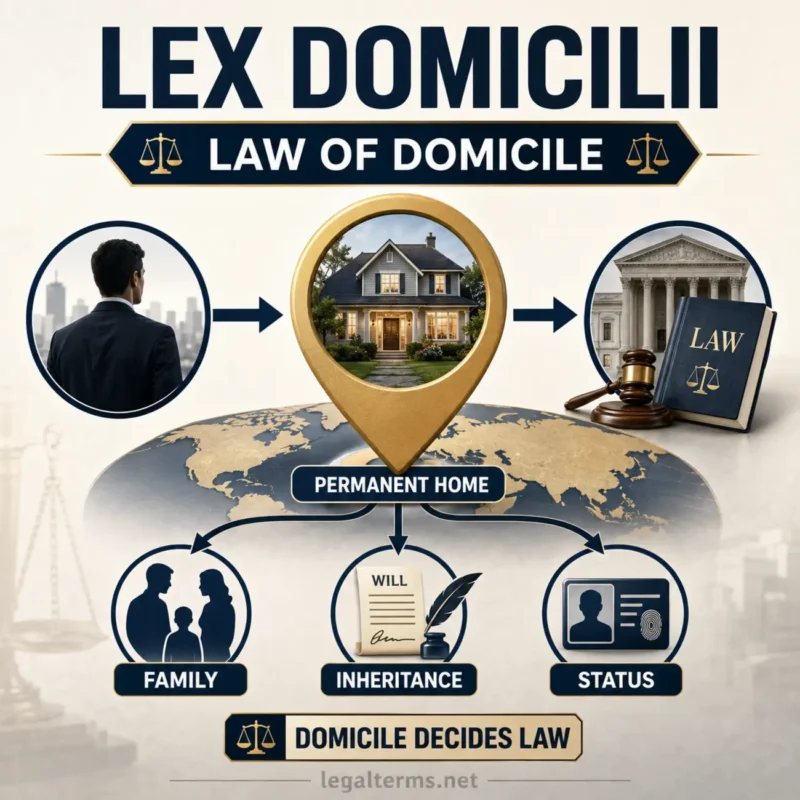
Lex domicilii is a Latin phrase meaning the law of a person’s domicile. Courts use it to decide which legal system governs personal matters when more than one country or state is connected to a case. This guide covers what it means, how it works, and where it changes.
What Does Lex Domicilii Mean?
Lex domicilii combines two Latin words. “Lex” means law. “Domicilii” comes from “domicilium,” which means a permanent home. Together the phrase points to the law of the place a person treats as their fixed home.
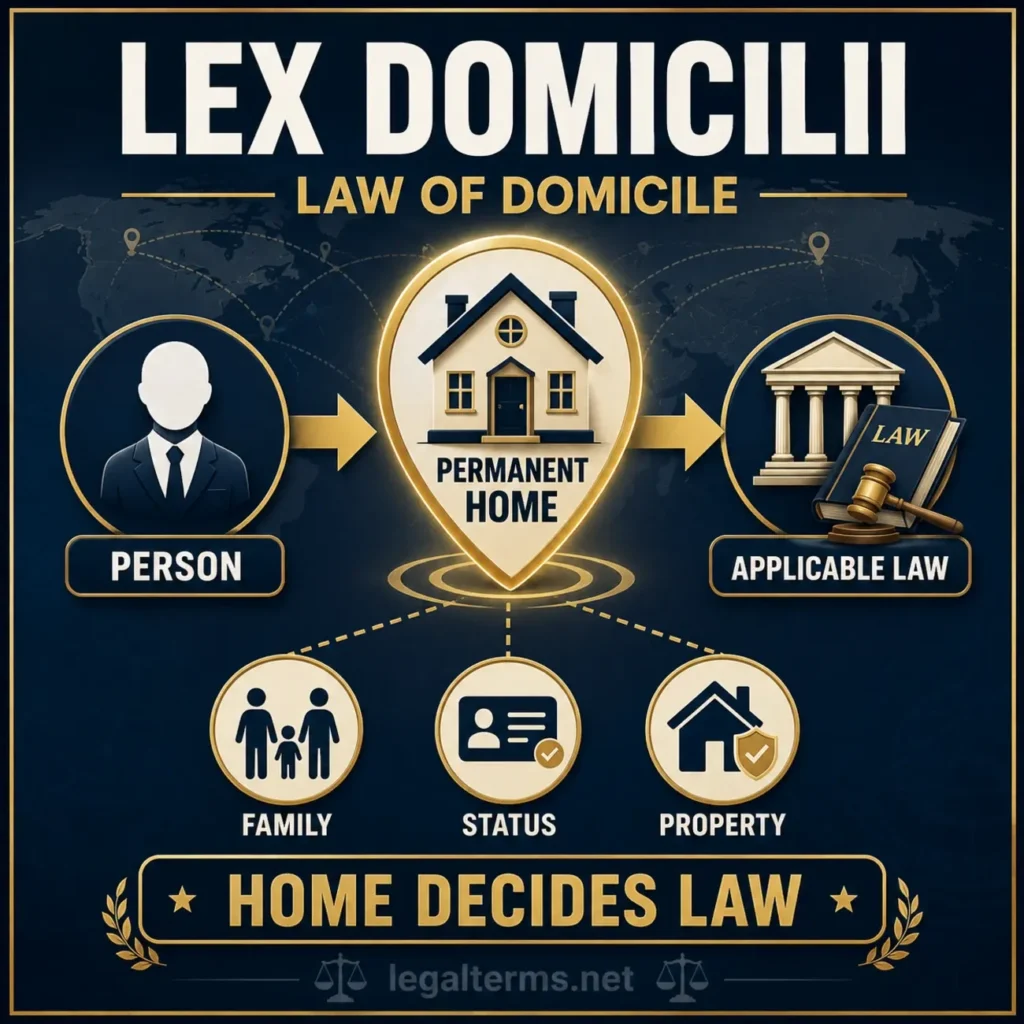
The idea is simple at its core. A person carries a personal legal home with them. That home decides certain questions about their status, family, and property, no matter where they happen to be standing at a given moment.
This matters most in cross-border cases. Imagine a person born in one country, living in a second, and owning property in a third. When a dispute touches their personal status, a court must pick one law to apply. Lex domicilii is one of the main tools for making that choice.
The phrase belongs to a field called conflict of laws. Some lawyers call it private international law. The field answers a single question first. When laws from different places clash, which one wins?
Lex Domicilii in the Conflict of Laws
A court does not apply a foreign law by accident. It follows a structured process. Lex domicilii fits inside that process as one possible answer.
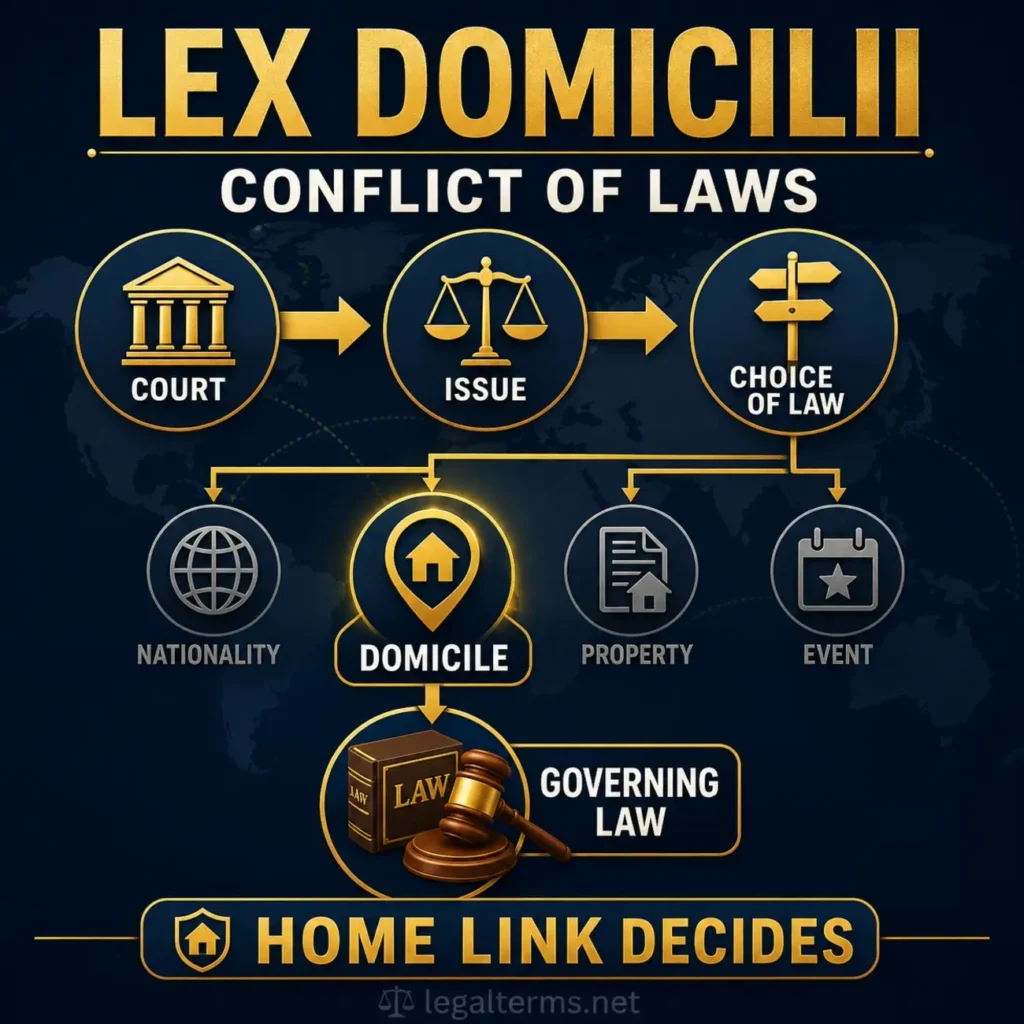
The process usually moves through three steps:
- The court checks if it has jurisdiction to hear the case.
- The court classifies the legal issue, for example marriage, capacity, or inheritance.
- The court applies a choice-of-law rule to pick the governing law.
Lawyers describe these rules using “connecting factors.” A connecting factor links a legal issue to one place. Domicile is one such factor. Nationality, location of property, and place of an event are others.
Common-law systems lean heavily on domicile for personal questions. England, many Commonwealth countries, and the United States all share this tradition. Civil-law systems often prefer nationality or habitual residence instead.
So lex domicilii is not the only option. It competes with other rules. The court picks the rule that fits the type of issue in front of it.
The goal is fairness and predictability. A person should not get a different marital status or inheritance result simply by crossing a border. Domicile gives a stable anchor for that purpose.
How Courts Decide Where You Are Domiciled?
Lex domicilii cannot work until a court fixes the domicile itself. This is often the hard part. Domicile is a legal conclusion, not just an address.
Courts in the United States follow a long-standing standard. A domicile needs two things at once. The person must live in a place, and the person must intend to make it a permanent or indefinite home. Both elements must exist together.
The United States Supreme Court set out this rule clearly in the 1800s. Residence alone is not enough. Intent alone is not enough. A change happens only by act and intent combined, a principle lawyers call “facto et animo.”
Courts look at real-world evidence to find intent. No single fact controls. They weigh many signals together.
Typical signals include:
- Where you vote and register to vote
- Where you file and pay income tax
- Where your driver’s license is issued
- Where you own or rent a long-term home
- Where your family, job, and bank accounts are based
Two rules shift the burden in these disputes. A domicile, once gained, is presumed to continue. The person claiming a change must prove it. This protects against quick or fake moves.
The standard also explains a key point. Long absence does not end a domicile on its own. A student, a soldier, or a worker abroad can keep an old domicile for years. The home stays until a new one is fully formed.
The Three Types of Domicile
Common-law systems sort domicile into three classic categories. Each one arises in a different way. Understanding them helps explain how lex domicilii is applied.
| Type | How it arises | Key feature |
|---|---|---|
| Domicile of origin | Given at birth | Usually taken from a parent. It is never destroyed, only suspended, and can revive later. |
| Domicile of choice | Acquired by an adult | Needs physical residence plus a settled intent to stay indefinitely. |
| Domicile of dependency | Held by dependents | Follows another person’s domicile, such as a young child’s. |
The domicile of origin is the starting point. A newborn cannot choose a home, so the law assigns one. In older common law this was often the father’s domicile for a child born in marriage.
A domicile of choice replaces the origin once an adult settles somewhere new with intent to remain. If that adult later abandons the chosen home without picking another, the domicile of origin can spring back. This revival rule is a feature of English common law.
The domicile of dependency covers people who cannot form their own intent. Minor children are the main example today. Historically it also covered married women and some adults under guardianship, though many of those rules have been reformed.
These categories are not just theory. They decide whose intent counts and when. That answer then drives the lex domicilii result.
Domicile vs Residence vs Nationality
People often mix these three words. The law keeps them apart. The difference changes which connecting factor applies.
| Concept | Based on | More than one? | Main use |
|---|---|---|---|
| Domicile | Permanent home plus intent | No, only one at a time | Personal status, succession, some tax |
| Residence | Physical presence | Yes, several at once | Tax residency, divorce filing in some states |
| Nationality | Citizenship | Sometimes, if dual | Personal law in many civil-law countries |
Residence is the loosest idea. It means you live somewhere, at least for now. You can have a home in a city and a second home by the coast. Both are residences.
Domicile is stricter. You can hold only one at any moment. It is your true, fixed home, the place you mean to return to. Tax authorities and courts treat this as a higher bar than residence.
Nationality is different again. It is the legal bond between a person and a country, shown by a passport. Civil-law systems use nationality through a rule called lex patriae. Common-law systems lean on domicile instead.
This split has a practical effect. A person can be a resident of one state, a national of one country, and domiciled in a third place, all at the same time. The court must decide which factor controls the issue.
What Lex Domicilii Governs?

Lex domicilii does not govern every legal question. It focuses on personal status and certain property matters. The rest is left to other rules.
Common areas controlled or influenced by domicile include:
- A person’s legal capacity, such as the age of majority
- Capacity and some validity questions about marriage
- The legitimacy and status of children
- Succession to movable, or personal, property on death
- The validity and reading of wills that cover movable property
Succession is the clearest example. Under the traditional common-law rule, movable property passes under the law of the deceased person’s domicile at death. Bank accounts, shares, and personal items fall into this group.
Real property is handled differently. Land follows the law of its location, called lex situs, not the owner’s domicile. So a single estate can split between two systems. The house obeys local law, while the savings obey the law of the home.
This is exactly why estate planning across borders is complex. A person with a home in one place and a trust or estate plan elsewhere may face two regimes at once. A clear, valid plan reduces conflict between them.
Marriage shows a mixed pattern too. The form of the ceremony usually follows the place where it happened. Capacity to marry, such as minimum age or close-relative bars, often follows each partner’s domicile before the wedding. Courts call this the dual domicile approach.
Lex Domicilii vs Other Choice-of-Law Rules
Lex domicilii is part of a family of Latin rules. Each one points to a different place. A court selects among them based on the issue.
| Latin term | Meaning | Typically governs |
|---|---|---|
| Lex domicilii | Law of the domicile | Personal status, capacity, movable succession |
| Lex patriae | Law of nationality | Personal law in many civil-law systems |
| Lex situs | Law of the property’s location | Land and immovable property |
| Lex fori | Law of the forum, the court | Procedure and evidence |
| Lex loci celebrationis | Law of the place of marriage | Formal validity of a marriage |
| Lex loci delicti | Law of the place of the wrong | Tort claims under traditional rules |
| Lex loci contractus | Law of the place of the contract | Contract formation under older rules |
The table shows a clear division of labor. Personal questions tend to point home, toward domicile or nationality. Property questions point to where the thing sits. Court process points to the forum itself.
Lex fori deserves a special note. It always governs how a case runs, including deadlines and proof. So a court may apply foreign law to the merits while still using its own procedure.
Modern American courts have added newer methods on top of these rules. Many now ask which place has the “most significant relationship” to the issue. Domicile still feeds into that test, but it shares space with other factors. Both the traditional rule and the flexible test can lead a court back to a person’s home.
Does Lex Domicilii Vary From State to State?
Yes, application varies inside the United States. The core idea stays the same, but each state controls how domicile is proven and used. This is the part many people overlook.
The federal rule on what domicile means is consistent. It is residence plus intent to remain. State courts apply that rule, yet they reach different results based on local statutes and facts.
The clearest variation appears in divorce. A court can only end a marriage if it has a real connection to a spouse. States set their own waiting periods to show that link.
| State | Minimum before filing | Note |
|---|---|---|
| Nevada | 6 weeks | Courts have treated physical presence as enough, not full domicile |
| Idaho | 6 weeks | A short waiting period applies after service |
| Alaska, South Dakota, Washington | No fixed period | Based on domicile and intent to remain |
| California | 6 months in state, 3 months in county | A community property state |
| Texas | 6 months domicile, 90 days in county | Both tests must be met |
| Louisiana | About 6 months, presumed | Based on domicile, and the presumption can be rebutted |
| New York | Up to 2 years | Shorter if the couple married or lived in the state |
These gaps create a real incentive to file in a friendly state. The law fights this through residency rules. Their main purpose is to block forum shopping, where a spouse moves only to win a tactical edge.
State variation also shows up in tax. Many states tax people based on domicile, not just presence. A move from a high-tax state to a low-tax state can trigger an audit. The state often demands proof of intent to leave, using the same signals courts use, such as voting and license records.
Inheritance follows the pattern too. When a person dies without a will, personal property passes under the law of their domicile at death. Real estate passes under the law of the state where it sits. Two states can each claim a wealthy decedent as their domiciliary, since each wants the estate tax.
So the headline is clear. The doctrine is national, but the details are local. Anyone with ties to several states should treat domicile as a planned choice, not an accident.
Real Examples of Lex Domicilii in Action
Examples make the rule concrete. Each one shows how a court picks the law of the home.
Consider a retired couple who split time between two states. They winter in a low-tax state and summer in a high-tax state. The high-tax state may argue the couple never truly left. Their voting record and main doctor point home. Their domicile, and the law that follows it, depends on intent.
Now take an inheritance case. A man dies owning shares in one country and a vacation house in another. His domicile at death decides who inherits the shares. The location of the house decides who inherits the property. One estate, two governing laws.
Picture a marriage question next. Two people from different states marry while on holiday abroad. The foreign country handles the ceremony’s form. Each partner’s home state handles their capacity to marry, such as age limits. If one partner was too young at home, that marriage may face a challenge.
Think about a student studying out of state for four years. The student lives on campus and holds a local license. Yet the parents’ home may still be the legal domicile, if the student plans to return. Presence does not erase the prior home on its own.
Finally, consider a soldier stationed overseas. Years abroad do not change the domicile by themselves. The home stays fixed until the service member adopts a new permanent home by act and intent. Until then, the old state’s law continues to apply to personal matters.
Why Lex Domicilii Still Matters?
Some scholars say domicile is fading. Habitual residence is rising in international treaties. Still, lex domicilii remains a working tool, especially in the common-law world.
The reason is stability. People move more than ever. Jobs, marriages, and assets cross borders with ease. A rule that anchors personal status to a chosen home brings order to that movement.
It also protects expectations. A person who builds a life in one place can rely on that law for status and inheritance. They do not lose protections by a short trip or a temporary posting abroad.
For ordinary people, the lesson is practical. Domicile is not a label you ignore. It shapes your taxes, your divorce options, and the fate of your estate. Treating it as a deliberate decision can prevent costly fights later.
Q&A About Lex Domicilii
What does lex domicilii mean in plain words?
It means the law of the place you treat as your permanent home. Courts use it to govern personal matters, such as status and inheritance, when more than one place is involved.
What is the difference between domicile and residence?
Residence is where you physically live, and you can have several. Domicile is your one true permanent home, defined by living there plus intent to stay. Domicile is the stricter standard.
How does a court decide my domicile?
It looks for residence joined with intent to remain. Courts weigh signals like voting, taxes, your driver’s license, and where your family and job are based. No single fact decides it alone.
Does lex domicilii apply to real estate?
Usually no. Land follows the law of the place where it sits, called lex situs. Lex domicilii mainly covers movable property, such as money and personal belongings.
Can my domicile change just by moving?
Not automatically. You must live in the new place and intend to make it your permanent home. Until a new domicile forms, the old one continues, even after a long absence.
Does domicile work the same in every US state?
The basic meaning is the same nationwide, but the rules differ in practice. Divorce waiting periods, tax tests, and inheritance results vary by state. So your home state can change the outcome.
Is lex domicilii the same as lex patriae?
No. Lex domicilii uses your home, while lex patriae uses your nationality. Common-law systems favor domicile, and many civil-law systems favor nationality.
Legal References
- Mitchell v. United States, 88 U.S. 350 (1874)
- United States v. Mitchell, 403 U.S. 190 (1971)
- Restatement (Second) of Conflict of Laws (1971)
- Dicey, Morris and Collins, The Conflict of Laws
- Re Annesley [1926] Ch 692 (England)
- Cal. Fam. Code section 2320; Tex. Fam. Code section 6.301; Nev. Rev. Stat. section 125.020

Hamit Sahin is the founder and editor of LegalTerms.net. He researches U.S. legal terminology and publicly available legal information using statutes, court rules, judicial opinions, government publications, and established legal reference sources.
His work focuses on organizing complex legal concepts into clear, plain-English explanations for general educational purposes.
Hamit is not an attorney and LegalTerms.net does not provide legal advice.