Memorandum of Understanding (MOU): Definition, Purpose, and Whether It’s Legally Binding

What Is a Memorandum of Understanding?
If you have ever been handed a document titled “Memorandum of Understanding” and wondered whether signing it locks you into anything, you are asking the right question. An MOU records what two or more parties have agreed to in principle, but whether it actually binds them is rarely as simple as the title suggests.
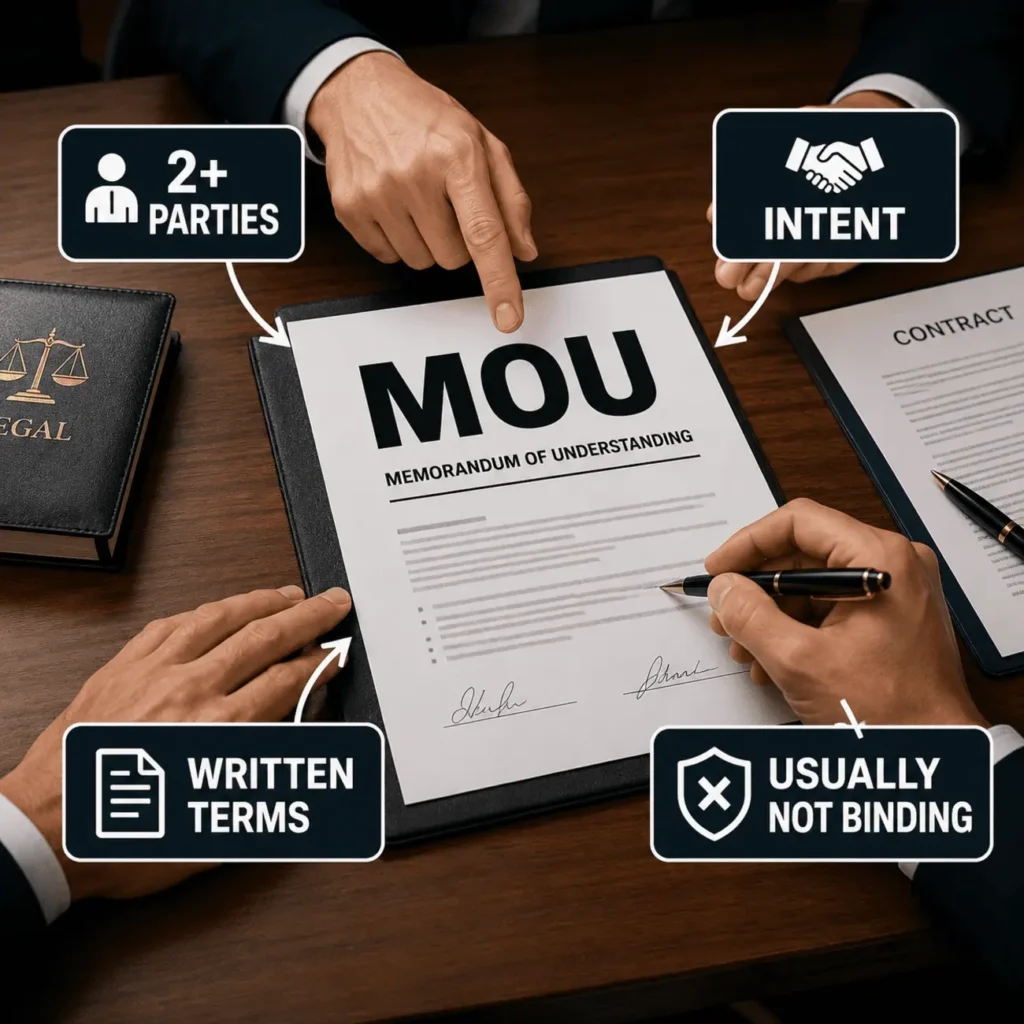
A memorandum of understanding is a written record of the terms and intentions that two or more parties share as they plan to work together. It signals serious commitment, but it usually stops short of creating the enforceable obligations a full contract carries.
Key Points at a Glance:
- Term: Memorandum of Understanding (MOU)
- Also Known As: Statement of intent, letter of understanding, cooperation agreement
- Legal Area: Contract law, commercial transactions, government and international relations
- Core Nature: A written statement of a shared understanding or intent between two or more parties
- Binding Status: Usually not binding as a whole, but this turns on its wording, not its title
- Common Uses: Business partnerships, joint ventures, government agencies, universities, international cooperation
- Key Risk: Specific clauses, such as confidentiality or exclusivity, can still bind you even when the overall MOU does not
The name itself tells you a good deal. The document memorializes an “understanding,” not a promise that a court will automatically enforce. Think of it as the moment two sides shake hands on the main points and write them down, while the detailed, binding paperwork is left for later. Everyone walks away knowing roughly where they stand and what comes next.
That middle position is exactly why MOUs are so common. They sit between a casual conversation and a signed contract, giving parties a way to mark progress without yet taking on the full weight of legal obligation. The catch, which the rest of this article unpacks, is that the title on the front page does not decide whether the document carries legal force.
Why Do Parties Use a Memorandum of Understanding?
Parties use an MOU to put a shared plan on paper, set expectations, and show good faith before anyone is ready to sign a binding contract.
The practical appeal comes down to flexibility. A full contract takes time, lawyers, and a willingness to commit, and at the early stage of a relationship that level of commitment is often premature. An MOU lets people move forward together while the details are still being worked out. It is a roadmap, not a finish line.
There are a few recurring reasons parties reach for one:
- To clarify each side’s role and what each expects from the other
- To create a framework that guides the negotiations still to come
- To show stakeholders, such as a board, an investor, or a funding agency, that a deal is genuinely moving
- To record agreement on the big-picture terms before spending money on a definitive contract
- To preserve a cooperative tone, since an MOU reads more like a partnership than a list of legal demands
In government and nonprofit settings, an MOU often does even more work. Agencies that cannot easily enter ordinary commercial contracts with one another use these documents to coordinate responsibilities, share resources, or run joint programs. The understanding carries real institutional and moral weight even where it carries little legal weight.

Is a Memorandum of Understanding Legally Binding?
In most cases a memorandum of understanding is not legally binding on its own, because the parties usually intend it as a statement of intent rather than a firm promise. Whether a particular MOU binds anyone depends on its wording and the parties’ intent, not on the label printed at the top.
This is the point that trips people up. A binding contract creates obligations a court will enforce, while a non-binding MOU mainly records intentions the parties remain free to walk away from. The trouble is that the line between the two is drawn by what the document actually says and does, not by what it is called. A document titled “Memorandum of Understanding” can still be treated as an enforceable contract if it contains everything a contract needs and the parties behaved as though they meant to be bound.
Courts approach the question by asking two things above all: did the parties objectively intend to be bound, and are the terms definite enough to enforce? If the answer to both is yes, the title becomes almost irrelevant. If the parties clearly signaled that nothing would bind them until a later formal agreement was signed, that signal usually holds.
Writing “this memorandum is not legally binding” into the document helps, and it is good practice, but it is not a magic spell. If the rest of the text reads like a finished deal and the parties start performing as if it were one, a court can look past the disclaimer to the substance. If you are trying to work out whether something you signed creates real obligations, it helps to understand how a contract differs from a general agreement in the first place.
What Determines Whether an MOU Is Enforceable?
Whether an MOU is enforceable comes down to a handful of factors courts weigh together, not to any single rule.
The starting point is intent, judged objectively. A court does not ask what each side privately hoped for; it asks what their words and conduct would signal to a reasonable observer. From there, a few other factors carry most of the weight:
- Definiteness of terms. If the essential terms are spelled out clearly enough to enforce, the document looks more like a contract. Vague or “to be negotiated” terms point the other way.
- Consideration. Enforceable promises usually require an exchange of something of value. An MOU that records a genuine bargain is closer to a contract than one that simply states hopes. You can read more about why this matters in our explainer on legal consideration in contracts.
- Conditional language. Phrases like “subject to a definitive agreement” or “subject to board approval” tell a court the parties did not yet mean to be bound.
- Conduct after signing. If the parties start performing as though the deal is done, that behavior can tip a court toward treating the MOU as binding.
Think of conditional language as a seatbelt. Adding “subject to formal contract” throughout the document is one of the clearest ways a party signals that it is not yet committing. Leave it out, fill in every essential term, and start acting on the deal, and you may find that the “understanding” hardened into an obligation without anyone signing a separate contract.
Which Parts of an MOU Can Still Bind You Even If the Rest Does Not?
Even when an MOU is non-binding as a whole, it often contains specific clauses that the parties do intend to enforce, and those clauses can bind you on their own.
This is the detail most general explanations skip, and it is where people get caught off guard. A confidentiality clause inside a non-binding MOU can still be enforced, because the parties usually intend that particular promise to take effect immediately, long before any final contract. Treating the whole document as harmless because the headline says “non-binding” is a mistake.
The clauses most likely to bind even in an otherwise non-binding MOU include:
- Confidentiality: protecting sensitive information shared during talks
- Exclusivity or “no-shop” provisions: a promise not to negotiate with anyone else for a set period
- Governing law and dispute resolution: which state’s law applies and where any dispute is heard
- Allocation of costs: who pays for due diligence, appraisals, or legal work
- Non-solicitation: a promise not to poach the other side’s staff or customers
The reason these survive is straightforward. They are the promises the parties genuinely want operative right now, while the larger deal is still being shaped. Many MOUs make this explicit by stating that the document is non-binding “except for” the listed clauses. Before you sign, those few exceptions deserve as much attention as the entire rest of the page.
What Does a Memorandum of Understanding Usually Include?
A typical memorandum of understanding identifies the parties, states their shared purpose, sets out who will do what, and says how long the understanding lasts.
Beyond those basics, the contents vary with the setting, but most well-drafted MOUs cover a recognizable set of sections:
| Section | What It Does |
|---|---|
| Parties | Names and roles of everyone involved |
| Purpose and objectives | Why the parties are coming together |
| Scope of cooperation | What the relationship will and will not cover |
| Roles and responsibilities | What each side commits to contribute |
| Timeline and duration | When it starts, and when it ends or is reviewed |
| Binding or non-binding clause | A statement of whether, and to what extent, the document is enforceable |
| Confidentiality | How shared information is protected |
| Termination | How either side can step away |
| Signatures and dates | Who agreed, and when |
Of all of these, the binding-or-non-binding clause does the heaviest lifting. It is the place where the parties state their intent directly, and as the earlier sections explained, stated intent is the first thing a court looks for. A clear sentence saying the MOU is non-binding except for named clauses can save everyone a great deal of argument later.
Where Are Memorandums of Understanding Commonly Used?
Memorandums of understanding turn up across business, government, education, and international affairs, anywhere parties want to coordinate before locking in firm commitments.
In the business world, they are a common first step toward joint ventures, partnerships, and acquisitions. Two companies exploring a deal will often sign an MOU to frame the relationship while their lawyers and accountants work through the definitive contract. The MOU keeps everyone aligned on the big points without forcing a premature commitment.
Government agencies lean on them heavily. Public bodies that cannot easily enter ordinary commercial contracts with one another use MOUs to divide responsibilities, share data, or run joint programs. Universities and research institutions do much the same when they set up student exchanges or collaborative projects, and nonprofits use them to coordinate shared services.
International relations offer the most striking example, and a slightly counterintuitive one. Nations often choose an MOU precisely because it is understood as a political commitment rather than a binding treaty. The whole point is to record cooperation and shared intent while keeping the document outside the formal, legally enforceable machinery of treaty law. Here, the non-binding quality is not a weakness to be managed but the very reason the form is chosen.
Is an MOU the Same as a Letter of Intent or a Memorandum of Agreement?
An MOU, a letter of intent, and a memorandum of agreement overlap heavily and are often used interchangeably, though each tends to carry a slightly different emphasis.
The honest answer is that the labels are not used consistently. A memorandum of understanding usually emphasizes a shared understanding between parties, while a memorandum of agreement more often signals that the parties expect to be bound to specific commitments. A letter of intent typically frames one party’s proposed terms as a step toward a deal, and is especially common in mergers, acquisitions, and real estate. For a closer look at that cousin document, see our explainer on the legal letter of intent.
| Document | Typical Emphasis | Usual Binding Status |
|---|---|---|
| Memorandum of Understanding | Shared intent and cooperation | Usually non-binding overall |
| Letter of Intent | One side’s proposed deal terms | Usually non-binding, with some binding clauses |
| Memorandum of Agreement | Defined commitments between parties | More likely to be treated as binding |
| Contract | Enforceable rights and duties | Binding by design |
What matters far more than the name is the content. As the cases below show, courts have enforced documents called “memoranda” and refused to enforce documents that looked like deals, based entirely on the language inside and the conduct around them.
What Courts Have Said
Two well-known cases sit at opposite ends of the binding question, and together they make the central lesson concrete.
The first is Texaco, Inc. v. Pennzoil Co. In 1984, Pennzoil and Getty Oil negotiated a deal and signed a memorandum of agreement, after which Getty backed out and sold to Texaco at a higher price. Pennzoil sued Texaco for interfering with what it argued was already a binding agreement. A Texas jury agreed, treating the memorandum as enforceable even though no formal contract had been finalized, and returned a verdict of roughly 10.53 billion dollars, later reduced on appeal but still among the largest in American history.
The reasoning that mattered: when parties have settled all the substantial terms and have not made being bound conditional on signing a later formal document, an informal agreement can hold them. The “memorandum” label gave Getty no shelter, and the cost of assuming otherwise was enormous.
The second case points the other way. In Empro Mfg. Co. v. Ball-Co Mfg., Inc. (1989), Empro sent a three-page letter of intent to buy Ball-Co’s assets, a letter that repeatedly made the purchase subject to a formal asset purchase agreement and further approvals. When talks collapsed, Empro tried to enforce the letter. The Seventh Circuit refused. Because the document kept making itself subject to a definitive contract, its objective language showed the parties did not yet intend to be bound, and intent in contract law is read from the words used, not from what a party later wishes it had meant.
The contrast is the whole point. Two preliminary documents from the same family produced opposite results, and the difference came down to the language inside them. Careful conditional wording protected Ball-Co’s counterpart; the lack of it exposed Getty. Your MOU lives somewhere on that same spectrum.
How to Tell Whether the MOU in Front of You Is Binding
Faced with an MOU and unsure where you stand, you can learn a great deal by reading it the way a court would, focusing on a few specific signals rather than on the title.
Start with the clause that states whether the document is binding, and read it before anything else. If there is no such clause, that absence is itself worth noting. From there, work through the document with these questions in mind:
- Look for conditional language. Phrases like “subject to a definitive agreement” or “subject to approval” suggest the parties did not yet mean to commit.
- Check how definite the terms are. The more completely the essential terms are filled in, the more the document resembles an enforceable contract.
- Find the carve-outs. Confidentiality, exclusivity, and similar clauses are often meant to bind immediately, even in a document labeled non-binding.
- Notice the conduct around it. If both sides are already performing as if the deal is done, that behavior can matter as much as the words.
If you are unsure after reading it, a short conversation with a lawyer can save a lot of trouble. Useful questions to bring include: which parts of this are meant to bind me right now, does anything here commit me to exclusivity or confidentiality, and what happens if the final contract is never signed. This kind of review helps you spot risk, but it is not a substitute for legal advice, and you should consult a licensed attorney before signing anything you are unsure about.
A Few Cautions
The single most important caution is the one this article keeps returning to: the title does not decide the legal effect. A document called a memorandum of understanding can bind you, and a carefully worded one can protect you, depending entirely on what it says and how the parties act.
A written “non-binding” statement helps your case, but treat it as a strong signal rather than an ironclad guarantee. If the rest of the text reads like a completed deal, a court can look past the disclaimer. Remember too that the carve-out clauses, especially confidentiality and exclusivity, frequently take effect on their own, so a “non-binding” MOU is rarely binding on nobody. Outcomes also vary by jurisdiction and turn heavily on the specific facts, which is one more reason general information cannot replace advice tailored to your situation. None of this is legal advice; for guidance on a document you have actually been asked to sign, speak with a licensed attorney.
Frequently Asked Questions
Is a memorandum of understanding the same as a contract?
Not exactly. A contract is built to be enforceable and creates rights and duties a court will uphold, while an MOU is generally meant to record shared intentions rather than firm obligations. The complication is that an MOU can still be treated as a contract if it contains everything a contract needs and the parties intended to be bound, so the difference is about substance, not the name on the page.
Can you back out of a memorandum of understanding?
Usually, yes, if the MOU is genuinely non-binding, since its purpose is to record intent rather than to lock anyone in. Be careful, though, about any clause meant to bind immediately, such as a confidentiality or exclusivity provision, because walking away from those can still expose you to liability even when the larger deal falls through.
Does an MOU need consideration to be valid?
It depends on what you mean by valid. As a record of intent, an MOU does not need consideration to exist or to do its job. But if a party wants to enforce it as a contract, the usual contract requirements, including consideration, come into play, and a document that lacks a real exchange of value is harder to treat as binding.
Do both parties have to sign a memorandum of understanding?
In practice, MOUs are almost always signed by every party involved, and signing is the clearest way to show that each side agrees to the terms. A signature does not by itself make the document binding, but it strengthens the record of who agreed to what, which matters if anyone later disputes the understanding.
Is a memorandum of understanding enforceable in court?
Sometimes. Courts have enforced documents called memoranda when the terms were definite and the parties clearly intended to be bound, and they have declined to enforce documents that were kept subject to a future formal agreement. Enforceability depends on the wording and the parties’ intent, not on the label, which is why the same kind of document can produce opposite results.
How long does a memorandum of understanding last?
That is set by the document itself. Many MOUs state a fixed term or an end date, while others continue until the parties sign a definitive agreement or simply walk away. If duration matters to you, look for a termination or expiration clause, because an MOU without one can leave its status unclear.
References
- Cornell Law School Legal Information Institute, Contract
- Cornell Law School Legal Information Institute, Pennzoil Co. v. Texaco, Inc.
- Justia, Empro Mfg. Co. v. Ball-Co Mfg., Inc., 870 F.2d 423 (7th Cir. 1989)
- LegalTerms.net Editorial Guidelines
- LegalTerms.net Sources and References
About This Article
Author: Hamit Sahin, Legal Researcher & Editor
Published: June 2026
Last Updated: June 2026
Article Type: Legal term definition and doctrine explanation
Research Sources: Cornell Law School Legal Information Institute, Justia, and the published decisions in Texaco, Inc. v. Pennzoil Co. and Empro Mfg. Co. v. Ball-Co Mfg., Inc.
Scope: This article explains what a memorandum of understanding is, why parties use one, what determines whether it is enforceable, and how it compares with related documents. It does not provide MOU templates, detailed state-by-state enforcement variations, international treaty law mechanics, or tax and accounting treatment.
Editorial Standards: This article was researched against primary legal sources and reviewed for accuracy and clarity before publication. Case details were verified against published court records.
Field Methodology: The recognition guidance in this article is intended to help you read and evaluate a document, not to draft one or build a legal argument. It identifies signals to look for and questions to raise with a professional, and it deliberately stops short of case-specific recommendations.
Disclaimer: This article is for general informational purposes only and does not constitute legal advice. For advice specific to your situation, consult a licensed attorney.
Disclosure: LegalTerms.net is an independent editorial resource. This article was not sponsored or influenced by any law firm, legal service provider, or other commercial entity.

Hamit Sahin is the founder and editor of LegalTerms.net. He researches U.S. legal terminology and publicly available legal information using statutes, court rules, judicial opinions, government publications, and established legal reference sources.
His work focuses on organizing complex legal concepts into clear, plain-English explanations for general educational purposes.
Hamit is not an attorney and LegalTerms.net does not provide legal advice.