What Is a Legal Standing Order? Meaning, Examples, and How It Works
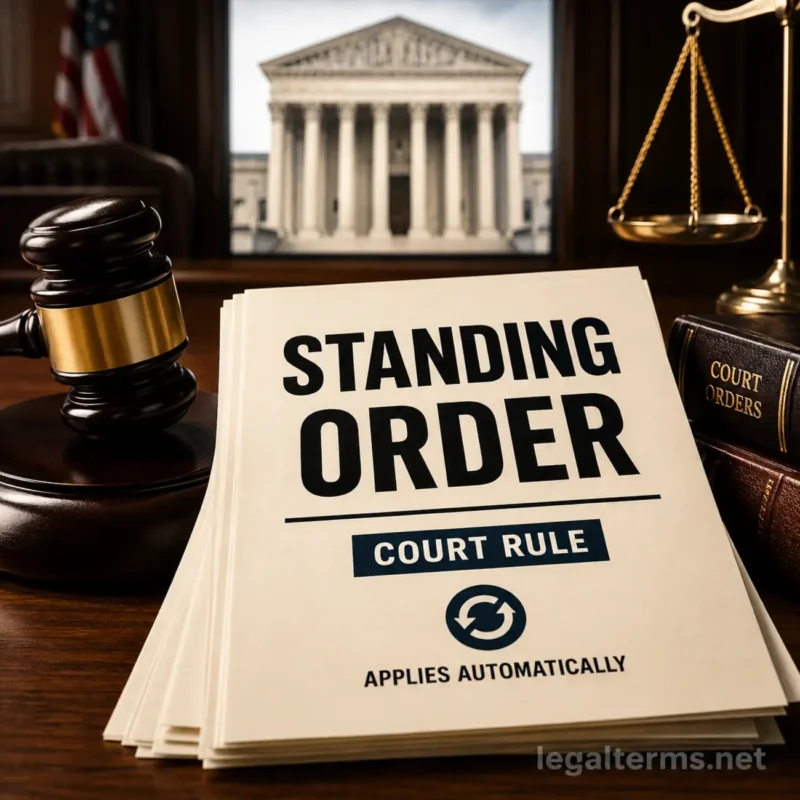
A legal standing order is a court order that applies automatically, without either side requesting it. It sets rules that the parties must follow while a case is active. Standing orders appear most often in family and civil courts, and a violation can carry real penalties.
This guide explains what standing orders mean, how they work in different courts, and what happens if you ignore one.
What a Legal Standing Order Really Means
The term standing order has two common meanings in United States law. Both involve a court setting rules in advance, rather than reacting case by case.
The first is a family law standing order, sometimes called a domestic standing order. It takes effect the moment a divorce or custody case is filed. It applies to both parties at the same time, and neither spouse has to ask for it.
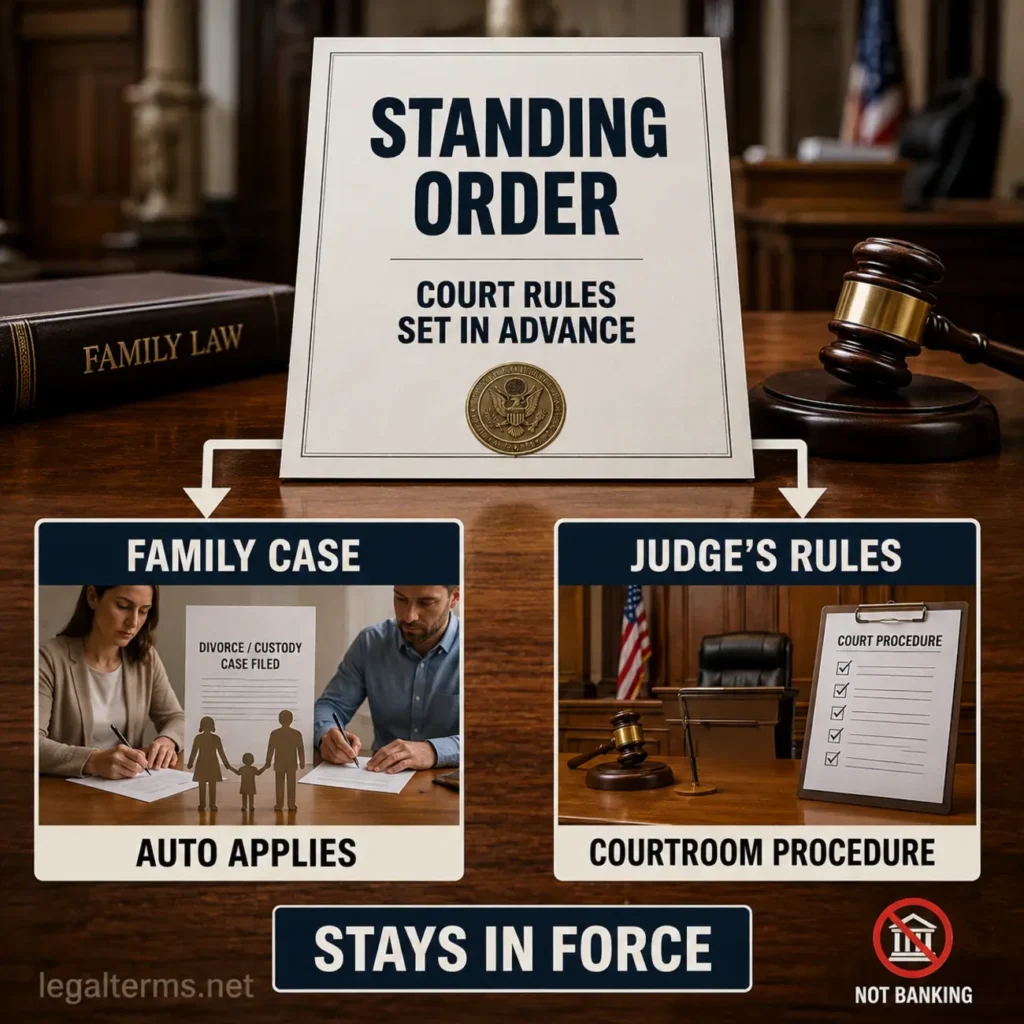
The second is a judge’s procedural standing order. This is a set of instructions that controls how cases run in one judge’s courtroom. Lawyers also call these individual rules or individual practices.
A standing order stays in force until the court changes it, withdraws it, or the case ends. It does not expire on its own the way some short term orders do.
In both senses, the goal is similar. The court wants order, fairness, and predictable conduct while a matter is pending. The order tells everyone the ground rules before problems start.
People sometimes confuse this with a banking standing order, which is a recurring payment instruction used mainly in the United Kingdom. That financial meaning has nothing to do with the court orders described here. On a United States legal site, a standing order almost always points to a court directive.
Why Courts Use Standing Orders
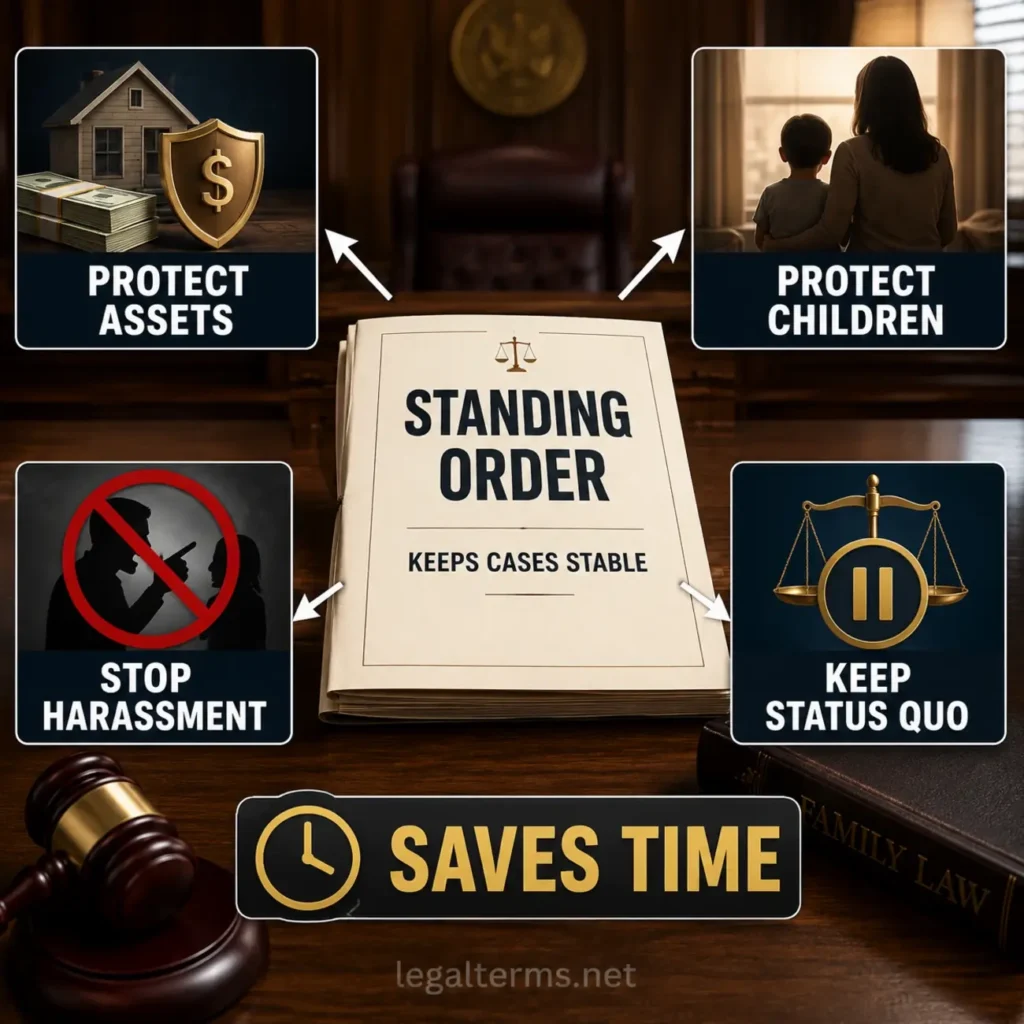
Courts issue standing orders to keep cases stable and fair. Family disputes can move fast, and emotions often run high. A standing order slows things down and protects everyone involved.
The most common reasons include:
- Preserving assets. The order stops one spouse from selling, hiding, or moving marital money before a judge can divide it.
- Protecting children. It blocks sudden moves, school changes, or attempts to keep a child from the other parent.
- Preventing payback. It bars threats, harassment, and retaliation while the case is open.
- Keeping the status quo. It freezes the situation so the court can decide based on real facts, not last minute changes.
There is also a practical reason. Without a standing order, courts would face a flood of emergency motions at the start of every case. The order answers many of those questions in advance, which saves time for the parties and the judge.
For a procedural standing order, the purpose is efficiency. A judge handles many cases at once and needs every party to file and argue in the same way. Clear rules reduce confusion and keep the docket moving.
Standing orders do not decide who wins. They simply set boundaries so the case can proceed in a calm and organized way.
How Standing Orders Work in Family Law Cases
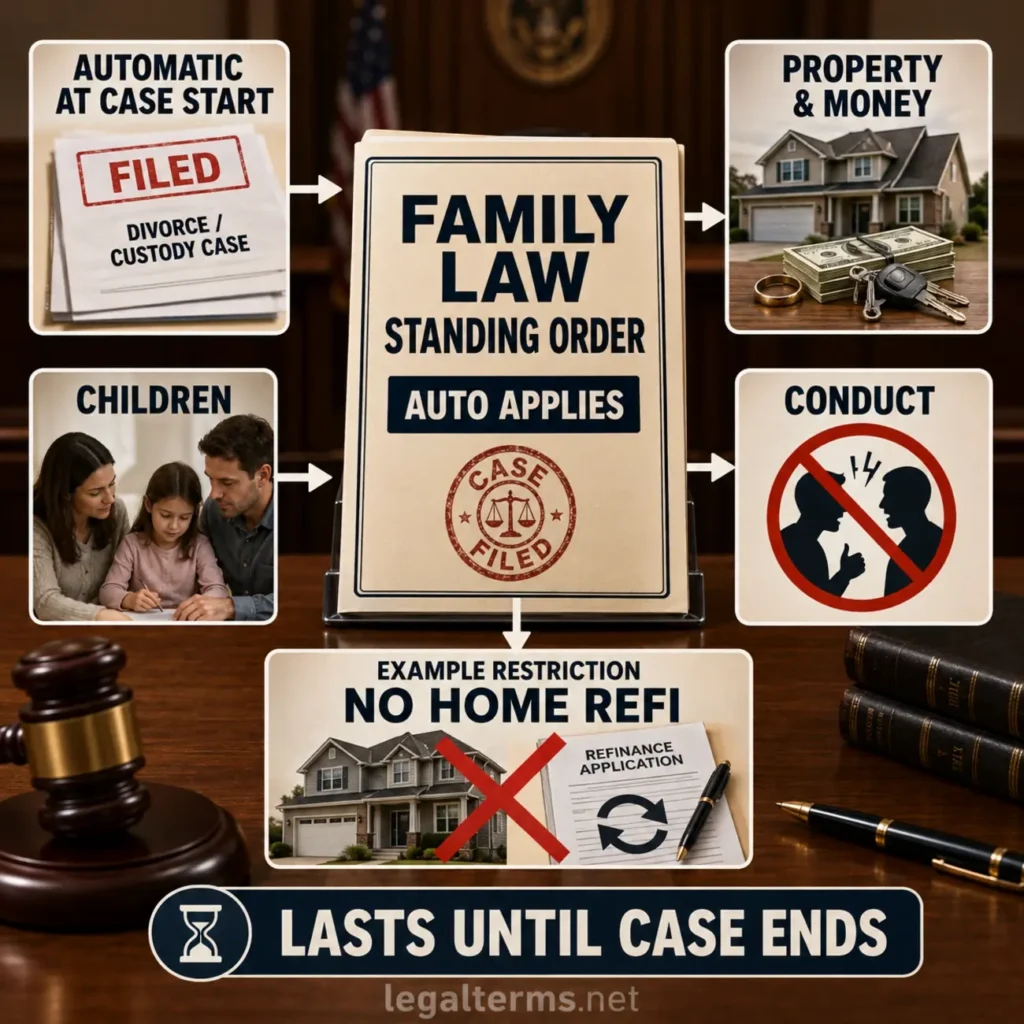
In family law, a standing order works much like an automatic temporary restraining order. Nobody has to request it. It binds both spouses or both parents as soon as the case begins, and it lasts until the case ends or the court issues a new order.
Standing orders in divorce and custody cases usually control three areas:
- Property and money. Parties often cannot sell, hide, or transfer marital assets, or cancel insurance policies.
- Children. Parents usually cannot move a child out of state, hide the child, or make major changes such as switching schools without agreement or court approval.
- Conduct. Parties may be barred from threats or from speaking badly about the other parent in front of the children.
Consider a common scenario. A spouse wants to refinance the family home in the middle of a divorce. A standing order may block that step, because it changes a shared asset before the court has divided property. The spouse would need agreement or court permission first.
Not every county uses standing orders. Some courts apply them automatically when a case is filed. Others require a party to request a temporary restraining order instead, which is a similar but separate step.
Because these orders touch parenting decisions, they connect closely with how courts handle legal custody. Parents should read the order in full before making any choice about the children.
These rules vary widely by state and county. Always consult a licensed attorney about the standing order that applies in your specific court.
Standing Orders in Civil and Criminal Courts
Outside family law, a standing order is usually a judge’s own procedural rule. Judges use these to manage their dockets and keep cases moving in an orderly way.
These orders fill gaps. When no local rule or national rule covers a situation, a judge can set the procedure. In federal court, this authority comes partly from Rule 16 and Rule 83(b) of the Federal Rules of Civil Procedure.
A judge’s standing order often covers practical details, such as:
- How and when to file motions
- Page limits and formatting for briefs
- Whether to send a letter before filing a discovery motion
- Scheduling and pretrial conference steps
The order applies to every case in front of that judge. Missing one of its requirements can lead to a stricken filing or even sanctions. Attorneys usually read a judge’s standing order as soon as a case is assigned to that courtroom.
A standing order can also require a step before trial. For example, a judge may direct all parties to attempt mediation before a hearing is scheduled.
There is a limit to this power. A judge cannot use a standing order to quietly replace local rules that must pass through a formal review process. Courts have warned that standing orders should not become substitute rulebooks that skip that review.
Criminal courts use standing orders as well. They often address scheduling, evidence exchange, and expected conduct in the courtroom.
Standing Order vs Restraining Order vs Injunction
People often mix up standing orders with other court orders that restrict behavior. The table below shows the main differences at a glance.
| Order type | Who starts it | How long it lasts | Main purpose |
|---|---|---|---|
| Standing order (family) | Automatic when the case is filed | Until the case ends or the court changes it | Preserve the status quo for both parties |
| Restraining order | Requested by a party | Often short term, then reviewed | Protect a person from harm or contact |
| Protective order | Requested by a party | Set by the court, can be long term | Keep an abuser away from a victim |
| Injunction | Requested by a party | Temporary or permanent | Order someone to stop or start an act |
A restraining order is asked for by one person who needs protection. A standing order, in contrast, applies to both sides at once and arrives by default.
An injunction is a broader civil tool. A court uses it to force a party to act or to stop acting. A family standing order works in a similar way, but it is built into the case rather than requested.
These categories can overlap, and the exact names vary by state. Always check how your own court defines each term before you rely on it.
What Happens If You Violate a Standing Order
A standing order is a real court order. Ignoring it carries serious risk, even if the rules feel minor.
If one party breaks the order, the other can ask the court to step in. This is usually done by filing a motion to enforce the order.
When a judge finds a violation, the result is often contempt of court. Contempt can lead to fines, makeup parenting time, or jail in serious cases. In a custody dispute, a violation can also shape how the judge views that parent.
The penalty depends on the type of violation and the harm caused. A small paperwork slip is treated very differently from hiding a child or draining a joint bank account.
You can be held responsible even if you never read the order. Courts generally expect parties to know the rules that apply to their own case.
If you believe the other side has violated a standing order, do not try to handle it on your own. Document what happened, keep your evidence, and consult a licensed attorney about the right next step.
How to Find and Comply With a Standing Order
Finding the standing order in your case is usually simple once you know where to look.
For family cases, many counties post their standing orders online. You may also receive a copy when you file your petition or when you are served.
For a judge’s procedural standing order, check the court’s website under the assigned judge’s name. These are often listed as individual rules or individual practices.
To stay compliant, a few habits help:
- Read the full order as soon as you receive it.
- Note every action it requires and every action it forbids.
- Ask first before doing anything major with money, property, or children.
- Keep records that show you followed the rules.
When the language is unclear, do not guess. A short conversation with a licensed attorney can prevent a costly mistake later.
Quick Questions and Answers
Question: Is a standing order the same as a restraining order?
Short answer: Not exactly. A restraining order is requested by one person for protection. A family standing order applies to both parties automatically when a case is filed.
Question: Does every county have standing orders?
Short answer: No. Some counties apply them automatically, while others use temporary restraining orders instead. Check your local court to see which rule applies.
Question: When does a family law standing order start and end?
Short answer: It usually starts the moment the case is filed. It stays in effect until the case is finished or the court replaces it with a new order.
Question: Can a standing order be changed?
Short answer: Yes. The judge who issued it can modify or withdraw it. A party can also ask the court to change the order through a proper request.
Question: What if I break a standing order without knowing about it?
Short answer: You can still face consequences. Courts expect parties to know the rules in their case, so lack of awareness is rarely a full defense.
Question: Do standing orders apply in criminal cases?
Short answer: Yes. Criminal courts use them for scheduling, evidence exchange, and courtroom conduct, though the content differs from family law orders.
References
- United States Courts, district court local rules and general orders information, uscourts.gov
- Legal Information Institute, Cornell Law School, Federal Rules of Civil Procedure (Rule 16 and Rule 83), law.cornell.edu
- Texas Judicial Branch, local rules, forms, and standing orders database, txcourts.gov

Hamit Sahin is the founder and editor of LegalTerms.net. He researches U.S. legal terminology and publicly available legal information using statutes, court rules, judicial opinions, government publications, and established legal reference sources.
His work focuses on organizing complex legal concepts into clear, plain-English explanations for general educational purposes.
Hamit is not an attorney and LegalTerms.net does not provide legal advice.