Non-Disclosure Agreement (NDA): Definition, Meaning and Examples
A Non-Disclosure Agreement is the contract businesses reach for when sharing information is unavoidable but leaking it would be costly. It turns a fragile promise of secrecy into a duty a court can enforce. This guide explains what an NDA actually is, the elements that make one stand up, the statutes that now reshape how far it can reach, and the drafting choices that decide whether it protects you or collapses when you need it most.
What a Non-Disclosure Agreement Means in Law
A Non-Disclosure Agreement (NDA), sometimes called a confidentiality agreement, is a legally binding contract that creates a confidential relationship between two or more parties. One side shares sensitive information. The other side accepts a legal duty not to disclose that information or use it outside an agreed purpose.
The core idea is simple. The complexity sits in the conditions. Courts treat an NDA like any other contract, which means it must rest on a valid binding contract foundation: a clear offer, acceptance, and an exchange of value. An NDA that is reasonable in scope, duration, and subject matter is usually enforceable. One that tries to lock down everything forever often is not.
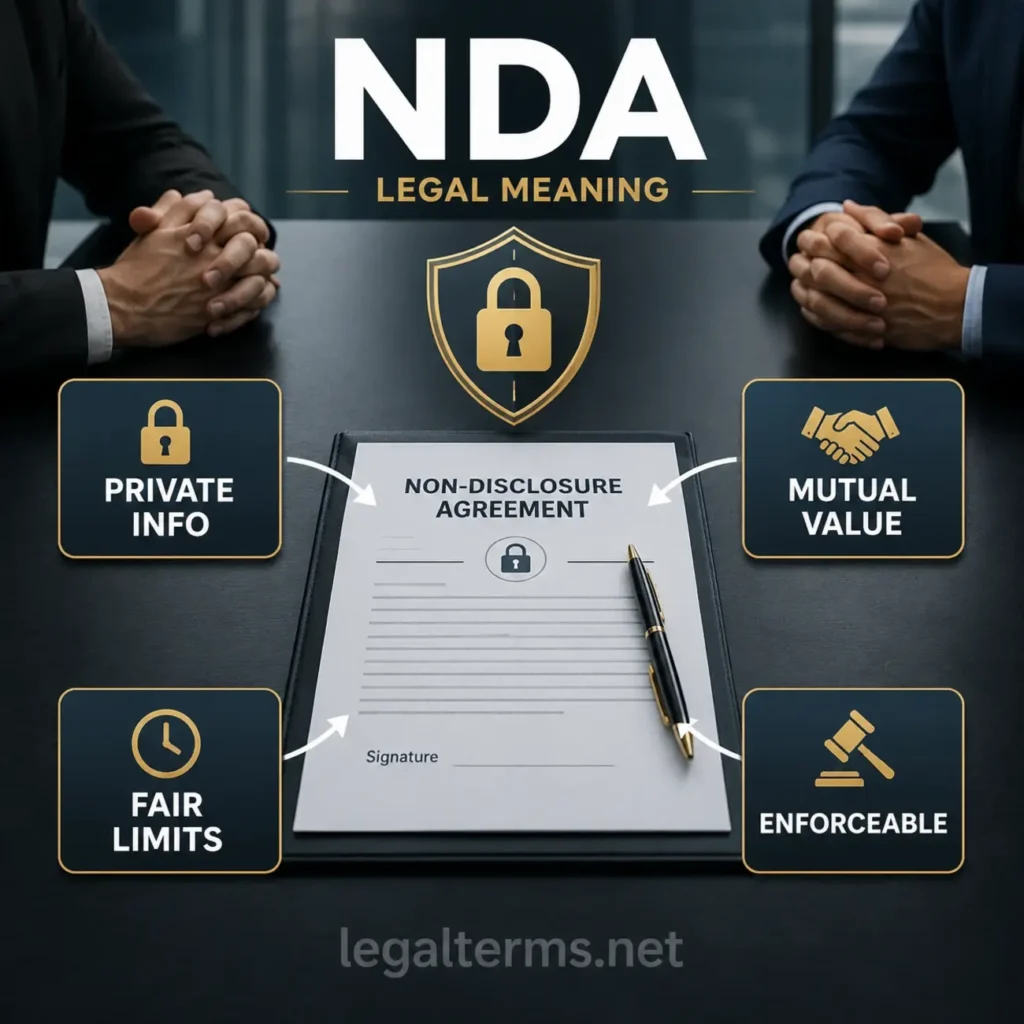
In plain English, an NDA is a written promise that specific information will stay private, limited to the purpose for which it was shared. It does three jobs at once. It defines what is confidential. It states who may see it. It sets out what happens if that trust is broken.
NDAs appear in predictable places. Employers use them when onboarding staff who will handle trade secrets. Companies use them before mergers, acquisitions, and partnerships, where financial and strategic data must change hands. Inventors and startups use them before pitching to investors or manufacturers. Each setting shares the same logic: share value without losing it.
| Aspect | What the law requires | Everyday example |
|---|---|---|
| Confidentiality | The information must be kept private | An employee cannot share source code |
| Consideration | Each side must give something of value | Access to a job or a deal |
| Reasonableness | Scope, time, and subject must be fair | A two-year limit on marketing plans |
| Enforceability | Standard contract rules must be met | Offer, acceptance, mutual intent |
An NDA is not a vague gentlemen’s agreement. It is a defined legal instrument, and its strength depends entirely on how precisely it is written.
The 7 Elements That Make an NDA Enforceable
Every NDA that survives a courtroom shares the same structural backbone. Strip any of these out and the agreement starts to look too vague to protect anything.
The first element is the parties. The agreement must clearly identify the disclosing party, who owns the information, and the receiving party, who promises to protect it. When both sides exchange secrets, they are mutual parties, and the obligations run in both directions.
The second element is the definition of confidential information. This is where most weak NDAs fail. The contract must spell out what counts as confidential, because a court will not guess. Typical categories include business strategies, technical data and prototypes, financial figures, customer and supplier lists, and unreleased product plans. A definition that is too narrow leaves gaps. One that simply labels “all information” as confidential invites a judge to strike it for vagueness.
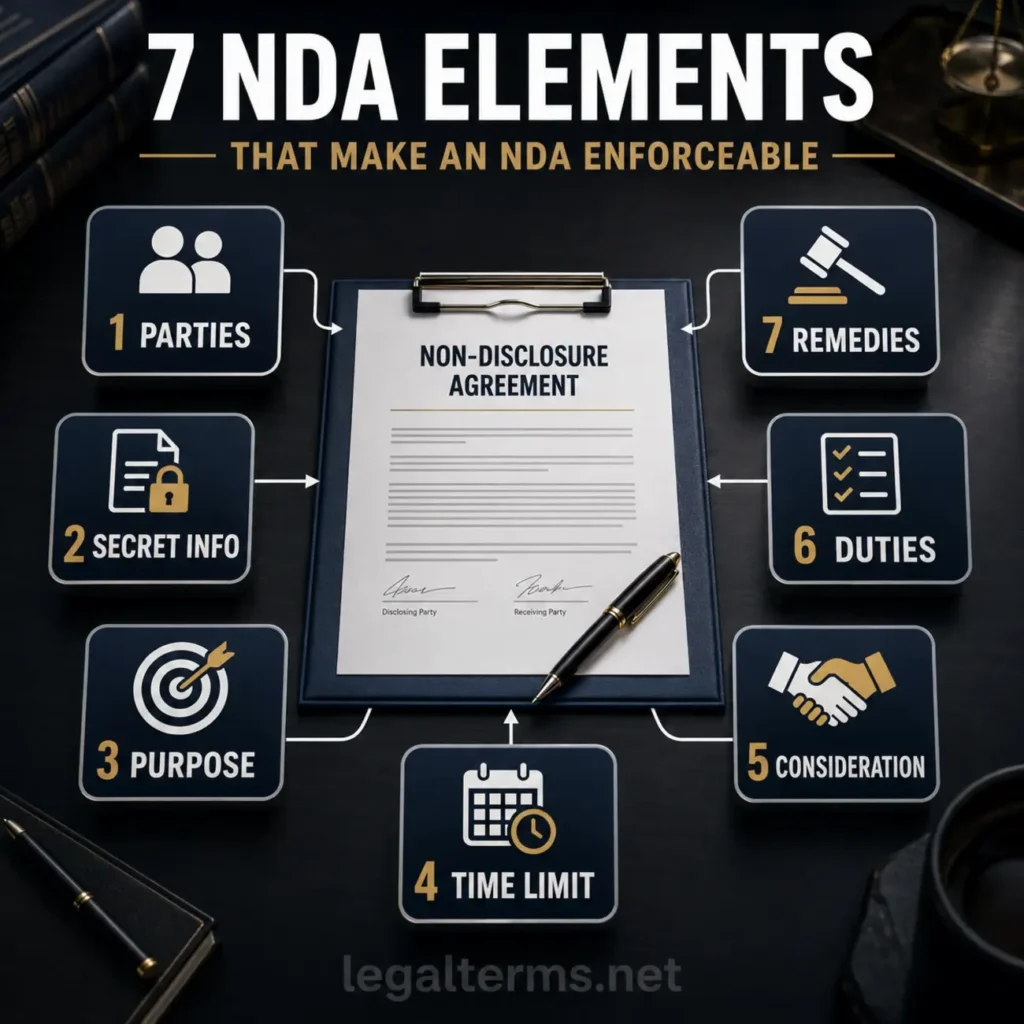
The third element is scope and purpose. A good NDA states why the information is being shared and how it may be used. An NDA signed for merger talks should say the data may be used only to evaluate that transaction, never to compete.
The fourth element is duration. Confidentiality is rarely permanent. Courts often expect a defined window, such as two to five years for ordinary business information. Trade secrets can be protected for as long as they stay secret, but general commercial data usually carries a time limit.
The fifth element is consideration. Like any contract, an NDA needs an exchange of value. For an employee, the job itself is consideration. For a vendor, it is the business opportunity. Asking a current employee to sign a new NDA with nothing offered in return can raise questions about whether valid consideration exists.
The sixth element is the obligations themselves: the duty not to disclose and the duty not to use the information beyond the stated purpose. These two promises are the heart of the contract.
The seventh element is remedies. The NDA should state what happens on breach, whether that means monetary damages, an injunction, or the return and destruction of materials. Without remedies, enforcement becomes a guessing game.
A quick drafting checklist captures all seven: name the parties, define confidential information precisely, limit the purpose, set a realistic duration, confirm consideration, state the obligations, and provide remedies. An NDA missing any of these is a lock without a working key.
The Three Types of NDAs
Not every confidentiality agreement is shaped the same way. The right structure depends on how many parties are sharing information and in which direction it flows.
A unilateral NDA is one-directional. Only one party discloses confidential information, and the other simply promises to protect it. This is the classic employer-to-employee form, used when a company hands staff access to trade secrets, client data, or internal processes.
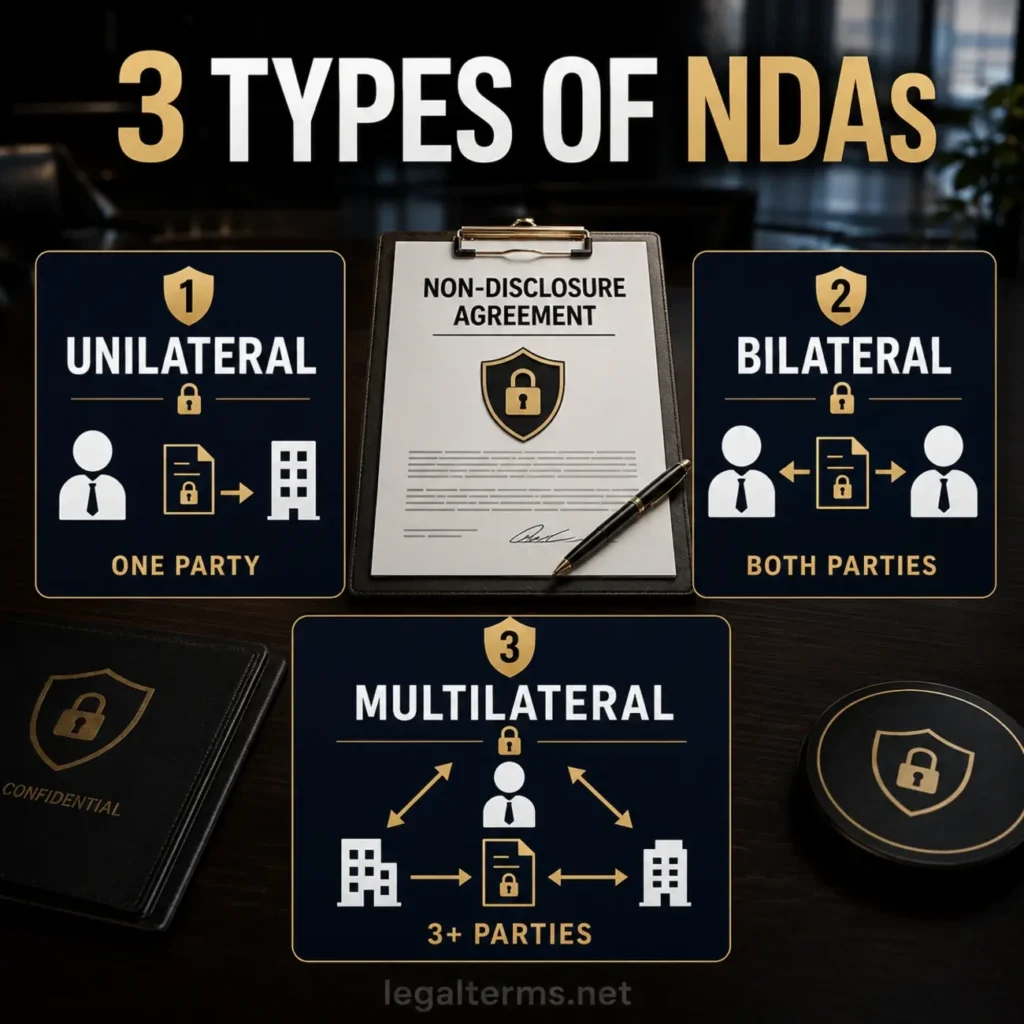
A bilateral NDA, often called a mutual NDA, runs both ways. Both parties disclose, and both accept confidentiality duties. Partnerships, joint ventures, and merger negotiations rely on this form because each side has something to protect.
A multilateral NDA binds three or more parties under one document. Instead of drafting several separate bilateral agreements, a single multilateral NDA covers everyone, which keeps complex projects manageable.
| Type | Who discloses | Typical use | Example |
|---|---|---|---|
| Unilateral | One party | Employer and employee | Protecting source code |
| Bilateral (mutual) | Both parties | Partnerships, mergers | Two startups sharing IP |
| Multilateral | Three or more | Multi-party projects | A lab, an investor, and a manufacturer |
A practical rule of thumb: startups lean on unilateral NDAs with staff and contractors, business partners prefer mutual NDAs for fairness, and large collaborations use multilateral NDAs to avoid a pile of overlapping contracts.
The Clauses You Will Find in a Strong NDA
The power of an NDA lives in its clauses. Each provision draws a boundary, and a missing or sloppy clause is usually where disputes begin.
The definition clause identifies exactly what information is protected. The non-use clause stops the receiving party from using confidential data for any purpose beyond the stated objective, so an investor cannot turn a startup’s pitch into a competing product. The non-disclosure clause prohibits sharing that information with unauthorized outsiders.
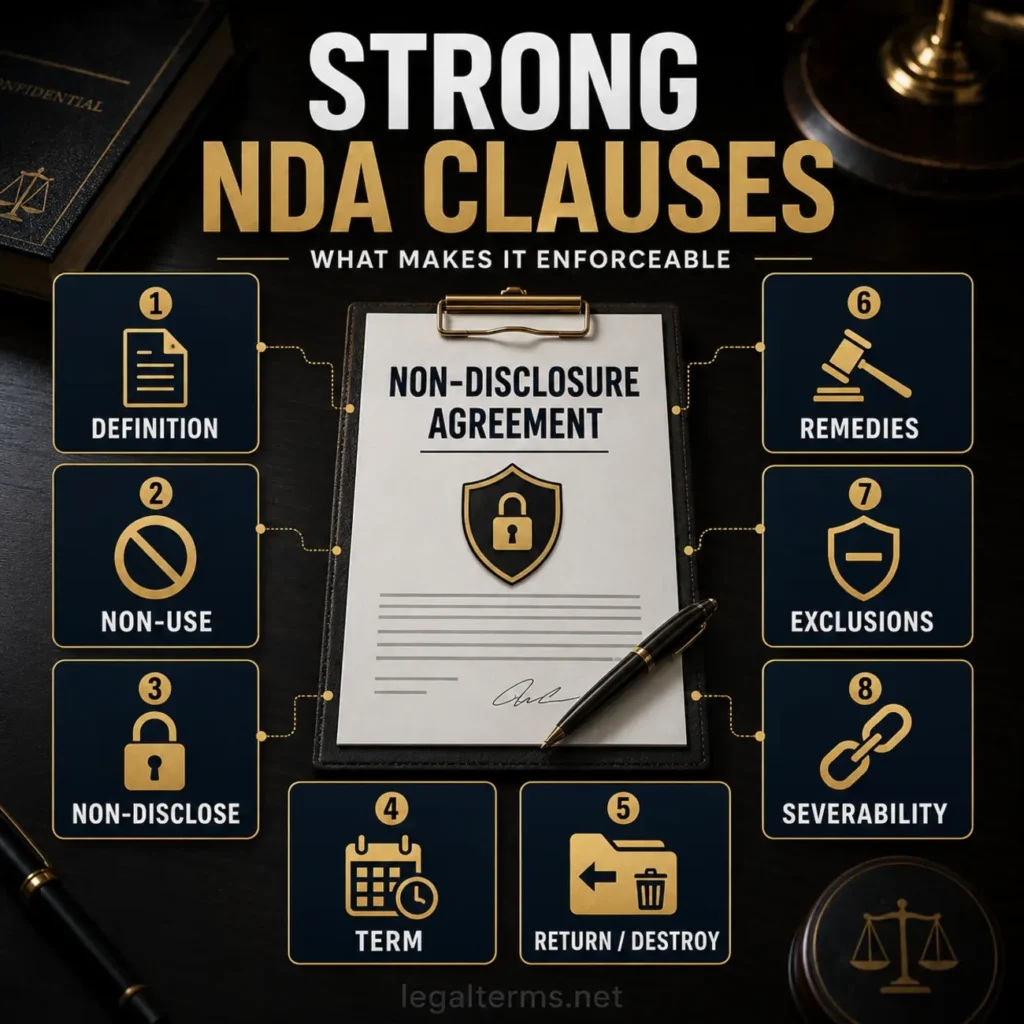
The term clause sets how long obligations last, often distinguishing a fixed period for general data from indefinite protection for trade secrets. The return-or-destruction clause requires the receiving party to hand back or delete documents, prototypes, and files once the relationship ends.
The remedies clause defines the consequences of breach, which may include damages, injunctions, or recovery of profits earned through misuse. The exclusions clause clarifies what is not confidential, such as public information, independently developed data, and disclosures compelled by law.
Two clauses that the old boilerplate often skips deserve attention. A severability clause keeps the rest of the contract alive if a court invalidates one provision, which matters because NDAs are frequently challenged piece by piece. A well-drafted severability clause means one overbroad sentence does not sink the entire agreement. A governing-law clause names which jurisdiction’s rules apply, an essential safeguard for any cross-border deal.
| Clause | Function | Example |
|---|---|---|
| Definition | Clarifies what is confidential | Trade secrets, technical data |
| Non-use | Limits how information is used | Investor cannot compete |
| Non-disclosure | Prevents sharing | Employee cannot leak client lists |
| Term | Sets time limits | Two years, indefinite for trade secrets |
| Return/destruction | Controls materials afterward | Consultant deletes files |
| Remedies | Provides enforcement | Damages, injunctions |
| Exclusions | Lists what is not covered | Public information |
| Severability | Saves the contract if one part fails | Invalid clause removed, rest survives |
The real strength of an NDA is not that it exists. It is the precision of these clauses.
What an NDA Cannot Do: Limits and Exceptions
NDAs are powerful, but they are not unlimited. Courts scrutinize them to make sure they are fair and reasonable, and they will refuse to enforce agreements that overreach.
The most common limit is overbreadth. An NDA that labels ordinary workplace conversation or publicly known facts as confidential is asking too much, and a court may decline to enforce it. A second limit is unreasonable duration. Binding someone for decades over a marketing plan that matters for two years invites a judge to strike the term. A third limit is restraint of trade. An NDA cannot operate as a hidden non-compete. If it effectively bars a person from working in their field, it can be struck down, because confidentiality protection and a ban on earning a living are different things.
NDAs also sit alongside other protections like patents and registered marks, and understanding where confidentiality ends and where trademark vs copyright protection begins helps avoid relying on the wrong tool.
Alongside these limits, most NDAs contain built-in exceptions where confidentiality simply does not apply:
- Public domain. Information already public cannot be made secret after the fact.
- Independent development. If the receiving party creates the same information on its own, without using disclosed data, the NDA does not bind it.
- Prior knowledge. Information the receiving party already knew before signing is excluded.
- Legal compulsion. A court order, subpoena, or regulatory demand overrides the NDA, though the receiving party can usually be required to give notice first.
- Whistleblowing. An NDA cannot legally stop someone from reporting illegal conduct to a government agency, and federal law now reinforces this directly.
These exceptions are not loopholes. They keep NDAs from silencing fairness while still protecting genuine secrets.
The Statutes That Now Reshape NDAs
For years, NDA enforcement was almost entirely a matter of state contract and trade secret law. That has changed. Three layers of statute now shape what an NDA can and cannot do, and a modern agreement that ignores them is already out of date.
The Defend Trade Secrets Act of 2016
The Defend Trade Secrets Act (DTSA), signed into law in May 2016, created the first federal civil cause of action for trade secret misappropriation. Before it, a trade secret owner generally had to sue under the law of whichever state applied, which made cross-state cases awkward. The DTSA lets owners sue in federal court, and it offers powerful remedies, including injunctions, damages, and in cases of willful and malicious theft, exemplary damages of up to twice actual damages plus attorney fees.
The DTSA carries a requirement that directly affects how NDAs are written. The statute protects whistleblowers: an individual cannot be held liable under trade secret law for disclosing a secret in confidence to a government official or attorney to report a suspected violation of law. Crucially, to keep the right to recover exemplary damages and attorney fees against an employee or contractor, the employer must include a notice of this immunity in any agreement that governs the use of trade secrets or confidential information. That includes NDAs.
The consequence is concrete. In one federal case, a trade secret owner that failed to include the immunity notice in its agreements was barred from recovering attorney fees and exemplary damages from the people it accused of misappropriation. An NDA drafted today without a DTSA immunity notice quietly forfeits some of the strongest remedies the law makes available.
The Speak Out Act of 2022
The Speak Out Act, signed in December 2022, limits how NDAs can be used to silence victims of workplace sexual misconduct. The law makes pre-dispute non-disclosure and non-disparagement clauses judicially unenforceable in cases involving sexual assault or sexual harassment.
The timing distinction is everything. The Act targets clauses signed before a dispute arises, such as the confidentiality language buried in a standard onboarding NDA. It does not bar confidentiality in a settlement reached after allegations surface. It also preserves the right to protect trade secrets and proprietary information. The practical effect is that an employer can no longer use an NDA signed on day one of employment to prevent someone from later speaking about harassment or assault.
The Act has already surfaced in real disputes. In a widely reported case, a former partner of a public figure asked a court to release her from an NDA, arguing the Speak Out Act made it unenforceable. The court ultimately ruled against her on the specific facts, finding her claims lacked detail, but the case showed how routinely the Act is now raised to challenge confidentiality clauses.
State laws and digital-signature rules
Several states go further than federal law. California’s Silenced No More Act, effective in 2022, expanded earlier restrictions to bar NDAs that prevent employees from disclosing harassment, discrimination, and retaliation. New Jersey enacted a comparable law rendering certain concealment provisions unenforceable. More than a dozen states now regulate NDAs and non-disparagement terms with varying scope, so a clause valid in one state may be void in another.
A separate layer governs how NDAs are signed. The federal E-SIGN Act and state versions of the Uniform Electronic Transactions Act give electronic signatures the same legal weight as ink, and the European Union’s eIDAS Regulation does the same across member states. An NDA executed through a digital signing platform is, in most settings, just as binding as a paper original.
How Courts Enforce NDAs
When an NDA is breached, the injured party can go to court. Enforcement turns on whether the agreement is reasonable, clearly written, and whether real harm can be shown.
Courts have several remedies available. An injunction, a form of equitable relief, orders the breaching party to stop disclosing or using the information, which matters when money alone cannot undo the damage. A request for injunctive relief is often the first move because a leak, once it spreads, cannot be recalled. Monetary damages compensate for losses such as lost profits or reduced market share. Liquidated damages clauses set a pre-agreed sum for breach, though courts enforce these only when the figure is a reasonable estimate of harm and not a punitive penalty. Return and destruction orders require physical documents to be handed back and digital copies deleted.
Because an NDA is a contract, a violation is a breach of contract, and the disclosing party generally has to prove the agreement existed, that the defendant broke it, and that harm followed.
Two cases illustrate how enforcement actually plays out:
- PepsiCo, Inc. v. Redmond (7th Cir. 1995). A senior PepsiCo manager who had signed an NDA, but no non-compete, accepted a similar role at rival Quaker Oats. The court applied the inevitable disclosure doctrine, reasoning that he could not realistically make decisions at Quaker without drawing on PepsiCo’s confidential strategy, and upheld an injunction limiting his move. The case remains the landmark example of an NDA protecting trade secrets even without a non-compete clause.
- Xoran Holdings LLC v. Luick (E.D. Mich. 2017). The court held that because the trade secret owner had not included the DTSA whistleblower immunity notice in its agreements, it could not recover attorney fees or exemplary damages from the alleged misappropriators. The lesson is practical: a missing notice clause directly shrinks the remedies a company can collect.
Enforcement is not automatic. Proving the dollar value of a leak is hard. Cross-border breaches raise questions about which court even has authority. And an NDA that is overly broad can be refused outright. Courts enforce NDAs to preserve the trust that makes business possible, not to reward agreements that overreach.
| Remedy | When it applies | Example |
|---|---|---|
| Injunction | Stop ongoing or threatened breach | Court order halting disclosure |
| Monetary damages | Compensate a measurable loss | Lost profits from a leak |
| Liquidated damages | Pre-agreed, reasonable penalty | A set sum for breach |
| Return/destruction | Remove access entirely | Delete confidential files |
NDAs Across Borders
When a deal crosses borders, an NDA gets harder to enforce. Different countries apply different rules to confidentiality, and a term that holds in one place may be void in another.
The first challenge is jurisdiction and choice of law. A cross-border NDA must state which country’s law governs it and where disputes will be heard. Without that, a single breach can spark parallel lawsuits in multiple countries. Naming a clear jurisdiction up front is one of the cheapest forms of insurance an international NDA can buy.
The second challenge is differing legal cultures. United States courts tend to enforce NDAs broadly, while some European courts will strike terms they view as anti-competitive or as overreaching on data protection grounds. The third challenge is language. Ambiguity multiplies when a contract is translated poorly, so best practice is to prepare the NDA in both English and the local language, with each party signing a version it fully understands.
The fourth challenge is enforcement abroad. Even a valid NDA may be difficult to enforce in a foreign court without a treaty or recognition mechanism. This is why international NDAs frequently include an arbitration clause naming a neutral forum such as the ICC or UNCITRAL rules, which produces an award that is easier to enforce internationally than a foreign court judgment.
| Issue | Risk | Practical fix |
|---|---|---|
| Jurisdiction | Lawsuits in several countries | Choice-of-law clause |
| Legal culture | Inconsistent enforcement | Tailor clauses per country |
| Language | Misinterpretation | Dual-language contract |
| Enforcement abroad | Hard to recognize a foreign ruling | International arbitration clause |
NDAs in the Digital Age
Most confidential information no longer lives in a locked filing cabinet. It moves through email, cloud servers, messaging apps, and shared drives, and NDAs have adapted to that reality.
Electronic execution is now standard. Under the E-SIGN Act in the United States and eIDAS in the European Union, an electronically signed NDA is legally binding, and click-to-accept agreements function much like clickwrap terms online.
Modern NDAs increasingly fold in data protection. Clauses may require compliance with regulations such as the GDPR in Europe or the CCPA in California, mandate encrypted storage, and limit access on a need-to-know basis. Many add a breach notification clause that requires the receiving party to report a cybersecurity incident within a set window, often within a day or two.
The digital environment also creates risks that a paper-era NDA never contemplated. Data breaches can leak information despite a signed agreement. Cloud storage spread across countries raises questions about which law applies. Employees can disclose information accidentally through an unsecured message or a misdirected email. Sensible safeguards address these directly: strong encryption, restricted permissions, prompt incident reporting, and explicit rules for remote work and personal devices.
In the digital era, an NDA is no longer only a promise of silence. It is a mix of legal duty and technical control.
How to Draft and Review an NDA
A strong NDA is not a copied template with names dropped in. It balances clarity, fairness, and enforceability while reflecting the specific deal in front of you.
Start with precise language. Replace vague phrases like “all business information” with named categories such as technical data, prototypes, financial reports, and customer databases. Define the purpose of disclosure so the information cannot be repurposed. Keep the duration realistic, commonly two to five years for general data and indefinite only for genuine trade secrets, because courts are far more willing to enforce sensible timelines.
Address modern risks directly. Require encryption and secure storage, and add a breach notification window. Specify remedies, including damages, injunctions, and dispute resolution, and add governing-law and arbitration clauses for any international element. Include standard exclusions so the agreement is not vulnerable to an overbreadth challenge. For agreements covering trade secrets, add the DTSA whistleblower immunity notice to preserve the right to fees and exemplary damages.
A focused review checklist:
- Are the parties named clearly and correctly?
- Is confidential information defined by category, not by a catch-all?
- Is the purpose of disclosure stated and limited?
- Is the duration reasonable for the type of information?
- Are remedies and a dispute-resolution method included?
- Does it address digital storage and breach notification?
- Are standard exclusions and a whistleblower notice present?
- Is there a severability and governing-law clause?
Watch for red flags that often render NDAs unenforceable: no definition of confidential information, a duration that runs for decades over ordinary data, a clause that functions as a disguised non-compete, or silence on remedies. Because these agreements carry real legal consequences and the rules vary by state and country, anyone drafting or signing a high-stakes NDA should consult a licensed attorney before relying on it.
NDA Compared to Related Documents
An NDA is one tool in a small family of agreements that handle trust and obligation, and confusing them is a common mistake.
A confidentiality agreement is, in practice, the same instrument as an NDA; the names are used interchangeably. A non-compete is different: it restricts where and for whom a person can work, not what they can reveal, and it faces much heavier legal scrutiny. A memorandum of understanding records the broad intentions of parties heading toward a deal and is often non-binding, whereas an NDA is a binding contract focused narrowly on secrecy.
| Document | Core function | Binding? |
|---|---|---|
| NDA / confidentiality agreement | Protect shared information | Yes |
| Non-compete | Restrict future employment | Yes, but heavily limited |
| Memorandum of understanding | Record intentions toward a deal | Often non-binding |
Choosing the right instrument matters. An NDA protects information. It does not, on its own, stop someone from competing or commit anyone to a transaction.
Questions and Answers
Question: What is the main purpose of an NDA? Short answer: An NDA protects confidential information from being disclosed or misused. It lets parties share sensitive business, technical, or financial details while keeping a legal duty of secrecy in place.
Question: Are NDAs legally enforceable? Short answer: Yes, when they are reasonable in scope, duration, and purpose. Courts can refuse to enforce NDAs that are vague, overly broad, or used to silence protected disclosures.
Question: How long does an NDA last? Short answer: General business information is usually protected for two to five years. Trade secrets can stay protected indefinitely, as long as the information remains secret.
Question: What happens if someone breaks an NDA? Short answer: The injured party can seek injunctions, monetary damages, or orders to return and destroy materials. Some NDAs also set liquidated damages, which courts enforce only if the amount is reasonable.
Question: Can an NDA stop someone from reporting harassment or illegal conduct? Short answer: No. The Speak Out Act of 2022 makes pre-dispute NDA clauses covering sexual harassment or assault unenforceable, and federal law protects whistleblowers who report illegal activity to authorities.
Question: Are NDAs valid internationally? Short answer: They can be, but enforceability depends on the jurisdiction. Cross-border NDAs should include choice-of-law and arbitration clauses, and ideally a dual-language version.
Question: What information is not covered by an NDA? Short answer: Public information, data the receiving party already knew or developed independently, and disclosures required by law or court order. These exceptions usually appear directly in the contract.
Question: Do electronic NDAs hold up in court? Short answer: Yes. Under the E-SIGN Act and eIDAS, electronically signed and click-to-accept NDAs are legally binding, and many now include data security and breach notification clauses.
References and Sources
- Defend Trade Secrets Act of 2016, Public Law 114-153, 18 U.S.C. Sec. 1836 et seq.
- 18 U.S.C. Sec. 1833(b) (whistleblower immunity notice requirement).
- Speak Out Act, Public Law 117-224, 42 U.S.C. Sec. 19401 et seq. (2022).
- PepsiCo, Inc. v. Redmond, 54 F.3d 1262 (7th Cir. 1995).
- Xoran Holdings LLC v. Luick, No. 16-13703 (E.D. Mich. 2017).
- California Silenced No More Act (S.B. 331); STAND Act (S.B. 820).
- Electronic Signatures in Global and National Commerce Act (E-SIGN), 15 U.S.C. Sec. 7001 et seq.
- Regulation (EU) No 910/2014 (eIDAS).
- Uniform Trade Secrets Act (UTSA), as adopted by individual states.

LegalTerms.net Editorial Staff produces plain-English explanations of legal terminology for general educational purposes. Content is developed through a structured research process using publicly available legal resources, including statutory frameworks, case law databases, and authoritative legal publications.
All articles are reviewed for clarity, factual consistency, and alignment with widely accepted legal standards before publication. Content does not constitute legal advice.
Learn how our content is created: Content Methodology · Editorial Guidelines · Legal Sources