What Is a Notary Public Duties, Process, and State Rules Explained

A notary public is a state-appointed official who confirms identities, witnesses signatures, and helps stop document fraud before it happens. The role looks simple, yet it quietly protects deeds, contracts, and court filings every day. This guide covers what a notary does, what they cannot do, and how the rules change from one state to the next.
What Is a Notary Public?
A notary public is an impartial official commissioned by a state government, and their core purpose is to deter fraud in written transactions. They confirm that the right person signed a document and that the person did so willingly, without pressure or confusion.
What a notary does not do is just as important. They never decide whether a document is fair, wise, or legally sound, and they are never a party to the transaction itself. Their job is to act as a neutral witness who follows a fixed legal process.

Every notary works under the law of the state that commissioned them, so they cannot stretch their powers beyond what that state allows. This single fact explains why the same routine task can look different in two neighboring states.
The notary’s stamp signals that this proper process actually took place, and banks, courts, and government offices trust that signal without re-checking it themselves. A notarized signature therefore carries more weight than a plain one, which is exactly why so many institutions insist on it.
What Does a Notary Public Actually Do?

A notary performs a short list of official tasks known as notarial acts, and each one has its own purpose and required wording. Four acts appear in nearly every state, and the table below sets them side by side.
| Notarial act | What it confirms | Common use |
|---|---|---|
| Acknowledgment | The signer admits the signature is theirs and was made willingly | Deeds, mortgages, powers of attorney |
| Jurat | The signer swears the contents are true under oath | Affidavits, sworn statements |
| Oath or affirmation | A verbal promise to tell the truth | Witnesses, official appointments |
| Copy certification | A photocopy is a true match of an original | Diplomas, records, ID copies |
Acknowledgments
The acknowledgment is the act most people encounter. The signer appears before the notary and confirms that the signature on the document is genuinely theirs, although in many states the signing itself can happen earlier, in private. Because this act suits documents that transfer ownership or authority, it is the standard choice for a power of attorney and for real estate paperwork.
Jurats and Sworn Statements
A jurat works differently and the difference matters. Here the signer must sign in front of the notary and then swear an oath that the contents are true. This is the act used for an affidavit, and the oath has real teeth, since a false sworn statement can expose the signer to a charge of perjury.
Oaths and Affirmations
An oath is a spoken promise of truth that traditionally invokes a higher power, while an affirmation is the same pledge made on personal honor instead. Both carry identical legal effect, so the choice is simply a matter of belief. Notaries administer these to witnesses and officials, and the same sworn promise underpins testimony given in a deposition.
Copy Certifications
Some states let a notary certify that a photocopy faithfully matches an original, which helps with diplomas, contracts, and personal records. This act is not universal, however, and many states either limit it or exclude vital records such as birth certificates entirely.
What a Notary Public Cannot Do?
Understanding the limits of the role prevents most misunderstandings. Unless the notary is also a licensed attorney, they cannot give legal advice, recommend a document, or explain what a clause means, because doing so can count as the unauthorized practice of law.
A notary also cannot pick the type of act for you. The document or the situation decides whether an acknowledgment or a jurat applies, and the notary only carries it out once that is clear. They cannot notarize anything for themselves either, nor act when they hold a personal or financial stake in the matter, since impartiality is the entire point of the position.
There are protective limits too. If a signer seems confused, coerced, or unable to understand the act, the notary must refuse, and that refusal shields vulnerable people from being taken advantage of. One more boundary surprises many first-timers: a notary never certifies that the contents of a document are true. They confirm identity and the act of signing, not the facts on the page.
Why Notarization Matters?
Notarization exists mainly to deter fraud, and it does so by forcing a face-to-face check of who is signing and whether they understand the act. That single step makes forgery and coercion far harder to pull off.
The process also gives a document real legal strength. Courts treat a properly notarized signature as presumptively genuine, which shifts the burden onto anyone who later wants to dispute it. Many lenders, title companies, and courts simply will not accept high-value documents without that seal, because it serves as a trusted shortcut for verification.
There is a record-keeping benefit as well. In states that require a journal, the notary logs the date, the signer, and the act performed, and that entry can become important evidence if a dispute ever arises. For ordinary people, the small fee buys a real layer of protection against altered deeds and forged contracts.
The Notarization Process Step by Step
Even when state rules differ, the sequence stays remarkably consistent. It begins with personal appearance, since the signer must be physically before the notary for in-person acts, and video presence is allowed only under remote notarization laws.
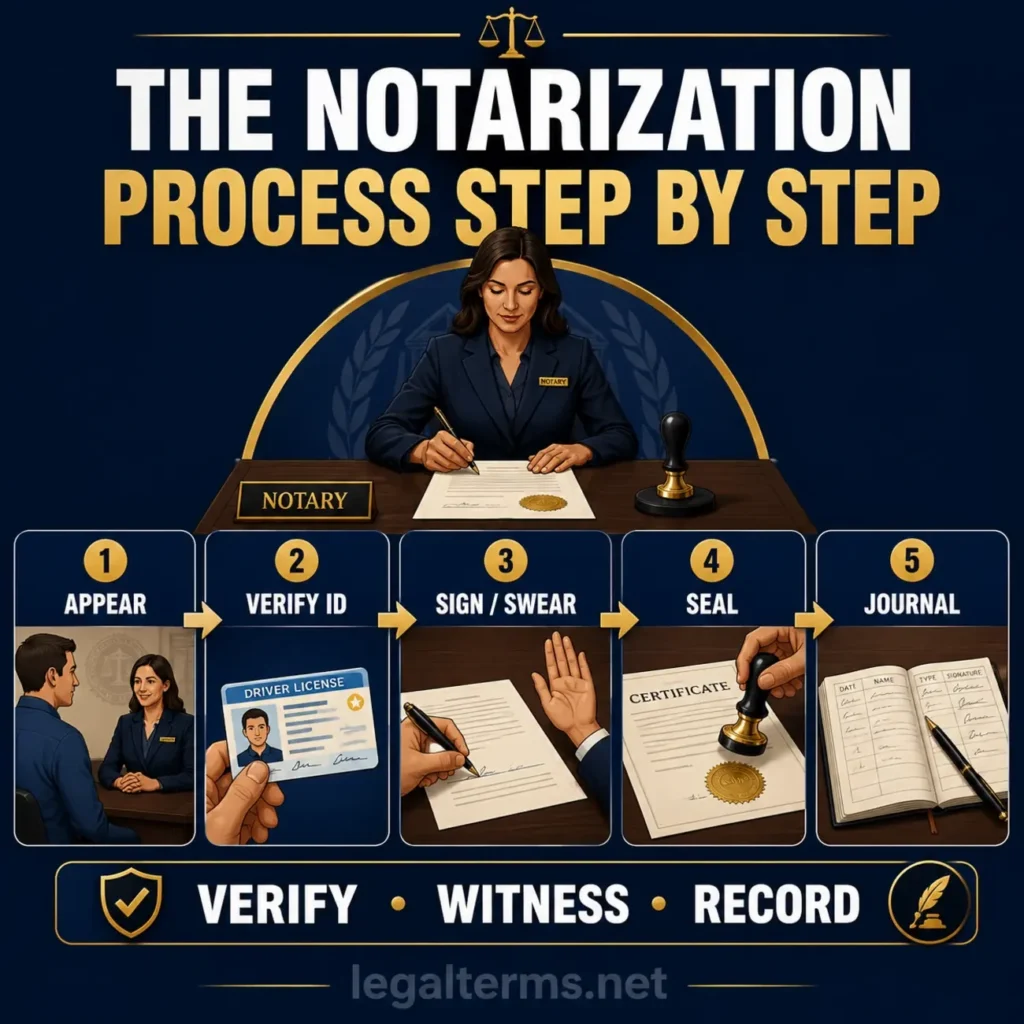
Next comes identity verification, usually through a current government-issued photo ID, though some states accept credible witnesses when no ID is available. The notary then confirms that the signer is aware and acting freely, watching for any sign of confusion or pressure, and stops if something feels wrong.
Once that is settled, the notary performs the correct act. For an acknowledgment the signer admits the signature, and for a jurat the signer signs and swears the oath. The notary completes the certificate, states which act took place, and applies the seal that makes it official. In many states a final step closes the process, as the notary records the event in a journal that becomes a permanent log.
Documents That Commonly Require a Notary
Not every document needs a notary, and the requirement tends to appear only where a paper carries legal or financial risk. Real estate documents lead the list, since deeds, mortgages, and property transfers almost always need a notary, and the sheer value involved makes fraud control essential.
Estate planning is another common trigger. Wills, trusts, and beneficiary forms may require a seal, although the rules vary widely and some states still demand witnesses alongside the notary. Documents that hand legal authority to another person, such as a power of attorney, fall into the same high-stakes category.
Sworn legal papers also rely on notarization, most often through the jurat used for affidavits and certain court filings. Businesses meet the requirement too, on loan agreements, vendor contracts, and some corporate filings, where banks and lenders set many rules of their own. A notarized signature destined for use in a binding contract abroad may need an extra step, as the document then passes through authentication or an apostille that confirms the notary’s authority outside the United States.
Notary Tools: Seal, Stamp, and Journal
A notary depends on a few simple tools, and each one supports the integrity of the act. The seal, or stamp, is the most recognizable, carrying the notary’s name, commission details, and state, and marking the document as officially notarized.
State rules on the seal are not uniform. Most states require an inked rubber stamp showing set information, but a few, including New York, do not require a stamp at all and accept a handwritten notarial format instead. The journal is the second key tool, a record book that logs each act with its date, signer, and document type, and several states have tightened these journal duties in recent years.
Some notaries also carry an embosser that presses a raised impression into the paper, though in most states an embosser alone is not enough because it does not reproduce well on a photocopy. Digital notaries use electronic versions of all of this, applying a digital seal and a tamper-evident signature while the session is recorded and stored.
How Notary Rules Vary by State?
Here the topic turns genuinely complex, because the United States has no single national notary law. Each state writes its own rules, so almost every detail of the role shifts as you cross a border.

Eligibility is the first difference. Most states ask that an applicant be at least 18 and a resident or worker in the state, and a felony conviction usually disqualifies a candidate. Training and exams diverge much more sharply. California requires a course and a proctored exam, while many states require neither, which is why some people are commissioned within a couple of weeks.
Commission length varies too. A four-year term is common, but some states run longer or shorter, and renewal rules differ alongside them. Bond requirements add another layer, since roughly thirty states require a surety bond in amounts ranging from a few hundred to tens of thousands of dollars, of which the notary pays only a small premium. Even the list of authorized acts changes, as most states allow acknowledgments, jurats, and oaths, but fewer permit copy certification. The snapshot below shows how three states compare.
| Feature | California | New York | Florida |
|---|---|---|---|
| Exam required | Yes | Yes | No |
| Training required | Yes, six-hour course | No formal course | Brief course |
| Surety bond | $15,000 | Not required | $7,500 |
| Stamp required | Yes | Not required | Yes |
| Typical term | 4 years | 4 years | 4 years |
These gaps matter in practice. A notary commissioned in one state cannot simply act in another, and whether a receiving state accepts an out-of-state notarization depends on that state’s own rules. The area also keeps moving: Texas, for instance, added new education and journal duties for applicants starting in 2026, so the safest habit is to confirm current rules with your state’s Secretary of State.
How Much Does a Notary Public Cost? Fees by State
Notary fees are also set by state law, and each state caps the maximum charge per notarial act. An act usually means one signature rather than one document, so three signatures across three documents count as three separate acts, each billed up to the limit.
The caps themselves swing widely. New York sets one of the lowest fixed rates at $2 per act, a figure that has not changed in decades, while some states reach roughly $25, and a small group set no statutory cap at all. The table below gives a few 2026 examples, though figures can change and should be checked before booking.
| State | Maximum fee per act (in-person) |
|---|---|
| New York | $2 |
| Florida | $10 |
| California | $15 |
| Maine | About $25 |
| Idaho, Louisiana, Massachusetts | No fixed statutory cap |
The capped fee is only part of the bill, because the most common extra charges sit outside it. Mobile notaries add a travel fee that is usually unregulated, so a $10 act can easily turn into a $75 visit once travel is counted. Timing pushes the total higher as well, since evening, weekend, and rush appointments often carry a premium, and planning ahead is the simplest way to save.
There are ways to pay little or nothing. Banks and credit unions frequently notarize for free for their account holders, while shipping stores tend to charge up to the state cap. A few states even mandate free service in specific cases, such as California, which requires no charge for veterans filing benefit claims.
Remote Online Notarization (RON) in 2026
Remote online notarization has reshaped the field. With RON, the signer and notary meet over secure video instead of in person, and identity is confirmed through digital credential analysis and other checks. The shift accelerated after 2020 and is now a permanent fixture rather than an emergency measure.
By 2026, the large majority of states authorize some form of remote notarization, with most counts placing permanent RON in around 49 states plus the District of Columbia. California stands out as the main holdout, having passed authorizing legislation while its permanent program remains unbuilt, with the full statute set to take effect on January 1, 2030 and only limited options available in the meantime.
There is helpful flexibility even where a signer’s home state lags behind. Documents notarized remotely in an authorized state are generally accepted across the country, provided the notary follows the law of the state that commissioned them. The rules are far from uniform, though. States differ on which documents qualify, and wills, trusts, and certain real estate finance documents are often excluded. Identity standards vary too, as some states require knowledge-based questions plus credential analysis, others accept a single method, and a few now permit biometric checks.
Pricing follows its own pattern. Online sessions often run higher per act, sometimes in the $25 to $40 range, with speed and zero travel as the trade-off. For documents headed overseas, caution is still wise, since some foreign authorities continue to prefer traditional in-person notarization, so it pays to confirm acceptance before choosing RON.
How to Become a Notary Public?
Becoming a notary is one of the more accessible credentials in the country, and the exact path depends entirely on your state. The general arc is similar everywhere, even when the details differ.
You start by confirming the basic requirements, which in most states means being 18 or older, living or working in the state, and having no disqualifying convictions. From there you complete any required training, mandatory in some states and optional in many, although even optional training cuts the risk of costly errors. If your state uses an exam, as California and a handful of others do, you pass that next, while most states have no exam at all.
The practical steps follow. You file your application and pay the fee, post a surety bond where required, and buy your tools, typically a stamp and, in many states, a journal, with errors and omissions insurance as an optional safeguard. Finally you take your oath and receive your commission, and some states require you to file with a county clerk before you can begin. Those who want to handle mortgage closings take one more step and train as signing agents, a role open only to people who are already commissioned notaries.
Notary Public vs Notary in Other Countries
The American notary differs sharply from notaries in much of the world, and the contrast explains the role’s narrow scope at home. In the United States the notary is mainly a witness who confirms identity and signing and gives no legal advice, and most are not lawyers.
In many civil law countries the role is far broader. A civil law notary is a trained legal professional who drafts documents, advises the parties, and holds real legal authority over the transaction. That difference becomes practical the moment a document crosses a border, because a signature notarized in the United States may need extra authentication abroad, which is exactly what the apostille process provides.
The lesson is that a notarized document is not automatically valid worldwide, since the receiving country applies its own standards. For everyday domestic needs the American model works smoothly and keeps the process fast and cheap, and the only trade-off is that the notary cannot help with the legal substance.
Common Mistakes and How to Avoid Them
Most notarization errors are simple and avoidable. The biggest is signing too early when an oath is required, because a jurat needs the signature to happen in front of the notary, and signing in advance can void the act. Bringing the wrong identification is another frequent stumble, so it helps to carry a current photo ID whose name matches the document.
A few other habits cause trouble. People often forget that fees apply per act rather than per document, so a packet with many signatures can cost more than expected, and asking for a total upfront avoids the surprise. Many also assume any notary can act in any state, which is not true, since the notary must hold a commission valid for that document. Finally, signers sometimes expect legal advice that the notary cannot provide, so anyone who needs that guidance should plan to consult a lawyer separately.
Real-World Examples

A few short scenarios show the role in motion. When a homeowner sells a property, the deed is notarized through an acknowledgment, and the notary checks the seller’s ID before confirming the signature is theirs. When a tenant files a sworn complaint, that document is an affidavit handled by a jurat, so the tenant signs in front of the notary and swears the contents are true.
The same logic carries through everyday life. A parent granting authority to a child signs a power of attorney before a notary, and the resulting seal helps banks accept the document later. A signer living in a state without active RON can still use an online notary commissioned elsewhere, and the remote notarization is accepted where the document is filed. In each case the pattern holds: the notary verifies identity and intent, records the act, and leaves the legal substance to the parties and their advisors.
Q&A About Notary Public
Is a notary public a lawyer?
No, not by default. A notary is only a witness who confirms identity and signing. Some notaries are also lawyers, but most are not and cannot give legal advice.
Does a notarized document mean the contents are true?
No. A notary confirms who signed and that they signed willingly. The notary does not verify the facts written inside the document.
Can a notary in one state notarize documents in another state?
Usually not. A notary acts under the state that commissioned them. Whether another state accepts that notarization depends on the receiving state’s rules.
How much does a notary cost?
It depends on the state. Per-act caps range from about $2 to $25, and a few states set no cap. Mobile and after-hours fees can add much more on top.
Is online notarization legal everywhere?
Almost. By 2026, most states allow remote online notarization, with California the main holdout. Remotely notarized documents are generally accepted nationwide.
Do I need to sign the document before I see the notary?
It depends on the act. An acknowledgment often allows earlier signing. A jurat requires you to sign in front of the notary and swear an oath.
What identification do I need for notarization?
A current, government-issued photo ID is standard. The name should match the document. Some states allow credible witnesses when ID is unavailable.
How long does a notary commission last?
A four-year term is common. Some states use longer or shorter periods. Renewal rules and any refresher training also vary by state.
Legal References and Sources
- National Notary Association, notary fees by state (2026)
- National Association of Secretaries of State, remote e-notarization status
- California Secretary of State, notary qualifications and fees (Government Code 8211)
- New York Department of State, notary commission requirements
- Florida Statutes 117.05(2), notary fee cap
- Texas Senate Bill 693, notary law updates effective 2026
- American Society of Notaries, state requirements and 2025 to 2026 law updates
- 2026 RON status guides (Proof, NotaryPublic24, RemoteNotary, Looking Glass Runners)

Hamit Sahin is the founder and editor of LegalTerms.net. He researches U.S. legal terminology and publicly available legal information using statutes, court rules, judicial opinions, government publications, and established legal reference sources.
His work focuses on organizing complex legal concepts into clear, plain-English explanations for general educational purposes.
Hamit is not an attorney and LegalTerms.net does not provide legal advice.