What Is a Deposition? How It Works, What to Expect, and Your Rights
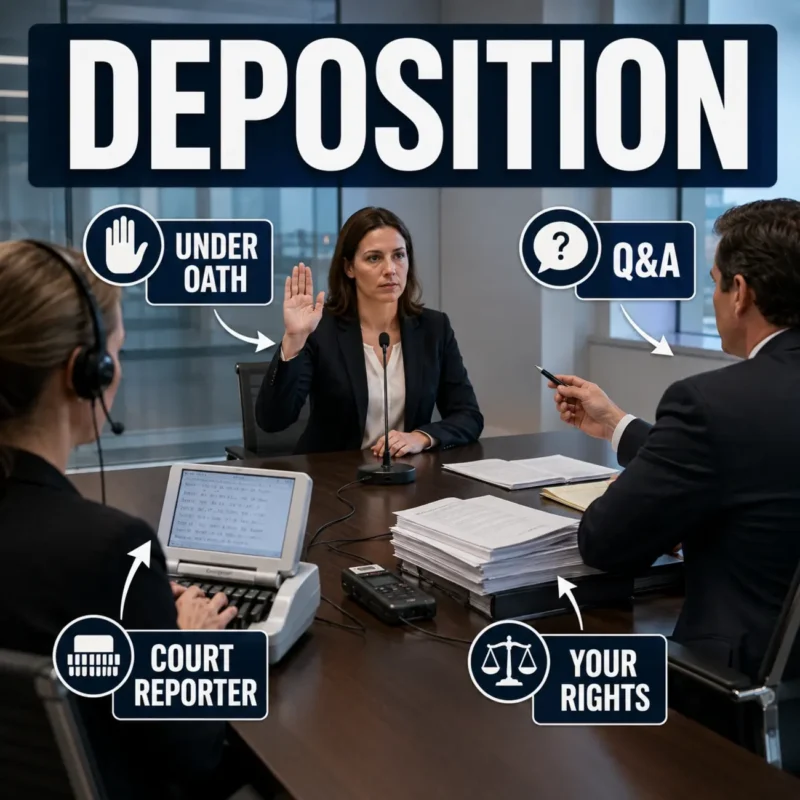
A deposition is sworn, out-of-court testimony given before a trial. A witness answers an attorney’s questions under oath while a court reporter records every word. This guide explains how depositions work, who attends, what your rights are, and what happens to the testimony afterward.
What a Deposition Actually Means?
A deposition is a formal question-and-answer session held outside the courtroom. The person being questioned is called the deponent. They swear an oath to tell the truth, then answer questions from one or more attorneys.
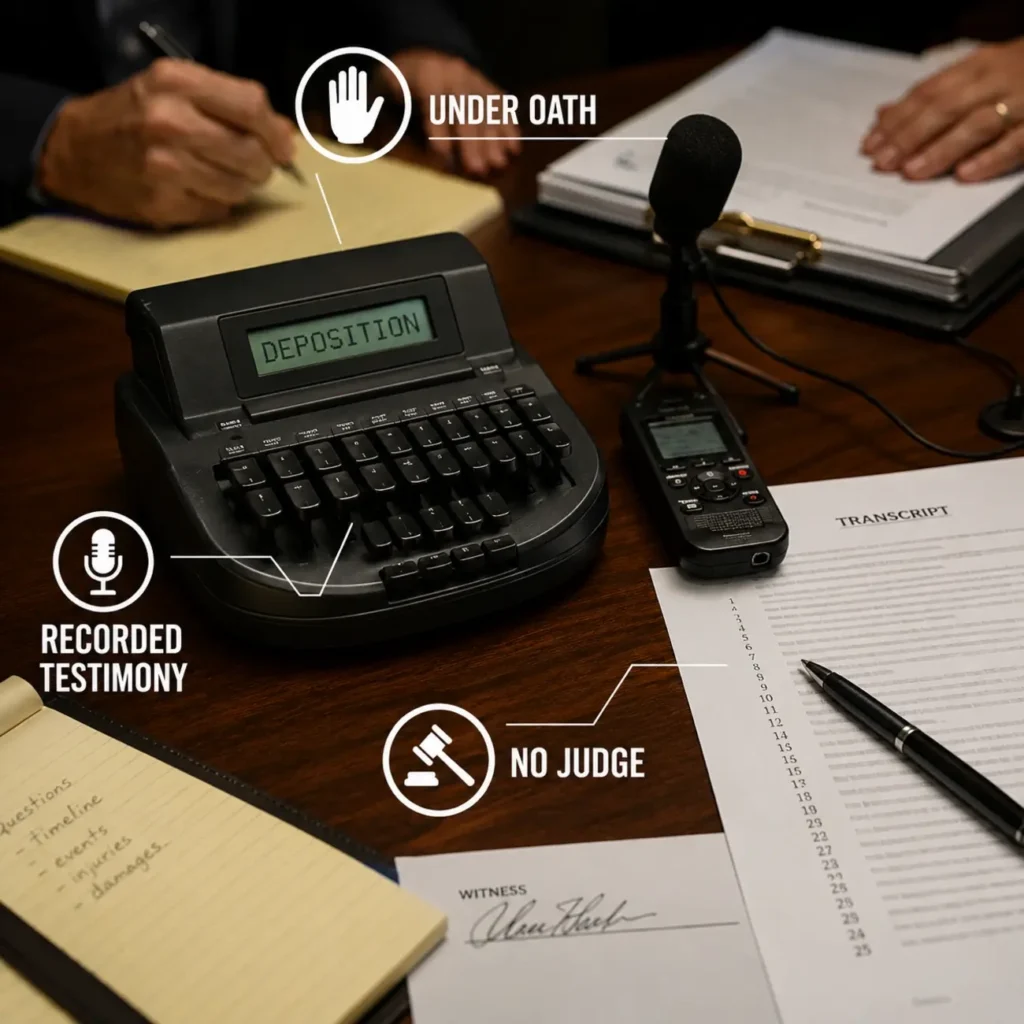
No judge is present. A court reporter takes down the testimony word for word and later produces a written transcript. Many depositions are also recorded on video.
The key point is simple. A deposition is not a casual interview. It is official testimony. The oath carries the same weight as testimony given in front of a jury. A witness who lies during a deposition can face the same exposure as a witness who lies on the stand.
Depositions appear most often in civil litigation, but they also arise in criminal matters and administrative cases. They are one of the main tools lawyers use to learn the facts of a case before trial.
Why Depositions Exist?
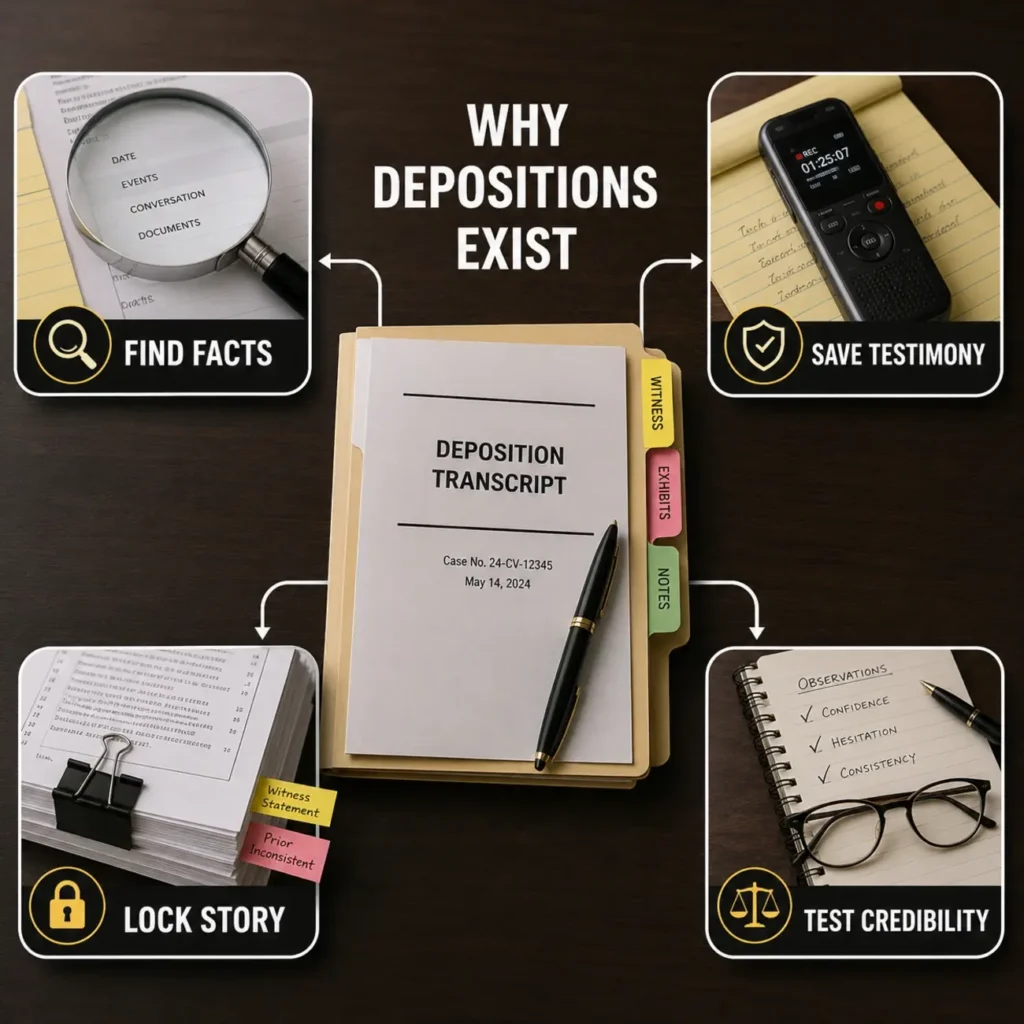
Lawyers do not take depositions for show. Each one serves a practical goal. There are four main reasons a deposition is taken.
To gather information. Attorneys use depositions to find out what a witness knows. They ask about events, documents, dates, and conversations. This builds a clear picture of the facts.
To preserve testimony. A witness may move away, fall ill, or become unavailable by the time trial arrives. A recorded deposition keeps that testimony safe for later use.
To lock in a story. Once a witness answers under oath, that answer is on the record. If the same person tells a different story at trial, the deposition can be used to challenge them.
To assess credibility. Lawyers watch how a witness responds. Confidence, hesitation, and consistency all help each side judge how strong the witness will be in front of a jury.
Together, these goals reduce surprises at trial. Both sides learn what the evidence looks like in advance. That often pushes cases toward settlement.
Where Depositions Fit in the Discovery Process?
A deposition is one part of a larger pretrial stage called discovery. During discovery, each side exchanges evidence and information so neither party is ambushed at trial.
Depositions are the spoken part of that process. Other discovery tools are written. Two common written tools sit close to depositions:
- Interrogatories. Written questions that the other party must answer in writing, under oath. These work well for basic facts. You can compare the two formats in our explainer on interrogatories.
- Requests for production. Formal demands for documents, emails, photos, or records.
Depositions stand out because they are live and flexible. A written question gets a written answer and stops there. A deposition lets the attorney hear an answer, then ask a follow-up on the spot. That back-and-forth often surfaces details that written questions miss.
For this reason, depositions usually come later in discovery. By then, attorneys have already reviewed documents and written answers. They walk into the deposition knowing what to probe.
Who Can Be Deposed?
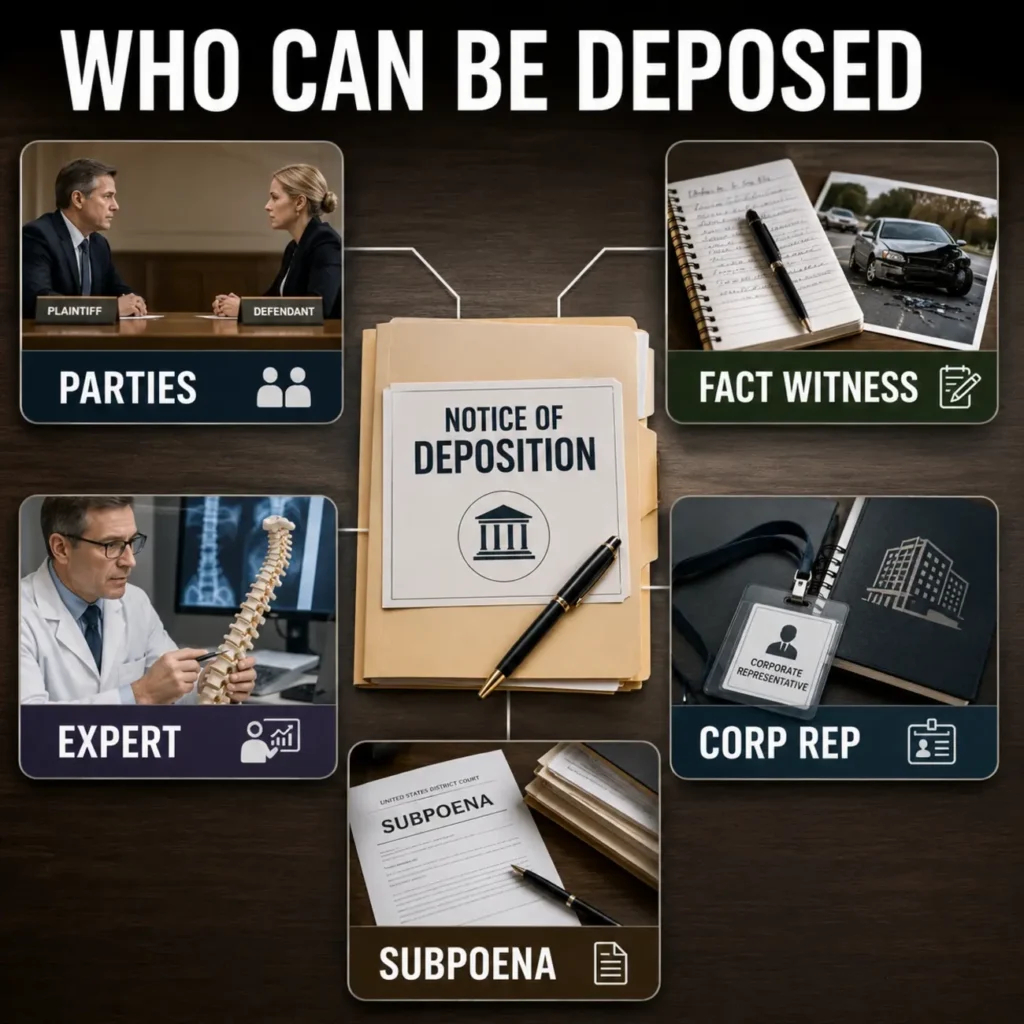
A wide range of people can be required to give a deposition. The list is broader than many expect.
Parties to the case. The plaintiff and the defendant can both be deposed by the other side.
Fact witnesses. Anyone with direct knowledge of relevant events may be deposed. A bystander to a car crash is a classic example.
Expert witnesses. Doctors, engineers, and other experts are often deposed about their opinions and methods. The party seeking the deposition usually pays the expert’s reasonable fee for that time.
Corporate representatives. A company itself can be deposed. Under the federal rules, a party can name an organization as the deponent. The company must then choose one or more people to testify on its behalf. This is known as a corporate or organizational deposition. The chosen person speaks for the company, not just for themselves.
A party can be ordered to appear simply through a notice. A nonparty witness usually must be served with a subpoena to be compelled to attend. The subpoena can also require the witness to bring documents.
Who Is in the Room During a Deposition?
A deposition has a small, defined cast. Each person has a clear role.
- The deponent. The witness who answers the questions.
- The questioning attorney. The lawyer for the side that requested the deposition.
- Defending counsel. The deponent’s own attorney, or the attorney for another party, who protects the witness and notes objections.
- The court reporter. A neutral officer who administers the oath and records every word.
- A videographer. Present only when the deposition is being recorded on video.
- An interpreter. Used when the witness does not speak English fluently.
A judge does not attend. That absence is normal and expected. Procedural rules still apply, and the court reporter keeps an official record of any disputes.
Other potential witnesses may sometimes be excluded from the room. This prevents one witness from shaping their answers around what another witness said.
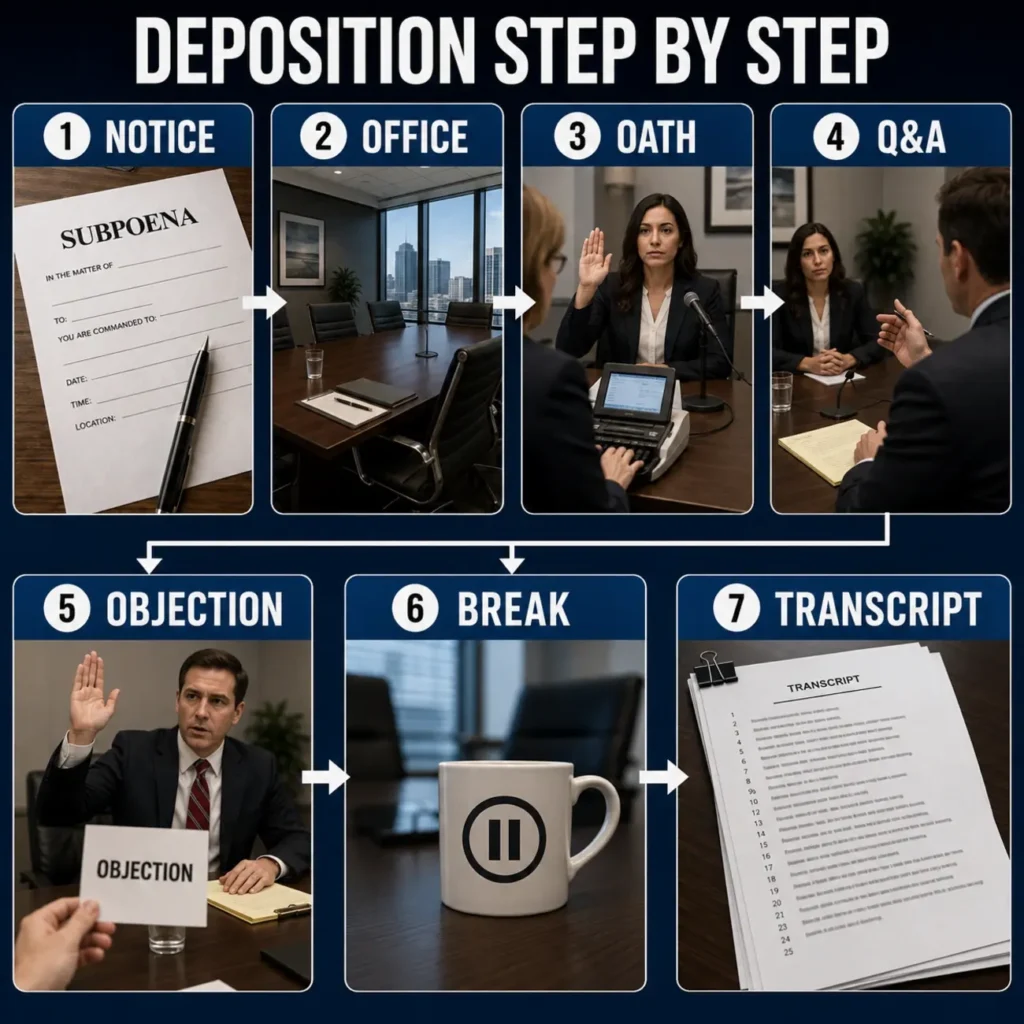
How a Deposition Works, Step by Step
Most depositions follow a predictable rhythm. Knowing the sequence removes much of the stress.
- Notice or subpoena. The deposition is scheduled through a written notice to the parties. A nonparty receives a subpoena.
- Location. The session usually happens in a law office or conference room, not a courtroom. Remote depositions by video link are now common and fully valid when the parties agree or the court allows it.
- Swearing in. The court reporter places the witness under oath. From this moment, every answer is sworn testimony.
- Background questions. The questioning attorney starts with name, address, and basic history. This eases the witness in and sets the record.
- Substantive questions. The attorney moves to the facts of the case. Questions can be detailed and repetitive on purpose.
- Objections. Opposing counsel may object to certain questions. In most cases the witness still answers, and the objection is preserved for later.
- Cross-questioning. Other attorneys may then ask their own questions.
- Breaks. Reasonable breaks are allowed. A witness can pause to use the restroom or rest, though usually not while a question is pending.
- Conclusion. When questioning ends, the deposition is closed and the reporter prepares the transcript.
The tone is formal but rarely hostile. Most depositions are methodical rather than dramatic.
How Much Does a Deposition Cost and Who Pays?
A deposition is rarely free, and the bill surprises many people the first time. The cost comes from several services, not a single flat fee. The total depends on length, location, and whether video is used.
The party that requests the deposition usually pays for the court reporter and the original transcript. Each side covers its own attorney. When an expert witness is deposed, the party seeking that testimony generally pays the expert’s reasonable hourly fee.
Below are typical 2026 cost ranges in the United States. Treat them as estimates, since rates vary widely by market and case.
| Service | Typical 2026 Range |
|---|---|
| Court reporter appearance fee | $100 to $500 |
| Transcript, per page | $3 to $8 |
| Full transcript total | $300 to $1,500 or more |
| Videographer | $250 to $600 per session |
| Interpreter, half day | $200 to $600 |
| Extra transcript copies, per page | $1 to $2 |
A simple deposition with a standard transcript often lands between $400 and $1,500. Add video, rush delivery, or an expert witness, and the total can climb past $5,000.
Several choices keep the cost down. Standard transcript delivery is far cheaper than rush delivery. A remote video link removes travel and room rental. Focused questioning that respects the seven-hour limit also trims hourly fees.
One point matters at the end of a case. The winning side can sometimes recover certain deposition costs from the losing side. This is not automatic. It depends on the court and the type of expense.
Oral Depositions vs. Written Depositions
Not every deposition is spoken. Federal rules allow two formats. Oral depositions are by far the more common, but written depositions have their place.
In an oral deposition, the attorney asks questions in person and the witness answers live. In a written deposition, the questions are prepared in advance and sealed. The officer then reads them aloud to the witness and records the answers. No live follow-up is possible.
| Feature | Oral Deposition | Written Deposition |
|---|---|---|
| How questions are asked | Live, in person or by video | Prepared in advance, read aloud |
| Follow-up questions | Allowed on the spot | Not possible |
| Attorneys present | Usually yes | Often no live attorney exchange |
| Typical cost | Higher | Lower |
| Best for | Complex testimony, credibility | Simple facts, distant witnesses |
| Flexibility | High | Low |
Written depositions cost less and suit a far-off witness with limited testimony. Oral depositions remain the standard when the facts are complex or when judging credibility matters.
How Long a Deposition Lasts and Other Limits?
Depositions are not open-ended. Federal rules set clear boundaries to prevent abuse.
A single deposition is generally limited to one day of seven hours. This counts only the time spent on the actual questioning. Lunch and short breaks do not count against the limit. A court can extend the time when fairness requires it, for example when an interpreter is needed.
There is also a limit on the number of depositions. Without agreement or court permission, each side may take no more than ten depositions. A party that needs more must ask the court for leave.
These limits protect witnesses and control cost. They also push attorneys to prepare and stay focused rather than wander. When a corporate deposition produces several designated witnesses, each one generally counts as a separate deposition toward the limit.
State courts often mirror these rules, though the exact numbers can vary. Anyone facing a deposition should confirm the limits that apply in their specific court.
What Happens If You Refuse or Skip a Deposition?
A deposition is not optional once it is properly noticed or subpoenaed. Ignoring it carries real consequences.
If a witness fails to appear, the other side can ask the court to act. The court may issue an order compelling attendance, known as a motion to compel. A witness who still refuses can face sanctions, including paying the other side’s costs and attorney fees.
In serious cases, refusing to obey a subpoena can lead to a finding of contempt of court. That can mean fines or other penalties.
There is an important difference between skipping a deposition and declining to answer a specific question. Skipping is rarely justified. Declining a single question may be proper in narrow situations, which the next section explains.
The safe path is to attend, take any concerns to your attorney, and raise them on the record rather than simply not showing up.
Objections and What You Can Refuse to Answer?
Objections during a deposition work differently than at trial. Because no judge is present, most objections cannot be ruled on in the moment.
When an attorney objects, the objection is noted on the record. The witness usually answers anyway. The testimony is taken “subject to” the objection, and a judge can decide later whether it is admissible. Many objections target the form of a question, such as a vague, compound, or leading question.
A witness can be instructed not to answer in only three narrow situations:
- To protect a legal privilege, such as the attorney-client privilege.
- To enforce a limit already ordered by the court.
- To stop a deposition being conducted in bad faith and seek a court order.
Outside these grounds, a witness generally must answer, even if the question seems unfair. Objections based on hearsay are typically saved for trial rather than used to block an answer. Your attorney guides you on which rare questions you may refuse.
Deposition vs. Court Testimony: The Key Differences
People often confuse a deposition with testimony at trial. Both involve sworn statements, but the settings and goals differ.
| Factor | Deposition | Trial Testimony |
|---|---|---|
| Location | Office or video link | Courtroom |
| Judge present | No | Yes |
| Jury present | No | Often |
| Purpose | Gather and preserve facts | Persuade the fact-finder |
| Atmosphere | Formal but private | Public and decisive |
| Direct effect on verdict | Indirect | Direct |
A deposition is a fact-finding tool used before trial. Trial testimony is the live performance that the judge or jury weighs to reach a verdict. A deposition can be read or played at trial in certain cases, but it does not automatically replace a witness appearing in person.
What Happens to the Testimony Afterward?
The deposition does not end when the questions stop. The transcript then becomes a working document in the case.
The court reporter prepares a written transcript of everything said. On request, the witness has 30 days to review the transcript after being told it is ready. During that window, the witness can note corrections on a form often called an errata sheet. Changes to substance can later be questioned, so this step deserves care.
The finished transcript has several uses at trial:
- Impeachment. If a witness contradicts their deposition on the stand, the transcript exposes the conflict.
- Unavailable witnesses. If a witness cannot attend trial, their deposition may be read into the record.
- Pretrial motions. Attorneys cite deposition testimony to support or oppose motions.
In large cases, deposition transcripts can run hundreds of pages. Legal teams often prepare short summaries so the key testimony is easy to find. Lying anywhere in this sworn record can expose a witness to perjury consequences.
How to Prepare for a Deposition?
Preparation is the difference between a smooth deposition and a damaging one. The rules below reflect what experienced attorneys tell their clients.
Tell the truth. This is the only safe rule. You are under oath, and the transcript is permanent.
Listen to the full question. Do not start answering until the attorney finishes. Let any objection from your lawyer come first.
Pause before you answer. A short pause gives you time to think and gives your attorney room to object.
Answer only what is asked. Do not volunteer extra information. A long, unprompted answer often opens new lines of questioning.
Say so if you do not know. “I don’t know” and “I don’t recall” are honest answers when true. Guessing creates problems.
Review key documents in advance. Go over relevant records with your attorney before the day arrives.
Stay calm and steady. A deposition can feel tense, but a composed witness is a credible witness.
Most witnesses meet with their own lawyer before the session. That meeting is the right place to raise fears and questions.
Quick Questions and Answers
Is a deposition legally binding?
Yes. Testimony is given under oath and forms part of the official record. False statements can lead to serious consequences, including perjury exposure.
Does a judge attend a deposition?
No. Depositions take place outside the courtroom with no judge present. Procedural rules still apply, and disputes are noted on the record for a judge to resolve later.
Can a deposition be used in court?
Yes. A transcript or video can be used to challenge a witness, support a motion, or replace a witness who cannot attend trial.
Can I refuse to answer a question?
Only in narrow cases, such as protecting a legal privilege. For most questions, you must answer, even when an objection is noted on the record.
How long does a deposition take?
Federal rules generally limit a deposition to one day of seven hours. Many last only a few hours, though complex cases can reach the full limit or beyond with court approval.
Do I need a lawyer at my deposition?
It is strongly advised. Your attorney protects your rights, notes objections, and helps you prepare. Facing a deposition without counsel puts you at a real disadvantage.
What should I bring to a deposition?
Bring any documents the subpoena requires and a valid photo ID. Your attorney will tell you exactly what to carry and what to leave at home.
Who pays for a deposition?
The party that requests the deposition usually pays the court reporter and transcript costs. Each side pays its own attorney, and the party deposing an expert generally pays the expert’s fee.
References and Legal Sources
- Federal Rules of Civil Procedure, Rule 30 (Depositions by Oral Examination), Legal Information Institute, Cornell Law School
- Federal Rules of Civil Procedure, Rule 31 (Depositions by Written Questions)
- Federal Rules of Civil Procedure, Rule 32 (Using Depositions in Court Proceedings)
- Federal Rules of Civil Procedure, Rule 26 (Duty to Disclose; General Provisions Governing Discovery)
- Federal Rules of Civil Procedure, Rule 45 (Subpoena)

Hamit Sahin is the founder and editor of LegalTerms.net. He researches U.S. legal terminology and publicly available legal information using statutes, court rules, judicial opinions, government publications, and established legal reference sources.
His work focuses on organizing complex legal concepts into clear, plain-English explanations for general educational purposes.
Hamit is not an attorney and LegalTerms.net does not provide legal advice.