Nulla Poena Sine Lege: Why Criminal Punishment Must Be Fixed by Law
What is Nulla Poena Sine Lege?
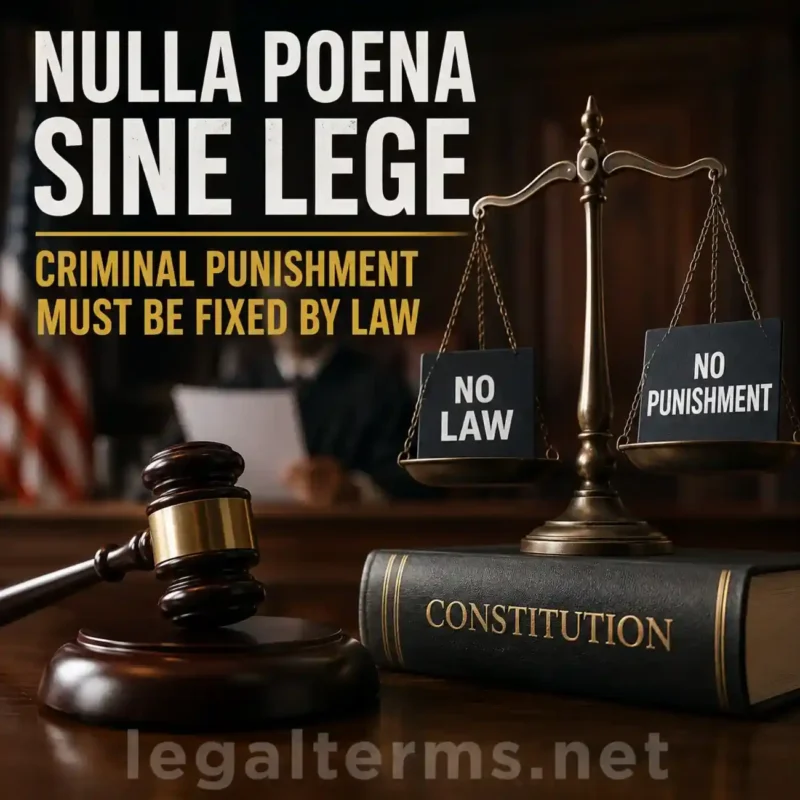
Nulla poena sine lege is a Latin criminal-law principle meaning “no punishment without law.” It requires criminal punishment to have a legal basis rather than being created after the fact by a court or legislature.
The principle is closely related to nullum crimen sine lege, which means “no crime without law,” but the two answer different questions. Nullum crimen asks whether the conduct was legally criminal. Nulla poena asks whether the punishment imposed for that conduct was legally authorized.
| Principle | Literal meaning | Main legal question |
|---|---|---|
| Nullum crimen sine lege | No crime without law | Was the conduct legally defined as criminal? |
| Nulla poena sine lege | No punishment without law | Was the punishment legally authorized? |
The distinction appears expressly in international criminal law. Rome Statute, Article 22, Nullum crimen sine lege addresses criminal responsibility for conduct defined as a crime under the Statute. Rome Statute, Article 23, Nulla poena sine lege separately provides that a person convicted by the International Criminal Court may be punished only in accordance with the Statute.
Nulla poena also has an important retroactivity dimension. A government generally cannot make punishment more severe after an offense and then apply the harsher rule to conduct that occurred earlier.
For example, suppose an offense carried a maximum sentence of five years when it was committed. If a later law increases the maximum to ten years, applying the new ten-year maximum to the earlier offense can raise a retroactive-punishment problem.
In the United States, similar protection appears through the U.S. Constitution, Article I, Section 9, Clause 3, Ex Post Facto Clause for federal legislation and Article I, Section 10, Clause 1 for state legislation.
The core idea is straightforward: criminal punishment must come from law that legally governs the offense, not from a harsher rule invented or imposed afterward.
Nulla Poena and Nullum Crimen Are Related but Not the Same
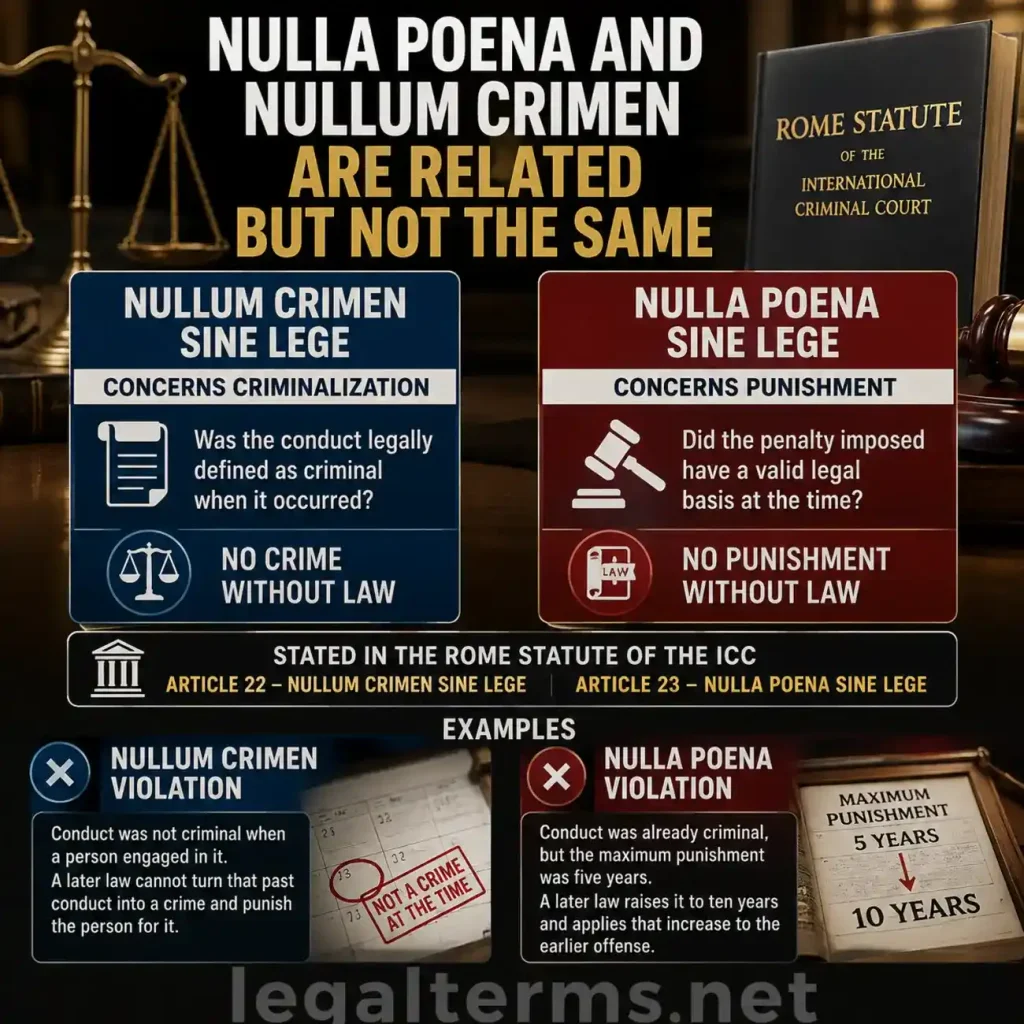
The two Latin principles are often grouped together under the broader principle of legality, but they perform different functions.
Nullum crimen sine lege concerns criminalization. It asks whether the conduct was legally defined as criminal when it occurred.
Nulla poena sine lege concerns punishment. It asks whether the penalty imposed for that conduct had a valid legal basis.
The distinction is stated directly in the Rome Statute of the International Criminal Court, Article 22, Nullum crimen sine lege, and Article 23, Nulla poena sine lege.
Article 22 deals with criminal responsibility under the Statute. Article 23 separately limits punishment to penalties authorized by the Statute.
A simple example shows the difference.
Suppose conduct was not criminal when a person engaged in it. A later law cannot ordinarily turn that past conduct into a crime and punish the person for it. That raises a nullum crimen issue.
Now suppose the conduct was already criminal, but the maximum punishment was five years. A later law raises the maximum to ten years and attempts to apply that increase to the earlier offense. That raises a nulla poena and retroactive-punishment issue.
The Principle Requires a Legal Basis for Punishment
At its core, nulla poena sine lege requires punishment to derive from law.
A court cannot impose a criminal penalty merely because the judge believes a harsher consequence would be appropriate. The punishment must fall within the legal framework governing the offense and sentencing authority.
The principle is stated unusually clearly in Rome Statute, Article 23, Nulla poena sine lege. It provides that a person convicted by the International Criminal Court may be punished only in accordance with the Statute.
That provision separates the power to convict from the power to punish.
A lawful conviction does not give a court unlimited sentencing authority. The punishment must still be one that the applicable legal framework permits.
This does not mean every offense must carry one predetermined sentence.
Criminal statutes often authorize a range of penalties. They may establish maximum terms, minimum terms, fines, alternative sanctions, or criteria that guide judicial discretion.
Nulla poena permits that kind of discretion when the law itself authorizes it.
The problem arises when punishment lacks a legal foundation or exceeds the authority that the governing law provides.
A Court Cannot Simply Invent a New Criminal Penalty
Consider a statute authorizing imprisonment of up to three years and a specified fine.
A judge might have considerable discretion within those limits. The court could potentially choose a shorter prison term, impose an authorized fine, or use another sentencing option expressly permitted by law.
But judicial discretion is not the same as an unrestricted power to create punishment.
If a court attempted to impose a punitive sanction that the governing legal framework did not authorize at all, the question would no longer be merely whether the punishment was severe. The issue would be whether the punishment had a lawful basis.
That is a direct application of nulla poena sine lege.
The distinction is especially important because modern sentencing systems frequently give judges choices.
A sentencing range does not violate the principle simply because the exact punishment was not mathematically predetermined before the offense.
What matters is that the available punishment and the authority to impose it come from law.
A Harsher Penalty Cannot Normally Be Added After the Crime
The legality principle also protects against retroactive increases in criminal punishment.
European Convention on Human Rights, Article 7(1), No Punishment Without Law expressly states that a heavier penalty may not be imposed than the one applicable when the criminal offense was committed.
The European Court of Human Rights treats Article 7 as requiring more than the formal existence of a criminal provision. Its current Article 7 case-law guidance also emphasizes legal basis, accessibility, and foreseeability.
The same underlying concern appears in a different constitutional form in the United States.
U.S. Constitution, Article I, Section 9, Clause 3 prohibits the federal government from passing ex post facto laws.
U.S. Constitution, Article I, Section 10, Clause 1 applies a corresponding prohibition to the states.
U.S. ex post facto doctrine is not simply another name for the full international doctrine of nulla poena sine lege.
But one important overlap is clear: legislation generally cannot increase the criminal punishment for past conduct and then apply that harsher rule retrospectively.
The relevant comparison is usually between the law governing punishment when the offense occurred and the later rule the government seeks to apply.
Four Examples of Nulla Poena in Criminal Law
Examples make the principle easier to distinguish from broader ideas about criminal legality.
Example 1: The Maximum Sentence Is Increased After the Offense
Assume an offense carries a maximum prison sentence of five years on the date it is committed.
Six months later, a new statute increases the maximum sentence to ten years.
The legislature can generally establish a higher maximum for future conduct. The legality problem arises if the government attempts to use that new ten-year maximum against a person whose offense occurred while the five-year maximum controlled.
The person had exposure to the punishment authorized at the time of the offense, not a harsher penalty created later.
In U.S. constitutional law, this type of retroactive increase fits directly within the traditional concerns of the Ex Post Facto Clauses.
Example 2: A New Mandatory Minimum Is Added Later
Suppose an offense originally allows a sentencing court to impose anywhere from probation to five years in prison.
After the offense occurs, the legislature changes the law and requires at least three years of imprisonment.
Applying that new mandatory minimum to the earlier conduct can make the punishment more onerous even though the statutory maximum has not changed.
A classic U.S. authority illustrating this principle is Lindsey v. Washington, 301 U.S. 397 (1937).
The Supreme Court treated a later sentencing law as constitutionally problematic when it made the punishment more burdensome for conduct committed under the earlier legal regime.
The broader lesson is important.
A retroactive punishment increase does not have to involve raising the maximum sentence. Removing sentencing leniency or creating a mandatory punishment can also materially increase the legal consequences of past conduct.
Example 3: Later Sentencing Rules Produce a Higher Range
Retroactivity questions can also arise when the statutory offense remains the same but the sentencing framework becomes harsher.
In Peugh v. United States, 569 U.S. 530 (2013), the Supreme Court considered the use of federal Sentencing Guidelines that were issued after the defendant’s offenses and produced a higher recommended sentencing range than the Guidelines in effect when the crimes occurred.
The Court held that applying the later Guidelines created an Ex Post Facto Clause problem because they generated a sufficient risk of increased punishment.
Peugh is useful because it shows that legality concerns are not limited to a legislature changing the maximum sentence printed next to an offense.
A later sentencing regime can also raise constitutional problems when it creates a significant risk that past conduct will receive harsher punishment.
Example 4: The Court Uses a Punishment the Law Does Not Authorize
Imagine a criminal statute authorizes imprisonment and a fine, while no applicable law authorizes an additional punitive sanction the court wants to impose.
Even if the court considers that sanction appropriate, punishment cannot rest solely on judicial preference.
The court needs legal authority for the penalty.
This example represents the narrowest meaning of nulla poena sine lege. Unlike the first three examples, the problem does not depend on a later law being applied retroactively.
The issue is more fundamental: the punishment itself lacks the required legal basis.
U.S. Law Uses Different Words for a Similar Protection
The U.S. Constitution does not use the Latin phrase nulla poena sine lege.
Instead, an important part of the same legality concern appears through the Ex Post Facto Clauses.
U.S. Constitution, Article I, Section 9, Clause 3, Ex Post Facto Clause restricts the federal government.
U.S. Constitution, Article I, Section 10, Clause 1, Ex Post Facto Clause imposes the corresponding restriction on the states.
These provisions have long been understood to prohibit certain retroactive criminal laws.
One prohibited category is a law that increases the punishment for criminal conduct after the conduct occurred.
That overlap is significant, but the doctrines should not be treated as exact synonyms.
Nulla poena sine lege is a broader legality principle concerning the lawful basis of punishment. U.S. ex post facto doctrine specifically addresses retroactive legislative changes falling within constitutional categories.
A punishment can therefore raise a legality question even when the problem is not simply that a legislature enacted a harsher law after the offense.
The Law Must Make Punishment Sufficiently Foreseeable
The principle of legality is not satisfied merely because some legal text concerning punishment exists.
A person should be able to determine, with appropriate legal interpretation where necessary, the nature of the criminal consequences attached to prohibited conduct.
In the European human rights framework, this concern appears in the interpretation of European Convention on Human Rights, Article 7, No Punishment Without Law.
European Court of Human Rights case law treats accessibility and foreseeability as important elements of Article 7.
Foreseeability does not mean every sentencing result must be predictable to an exact number of months or years.
Legal systems can authorize judicial discretion.
Sentencing statutes can provide ranges, factors, or alternative sanctions without violating the principle merely because different lawful outcomes are possible.
The key point is that the sentencing authority and possible punishment must remain anchored in law.
A judge interpreting an existing penalty provision is different from a judge creating a new punishment without legal authority.
Nulla Poena Also Limits Expansion by Analogy
The broader criminal-law principle of legality restricts the use of analogy when it expands criminal liability or punishment to a defendant’s detriment.
A court cannot simply reason that an unauthorized punishment is similar to an authorized one and therefore should also be available.
The legal system must supply the authority.
This concern is particularly visible in European Article 7 jurisprudence, where criminal provisions are expected to be interpreted consistently with the prohibition against extending criminal law by analogy to the accused’s disadvantage.
That does not eliminate ordinary judicial interpretation.
Courts routinely resolve ambiguous statutory language and apply established legal concepts to new factual situations.
The boundary is crossed when interpretation effectively creates criminal exposure or punishment that could not reasonably be derived from the existing law.
Does Nulla Poena Mean Criminal Penalties Can Never Change?
No.
Legislatures can change criminal penalties.
They can increase maximum sentences, add mandatory minimums, create new sentencing structures, or reduce punishment for future offenses, subject to other constitutional and statutory limits.
Nulla poena sine lege does not freeze criminal law permanently.
The central question is which penalty rules may lawfully govern conduct that occurred before the change.
A new, harsher punishment generally creates the strongest legality concern when the government attempts to apply it retrospectively.
A law that increases a penalty today can ordinarily govern offenses committed after the law takes effect without creating the same retroactivity problem.
A later reduction in punishment presents a different question.
Some legal systems expressly provide that an offender should benefit when the law later establishes a lighter penalty.
For example, International Covenant on Civil and Political Rights, Article 15(1) provides that if a lighter penalty is introduced after an offense, the offender shall benefit from it.
This principle is sometimes described through the concept of lex mitior, meaning application of the more lenient criminal law.
Whether a later reduction applies in a particular domestic case depends on the governing legal system.
What Nulla Poena Sine Lege Does Not Mean
The principle is easier to understand when several common misconceptions are removed.
It does not require one fixed sentence for every offense
A statute can authorize a sentencing range.
For example, a law could permit imprisonment from zero to five years and allow a judge to select the appropriate sentence within that range.
The exact result was not fixed before the offense, but the court’s sentencing authority was.
That is different from inventing a punishment outside the authorized framework.
It does not eliminate judicial sentencing discretion
Judges can exercise discretion when the law grants it.
Sentencing factors, statutory ranges, authorized alternatives, and legally established guidelines can all leave room for judicial judgment.
Nulla poena limits the source and boundaries of that power. It does not require sentencing to become automatic.
It does not prohibit prospective increases in punishment
A legislature can generally make an offense carry a harsher penalty for conduct committed after the new law becomes effective.
The retroactivity concern arises when the government attempts to apply the harsher rule to earlier conduct.
It is not the same as double jeopardy
Double jeopardy concerns repeated prosecution or punishment in circumstances protected by the applicable constitutional rule.
Nulla poena asks whether the punishment itself has a valid legal basis.
The two doctrines can both protect criminal defendants, but they address different legal problems.
It is not identical to nullum crimen sine lege
Nullum crimen asks whether the conduct was legally criminal.
Nulla poena asks whether the punishment was legally authorized.
A case can therefore present a punishment problem even when no one disputes that the conduct was already a crime.
It does not invalidate every change in sentencing procedure
Not every later procedural change increases punishment in the legally relevant sense.
Courts often distinguish between changes that alter substantive punishment and changes that merely modify procedure.
In U.S. constitutional law, whether a change creates an Ex Post Facto Clause problem depends on its legal effect, not simply on whether the sentencing process looks different.
Why the Principle Matters in Criminal Law
Criminal punishment is one of the strongest powers available to government.
Imprisonment, fines, restrictions on liberty, and other penal consequences cannot depend solely on what a decision-maker later considers appropriate.
Nulla poena sine lege requires punishment to remain connected to previously established legal authority.
The principle serves several related purposes.
It restrains arbitrary punishment, protects legal certainty, supports fair notice, and separates lawful sentencing discretion from the creation of new penalties after the fact.
It also reinforces the distinction between making law and applying law.
Legislatures define the available criminal penalties within constitutional limits. Courts interpret and apply those penalties within the authority the legal system gives them.
A court may decide which authorized punishment fits a particular defendant.
It cannot obtain additional punitive power simply because an unauthorized penalty appears desirable.
That is the practical core of nulla poena sine lege.
FAQ’s About Nulla Poena Sine Lege
What does nulla poena sine lege mean?
Nulla poena sine lege means “no punishment without law.”
In criminal law, the principle requires punishment to rest on legal authority. A court cannot impose a criminal penalty that the governing law does not authorize.
The principle also supports protection against retroactively imposing a harsher punishment than the one legally applicable when the offense was committed.
What is an example of nulla poena sine lege?
Suppose an offense carried a maximum sentence of five years when it was committed.
A later statute increases the maximum to ten years.
Applying the new ten-year maximum to the earlier offense can violate rules against retroactive increases in punishment.
The key issue is not whether the legislature may increase the penalty for future offenses. It is whether the harsher rule can lawfully be applied to conduct that occurred before the change.
What is the difference between nullum crimen and nulla poena?
Nullum crimen sine lege means “no crime without law.” It concerns whether conduct was legally defined as criminal.
Nulla poena sine lege means “no punishment without law.” It concerns whether the punishment imposed for criminal conduct was legally authorized.
The Rome Statute separates the two principles in Article 22, Nullum crimen sine lege, and Article 23, Nulla poena sine lege.
Does nulla poena prohibit retroactive punishment?
It strongly protects against retroactively imposing a more severe criminal punishment.
That principle appears expressly in European Convention on Human Rights, Article 7(1), No Punishment Without Law, which prohibits imposing a heavier penalty than the one applicable when the offense was committed.
In U.S. law, related protection appears through the federal and state Ex Post Facto Clauses.
Is nulla poena sine lege part of U.S. law?
The U.S. Constitution does not use the Latin phrase itself.
However, important parts of the same legality concern are reflected in the Ex Post Facto Clauses of Article I, Sections 9 and 10, which prohibit certain retroactive criminal laws, including laws that increase punishment for earlier conduct.
The doctrines overlap, but they should not be treated as perfectly identical.
Where is nulla poena sine lege written in international law?
A direct formulation appears in Rome Statute of the International Criminal Court, Article 23, Nulla poena sine lege.
A closely related protection appears in European Convention on Human Rights, Article 7, No Punishment Without Law.
International Covenant on Civil and Political Rights, Article 15 also protects against retroactive criminal punishment and addresses later reductions in penalty.
Legal References
International Legal Authorities
- Rome Statute of the International Criminal Court, Articles 22 to 24
- European Convention on Human Rights, Article 7
- European Court of Human Rights, Guide on Article 7 of the European Convention on Human Rights
- International Covenant on Civil and Political Rights, Article 15
U.S. Constitutional and Case Authorities
- U.S. Constitution Annotated, Article I, Section 9, Clause 3, Ex Post Facto Laws
- U.S. Constitution Annotated, Article I, Section 10, Clause 1, Ex Post Facto Laws
- Lindsey v. Washington, 301 U.S. 397 (1937)
- Peugh v. United States, 569 U.S. 530 (2013)
- Weaver v. Graham, 450 U.S. 24 (1981)
About This Article
Author: Hamit Sahin
Last reviewed: August 2026
Jurisdiction: United States and international criminal law
Article type: Legal Principle / Criminal Law Doctrine
Primary sources: Rome Statute of the International Criminal Court, European Convention on Human Rights, International Covenant on Civil and Political Rights, U.S. Constitution Annotated, and U.S. Supreme Court decisions
Scope: This article explains the meaning of nulla poena sine lege, its relationship to retroactive punishment, its distinction from nullum crimen sine lege, and practical examples in criminal law.
Editorial standard: The article distinguishes international legality principles from the U.S. constitutional Ex Post Facto framework rather than treating them as identical.
Disclaimer: General legal information only. This article does not provide legal advice or create an attorney-client relationship.

Hamit Sahin is the founder and editor of LegalTerms.net. He researches U.S. legal terminology and publicly available legal information using statutes, court rules, judicial opinions, government publications, and established legal reference sources.
His work focuses on organizing complex legal concepts into clear, plain-English explanations for general educational purposes.
Hamit is not an attorney and LegalTerms.net does not provide legal advice.