Juvenile Court vs Adult Court: Rights, Sentencing, and When a Case Can Transfer
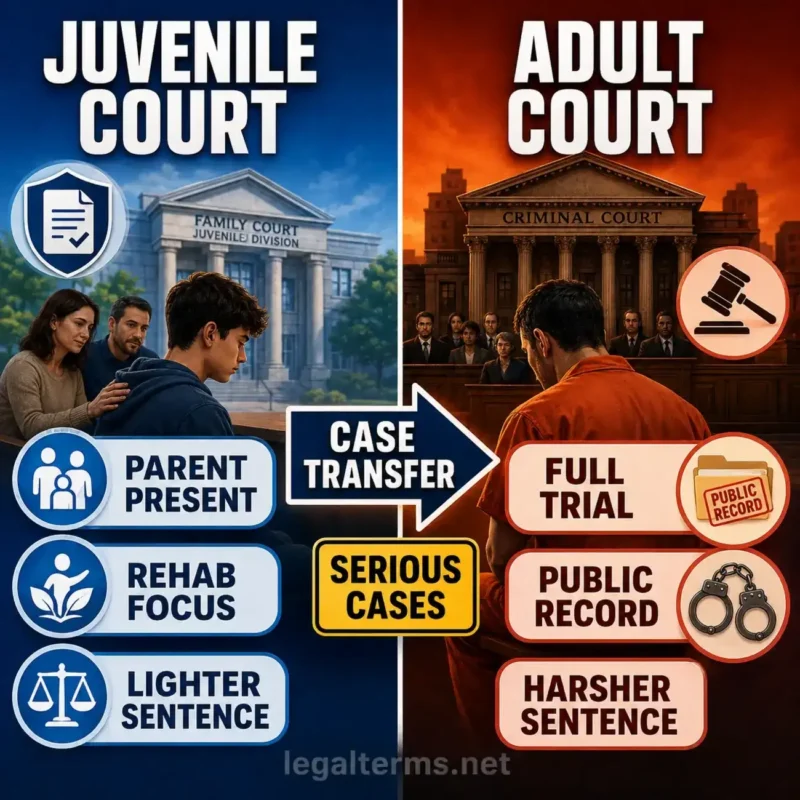
Juvenile court and adult court can both handle serious unlawful conduct, but they are built around different legal frameworks.
Juvenile court generally handles delinquency cases involving minors and places greater emphasis on rehabilitation, supervision, and development. Adult criminal court focuses on criminal prosecution under the ordinary criminal justice system, with conviction and sentencing carrying different procedural and long-term consequences.
The difference is not simply that juvenile court is “less serious.” Juveniles can face detention, restrictive placements, probation, and other significant consequences. At the same time, they receive important constitutional protections, and state law determines when a youth can remain in juvenile court or face prosecution in adult criminal court.
| Question | Juvenile Court | Adult Court |
|---|---|---|
| Main legal framework | Juvenile delinquency proceeding | Criminal prosecution |
| Common terminology | Petition, adjudication, disposition | Charge, conviction, sentence |
| Main emphasis | Rehabilitation, accountability, and public safety | Criminal responsibility, punishment, deterrence, and rehabilitation |
| Jury trial | Not constitutionally required in ordinary juvenile adjudications | Protected in qualifying criminal prosecutions |
| Burden of proof | Beyond a reasonable doubt for delinquency based on criminal conduct | Beyond a reasonable doubt |
| Hearings and records | Often receive additional confidentiality protections | Generally more public |
| Typical outcome | Adjudication and disposition | Conviction and sentence |
| Can a minor appear here? | Usually, if within juvenile jurisdiction | Yes, when transfer or original adult-court jurisdiction rules apply |
A major point is often missed: juvenile court does not mean fewer basic constitutional protections. The Supreme Court has recognized important rights for juveniles, including notice of charges, counsel, confrontation, protection against self-incrimination, and proof beyond a reasonable doubt in qualifying delinquency cases.
The systems diverge more sharply in areas such as jury trials, terminology, record treatment, disposition, and transfer to adult court.
The exact boundary depends heavily on state law. A serious offense does not automatically send every minor to adult court nationwide. Depending on the jurisdiction, the decision may come from a judge, a prosecutor acting under statutory authority, or a law that places certain cases in adult court from the beginning.
The Two Courts Start With Different Legal Ideas
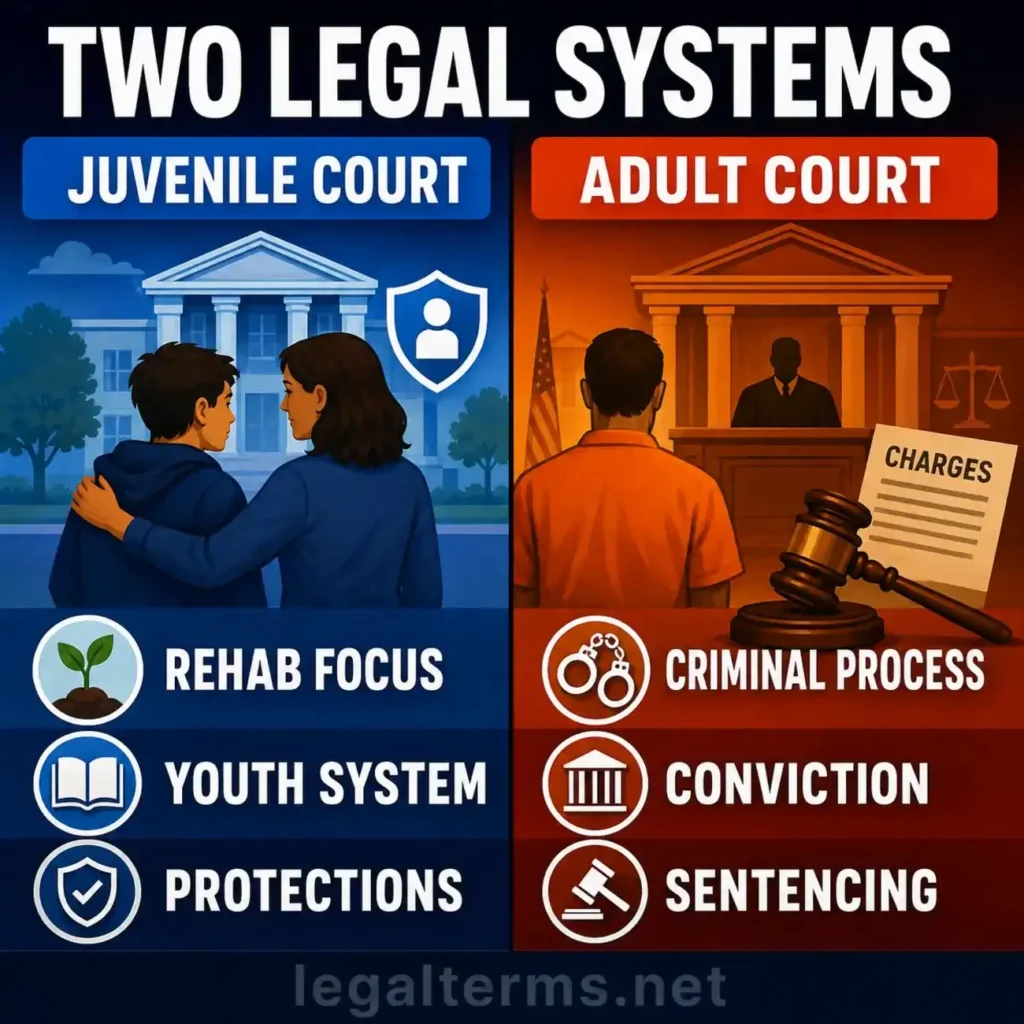
Juvenile court is designed around a separate legal framework for young people accused of conduct that would be criminal if committed by an adult.
The system traditionally places more emphasis on rehabilitation, supervision, treatment, education, and development than the ordinary adult criminal process. Public safety and accountability still matter, especially in serious cases.
Adult criminal court starts from a different structure. The person is prosecuted as a criminal defendant under the ordinary criminal justice system, with the possibility of conviction and the sentencing consequences authorized for the offense.
That difference affects more than punishment. It changes terminology, procedure, decision-making authority, access to records, and the path a case follows from filing through final disposition.
Juvenile court should not be described as informal in a way that suggests constitutional protections disappear.
Modern juvenile proceedings can involve lawyers, evidentiary hearings, detention, contested factual questions, and significant restrictions on liberty. The Supreme Court has repeatedly recognized that serious juvenile proceedings require meaningful procedural protections.
The contrast is therefore better understood as a different legal system for delinquency cases, not simply a lighter version of adult court.
Juvenile Court Uses Different Legal Language
The vocabulary used in juvenile court reflects its separate legal structure.
Adult criminal cases generally speak in terms such as charges, defendants, guilty verdicts, convictions, and sentences.
Juvenile delinquency proceedings often use different terms.
| Adult criminal court | Juvenile court |
|---|---|
| Criminal charge | Delinquency allegation or petition |
| Defendant | Juvenile, youth, or respondent |
| Trial | Adjudicatory hearing |
| Guilty finding | Adjudication of delinquency |
| Conviction | Delinquency adjudication |
| Sentencing | Disposition |
| Sentence | Dispositional order |
| Jail or prison sentence | Detention or placement, depending on the case |
The exact terminology varies among jurisdictions.
A state may use different labels for the youth, the petition, or the final order. The important point is that juvenile court generally does not treat a delinquency adjudication as identical to an adult criminal conviction.
That distinction can matter later when discussing records, collateral consequences, sentencing terminology, and transfer to adult court.
The different vocabulary also prevents a common mistake.
A juvenile who is found responsible for delinquent conduct has not necessarily been “convicted” in the same legal sense as an adult defendant, even though the underlying conduct may involve the same criminal statute.
Juveniles Have Due Process Rights Too
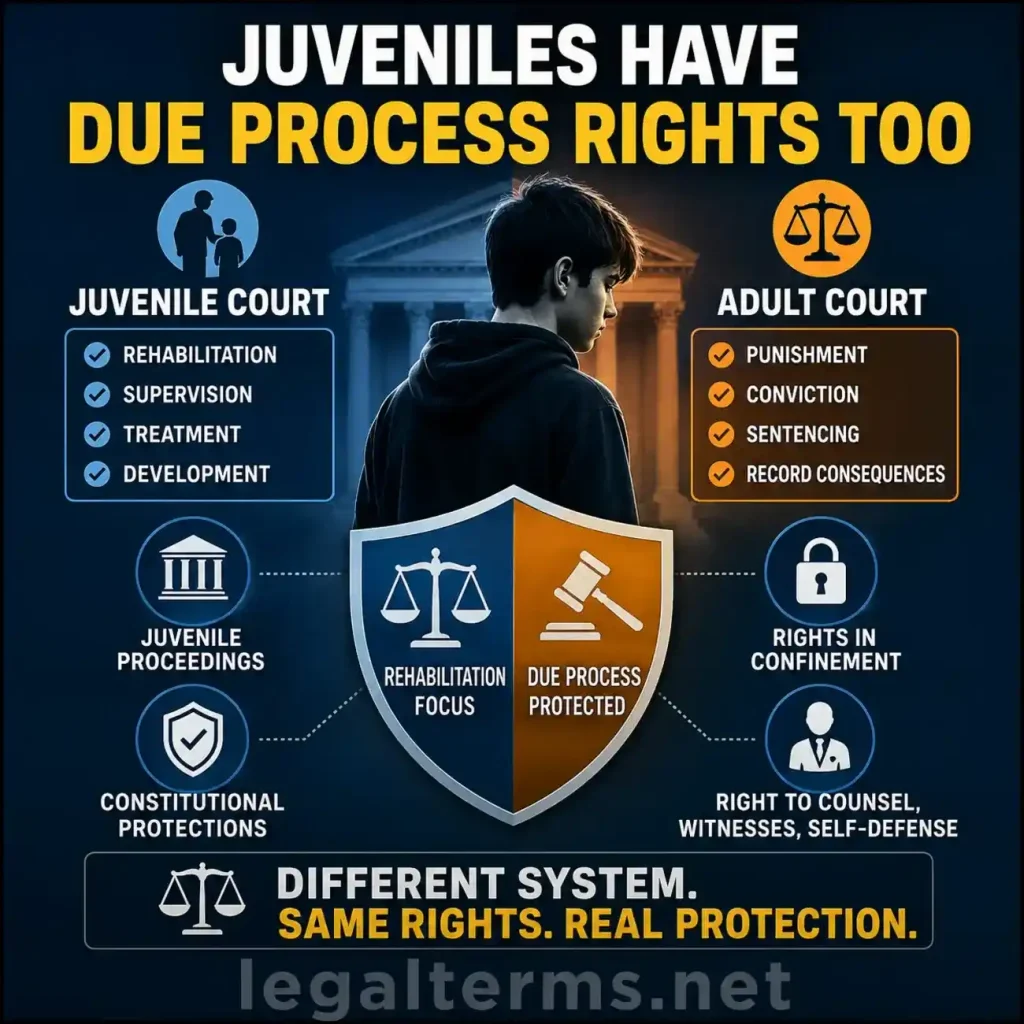
Juvenile court was historically built around a more informal and protective model, but informality created its own risks when young people faced serious consequences without many of the protections available in criminal court.
The Supreme Court changed that landscape in In re Gault.
The case involved a juvenile delinquency proceeding that resulted in a serious period of confinement. The Court held that certain fundamental due process protections apply when a juvenile faces proceedings that can result in commitment.
Those protections include adequate notice of the allegations, the right to counsel, the opportunity to confront and cross-examine witnesses, and protection against compelled self-incrimination.
That decision is important because it rejects the idea that a rehabilitative label can substitute for basic procedural fairness.
A juvenile court can pursue rehabilitation while still being required to respect constitutional rights.
This is also a natural connection to the broader concept of due process. Due process does not require every legal proceeding to look identical, but it does require procedures appropriate to the liberty interests and legal stakes involved.
Juvenile and adult courts can therefore differ significantly without juvenile proceedings becoming constitutionally unprotected.
The Burden of Proof Is Not Lower Just Because the Defendant Is a Minor
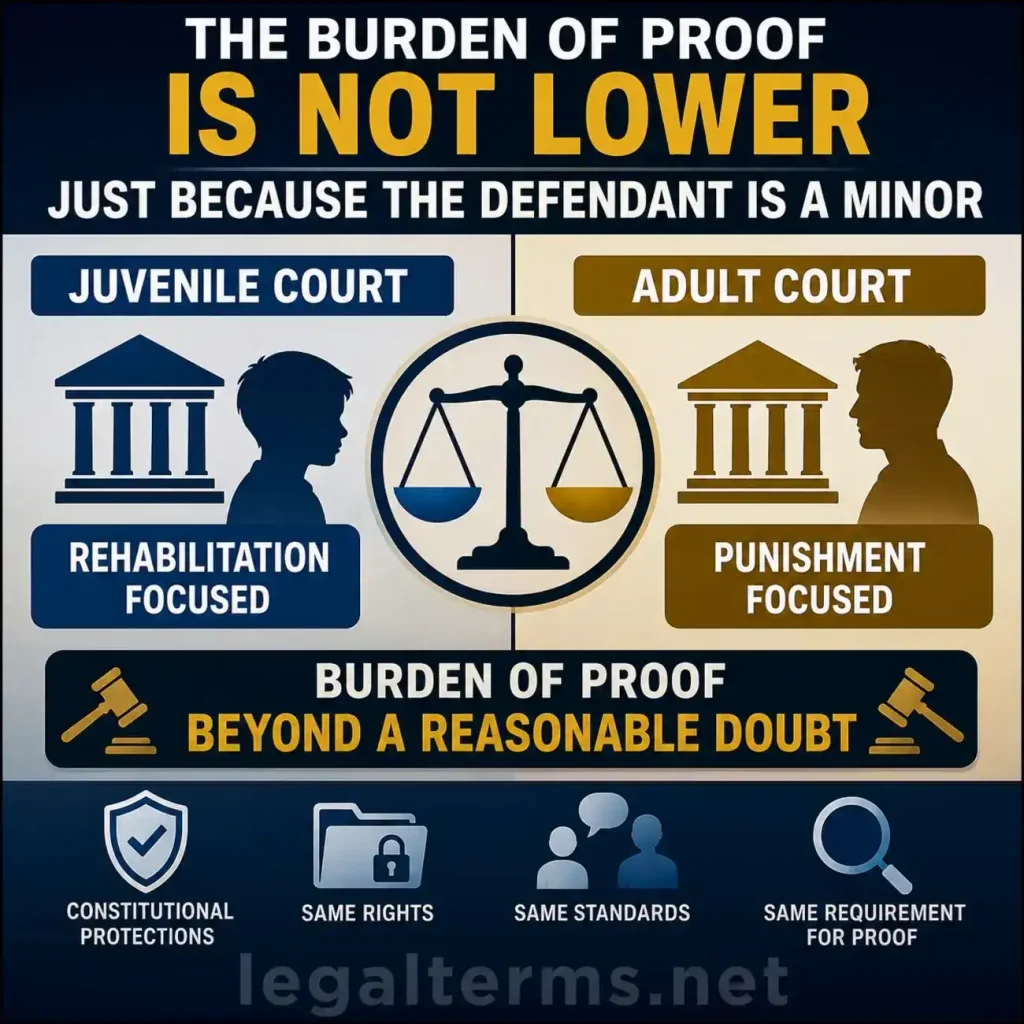
Another common misconception is that juvenile court can find delinquency under a weaker standard because the proceeding is intended to be rehabilitative.
That is not the rule for delinquency adjudications based on conduct that would constitute a crime if committed by an adult.
In In re Winship, the Supreme Court held that the constitutional requirement of proof beyond a reasonable doubt applies in that situation.
The principle matters because the burden of proof is one of the most important protections in any adjudication involving alleged criminal conduct.
Juvenile court may use different terminology, but it does not get to lower the evidentiary standard merely because the accused person is a minor.
This creates an important contrast.
Juvenile proceedings may be less formal in some respects, and they may emphasize rehabilitation more heavily, but the government still must meet the beyond-a-reasonable-doubt standard when seeking a delinquency adjudication based on criminal conduct.
That is one of the clearest examples of how juvenile court can be structurally different from adult court without abandoning core constitutional safeguards.
One Major Difference Is the Jury
The right to a jury is one area where juvenile and adult court diverge more sharply.
In ordinary adult criminal prosecutions, the Sixth Amendment provides a jury-trial right in cases that meet the constitutional requirements for that protection.
Juvenile delinquency proceedings are different.
In McKeiver v. Pennsylvania, the Supreme Court held that the Federal Constitution does not require jury trials in ordinary state juvenile delinquency adjudications.
That does not mean a juvenile can never have a jury.
State constitutions, statutes, or court rules can provide broader rights than the federal constitutional minimum. The availability of a jury therefore depends in part on the jurisdiction.
The accurate nationwide distinction is narrower:
A jury trial is not federally required in ordinary juvenile delinquency proceedings merely because the alleged conduct would be criminal if committed by an adult.
This difference reflects the separate structure of juvenile court, but it does not reduce the burden of proof or eliminate the right to counsel and other due process protections.
Juvenile Records and Hearings Can Receive More Privacy
Juvenile proceedings often receive confidentiality protections that are not available in the same form in ordinary adult criminal cases.
Those protections can involve court access, identifying information, case records, or later opportunities to seal or restrict records.
But this is an area where broad statements quickly become inaccurate.
It is not safe to say:
“Juvenile court is always private.”
It is also not safe to say:
“Juvenile records automatically disappear when the person turns 18.”
State laws differ. Serious offenses, transfer proceedings, public-interest exceptions, victim-access rules, and record statutes can all affect confidentiality.
Adult criminal proceedings are generally more public, and adult conviction records often have fewer automatic confidentiality protections.
The practical difference is therefore one of greater potential protection, not guaranteed secrecy.
A juvenile case may receive significant privacy protections while still generating records that matter later. The exact rules depend on the jurisdiction, the type of case, and what happened during the proceeding.
Disposition Is Not Just Adult Sentencing With a Different Name
A juvenile case typically ends with a disposition rather than an adult criminal sentence.
That change in terminology reflects a different legal framework, not merely different wording.
Depending on state law and the case, juvenile dispositions can include:
- probation;
- counseling or treatment;
- community-based programs;
- restitution;
- educational requirements;
- placement outside the home;
- secure juvenile confinement;
- other rehabilitative or supervisory conditions.
The available options vary by jurisdiction and offense.
Adult criminal sentencing can also include probation, treatment, restitution, fines, community-based sanctions, and incarceration.
The difference is therefore not that juvenile court rehabilitates while adult court only punishes.
Both systems can use rehabilitation and supervision.
Juvenile court generally gives developmental and rehabilitative goals a more central role within a legal system designed specifically for young people.
Adult criminal court operates under the jurisdiction’s ordinary criminal sentencing laws.
This distinction also connects to restorative justice, which some juvenile systems use in appropriate cases as part of broader accountability and rehabilitation efforts.
The key issue is not whether juvenile court consequences are serious.
They can be.
The important difference is the framework used to choose and describe those consequences.
When Can a Juvenile Be Tried in Adult Court?
A minor does not automatically remain in juvenile court simply because of age.
State laws create different paths that can place certain cases in adult criminal court. The rules often depend on the youth’s age, the alleged offense, prior history, and the transfer mechanism authorized by the jurisdiction.
Three major mechanisms appear repeatedly in state juvenile justice systems:
- judicial waiver;
- prosecutorial discretion or direct file;
- statutory exclusion.
These mechanisms are not interchangeable. They differ mainly in who has the authority to determine that the case belongs in adult court.
| Transfer mechanism | Who controls the forum decision? | Basic idea |
|---|---|---|
| Judicial waiver | Judge | Juvenile court considers whether the case should move to adult court |
| Direct file | Prosecutor | Prosecutor may choose juvenile or adult court within statutory limits |
| Statutory exclusion | Legislature | State law places defined cases outside ordinary juvenile court jurisdiction |
The exact terminology and availability of each mechanism vary by state.
A jurisdiction may use more than one system. Age thresholds, qualifying offenses, evidentiary standards, hearing requirements, and opportunities to return a case to juvenile court can also differ.
That is why a nationwide statement such as “a 16-year-old charged with a felony is tried as an adult” is inaccurate.
Judicial Waiver Puts the Transfer Question Before a Judge
Under a judicial waiver system, a case generally begins within juvenile jurisdiction.
A judge then determines whether the case should remain there or move into adult criminal court under the state’s transfer statute.
The decision can involve factors such as:
- the youth’s age;
- seriousness of the alleged offense;
- prior delinquency history;
- public safety concerns;
- available treatment programs;
- maturity or development;
- previous rehabilitation efforts;
- the time available for treatment within juvenile jurisdiction.
This list is illustrative, not a nationwide legal test.
Each state defines its own transfer criteria. Some statutes also distinguish between discretionary waiver and presumptive waiver, which can alter how the transfer question is evaluated.
The seriousness of the alleged conduct can be central, but offense labels alone do not create one universal rule.
A felony classification may matter under a transfer statute, but being accused of a felony does not automatically establish adult-court jurisdiction throughout the United States.
Direct File Gives Prosecutors a Different Kind of Authority
Some states authorize prosecutors to file certain juvenile cases directly in adult criminal court.
This mechanism is often called direct file, prosecutorial discretion, or concurrent jurisdiction.
The prosecutor does not receive unlimited power to choose adult court for any juvenile case. The authority comes from state law and is usually limited by factors such as age and offense category.
This differs significantly from judicial waiver.
With judicial waiver, a judge evaluates whether an eligible case should leave juvenile court.
With direct file, the legislature has authorized the prosecutor to select the forum within a defined category of cases.
That difference can affect when the forum decision occurs and which procedures apply before the youth enters adult court.
Direct-file laws have also changed in a number of states over time. Current state law must therefore be checked before assuming that a prosecutor has this authority in a particular jurisdiction.
Statutory Exclusion Can Put the Case in Adult Court From the Start
Statutory exclusion works differently from both judicial waiver and direct file.
Under an exclusion statute, the legislature identifies categories of cases that fall outside ordinary juvenile court jurisdiction.
A qualifying case may therefore begin in adult criminal court without a juvenile judge first deciding whether to waive jurisdiction.
This creates an important terminology issue.
People often describe every juvenile prosecuted as an adult as having been “transferred.”
Technically, that may not be what happened.
If state law gives adult criminal court original jurisdiction over the particular age and offense combination, there may have been no juvenile proceeding to transfer in the first place.
The distinction matters when researching a specific case because the procedural route can affect hearing rights, filing decisions, and whether another mechanism exists to return the case to juvenile court.
Some jurisdictions provide a procedure commonly called reverse waiver or a similar mechanism that can allow an adult-court case to be considered for juvenile treatment.
That option is not universal.
Transfer to Adult Court Is a Critically Important Legal Decision
The Supreme Court addressed the seriousness of juvenile waiver proceedings in Kent v. United States.
Kent involved the District of Columbia’s juvenile system and a court decision waiving juvenile jurisdiction. The Supreme Court concluded that the waiver had been entered without compliance with the procedures required under the governing law.
The Court described waiver of juvenile jurisdiction as a “critically important” action because it affected significant statutory rights associated with juvenile treatment.
Kent should not be converted into a single nationwide checklist for every modern transfer proceeding.
The case arose under a specific District of Columbia statutory framework. State legislatures have since developed many different transfer systems.
Its broader importance is procedural.
When the law makes a judicial transfer decision consequential and provides procedural protections around that decision, the juvenile court cannot treat waiver as a casual administrative step.
What Changes After a Case Moves to Adult Court?
Moving a case into adult criminal court changes more than the name of the proceeding.
The youth generally becomes subject to the adult criminal process for that prosecution rather than an ordinary juvenile delinquency adjudication.
That can change:
- charging procedures;
- courtroom terminology;
- jury-trial rights;
- public access;
- record treatment;
- available sentencing rules;
- the legal meaning of the final judgment;
- the long-term consequences associated with a criminal conviction.
The precise effects depend on state law.
Adult prosecution does not necessarily mean that every young defendant is housed with adult prisoners, receives the maximum adult sentence, or loses every protection associated with age.
Separate laws can govern detention, correctional placement, sentencing, and youth-specific protections.
The key distinction is that the case is now being handled under the adult criminal jurisdiction authorized by law.
That is a much larger change than simply moving the hearing to another courtroom.
Adult Court Can Create a Criminal Conviction Rather Than a Delinquency Adjudication
One of the most important consequences of adult prosecution is the legal status of the final judgment.
An ordinary juvenile delinquency case generally results in an adjudication and disposition rather than an adult criminal conviction and sentence.
When a youth is prosecuted and convicted in adult criminal court, the result is generally an adult criminal conviction.
That distinction can affect areas far beyond the immediate sentence.
Possible consequences of an adult conviction can involve employment, licensing, immigration, firearms restrictions, future sentencing, public records, and other legal disabilities.
The exact consequences depend heavily on the offense and jurisdiction.
The important point is not that every adult conviction produces the same lifelong effects.
It is that an adult criminal conviction belongs to a different legal category from an ordinary juvenile delinquency adjudication.
Federal Juvenile Cases Have Their Own Transfer Rules
Federal juvenile cases operate under a separate statutory framework, primarily the Federal Juvenile Delinquency Act.
The federal juvenile system is relatively limited because most juvenile cases are handled by state, local, or tribal systems.
The Department of Justice describes federal juvenile proceedings as emphasizing rehabilitation while also providing procedural and substantive protections specific to juveniles.
Federal law also permits certain juvenile cases to move into adult criminal prosecution.
The Department of Justice’s current juvenile prosecution guidance identifies three principal routes under the federal framework:
- written waiver of juvenile status upon advice of counsel;
- discretionary transfer by a court in the interest of justice;
- mandatory transfer for certain qualifying repeat offenders.
These federal categories should not be confused with the broader state-law labels discussed earlier.
For example, state systems may use prosecutorial direct file or statutory exclusion rules that do not map neatly onto the Federal Juvenile Delinquency Act.
Federal discretionary transfer also involves statutory eligibility requirements and an interest-of-justice determination.
The court considers factors specified by federal law rather than applying a generic national juvenile-transfer test.
Juvenile Court Does Not Mean Minor Consequences
The word “juvenile” can make the system sound temporary or insignificant.
That is misleading.
A juvenile court can order probation, treatment, restrictive placement, secure confinement, restitution, and other serious consequences when authorized by law.
A youth can also spend substantial time under court supervision.
The consequences may extend beyond the immediate disposition.
Records may remain accessible in some circumstances, later offenses may interact with earlier juvenile history, and certain adjudications can have consequences under state or federal law.
Those effects are not uniform enough to summarize as one national rule.
It is equally inaccurate to assume that everything disappears when the person turns 18.
Age eighteen is important in many legal contexts, but it is not a universal expiration date for juvenile court records, orders, or consequences.
The actual result depends on the jurisdiction and the type of case.
The Same Age Can Produce Different Results in Different States
Age alone does not determine whether a case belongs in juvenile or adult court.
Two youths of the same age accused of similar conduct in different states can face different procedural paths because state legislatures define juvenile jurisdiction and transfer rules differently.
Relevant differences can include:
- the upper age of juvenile court jurisdiction;
- minimum ages for particular transfer mechanisms;
- offenses eligible for waiver;
- statutory exclusion categories;
- prosecutorial filing authority;
- reverse-transfer procedures;
- prior-offense rules;
- extended juvenile jurisdiction.
This is one of the most important limitations on any national comparison.
“Juvenile Court vs Adult Court” describes two broad legal systems, but the boundary between those systems is created largely by state law.
For a specific case, the controlling statute and current court rules matter more than a nationwide age chart.
Is Juvenile Court More Lenient Than Adult Court?
Not necessarily.
Juvenile court is often more rehabilitation-focused, but that does not make every juvenile disposition mild. Courts can impose intensive supervision, residential placement, secure confinement, treatment requirements, restitution, and other significant restrictions when authorized by law.
The better distinction is structural.
Juvenile court is designed specifically for young people and generally gives greater weight to development and rehabilitation. Adult criminal court applies the ordinary criminal prosecution and sentencing framework.
A serious juvenile disposition can therefore be more restrictive than a minor adult sentence in a different case.
The labels alone do not tell you how severe the actual consequences will be.
A Juvenile Case Can Still Have Long-Term Consequences
Another common misconception is that juvenile cases automatically disappear when the person becomes an adult.
That is too broad.
States have different rules governing confidentiality, sealing, expungement, disclosure, later use of juvenile records, and access by courts or government agencies.
Some juvenile records may receive stronger protections than adult criminal records. Others may remain relevant in later proceedings or under specific statutory exceptions.
The consequences can also depend on whether the case remained in juvenile court or resulted in an adult criminal conviction.
For that reason, “juvenile record” should not be treated as a synonym for “temporary record.”
The Key Difference Is Which Legal System Controls the Case
The juvenile and adult systems overlap in important ways.
Both can involve:
- lawyers;
- contested evidence;
- proof beyond a reasonable doubt;
- supervision;
- detention or incarceration;
- restitution;
- treatment requirements;
- serious restrictions on liberty.
Their differences become clearer when the entire process is considered rather than a single sanction.
Juvenile court uses a delinquency framework designed around youth. Adult court uses the ordinary criminal prosecution framework.
That distinction influences the terminology, available procedures, jury rights, records, final judgment, sentencing structure, and authority responsible for deciding where the case belongs.
Transfer laws are what make the boundary between the two systems especially important.
FAQ
Is juvenile court a criminal court?
Juvenile delinquency court is generally treated as a separate legal system rather than ordinary adult criminal court.
The proceedings can still involve conduct that would constitute a crime if committed by an adult, and they can produce serious restrictions on liberty.
Juvenile courts also must provide important constitutional protections.
The exact legal classification and terminology can vary by jurisdiction.
Do juveniles have the same constitutional rights as adults?
Juveniles have many important constitutional protections, but juvenile proceedings are not procedurally identical to adult criminal prosecutions.
Under In re Gault, juveniles facing delinquency proceedings involving potential loss of liberty receive protections including notice, counsel, confrontation, cross-examination, and protection against compelled self-incrimination.
Other differences remain, including the federal constitutional treatment of jury trials.
Do juveniles have a right to a jury trial?
Not under the Federal Constitution in every ordinary juvenile delinquency adjudication.
In McKeiver v. Pennsylvania, the Supreme Court held that the Constitution does not require jury trials in ordinary state juvenile delinquency proceedings.
A state can provide broader jury rights through its own constitution, statutes, or court rules.
The answer for a particular case therefore depends on both federal and state law.
Is the burden of proof lower in juvenile court?
No, not when the government seeks a delinquency adjudication based on conduct that would constitute a crime if committed by an adult.
In In re Winship, the Supreme Court held that proof beyond a reasonable doubt is constitutionally required in that situation.
Different terminology does not create a lower evidentiary standard.
Can a 16-year-old be tried as an adult?
Yes, in some circumstances.
Whether a 16-year-old can be prosecuted in adult court depends on the state, the alleged offense, the applicable transfer mechanism, prior history, and other statutory requirements.
There is no nationwide rule that automatically places every 16-year-old accused of a serious offense in adult court.
Federal juvenile cases follow a separate statutory framework.
Does being charged with a felony automatically send a juvenile to adult court?
No.
A felony allegation can be important under a state’s transfer statute, but felony classification alone does not create a universal adult-court rule.
Some states authorize judicial waiver for certain felonies. Others use statutory exclusion, prosecutorial filing authority, or different combinations of transfer rules.
Age and offense criteria also vary.
Can a juvenile case start directly in adult court?
Yes.
Under some statutory exclusion laws, adult criminal courts receive original jurisdiction over specified categories of juvenile cases.
Some jurisdictions also authorize prosecutors to file certain eligible cases directly in adult court.
When original adult jurisdiction applies, describing the case as “transferred” may be technically inaccurate because it did not first proceed through ordinary juvenile jurisdiction.
Can a juvenile case be moved back from adult court?
Sometimes.
Certain jurisdictions provide reverse-waiver, reverse-transfer, or similar procedures that can allow an eligible case to return to juvenile court.
The availability, procedure, and eligibility requirements are controlled by state law.
It should not be assumed that every adult-filed juvenile case can be sent back.
Are juvenile records always sealed?
No.
Juvenile records often receive confidentiality protections that differ from ordinary adult criminal records, but automatic sealing is not a nationwide rule.
Access, sealing, expungement, disclosure, and later use of juvenile records vary by jurisdiction and case type.
Serious offenses or adult prosecution can also change the applicable rules.
What happens when a juvenile is tried as an adult?
The case proceeds under the adult criminal framework authorized by the jurisdiction.
That can change jury rights, courtroom procedures, record treatment, sentencing exposure, terminology, and the legal status of the final judgment.
An adult conviction can also produce consequences different from a juvenile delinquency adjudication.
The exact sentencing and correctional rules remain jurisdiction-specific.
References
U.S. Supreme Court Authorities
- In re Gault, 387 U.S. 1 (1967)
- In re Winship, 397 U.S. 358 (1970)
- McKeiver v. Pennsylvania, 403 U.S. 528 (1971)
- Kent v. United States, 383 U.S. 541 (1966)
Federal and Government Sources
- Office of Juvenile Justice and Delinquency Prevention, Juvenile Justice 101
- Office of Juvenile Justice and Delinquency Prevention, Trying Juveniles as Adults
- Office of Juvenile Justice and Delinquency Prevention, Delinquency Cases Waived to Criminal Court, 2020
- U.S. Department of Justice, Justice Manual Section 9-8.000: Juveniles
- U.S. Constitution Annotated, Due Process Rights of Juvenile Offenders

Hamit Sahin is the founder and editor of LegalTerms.net. He researches U.S. legal terminology and publicly available legal information using statutes, court rules, judicial opinions, government publications, and established legal reference sources.
His work focuses on organizing complex legal concepts into clear, plain-English explanations for general educational purposes.
Hamit is not an attorney and LegalTerms.net does not provide legal advice.