Probation vs Parole: Key Differences, Violations, and Supervised Release
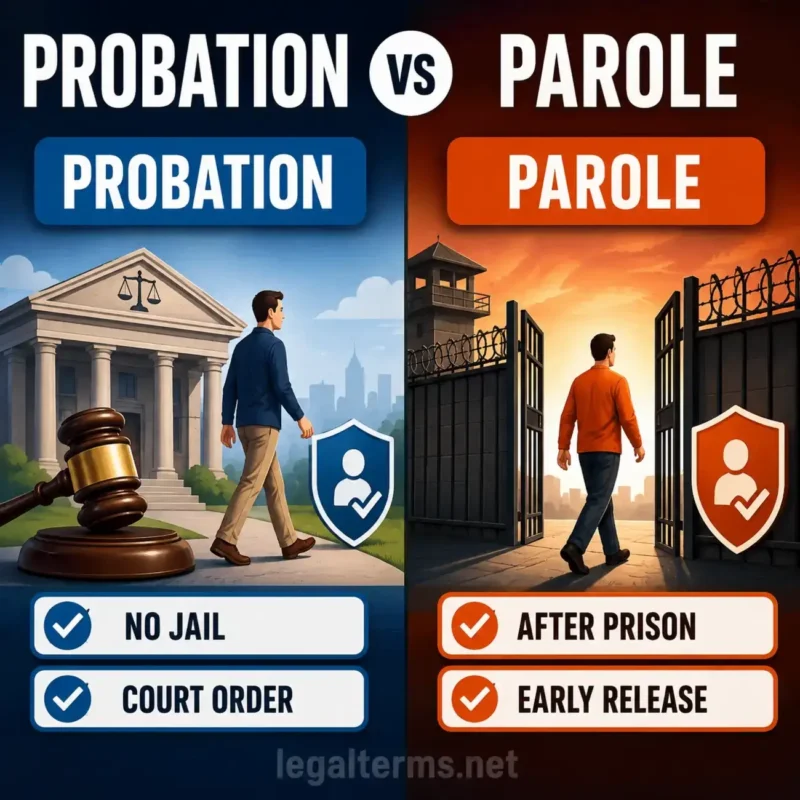
Probation and parole both allow a person to live in the community under supervision, but they enter the criminal justice process at different points.
Probation is generally imposed by a court as part of a sentence and often allows a person to remain in the community instead of serving a full term of incarceration. Parole usually comes later, after a person has already served part of a prison sentence and is conditionally released into the community.
That basic distinction is useful, but it is not the whole story. Some jurisdictions use split sentences that combine a period of incarceration with probation. Parole systems also vary widely among states, and traditional parole is no longer the normal post-prison supervision system for most modern federal offenses.
| Question | Probation | Parole |
|---|---|---|
| When does it usually begin? | At sentencing | After part of a prison sentence has been served |
| Is prior imprisonment required? | Not necessarily | Generally yes |
| Who typically authorizes it? | A court | A parole board or other release authority, depending on the jurisdiction |
| Does it involve community supervision? | Yes | Yes |
| Can conditions be imposed? | Yes | Yes |
| Can violations lead to custody? | Yes | Yes |
| Is it the same as supervised release? | No | No |
The Bureau of Justice Statistics treats both probation and parole as forms of community corrections, but their legal foundations are different.
That difference affects who makes the key decisions, when supervision starts, what happens after a violation, and whether the person is serving a court-imposed community sentence or completing part of a prison sentence outside the institution.
There is also an important federal complication. In the modern federal system, supervised release has largely replaced traditional parole for people convicted of federal offenses committed after November 1, 1987. Federal probation, federal supervised release, and traditional federal parole are therefore three different concepts, not interchangeable labels.
The rest of this comparison explains how those systems differ, where they overlap, and why state law can change the answer.
The Difference Starts With Where You Are in the Sentence
The clearest way to separate probation from parole is to ask one question: Has the person already been serving a prison sentence?
Probation usually begins with the court’s sentencing decision. Instead of requiring the person to serve the entire sentence in jail or prison, the court may allow some or all of the sentence to be served in the community under specified conditions.
Parole starts from a different place. The person has already been incarcerated and is later released into the community under supervision before the relevant sentence or release period has fully ended.
That makes the basic sequence look like this:
Probation: conviction or plea → sentencing → community supervision
Parole: conviction or plea → sentencing → incarceration → conditional release → community supervision
The distinction is useful, but it should not be turned into the overly simple rule that probation always means “no jail.”
The Bureau of Justice Statistics notes that some jurisdictions use split sentences, which combine a period of incarceration with probation. A person might therefore spend some time in custody and then begin probation without ever being considered a parolee.
That is one of the reasons probation and parole are better understood by asking why the person is in the community, rather than simply whether they have ever been incarcerated.
With probation, community supervision generally comes from the sentence imposed by the court.
With parole, community supervision generally follows release from a period of imprisonment.
Probation Is Usually a Sentencing Decision
Probation is a criminal sentence or part of a criminal sentence that allows a person to live in the community while complying with court-imposed conditions.
It may be used in cases involving both misdemeanors and felonies, depending on the offense, the jurisdiction, the person’s record, and applicable sentencing law. The availability of probation is not universal for every crime, and some offenses may carry restrictions or mandatory incarceration.
This is also where probation connects with the broader distinction between felonies and misdemeanors. The offense classification can affect potential punishment, but it does not by itself tell you whether probation will be available.
Probation can replace some or all incarceration
A straightforward probation sentence may allow a defendant to remain in the community without serving a prison term.
But other arrangements are possible.
A court may impose:
- probation without a period of incarceration;
- a short period in custody followed by probation;
- probation combined with fines, restitution, treatment, or community service;
- different levels of supervision depending on the case.
The terminology and permitted sentencing structures vary by jurisdiction.
Probation therefore should not be defined simply as “getting out of jail.” It is a form of legal supervision with enforceable conditions.
Conditions are part of the sentence
A person on probation may be required to comply with conditions imposed by the court or authorized under applicable law.
Depending on the case, conditions can involve matters such as:
- reporting to a supervising officer;
- avoiding new criminal conduct;
- completing treatment or counseling;
- drug or alcohol testing;
- maintaining employment or education;
- complying with geographic or travel restrictions;
- avoiding specified people or places;
- paying restitution, fines, or other court-ordered amounts.
Not every person on probation receives every condition on that list.
The specific requirements come from the sentence, court orders, statutes, supervision policies, and the circumstances of the case. A condition that is common in one category of cases may be irrelevant in another.
Probation can also range from intensive supervision to substantially less frequent monitoring.
Parole Begins With Release From Prison
Parole generally involves conditional release after a person has already served part of a custodial sentence.
The person leaves the correctional institution but remains subject to legal supervision and release conditions.
This is fundamentally different from probation because parole does not ordinarily replace the original decision to incarcerate. The imprisonment has already begun.
A simplified sequence might look like this:
- A person is convicted and sentenced to imprisonment.
- The person serves part of that sentence.
- The applicable release system determines that the person may leave the institution under supervision.
- The person must comply with parole conditions while living in the community.
- A serious or repeated violation may trigger revocation proceedings and possible return to custody.
The exact process varies significantly by jurisdiction.
Some systems use discretionary parole, where a parole board or similar authority evaluates whether an eligible person should be released.
Other release systems rely more heavily on statutory release rules, determinate sentencing, earned credits, or other mechanisms. Some states have also restructured or limited traditional parole for particular categories of offenses.
For that reason, it is safer to describe parole as a type of conditional post-incarceration release rather than assume every state uses the same parole-board model.
Probation and Parole Can Look Similar Once Supervision Starts
Once both people are living in the community, probation and parole can appear surprisingly similar.
A probationer and a parolee might both report to supervising officers, undergo drug testing, participate in treatment, face restrictions on travel, and be required to avoid new criminal conduct.
That surface similarity is one reason the two terms are commonly confused.
| Supervision issue | Probation | Parole |
|---|---|---|
| Community supervision | Yes | Yes |
| Regular reporting | Often required | Often required |
| Drug or alcohol testing | Possible | Possible |
| Treatment programs | Possible | Possible |
| Employment requirements | Possible | Possible |
| Travel restrictions | Possible | Possible |
| Restrictions on contact with certain people | Possible | Possible |
| Consequences for violations | Yes | Yes |
The table shows overlap, not universal rules.
The exact conditions depend on the jurisdiction, the offense, the person’s supervision level, the sentencing court or release authority, and other case-specific factors.
The important distinction remains the source of the supervision.
A person on probation is generally in the community because the court imposed community supervision as part of the sentence.
A person on parole is generally in the community because a release authority allowed the person to leave incarceration subject to continuing conditions.
That difference becomes more important when looking at who makes decisions about supervision and what happens when those conditions are violated.
Who Decides: Judge, Probation Agency, or Parole Board?
Probation and parole also differ in the institutions that typically control major decisions.
For probation, the sentencing court usually plays the central legal role. The court imposes the sentence and establishes or approves the conditions of probation. A probation agency or supervision officer then monitors compliance.
Parole traditionally involves a parole board, parole commission, or another release authority deciding whether an eligible incarcerated person may be conditionally released.
That does not mean every jurisdiction follows the exact same structure.
Some states place probation and parole supervision within the same corrections agency. In some places, officers may supervise people from both populations. Titles also vary. An employee who performs community supervision functions may not literally be called a “parole officer” or “probation officer.”
The institutional labels matter less than the underlying authority.
For probation, the key legal decision usually begins with the sentencing court.
For traditional parole, the key release decision generally comes after incarceration and is made under the jurisdiction’s parole or release system.
That distinction also affects violations. A probation violation usually returns the issue to a court or judicial process, while a parole violation typically enters the revocation process established for the applicable parole system.
What Happens If You Violate Probation?
A probation violation does not always mean the person committed a new crime.
Some violations involve conduct that would be criminal on its own, such as being arrested for a new offense. Others are technical violations, meaning the person allegedly failed to comply with a condition of supervision.
Examples can include:
- failing to report as required;
- missing treatment or counseling;
- violating a travel restriction;
- testing positive for a prohibited substance;
- failing to complete community service;
- contacting a person the court ordered the probationer to avoid;
- failing to comply with another supervision condition.
What happens next depends on the jurisdiction, the seriousness of the alleged violation, the person’s history on supervision, and the authority given to the court or probation agency.
Possible responses can range from continued supervision or modified conditions to formal revocation proceedings and incarceration.
That range matters because the phrase “probation violation” covers very different situations.
Missing one required appointment is not legally identical to committing a new violent offense while under supervision, even though both can potentially trigger action by the probation system.
The court may also distinguish between an allegation and a proven violation. A probationer does not automatically lose probation simply because a supervising officer reports noncompliance.
A Parole Violation Can Lead Back to Custody
Parole violations follow a different procedural path because the person was already serving a custodial sentence before being conditionally released.
A parolee may violate supervision by committing a new offense or by failing to comply with a condition of release.
Possible conditions can include:
- reporting requirements;
- treatment or testing;
- restrictions on travel;
- restrictions on contact with particular people;
- requirements concerning residence or employment;
- compliance with laws and release instructions.
A violation can trigger a parole revocation process. Depending on the applicable system, the result may include continued parole, modified conditions, a period in custody, or revocation and return to incarceration.
But a parole violation is not automatically the same thing as a new criminal conviction.
For example, failing to report to a parole officer may violate a condition of parole even if the conduct is not itself prosecuted as a separate criminal offense.
That distinction becomes important because revocation proceedings have their own legal standards and procedures.
Revocation Has Due Process Rules
Probation and parole supervision are conditional, but the government does not have unlimited authority to revoke that status without process.
The Supreme Court addressed parole revocation in Morrissey v. Brewer, holding that a parolee facing revocation is entitled to minimum procedural protections under the Due Process Clause.
Those protections include notice of the alleged violations, disclosure of the evidence, an opportunity to be heard and present evidence, a qualified opportunity to confront adverse witnesses, a neutral decisionmaker, and a written statement explaining the evidence relied on and the reasons for revocation.
The Court also made an important distinction: a parole revocation proceeding is not a new criminal prosecution. That means it does not necessarily include every procedural protection that would apply in a criminal trial.
A year later, the Supreme Court extended the basic revocation framework to probation in Gagnon v. Scarpelli.
This does not mean probation and parole revocation procedures are identical in every jurisdiction. State statutes, court rules, administrative procedures, and federal rules can add important details.
It does mean that revocation cannot accurately be described as an informal decision with no procedural protections at all.
A violation hearing is different from a criminal trial
Suppose a person on probation is accused of committing a new offense.
Two different legal processes may follow:
- The government may prosecute the alleged new crime.
- The supervision system may separately address whether the same conduct violated probation.
Those proceedings serve different purposes.
The criminal case asks whether the person committed the charged offense under the criminal law and applicable burden of proof.
The revocation proceeding asks whether supervision conditions were violated and what should happen to the existing probation or parole status.
The same underlying conduct can therefore matter in more than one proceeding without making the proceedings legally identical.
Probation Officer vs Parole Officer
The labels suggest a simple division: probation officers supervise probationers, while parole officers supervise parolees.
In practice, the organizational structure can be more complicated.
Some jurisdictions use separate probation and parole agencies. Others combine community supervision functions within one department. The same agency may supervise people on probation, parole, or other forms of post-release supervision.
That is why the more useful distinction is not the officer’s job title but where the supervision authority comes from.
| Issue | Probation | Parole |
|---|---|---|
| Why is the person supervised? | Court-imposed sentence or sentencing arrangement | Conditional release after incarceration |
| Who generally establishes the legal status? | Sentencing court | Parole or release authority |
| Who monitors compliance? | Probation or community supervision agency | Parole or community supervision agency |
| Who handles serious violations? | Often a court | Parole board, commission, court, or other authority depending on the system |
Supervising officers commonly perform functions such as monitoring compliance, coordinating services, documenting violations, and reporting information to the authority responsible for the case.
They do not necessarily have the final power to revoke probation or parole on their own.
The ultimate decision-making structure depends on the jurisdiction.
The Federal System Changes the Comparison
A basic probation-versus-parole explanation becomes misleading if it assumes modern federal cases work exactly like traditional state parole systems.
For most modern federal offenses, traditional federal parole is no longer the standard mechanism for release from prison.
The Sentencing Reform Act eliminated parole for federal crimes committed after November 1, 1987. The U.S. Parole Commission still exists, but its jurisdiction now covers limited categories, including certain older federal cases and other specific populations.
That means three terms need to be kept separate in federal law:
Federal probation
Federal probation is a sentence of community supervision imposed by a federal court.
A person sentenced to probation is not simply a federal prisoner who has been released early on parole.
Federal supervised release
Supervised release is generally a separate period of community supervision imposed by the sentencing court to follow imprisonment.
A defendant may therefore receive:
prison term → supervised release
That sequence can look similar to parole from the outside because both involve supervision after incarceration. Legally, however, they are different systems.
Traditional federal parole
Traditional federal parole involves conditional release under parole law and the authority of the U.S. Parole Commission.
The Department of Justice explains that the Sentencing Reform Act eliminated parole for federal offenses committed after November 1, 1987. Traditional federal parole therefore remains relevant mainly to older federal cases and certain special categories rather than functioning as the standard release system for modern federal convictions.
Parole and Supervised Release Are Not Interchangeable
This distinction deserves its own comparison because the terms are often used casually as though they mean the same thing.
They do not.
| Parole | Federal supervised release | |
| When does it occur? | After incarceration | After incarceration |
| Is it a form of community supervision? | Yes | Yes |
| Is it traditional early release from a prison sentence? | Generally yes | No |
| Who provides the legal framework? | Parole system or release authority | Sentencing court and federal law |
| Is it the ordinary system for modern federal offenses? | Generally no | Yes |
The key difference is structural.
Parole traditionally allows a person to serve part of an existing prison sentence outside the institution under conditions.
Federal supervised release is a separate term of supervision ordered by the court to follow imprisonment.
So if someone says a modern federal defendant “got parole,” that description may be inaccurate. The person may actually be serving a term of supervised release.
This is one of the biggest reasons probation and parole should not be learned as two universal labels that explain every form of community supervision in the United States.
Why the Answer Changes by State
Probation exists throughout the United States, but parole is much harder to describe with one nationwide model.
States have adopted different sentencing structures, release systems, eligibility rules, and supervision terminology. Some retain broad forms of discretionary parole. Others sharply restricted or abolished parole for offenses committed after a particular date while preserving it for older sentences or limited categories of people.
That means two people serving similar sentences in different states may reach community supervision through very different legal paths.
Virginia sharply limited traditional parole
Virginia provides a useful example of why the date of the offense can matter.
Under current Virginia law, a person incarcerated for a felony committed on or after January 1, 1995 generally is not eligible for parole for that offense, subject to statutory exceptions.
Traditional parole still matters in Virginia because some people remain eligible under older sentencing rules or specific exceptions. The Virginia Parole Board therefore continues to operate even though discretionary parole is unavailable for the ordinary modern felony sentence covered by the post-1994 rule.
Probation remains a separate part of Virginia’s community supervision system.
The lesson is not simply that “Virginia has no parole.” That statement would erase the remaining categories of parole eligibility.
A more accurate description is that Virginia substantially abolished discretionary parole for modern felony offenses while retaining parole law for specified cases.
California shows a different parole structure
California continues to operate an extensive parole system, including parole suitability proceedings for certain incarcerated people.
Its sentencing system distinguishes between determinate sentences, which generally specify a fixed term, and indeterminate sentences such as life with the possibility of parole.
Some people serving indeterminate sentences may become eligible for a parole suitability hearing after reaching the applicable eligibility point. Certain people serving determinate sentences can also become eligible for particular parole consideration processes under California law.
So California cannot be reduced to the idea that every prisoner is simply released by a parole board after serving part of a sentence.
Sentence type, offense, eligibility rules, credits, and special parole provisions can all affect the route to release.
Maine shows how old parole law can survive long after reform
Maine provides another useful contrast.
The modern Maine Criminal Code took effect in 1976, and current statutes still contain provisions addressing parole eligibility for people sentenced under the earlier legal system.
That illustrates a recurring problem with nationwide parole explanations: a state can largely move away from an older parole model while still having people whose sentences remain governed by that older system.
The result is that the question “Does this state have parole?” may be too simple.
A better set of questions is:
- When was the offense committed?
- What sentencing law applied?
- What type of sentence was imposed?
- Does the person fall within an exception or legacy system?
- What release authority has jurisdiction?
These questions become especially important when dealing with older convictions.
Probation and Parole Are Not Two Levels of the Same Program
One common misconception is that probation comes first and parole comes later, almost like two stages of one supervision system.
That is not how the concepts generally work.
A person does not ordinarily complete probation and then graduate into parole.
Probation arises from a sentence that places the person under community supervision. Parole arises from conditional release following incarceration under a parole system.
A person could experience both at different times because of separate cases, different sentences, or unusual sentencing circumstances. But one does not normally transform into the other.
This distinction also explains why asking “Which comes first, probation or parole?” can be misleading.
They are usually alternative legal paths rather than sequential stages.
Which Is More Restrictive, Probation or Parole?
Neither label alone tells you how restrictive the supervision will be.
A person on intensive probation could face frequent reporting, electronic monitoring, treatment requirements, geographic restrictions, drug testing, and close supervision.
Another probationer might have far fewer reporting requirements.
The same variation exists with parole.
Supervision can depend on factors such as:
- the offense;
- criminal history;
- risk classification;
- court orders;
- parole or release conditions;
- treatment needs;
- jurisdiction;
- length of supervision;
- conduct while under supervision.
It is therefore too broad to say that parole is always stricter because the person has been to prison.
It is equally unreliable to assume probation is easier simply because incarceration may have been avoided.
The actual conditions matter more than the label.
Probation vs Parole in One Example
Consider two hypothetical defendants convicted in a jurisdiction that uses both systems.
The first defendant receives a sentence of three years of probation. The court allows the person to remain in the community subject to supervision, treatment, and other conditions.
The second defendant receives a prison sentence. After serving the required portion of that sentence and satisfying the applicable release rules, the person is granted parole and finishes the relevant release period in the community under supervision.
Both people may:
- report to supervising officers;
- face travel restrictions;
- undergo testing;
- participate in treatment;
- be prohibited from committing new offenses;
- face consequences for violating conditions.
But the legal reason each person is in the community is different.
The probationer is there because of the court’s sentencing arrangement.
The parolee is there because the person was conditionally released after incarceration.
That difference affects which authority controls the supervision, how violations are handled, and what legal status remains if supervision is revoked.
FAQ
Is probation better than parole?
There is no universal answer.
Probation often allows a person to avoid serving a full prison sentence, which can make it appear more favorable. But probation conditions can still be demanding, and violations can have serious consequences.
Parole applies after incarceration has already occurred. Its restrictions also vary substantially.
Whether one is more favorable depends on the sentence, conditions, jurisdiction, and individual circumstances.
Can you go to jail or prison while on probation?
Yes, incarceration can become a possible consequence of a probation violation, depending on the jurisdiction, the original sentence, and what the court decides after the required process.
Not every violation produces incarceration. Responses can differ based on the seriousness and type of violation.
A new criminal offense can also lead to a separate prosecution in addition to probation proceedings.
Can parole send you back to prison?
A parole violation can lead to revocation and a return to custody under the applicable parole system.
That result is not necessarily automatic after every alleged violation. Revocation procedures and available sanctions depend on the jurisdiction and circumstances.
Does probation always mean no jail time?
No.
Although probation is commonly used instead of incarceration, some jurisdictions permit split sentences that combine a period of confinement with probation.
A person who spent time in custody can therefore still later be serving probation rather than parole.
Do probation and parole have the same rules?
No.
They may involve similar conditions, but they arise from different legal authorities and can be governed by different statutes, regulations, court orders, and agency rules.
Even two people on probation in the same state may have different conditions.
Is parole still used in federal cases?
Traditional federal parole remains relevant to limited categories of cases, but it is not the standard release system for most modern federal offenses.
The Sentencing Reform Act eliminated parole for federal offenses committed after November 1, 1987. Modern federal defendants who receive prison sentences commonly face supervised release afterward instead.
What is supervised release, and is it the same as parole?
Supervised release is not the same as parole.
In the federal system, supervised release is a separate period of community supervision imposed by the sentencing court to follow imprisonment.
Traditional parole involves conditional release from incarceration under a parole system.
Both can involve post-prison supervision, but their legal structures are different.
Can probation turn into parole?
Not ordinarily.
Probation and parole are separate legal statuses. Probation does not normally convert into parole after a person completes part of the supervision period.
A person could experience both because of different criminal cases or sentencing circumstances, but that is different from probation turning into parole.
Which is stricter, probation or parole?
Neither is automatically stricter.
The actual restrictions depend on supervision conditions, offense type, risk level, jurisdiction, and decisions made by the relevant court or release authority.
The word “parole” or “probation” by itself does not reveal how closely someone will be supervised.
Can you travel while on probation or parole?
Travel may be restricted, but the rules depend on the person’s conditions and supervising system.
Some people need approval before leaving a state, judicial district, or other geographic area. Others may have different restrictions.
A person’s actual supervision order and agency rules determine what applies in a specific case.
References
Primary Authorities
- Morrissey v. Brewer, 408 U.S. 471 (1972)
- Gagnon v. Scarpelli, 411 U.S. 778 (1973)
- Code of Virginia § 53.1-165.1, Limitation on the Application of Parole Statutes
- Maine Criminal Code § 2313, Parole Eligibility for Pre-Code Sentences
Official Government Sources
- Bureau of Justice Statistics, Community Corrections
- U.S. Department of Justice, United States Parole Commission
- California Board of Parole Hearings, Parole Eligibility
- Virginia Department of Corrections, Probation and Parole

Hamit Sahin is the founder and editor of LegalTerms.net. He researches U.S. legal terminology and publicly available legal information using statutes, court rules, judicial opinions, government publications, and established legal reference sources.
His work focuses on organizing complex legal concepts into clear, plain-English explanations for general educational purposes.
Hamit is not an attorney and LegalTerms.net does not provide legal advice.