Can I Be Sued for Defending Myself?
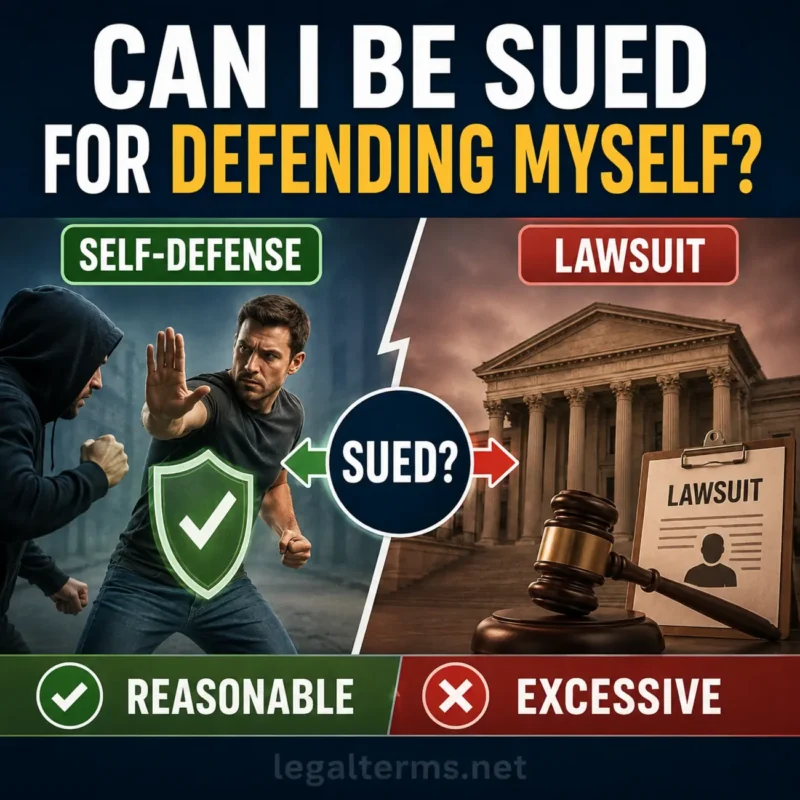
Yes, you can potentially face a civil lawsuit after defending yourself, but being sued and being legally liable are not the same thing.
Self-defense can operate as a defense in both criminal law and tort law. If your use of force was legally justified, that may prevent the other person from successfully holding you civilly liable for injuries caused during the encounter. However, self-defense rules are largely shaped by state law, so the protection available in one state may not work exactly the same way in another.
| Situation | What it can mean |
|---|---|
| Your force qualifies as lawful self-defense | Self-defense may defeat a civil claim based on the force you used |
| Your state provides civil immunity | State law may provide additional protection against a civil action |
| You used more force than the law justified | Self-defense may not protect all of your conduct |
| The facts are disputed | A court may have to determine whether the force was actually justified |
The distinction between a defense and civil immunity is especially important. A defense gives you a legal reason why you should not be held liable. Some states go further. Florida, for example, provides statutory immunity from civil action when force is justified under specified self-defense laws. That does not mean every state provides the same protection, or that simply calling an incident “self-defense” triggers immunity.
Questions such as whether you reasonably believed force was necessary, whether the threat was imminent, whether you started or escalated the confrontation, and how much force you used can affect the analysis. The precise requirements vary by jurisdiction. Even rules about retreat differ among states.
So the more useful question is not simply “Can someone sue me?” It is “Would self-defense protect me from civil liability under the law of the state where the incident occurred?” That is a separate legal question from whether police made an arrest or prosecutors filed criminal charges.
Being Sued Is Not the Same as Being Liable
A civil lawsuit begins with an allegation. Liability comes later.
That distinction matters in a self-defense case because an injured person may claim that you committed battery or another tort, while you may argue that the contact was legally justified. The filing of the lawsuit does not, by itself, answer which side is legally correct.
Civil liability refers to being legally responsible for harm in a civil case. A court may order a liable defendant to pay damages or provide another civil remedy. That is different from criminal liability, where the government prosecutes someone for an alleged crime.
Consider a simple hypothetical.
Imagine someone attacks you outside a store. You push the person away to stop the attack, and the person falls and breaks an arm. The fact that an injury occurred could become the basis for a civil claim. But the injury alone does not settle whether your conduct was wrongful. If the push qualified as lawful self-defense under the applicable state law, that defense could change the outcome of the claim.
This is why the question has two layers:
- Can the injured person bring a civil claim?
- Can the injured person establish that you are legally responsible for the injury?
They are not interchangeable questions.
There is another distinction that becomes important later: some states provide a specific form of civil immunity for qualifying uses of defensive force. That can offer protection beyond simply raising self-defense as a defense to liability. The existence and scope of that protection depends on state law.
Self-Defense Can Apply in a Civil Case Too
Self-defense is often discussed in connection with criminal charges, but its legal role is not limited to criminal court.
The Legal Information Institute’s explanation of self-defense identifies justified self-defense as a defense in both criminal law and tort law. This matters because intentional physical contact can have consequences in both systems.
For example, battery can refer to an intentional tort as well as a crime. In a civil battery claim, the plaintiff is generally alleging harmful or offensive intentional contact. Self-defense can provide a justification for conduct that would otherwise expose the defendant to liability.
Put differently, the law does not necessarily treat every intentional injury as a wrongful injury.
If someone reasonably uses legally permitted force to stop an attack, the fact that the attacker was injured does not automatically establish tort liability. The self-defense question asks whether the circumstances justified the otherwise actionable use of force.
That does not mean saying “I acted in self-defense” ends the dispute.
The underlying facts may themselves be contested. One person may describe an imminent attack; the other may say the threat had already ended. One may describe a defensive push; the other may characterize the response as a continued beating after the danger was over.
Those factual differences can determine whether self-defense applies.
State law also matters. Tort law is shaped substantially by state common law and statutes, and self-defense rules are not expressed identically across the country. The general principle may be recognizable nationwide, while the requirements, exceptions, procedures, and available immunity can differ by jurisdiction.
What Makes Defensive Force Legally Justified?
There is no single federal self-defense statute that supplies one civil-liability test for every incident in every state.
Still, several recurring questions help explain why one use of force may qualify as self-defense while another may not. The precise legal language and requirements must be checked under the law of the relevant jurisdiction.
Was there an imminent threat?
Self-defense generally concerns force used in response to a threat that is occurring or about to occur, rather than retaliation for something that already happened.
Timing can therefore become crucial.
Imagine that a person punches you and raises a fist to strike again. Force used to stop the continuing attack presents a different legal question from finding that person twenty minutes later and hitting them in return.
The second situation looks less like protection from an imminent threat and more like retaliation.
Did you reasonably believe force was necessary?
Self-defense law commonly looks beyond what a person says they believed. The reasonableness of that belief can matter as well.
A court may have to examine the circumstances as they appeared during the confrontation rather than simply accept either party’s later description of events.
Facts such as threatening movements, physical disparity, weapons, prior actions during the encounter, and whether the apparent danger was continuing may become relevant depending on the jurisdiction and the claim.
Reasonableness is especially important because self-defense does not generally create an unlimited privilege to use force whenever someone feels afraid, angry, or uncomfortable.
How much force was used?
The kind and degree of force can matter separately from the decision to use force at all.
A person may have a valid reason to use some defensive force without necessarily being justified in using every level of force. Deadly force, in particular, is governed by stricter standards than ordinary physical force.
This also means an encounter can change over time.
Force that was justified at the beginning of an attack may become harder to justify once the immediate danger has stopped. Self-defense is tied to protection from the threat, not punishment of the other person afterward.
Who started or escalated the confrontation?
Initial-aggressor and provocation rules can also affect a self-defense claim.
The exact rules differ among jurisdictions, so it would be misleading to treat “who threw the first punch?” as a complete nationwide legal test. A confrontation can involve threats, escalation, withdrawal, renewed aggression, and other facts that complicate that simple question.
But the broader point remains important: a person who initiates or deliberately escalates violence may face restrictions on relying on self-defense, depending on the governing law.
Was retreat legally required?
This is another area where state law matters significantly.
Some jurisdictions impose a duty to retreat in certain circumstances before deadly force may be used when safe retreat is possible. Other jurisdictions have adopted forms of Stand Your Ground, which can remove a duty to retreat when statutory conditions are satisfied.
These doctrines should not be confused with the broader question of civil immunity.
A rule saying that a person had no duty to retreat does not, by itself, answer every question about whether the force was justified, whether a civil claim can proceed, or whether a state provides separate immunity from that claim.
That distinction becomes especially clear when looking at states that have enacted specific civil-immunity provisions.
Some States Give More Than a Defense: Civil Immunity
A successful self-defense argument and civil immunity are related, but they are not the same legal protection.
A defense is a reason you should not be held liable for conduct that would otherwise support a civil claim. Civil immunity can go further by limiting whether a lawsuit based on that conduct may proceed at all, depending on the statute and the circumstances.
Florida provides a useful example because its law addresses both justified force and civil immunity separately.
Under Florida Statutes § 776.012, a person may use nondeadly force when they reasonably believe it is necessary to defend against another person’s imminent use of unlawful force. Deadly force is subject to a higher threshold, including a reasonable belief that it is necessary to prevent imminent death, great bodily harm, or the imminent commission of a forcible felony.
A separate provision, Florida Statutes § 776.032, provides immunity from criminal prosecution and civil action when force is justified under specified sections of Florida’s use-of-force law.
That distinction is important.
A person does not receive civil immunity merely because they describe their conduct as self-defense. The use of force must first satisfy the requirements of the statute that makes the conduct justified.
Florida law also provides an unusual practical consequence when immunity applies in a civil case. If a court finds that the defendant is immune under § 776.032, the statute directs the court to award reasonable attorney’s fees, court costs, compensation for lost income, and expenses incurred in defending the civil action.
This is a state-specific rule, not a nationwide rule.
Other states may provide different forms of immunity, different procedures for asserting it, or no equivalent protection in the same form. That is why a statement such as “Stand Your Ground means you cannot be sued” is too broad to be reliable.
A Florida Example Shows Why Your State Matters
Suppose two people argue in a parking lot. One advances toward the other and appears ready to attack. The second person uses force and injures the first.
Whether the injured person can successfully pursue a civil claim is not answered by the label “self-defense.” Under Florida’s statutory framework, several separate questions can matter.
Was the threat imminent?
Did the person using force reasonably believe force was necessary?
Was the degree of force permitted under the circumstances?
Was the person using force engaged in conduct that affects the availability of the justification?
Florida’s law specifically limits self-defense protection in some situations involving an initial aggressor. Florida Statutes § 776.041 addresses circumstances in which a person initially provokes the use or threatened use of force and identifies limited situations in which justification may become available again.
This is one reason “who started it?” can matter without being the only relevant question.
For example, an initial aggressor who clearly withdraws from physical contact and communicates an intent to stop the confrontation may be treated differently if the other person nevertheless continues or resumes the use of force. The exact statutory requirements matter.
Florida also illustrates why Stand Your Ground and civil immunity should not be treated as synonyms.
Section 776.012 addresses when qualifying persons do not have a duty to retreat before using certain defensive force. Section 776.032 separately addresses immunity from civil action and criminal prosecution.
They interact, but they perform different legal functions.
A state’s retreat rule answers one part of the self-defense analysis. It does not automatically answer whether a civil lawsuit is barred, what procedure applies if immunity is claimed, or whether the underlying force was justified in the first place.
Where Self-Defense Can Stop Protecting You
A confrontation can begin as lawful self-defense and still create legal problems if the use of force changes after the threat changes.
This is why courts and statutes often focus on the circumstances surrounding the force rather than on a single label for the entire encounter.
The threat had already ended
Self-defense is generally tied to protection against an imminent threat.
Suppose someone swings at you and you use reasonable force to stop the attack. If that person falls, stops fighting, and no longer presents an immediate danger, additional force can raise a different legal question.
The fact that earlier force may have been justified does not necessarily make everything that follows part of the same privilege.
The response exceeded what the law permitted
The existence of a threat and the amount of permissible force are separate issues.
A minor unlawful use of force does not automatically justify any level of response. Deadly force, in particular, is commonly governed by more demanding statutory conditions.
Florida’s statute provides a concrete example: nondeadly force and deadly force are addressed under different standards. Deadly force requires a reasonable belief that it is necessary to prevent imminent death, great bodily harm, or an imminent forcible felony.
Other jurisdictions may phrase the test differently, but the larger point remains: proportionality and necessity can become central to whether the conduct remains legally justified.
You provoked or escalated the confrontation
Aggressor rules can restrict the availability of self-defense.
But these rules are not simple enough to reduce to “the first person who touches someone loses self-defense.”
Threats, withdrawal, renewed force, escalation, and state-specific statutory language can all affect the result.
If a civil lawsuit turns on one of these issues, the parties may dispute not only what happened but how the governing self-defense law applies to those facts.
What If the Police Never Charged You?
A decision not to arrest or prosecute someone does not turn a civil dispute into a criminal case, and the two systems answer different legal questions.
Criminal prosecution is brought by the government. A civil action is generally brought by a private plaintiff seeking damages or another remedy. Civil liability is therefore distinct from criminal liability.
That distinction also means a criminal outcome should not automatically be treated as a complete answer to every possible civil claim.
Imagine three different situations:
- police investigate and make no arrest;
- prosecutors file charges but later dismiss them;
- a criminal case goes to trial and ends in an acquittal.
Those outcomes can be highly relevant to the people involved, but the effect on a later civil action can depend on state law, the applicable immunity statute, the legal issues actually decided, and the facts of the case.
It would therefore be too broad to say that being cleared criminally always prevents a civil lawsuit.
The reverse assumption is also unreliable. The fact that a civil claim is filed does not establish that the defensive force was unlawful.
Florida again demonstrates why jurisdiction matters. Its statutory immunity provision expressly covers both criminal prosecution and civil action when the statutory requirements are met. Other states may structure those protections differently.
The safest general distinction is this:
Criminal exposure and civil liability are separate legal questions, even when both arise from the same physical confrontation.
A Civil Lawsuit Can Focus on More Than Who Started the Fight
Self-defense disputes often turn on a sequence of events rather than one isolated act.
A civil court may need to examine questions such as:
- What did each person do immediately before force was used?
- Was an unlawful threat actually occurring or about to occur?
- What did the person claiming self-defense reasonably perceive?
- How much force was used?
- Did the force stop when the threat stopped?
- Did either person withdraw and then reengage?
- Was a weapon involved?
- Does the state’s law impose a retreat requirement in the circumstances?
- Does a statutory immunity provision apply?
That is why two cases that sound similar in a headline can have very different legal outcomes.
“Person injured attacker in self-defense” leaves out almost every fact that may determine the legal result.
The central issue is usually not whether the defendant felt threatened in some general sense. It is whether the use of force met the legal requirements of self-defense under the applicable jurisdiction and remained within those limits throughout the encounter.
If a Lawsuit Has Already Been Filed
Once an actual civil complaint has been filed, the issue is no longer just a general question about self-defense. Court deadlines, procedural rules, state law, and the specific allegations in the complaint can all matter.
Without getting into litigation strategy, a few basic details are worth identifying immediately:
- Which court issued the documents?
- In which state was the case filed?
- What claims does the plaintiff actually allege?
- Is there a response date or other deadline on the documents?
- Does the complaint describe the same confrontation that led to the self-defense claim?
- Does the state’s law provide a specific procedure for asserting self-defense immunity?
Those questions help identify the legal framework. They do not determine the outcome by themselves.
A person may also need to determine whether any insurance policy potentially applies to the claim. Coverage for intentional acts, defensive conduct, exclusions, and notification requirements can be complicated and policy-specific, so the existence of insurance should not be assumed either way.
Because missing a court deadline can have procedural consequences, an already-filed lawsuit is also one of the situations in which obtaining advice from a lawyer licensed in the relevant state may be especially important.
FAQ
Can someone sue me even if I acted in self-defense?
Potentially, yes. But the filing of a lawsuit does not establish that you are liable.
Self-defense can operate as a defense to tort liability when the force was legally justified. Some states also provide statutory civil immunity for qualifying defensive force. The exact protection depends on the law of the jurisdiction and the facts surrounding the confrontation.
Does self-defense protect me from a civil lawsuit?
It can protect against civil liability, and in some jurisdictions the law may provide additional immunity from civil action.
Those are different concepts. A self-defense argument may defeat liability, while a statutory immunity provision can provide a separate procedural or substantive protection against a civil action. Whether either applies depends on state law.
Can I be sued if the police did not charge me?
The absence of criminal charges does not by itself answer the civil-liability question.
Criminal proceedings are brought by the government, while civil claims are generally brought by private parties. A state’s self-defense or immunity law may affect both systems, but the effect of a police or prosecutorial decision on a later civil case depends on the applicable law and circumstances.
Can I be sued after being found not guilty?
An acquittal in a criminal case and civil liability are separate legal questions.
The significance of the acquittal in a later civil case can depend on the jurisdiction, the legal issues involved, and any applicable immunity statute. It would therefore be too broad to say that an acquittal always prevents a civil action.
Does Stand Your Ground prevent a civil lawsuit?
Not automatically.
Stand Your Ground generally concerns whether a person has a duty to retreat before using otherwise justified defensive force under specified circumstances. Civil immunity is a separate legal concept.
Some states connect the two through the same statutory framework. Florida, for example, separately addresses the justification for defensive force and immunity from civil action. Other states may structure their laws differently.
Can I be liable if I used too much force while defending myself?
Potentially.
The existence of a legitimate threat does not necessarily authorize every degree of force. Whether the response remained justified can depend on factors such as the seriousness and immediacy of the threat, the type of force used, and the law of the jurisdiction.
This is one reason self-defense disputes can focus on what happened throughout the encounter rather than simply on who initiated the first physical contact.
What if I kept using force after the attacker stopped?
That can create a different legal issue.
Self-defense generally concerns force used to protect against an imminent threat. Once the threat has ended, continued force may no longer be covered by the same justification. The precise standard and consequences depend on state law and the circumstances.
Can an attacker’s family bring a lawsuit after a fatal self-defense incident?
A fatal incident can potentially lead to civil claims such as wrongful death, but whether a claim can proceed or succeed may depend heavily on the state’s self-defense and civil-immunity laws.
Some states provide statutory immunity when deadly force satisfies their justification requirements. Because both wrongful-death law and self-defense immunity vary by jurisdiction, there is no single nationwide answer.
References
Primary Authorities
- Florida Statutes § 776.012 — Use or threatened use of force in defense of person
- Florida Statutes § 776.032 — Immunity from criminal prosecution and civil action for justifiable use or threatened use of force
- Florida Statutes § 776.041 — Use or threatened use of force by aggressor
Secondary Legal Sources
- Cornell Legal Information Institute — Self-Defense
- Cornell Legal Information Institute — Civil Liability
- Cornell Legal Information Institute — Battery
- Cornell Legal Information Institute — Duty to Retreat
- Cornell Legal Information Institute — Stand Your Ground Law

Hamit Sahin is the founder and editor of LegalTerms.net. He researches U.S. legal terminology and publicly available legal information using statutes, court rules, judicial opinions, government publications, and established legal reference sources.
His work focuses on organizing complex legal concepts into clear, plain-English explanations for general educational purposes.
Hamit is not an attorney and LegalTerms.net does not provide legal advice.